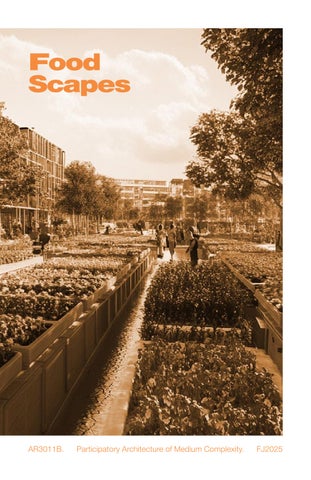
Food Scapes
AR3011B.
Participatory Architecture of Medium Complexity.
FJ2025
Food Scapes
CONTENTS Foodscapes . . . . . . . . . . . . . . . . . . . . . . . . . . . . . . 6 AR3011B. Participatory Architecture of Medium Complexity.
Impact domains of Foodscapes . . . . . . . . . . . . . . . . . . . . 8 Food Miles and Urban food Landscapes . . . . . . . . . . . . . . . 10
FJ2025 25 Mon.Tue.Thu.Fri 9:00-15:00 hrs. Classroom: Architecture Lab Tecnológico de Monterrey, Querétaro. EAAD. Escuela de Arquitectura Arte y Diseño.
Addresing the Paradox of food and health in Mexico . . . . . . . . . 12
Teaching Team
Food Environments . . . . . . . . . . . . . . . . . . . . . . . . . . 18
Diana García. Rodrigo Pantoja. Pedro Mendoza. Yetzi Tafoya. Miguel Anaya. Viviana Barquero. Daniela Cruz. Andrea Parga. Gilberto Osornio.
dgarciace@tec.mx rpantojac@tec.mx pmendozah@tec.mx yetzi.tafoya@tec.mx manaya@tec.mx viviana.barquero@tec.mx dany.cn@tec.mx andrea.parga@tec.mx
Academic Directors Viviana Barquero. Daniel Savedra. Lesly Pliego.
Convenience stores and Obesity . . . . . . . . . . . . . . . . . . . 16
Qro as Project . . . . . . . . . . . . . . . . . . . . . . . . . . . . 22 Area of study . . . . . . . . . . . . . . . . . . . . . . . . . . . . . 24 The Studio . . . . . . . . . . . . . . . . . . . . . . . . . . . . . . 26 Research / Design Question . . . . . . . . . . . . . . . . . . . . . 28 Research . . . . . . . . . . . . . . . . . . . . . . . . . . . . . . . 30 Lines of research . . . . . . . . . . . . . . . . . . . . . . . . . . . 32
EAAD Division Director. Department Director. Program Director.
Methodology . . . . . . . . . . . . . . . . . . . . . . . . . . . . . 34 Assessment . . . . . . . . . . . . . . . . . . . . . . . . . . . . . 36
Alliances
Calendar . . . . . . . . . . . . . . . . . . . . . . . . . . . . . . . 38
Kent State University / Brendan Ho + Cat Soergel Marshall. UNAM / Elena Tudela + Daniel Daou (Seminario Especial de Titulación Intersticios 8).
Competences Tec21 . . . . . . . . . . . . . . . . . . . . . . . . . 42 Teaching Team . . . . . . . . . . . . . . . . . . . . . . . . . . . . 46 Students . . . . . . . . . . . . . . . . . . . . . . . . . . . . . . . 48 Bibliography . . . . . . . . . . . . . . . . . . . . . . . . . . . . . 50 Glossary . . . . . . . . . . . . . . . . . . . . . . . . . . . . . . . 52 References . . . . . . . . . . . . . . . . . . . . . . . . . . . . . . 56
Editorial Design: Luisa Medina + Rodrigo Pantoja.
FOODSCAPES
Urban Strategy for Sustainability and Health The concept of foodscapes is used in disciplines such as architecture and urban planning to analyze and design urban landscapes generated by the interaction between food systems and urban environments. These systems - encompassing food production, distribution, and consumption - have a significant impact on cities. Therefore, the strategic implementation of foodscapes can comprehensively address urban challenges in several dimensions: social, environmental, public health, and economic.
Image generated by AI.
6
7
IMPACT DOMAINS OF FOODSCAPES 1. Urban: Foodscapes revitalize underutilized spaces through urban gardens, edible gardens, and local markets, promoting food corridors that improve connectivity and green infrastructure.
2. Social: They foster the creation of community spaces that promote social cohesion and raise awareness of sustainable production practices.
3. Health: They improve access to fresh and nutritious food, reduce food deserts, and combat diseases related to poor diets. They also contribute to the psychological well-being associated with interaction in natural environments.
Image generated by AI.
4. Environmental: They help reduce the carbon footprint through local food chains, promote biodiversity with pollinator gardens, and manage resources such as water and organic waste sustainably.
5. Economic: They boost job creation in the production, distribution, and sale of local food, encourage affordable prices, and promote the circular economy through the use of organic waste.
8
9
FOOD MILES AND URBAN FOOD LANDSCAPES The Leopold Center for Sustainable Agriculture at Iowa State University researched the average distance food travels from crop fields to the dinner table, revealing that it generally spans over 2,000 miles [1]. Although these figures may vary by city or country, the impact of food miles on the environment is profound. Friends of the Earth Organization also authored a study on the movement of food and its environmental harm titled “How many kilometers does food travel before it reaches your plate?” [2]. This research gained notice within academic, economic, and political circles, sparking widespread attention on “food miles.” The study introduced the idea of “food miles,” which was first created to measure the distance between the producer and the food consumer. “To reduce food miles implies the need for food systems grounded in local ecologies and responsive to consumer demands for quality food” [3].
10
Huertos Urbanos Comunitarios para Zonas Marginadas de Querétaro. Rodrigo Pantoja / EVO-A-LAB.
11
ADDRESSING THE PARADOX OF FOOD AND HEALTH IN MEXICO The global food paradox, characterized by the overproduction of food alongside high rates of malnutrition and environmental problems, is a pressing concern. According to the Food and Agriculture Organization’s (FAO) report, around 600 million people will be chronically undernourished by 2030. In 2022, an estimated 2.4 billion people were moderately or severely food insecure, lacking access to adequate nutrition [4]. This condition in Mexico is becoming increasingly critical. While Queretaro’s GDP per capita is higher than that of similar regions, almost half of the inhabitants still need to be more capable of affording a basic food basket. This economic disparity is associated with high rates of obesity and malnutrition, particularly in economically deprived neighborhoods.
Image generated by AI.
With 75% of the population affected, Mexico has one of the highest rates of obesity in the world. This high prevalence is associated with a shift in the diet toward foods and beverages high in calories and processed [5]. Notably, the prevalence of obesity in the poorest regions of Mexico mirrors that of wealthier areas despite a significant increase in noncommunicable diseases (NCDs) and ongoing problems with malnutrition and poor sanitation [6].
12
13
ADDRESSING THE PARADOX OF FOOD AND HEALTH IN MEXICO Furthermore, the proliferation of convenience stores, such as OXXO, is exacerbating this problem by offering food that is predominantly low in nutritional value and contributing to an obesogenic environment in which excessive food intake is encouraged [7]. Although the effect of the food environment on obesity is well documented, further research is needed on the particular role of convenience stores, with their prominence on processed foods, in prolonging unwholesome diets and their rising public health consequences in Mexico. Image generated by AI.
14
15
CONVENIENCE STORES AND OBESITY Over time, food systems and diets change. “As large companies increasingly dominate markets, highly processed foods become more readily available, and traditional foods and eating habits are displaced” [4]. Processed foods have become part of people’s daily diets, increasing chronic and degenerative diseases due to high levels of sugar and fat. As Francesco Branca, Director of the World Health Organization’s Department of Nutrition for Health and Development, described: “We have solid evidence that keeping intake of free sugars to less than 10% of total energy intake reduces the risk of overweight, obesity and tooth decay” [7]. With over 12,000 OXXO convenience stores, Grupo FEMSA has a monumental presence selling mainly processed foods in Mexico. Each OXXO has more than 3,000 items, many of them processed foods, and according to El Economista, 20% of their sales are from soft drinks, 20% from tobacco, and 10% from food [8].
Image generated by AI.
Because of the significant presence of convenience stores with products with few nutrients, many areas of Mexico have become food swamps and obesogenic environments. The current epidemic of obesity is mainly caused by an environment that promotes excessive food intake and discourages physical activity [9].
16
17
FOOD ENVIRONMENTS Food environments are composed of opportunities, environments, and physical, economic, political, and socio-cultural conditions that determine the interaction of people and the food system [1] and influence food behavior (consumption and acquisition) [2]. In an urban context, food environments are recognized according to their food accessibility and are divided into three categories: food deserts, food swamps, and food oases. Food deserts are deprived areas with limited access to nutritious and affordable food. In contrast, food oases are privileged by their access to healthy food. Finally, food swaps are where food is available but is characterized by high-calorie content dominating healthy food environments [10].
18
Image generated by AI.
19
FOOD ENVIRONMENTS FOOD DESERTS Outskirts of Lima, Perú. Many peripheral neighborhoods in Lima, such as Villa El Salvador, experience limited access to affordable and nutritious food. These areas often lack sufficient supermarkets or fresh produce markets, leaving residents dependent on convenience stores with limited healthy options.
FOOD SWAMPS Ciudad Juárez, Mexico Parts of Ciudad Juárez are characterized by a proliferation of fastfood chains, convenience stores, and street vendors selling highcalorie, processed foods. These dominate the food landscape, making it challenging for residents to prioritize healthy eating.
FOOD OASES Polanco, Mexico City, Mexico Polanco is a prime example of a food oasis in Latin America, where residents enjoy access to high-quality grocery stores, organic food markets, and specialty shops offering a wide variety of fresh and nutritious options.
Image generated by AI. 20
21
QRO AS PROJECT Querétaro, located in Central Mexico, has experienced rapid land transformation and anthropization of the natural environment, causing socioeconomic and environmental damage. Querétaro is one of many cities that have undergone industrial expansion and generated economic growth while causing ecological harm. In recent years, urban and peri-urban areas have developed exponentially. Rapid urbanization, over-extraction of natural resources, environmental deterioration (water and air pollution), resource shortages, and droughts due to the imbalance in the urban hydrologic cycle represent the scenario that Querétaro and many Mexican cities are facing (González-Sosa et al. 2010). Assuming the role of an educational institution and the responsibility of our discipline, we focus on our city as the Project for the Future City.
Google Maps, 2025.
5 km 22
23
AREA OF STUDY DistritoQro
This study investigates how architecture and landscape, through edible landscapes, can regenerate Distrito Tec, an industrial estate of approximately 100 hectares. The aim is to revitalize and dignify this area, transforming it into a mixed, vibrant, inclusive, and sustainable environment that reflects the principles of foodscapes.
STRATEGIC OPPORTUNITY These strategies represent a key opportunity to rethink cities from a food perspective, moving towards a more equitable, resilient, and sustainable future.
DistritoQro, 2024.
Distrito Qro Delegación Centro Histórico Distrito Qro Industria Habitacional Universidades Servicios / Comercial Equipamiento Barrios tradicionales Espacio abierto 24
500 m 25
THE STUDIO Projects for the Future City is an effort to address climate justice by exploring the sociocultural and ecopolitical dimensions of the climate crisis in the Mexican context. For the last two years, the studio has investigated four topics: hydric stress, energy transition, urban heat island, and soil degradation. Exploring these climate design themes led us to define a new set of issues that will be addressed for the next two years to complete the climate justice mosaic, outlining the desirable possibilities of addressing multiple facets within the local challenges. The opportunities rely on designing actions that address the scale and impact of climate change challenges regarding food and water security, especially in the Global South. Our discipline’s question is how to shift from a ¨spectator role¨ to understanding and acting on climate justice.
UAQ
UNAM UC Chile
Projects for the Future City
Seminario de Paisaje, Agua y NBS
Kent State
UHI
Soil
Hydric Stress Water
Climate Resilient Design
Wellbeing
Climate Vulnerability
Energy Transition
Food
Production Production Industry
26
27
Concentración DR Monterrey
Kent State UNAM
RESEARCH - DESIGN QUESTION Can urban climate-responsive design interventions engage different faces of climate injustice? The studio explores how architecture and landscape architecture can contribute to the construction of foodscapes to create more resilient environments facing climate change. And what role do climate-responsive design and urban recycling plays in transforming into healthier, more connected, and equitable environments? Image generated by AI.
28
29
RESEARCH Agenda
Strategic Framework
Research on the socio spatial, economical, environmental and geopolitical dimensions that determine the agenda of climate injustice through the lens of each topic (hydric stress, energy consumption, waste management, and urban heat island).
Design Intervention
Territorialization Evidence on our territory of the socio spatial, economical, environmental and geopolitical dimensions. Identify the uneven effects of the climate crisis and how they interconnect. This phase includes the recognition of stakeholders and the normative dimension involved on each topic.
Hydric Stress Urban Heat Islands Waste Management Energy Consumption Soil Foodscapes
Vision and spatial strategies for mitigation and adaptation identifying a set of key actions, timeframe and actors involved on the process.
Agenda
30
Territorialization
A design project, that is supported by the strategic framework, that achieves a specific topic of the agenda in our territory.
Strategic Framework
Design Intervention
31
LINES OF RESEARCH AND STRATEGIES #watermanagement #care #technologyandinnovation
#bluegreeninfraestructure #nbs #climateadapative
1. Productive and Adaptive Infrastructure: Edible Landscapes and Urban Agriculture. Objective: To explore strategies for the transformation of industrial land and brownfield sites into productive spaces through agricultural systems in urban and peri-urban areas.
Key topics: Degraded soils, phytoremediation, productive green roofs, hydroponic and aquaponic systems adapted to industrial contexts.
Impact: Improve food security and reduce the carbon footprint of food supply.
2. Inclusive Design and Social Participatory Strategies. Objective: Involve local communities, workers and key stakeholders in the co-creation of foodscapes to foster ownership and social impact of the project.
Key topics:
3. Productive Urban Ecologies and Environmental Regeneration. Objective: To study the relationships between food systems and urban ecologies to regenerate the degraded (industrial) landscape.
Key topics: Productive green corridors, urban biodiversity, water and organic waste management, microclimates and air quality improvement.
Impact: Create multifunctional landscapes that combine food production, environmental improvement and urban quality of life.
4. Circular Economy and Sustainable Management Models Objective: To analyze economic and management models that enable the financial, social and ecological sustainability of foodscapes.
Key topics: Use of waste, short production and distribution chains, cooperative models, financing and public policies.
Impact: Boost local economies, reduce food waste and promote selfsufficiency.
Participatory design, community gardens, food equity, social resilience and circular economy.
Impact: Strengthen the social fabric and promote community integration through food production. 32
33
METHODOLOGY - Topic Definition. - Definition of general research question. - Methodology. - Calendar.
Agenda
Territorialization
Futures
Project
- Problem Definition. - Definition of research question
- Understand the spatial, economic, social and ecological dynamics in the territory (site), multiscalar - Diagnosis based on specific research questions. - Definition of critical areas.
- Definition of a frame of reference for the desirable future. - Definition of strategies (pericity and systemic impact). - Definition of architectural-urban programs. - Relate critical areas, strategies and programs to generate a project portfolio.
- Site analysis. - Project strategies. - Design premises. - Programmatic alternatives and location criteria. - Definition of landscape, construction, structural and installation criteria. - Project communication.
Tools - Comparative cases of analogous studies. - Literature review: scientific articles, books and previous studies.
Tools - Layer mapping of territorial dynamics. - QGis Maps. - Stadistic analysis. - Interviews, surveys. - Participatory diagnosis workshops with the community. - Perceptual mapping - Validation with external experts. - Thematic manuals.
Tools - Dystopian vision. - Utopian vision. - Manifesto.
Tools - Site mapping. - QGis. - Graphics. - Digital models. - Digital presentations. - Participatory diagnosis workshops. - Validation with external experts.
34
35
METHODOLOGY The design studio is based on an academic methodology of transversal learning groups. The scopes transcend the architectural-constructive project by first producing a socio-spatial diagnosis of the site that generates a spatial vision that will eventually develop a design proposal. The challenge takes place in five phases over 17 weeks. Phase 01 Phase 02 Phase 03 Phase 04 Phase 05
Diagnosis. Alternatives for the future: Vision. Programming and volumetric variations. Development of the architectural project and its criteria. Project Communication.
Image generated by AI.
ASSESSMENT To be eligible to pass the block, students are required to complete all forms of evaluation and must show a reasonable level of competence in the course. When evaluating course activities, students are expected to have a firm understanding of the content; to analyze and synthesize in depth, to have the ability to process complexity and to integrate complex strategies and design, accompanied by solid communication skills. The evaluation is broken down as follows:
Evidence 01: Mid Term Presentation (phase 1-4)
50%
Evidence 02: Project development (phase 5)
45%
External Evaluation:
05%
TOTAL:
100% 36
37
CALENDAR S1 Febrero 9:00 11:30 12:00 15:00
Repentina Análisis de Sitio
S2 Febrero 9:00 11:30 12:00
Fase 01 Lecturas
15:00
Jueves 13
Viernes 14
S7 Marzo
Design Sprint Analysis
Design Sprint Analysis
Design Sprint Analysis
9:00
Taller (Autodirigido)
Taller (Autodirigido)
Taller (Autodirigido)
11:30
Lunes 10
Martes 11
Intro Investigación Análisis de Sitio Lunes 17
Martes 18
Taller (Autodirigido) P0: Design Sprint Analysis
Mi 12
Mi 19
Jueves 20
Viernes 21
Studio Research Design
Studio Research Design
Studio Research Design
Taller (Autodirigido)
Taller (Autodirigido)
Taller (Autodirigido)
Lunes 24
Martes 25
Studio Programmatic and volumetric experimentation
Jueves 27
Viernes 28
Studio Programmatic and volumetric experimentation
Studio Programmatic and volumetric experimentation
Studio Programmatic and volumetric experimentation
15:00
Taller (Autodirigido)
Taller (Autodirigido)
Taller (Autodirigido)
Taller (Autodirigido)
S8 Abril
Lunes 31
Martes 1
Jueves 3
Viernes 4
9:00
Taller (Autodirigido)
Studio Conceptual Design
P5: Programmatic and volumetric experimentation
Taller (Autodirigido)
Lunes 7 Taller (Autodirigido)
Martes 8 Studio Arch Design
P6: Conceptual Design
Taller (Autodirigido)
Fase 02
12:00
11:30 S3 Febrero
Lunes 24
Martes 25
Jueves 27
Viernes 28
12:00
Taller (Autodirigido)
Studio Futures
Studio Futures
Studio Futures
15:00
15:00
P1: First Results Research Design
Taller (Autodirigido)
Taller (Autodirigido)
Taller (Autodirigido)
S9 Abril 9:00
S4 Marzo
Lunes 3
Martes 4
Jueves 6
Viernes 7
9:00
Taller (Autodirigido)
Studio Agenda
Studio Agenda
P2: Future Scenarios
Taller (Autodirigido)
Taller (Autodirigido)
Lunes 10
Martes 11
9:00 11:30 12:00
11:30 12:00 15:00
Fase 01 Escenarios
Fase 01 Manifesto / Agenda
S5 Marzo 9:00 11:30 12:00 15:00 S6
Fase 01 Agenda / programas, proyectos
Taller (Autodirigido) P3: Manifesto
Studio Strategies Taller (Autodirigido)
Mi 26
Mi 5
Mi 12
Jueves 13 Studio Projects
Semana Tec (17-21 Marzo)
11:30 12:00
Fase 03
15:00
Acto de Protesta
Viernes 14 P4: Manifesto, strategies and list of projects
Mi 2
Studio Studio Conceptual Design Conceptual Design
Mi 9
Taller (Autodirigido)
Taller (Autodirigido)
Jueves 10 Studio Arch Design
Viernes 11 Studio Arch Design
Taller (Autodirigido)
Taller (Autodirigido)
Semana Santa (14-18 Abril) S10 Abril
Lunes 21
Martes 22
9:00
Studio Arch Design
Studio Arch Design
15:00
Taller (Autodirigido)
Taller (Autodirigido)
S11 Mayo
Lunes 28
Martes 29
CRITDAY
CRITDAY Retro Interna (Exatecs)
11:30 12:00
Fase 03
9:00 11:30 12:00 15:00 S12
38
Fase 02
Mi 26
Fase 03
Mi 23
Jueves 24 How Space Can (Congreso ARQ)
Mi 30
Studio Arch Design Taller (Autodirigido)
Jueves 1
Viernes 2
ASUETO
CRITDAY Retro Interna (Profes)
Semana Tec (5-9 Mayo)
39
Viernes 25
CALENDAR S13 Mayo
Lunes 12
Martes 13
9:00
Studio Arch Design Taller (Autodirigido)
11:30 12:00
Fase 03
15:00
Mi 14
Jueves 15
Viernes 16
Studio Arch Design
Studio Arch Design
Studio Arch Design
Taller (Autodirigido)
Taller (Autodirigido)
Taller (Autodirigido)
Revisión con Andrea Parga por cita S14 Mayo
Lunes 19
9:00 11:30 12:00
Fase 03
ASUETO
15:00
Martes 20
Mi 21
Jueves 22
Viernes 23
Studio Arch Design
Studio Arch Design
Studio Arch Design
Taller (Autodirigido)
Taller (Autodirigido)
Taller (Autodirigido)
Revisión con Andrea Parga por cita S15 Mayo 9:00 11:30 12:00
Fase 04
15:00 S16 Junio 9:00 11:30 12:00
Fase 04
15:00
Lunes 26
Martes 27
Studio / Representation, drawings and models
Studio / Representation, drawings and models
Lunes 2
Martes 3
Studio / Representation, drawings and models
Studio / Representation, drawings and models
Mi 28
Mi 4
Jueves 29
Viernes 30
Studio / Representation, drawings and models
Studio / Representation, drawings and models
Jueves 5
Viernes 6
Studio / Representation, drawings and models
Studio / Representation, drawings and models
S17
Lunes
Martes
Mi
Jueves
Viernes
Junio
9
10
11
12
13
9:00
Studio / Representation, drawings and models
Studio / Representation, drawings and models
P7: Final Review (Tec)
CRITDAY Retro Interna
11:30 12:00 15:00 S18
Fase 04
Semana Tec (16-20 Junio) EXPOEAAD 18 de Junio
40
COMPETENCES Tec21
Participatory Architecture of Medium Complexity. A. SAR0200. DESIGN. 1. SAR0201C. Inventive representation of architectural projects. Inventively represents concepts and architectural projects of various scales, showing mastery in the selection and mix of digital techniques and manual representation.
2. SAR0202C. Preparation of Architectural Programs. Develops architectural programs taking into account the requirements of a community, its relationship with the city and with multidisciplinary groups that allow it to cover and understand the complexity of the context of a region, uses and customs.
3. SAR0203C. Design Premises. Establishes the design premises and guiding ideas, integrating criteria of program functionality, climate, shape, volume, structure, materiality, composition, spatial organization, habitability, constructability, economy, sustainability, and spatial phenomenology.
4. SAR0204C. Projection of Spaces. Projects architectural spaces that coherently integrate components of a complex architectural program, such as environmental, social, economic, cultural aspects, construction processes, structural and cognitive aspects of multiple types of user or a heterogeneous social group.
B. SAR0400. INVESTIGATION. 1. SAR0401B. Diagnoses Problems. Diagnose problems related to architecture within a line of research or context for a real project.
2. SAR0402B. Proposal of alternative solutions. Proposes alternative solutions to architectural problems in real contexts. 42
43
COMPETENCES Tec21
Participatory Architecture of Medium Complexity. C. SAR0600. CONSTRUCTION. 1. SAR0601C. Construction materials. Defines the materials and construction procedures in the medium complexity project under the criteria of life cycle of materials, UN sustainability principles and the regulatory framework of the region where the project will be built.
2. SAR0602C. Construction systems. It uses construction systems, identifying the technical requirements of the vertical or mixed-use building project and the context where it is applied.
3. SAR0603C. Construction project. Develops the construction project for vertical or mixed-use buildings, based on current regulations.
4. SAR0604C. Facilities. Designs the plumbing, electrical, special and heating, ventilation and air conditioning (HVAC) installations according to the needs of the vertical or mixed-use building project and under sustainability criteria.
5. SAR0605C. Structural Criteria. Applies structural criteria in the solution of architectural projects with flat frames, based on analysis and calculation methods for simple structures. Calculates the loads that act on structural elements subjected to biaxial forces.
6. SAR0606C. Costs and Budgets. Prepares the detailed cost and time budget of the civil works, or a part of it, based on the catalog of concepts and unit prices, including direct and indirect costs.
D. SEG0300. SOCIAL INTELLIGENCE. 1. SEG0303. Collaboration. Builds agreements, interactions and social relationships through collaboration that takes into account differences, as well as their own abilities and those of others, in the immediate context.
44
45
TEACHING TEAM Rodrigo Pantoja
Miguel Anaya
Studio coordinator. Design & Landscape.
Structure.
Diana García
Viviana Barquero
Studio coordinator. Design & Urbanism.
Energy expert. Design.
Pedro Mendoza
Daniela Cruz
Design. Construction Materials. Design Budget.
Representation & Visualization.
Yetzi Tafoya Urban strategies. Design.
46
International Faculty Andrea Parga
Gilberto Osornio
Narrative.
Energy Models.
47
STUDENTS Abril Espinoza Espinoza. Alejandro Meza Muñiz. Brenda Lizeth Escárcega. Cristina Rayon Villela. Dana Paola Bernal Serrano. Erik García Becerril. Hugo Alejandro Salas Guerra.
Image generated by AI.
Hugo Gabriel Piña Chávez. Ivanna De la Torre Hernández. Julio César Mata García. María José Ortiz Valle. Mildred Yamilet Martínez Pérez. Natalia Vega Gutiérrez. Nicole Abril López Chávez. Renata Frias Frias. Santiago López Tello Juárez. Sara Seade González. Sara Valentina Bottle Herrera. Silvia Lourdes Lagos Aguilar. Vladimir Jovanovic Rosas. Virginia de los Ángeles Rojas Martínez. Ximena Pérez Ramírez. 48
49
BIBLIOGRAPHY The Whole Beast
Designing Urban Agriculture
Food and the City
The Whole Beast is a tribute to the art of “nose-to-tail” cooking. This book celebrates the holistic use of animals with unique recipes and traditional techniques. Its ethical and creative approach inspires sustainable cooking, highlighting the richness of flavors in less conventional cuts.
April Philips.
Jennifer Cockrall-King.
FED UP
Log 34: The Food Issue
Food for the City
Stephanie Soechtig.
Architecture Journal.
Struom Den Haag.
Fergus Henderson.
Fed Up is a 2014 American documentary film directed, written and produced by Stephanie Soechtig. The film focuses on the causes of obesity in the US, presenting evidence showing large quantities of sugar in processed foods are an overlooked root of the problem, and points to the monied lobbying power of “Big Sugar” in blocking attempts to enact policies to address the issue.
50
51
GLOSSARY
(Extract from “Food and the City”) Biofuel. An alternative fuel source made from plant-based alcohol (bioethanol) or vegetable oils (biodiesel). This is an alternative to fossil fuels, which are derived from oil and gas deposits. Companion planting. When a biological or structural symbiosis can be used in two or more plants to increase the yield or vigor of food crops. Co-producer. The term used by Carlo Petrini, founder of the Slow Food movement, to refer to consumers. Petrini urges consumers to think of themselves as co-producers to encourage them to acknowledge that their food choices are important and that they take an active role in the food system as opposed to a passive role. Edible forest. The practice of cultivating food gardens that mimic or utilize natural woodland ecosystems as their model. This system is a lower-input alternative to food cultivation than agriculture, but it can produce surprising amounts of edible products. Also known as forest gardening. Food mile. The distance food travels from where it is grown or raised to where it is ultimately purchased by the consumer or end-user. Food policy. A directive that proposes guidelines and policies surrounding the production, distribution, and consumption of food for a defined group of people. Many municipal governments are adopting food policies written by grassroots food-security organizations in their cities.
Food security. A catchall term for the level of accessibility to fresh, healthy, nutritious food for a person, family, or community. The United Nations Food and Agriculture Organization’s most current definition of food security is when “all people, at all times, have physical, social and economic access to sufficient, safe and nutritious food which meets their dietary needs and food preferences for an active and healthy life”. Foodshed. Describes the complex interaction of relationships between all the food that is produced, distributed, and consumed within a geographic region. Food shock. A sudden, drastic interruption to food supplies for any reason, such as a weather or natural catastrophe, war, or lack of fuel. Food sovereignty. A term describing a person’s or group’s ability to choose their own foods and agricultural system of production. The idea came about as a reaction to the globalization of food and the industrial food chain that leaves little cultural and individual freedom of choice of what or how food is produced. French Intensive Agriculture. A system of food production that brought together a number of techniques such as raised beds, heavy dressings of compost, cold frames for early forcing of crops, thick stone walls surrounding gardens to create a warmer microclimate, companion planting, and densely planted crops to reduce water loss and weeding. French Intensive Agriculture allowed Paris to produce impressive amounts of fresh food in an urban setting in the first half of the nineteenth century.
Food-policy council. The organizing body that writes or oversees the food policy. A food-policy council can either be an officially appointed group of people or a selfappointed citizen volunteer group. 52
53
GLOSSARY
(Extract from “Food and the City”) Green Revolution. The term applied to the advances in crop and chemical sciences that produced much higher-yielding cereal and grain varieties in conjunction with new chemical fertilizers and pesticides. It also refers to the exporting of this new technology to at-that-time-developing countries like Mexico and India to industrialize their farming as a form of aid and foreign development. The Green Revolution took place between the 1940s and 1970s. Guerilla gardening. A form of social and political activism in which gardeners plant flowers or food on underutilized private or public land without the consent of the owner. Industrial food. Food grown and produced according to an industrialist mindset that is concerned with mechanizing and lowering cost of production by largescale production and by concentrating manufacturing and distribution chains to achieve the lowest possible cost of unit production. Author Michael Pollan offers this definition of industrial food in The Omnivore’s Dilemma: “Any food whose provenance is so complex or obscure that it requires an expert to help ascertain.” Intercropping. When two or more crops or plants are grown simultaneously in the same area, usually to achieve a more rapid succession of harvests than if one crop was planted, allowed to mature, harvested, and then removed before the next crop was planted. Locavore. A person who seeks out locally grown or locally produced foods. Organopónico. A small-scale, organic, cooperative-run urban farm in Cuba that grows food for its surrounding community. The term is now being used for similar small-scale urban organic farms in other Latin American countries.
54
Permaculture. An approach to living and growing food in a permanently sustainable way that draws heavily on or even closely mimics natural ecosystems. It takes an integrated approach toward food-production systems and other human needs. Slow Food. An Italy-based grassroots food movement that now counts over 100,000 members in 130 countries. It began in 1989 as a countermovement to the globalization of fast food but now works on issues of food sovereignty and biodiversity preservation and in service to its motto of “good, clean, fair food for all. Terroir. A French term, borrowed from viticulture and wine production, that encompasses the cumulative effect of geography, geological variations, and climate on the flavor characteristics of foods. It not only describes the effect of place but takes into account the time frame during which the product was made. Urban agriculture. The act of growing and, according to some definitions, distributing food in a defined urban area. The idea is to produce food closer to where the majority of consumers are, in cities. Urban agriculture tends to be smallscale agricultural enterprises, even on a household scale. Vertical farming. A concept of stacked agricultural production, in vertical layers, to shrink the footprint of land-based agriculture. Some vertical-farm designs are essentially food-producing skyscrapers (though none of these designs have been realized yet). Vertical farming tends to incorporate closed-loop agricultural systems where nutrients in food production are recycled from one food-production area (such as freshwater fish tanks) to another (such as salad greens).
55
REFERENCES 1. Pirog, R.; Van Pelt, T.; Enshayan, K.; Cook, E. Food, Fuel, and Freeways: An Iowa Perspective on How Far Food Travels, Fuel Usage, and Greenhouse Gas Emissions, 2001. http://large.stanford.edu/ courses/2014/ph240/pope1/docs/pirog.pdf. 2. Pérez Neira, D., Copena Rodríguez, D., Delgado Cabeza, M., Soler Montiel, M., & Simon Ferández, X. (1995). Cuántos Kilómetros Recorren los Alimentos Antes de Llegar a tu Plato. Análisis de La Presión Ambiental Del Transporte de La Importación de Alimentos (Consumo Humano, Industria o Consumo Animal) En El Periodo, 2011.https://www.tierra.org/ wp-content/uploads/2016/01/alimentos_kilometricos_2.pdf 3. Murdoch, J.; Marsden, T.; Banks, J. Quality, Nature, and Embeddedness: Some Theoretical Considerations in the Context of the Food Sector. Economic Geography 2000, 76 (2), 107. https://doi. org/10.2307/144549. 4. The State of Food Security and Nutrition in the World 2023; FAO; IFAD; UNICEF; WFP; WHO; 2023. https://doi.org/10.4060/cc3017en. 5. Pineda, E., Brunner, E. J., Llewellyn, C. H., & Mindell, J. S. (2021). The retail food environment and its association with body mass index in Mexico. International journal of obesity (2005), 45(6), 1215–1228. https:// doi.org/10.1038/s41366-021-00760-2.
6. Barquera, S.; Rivera, J. A. Obesity in Mexico: Rapid Epidemiological Transition and Food Industry Interference in Health Policies. The Lancet Diabetes & Endocrinology 2020, 8 (9), 746–747. https://doi.org/10.1016/ S2213-8587(20)30269-2. 7. Sánchez, E. OXXO se pone al tú por tú con los grandes. El Economista. Digital. México September 24, 2011. https://www. eleconomista.com.mx/empresas/OXXO-se-pone-al-tu-por-tu-con-losgrandes-20110924-0042.html (accessed 2024-07-25). 8. Turner, B. Embodied Connections: Sustainability, Food Systems, and Community Gardens. Local Environment 2011, 16 (6), 509–522. https:// doi.org/10.1080/13549839.2011.569537 9. WHO calls on countries to reduce sugar intake among adults and children. News. https://www.who.int/news/item/04-03-2015-whocalls-on-countries-to-reduce-sugars-intake-among-adults-and-children (accessed 2024-07-30). 10. Glanz, K.; Sallis, J. F.; Saelens, B. E.; Frank, L. D. Healthy Nutrition Environments: Concepts and Measures. Am J Health Promot 2005, 19 (5), 330–333. https://doi.org/10.4278/0890-1171-19.5.330.
56
57
Issuu Projects for the Future City.