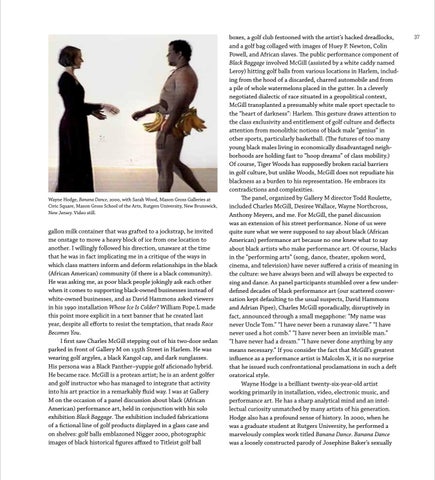
Wayne Hodge, Banana Dance, 2000, with Sarah Wood, Mason Gross Galleries at Civic Square, Mason Gross School of the Arts, Rutgers University, New Brunswick, New Jersey. Video still.
gallon milk container that was grafted to a jockstrap, he invited me onstage to move a heavy block of ice from one location to another. I willingly followed his direction, unaware at the time that he was in fact implicating me in a critique of the ways in which class matters inform and deform relationships in the black (African American) community (if there is a black community). He was asking me, as poor black people jokingly ask each other when it comes to supporting black-owned businesses instead of white-owned businesses, and as David Hammons asked viewers in his 1990 installation Whose Ice Is Colder? William Pope.L made this point more explicit in a text banner that he created last year, despite all efforts to resist the temptation, that reads Race Becomes You. I first saw Charles McGill stepping out of his two-door sedan parked in front of Gallery M on 135th Street in Harlem. He was wearing golf argyles, a black Kangol cap, and dark sunglasses. His persona was a Black Panther–yuppie golf aficionado hybrid. He became race. McGill is a protean artist; he is an ardent golfer and golf instructor who has managed to integrate that activity into his art practice in a remarkably fluid way. I was at Gallery M on the occasion of a panel discussion about black (African American) performance art, held in conjunction with his solo exhibition Black Baggage. The exhibition included fabrications of a fictional line of golf products displayed in a glass case and on shelves: golf balls emblazoned Nigger 2000, photographic images of black historical figures affixed to Titleist golf ball
boxes, a golf club festooned with the artist’s hacked dreadlocks, and a golf bag collaged with images of Huey P. Newton, Colin Powell, and African slaves. The public performance component of Black Baggage involved McGill (assisted by a white caddy named Leroy) hitting golf balls from various locations in Harlem, including from the hood of a discarded, charred automobile and from a pile of whole watermelons placed in the gutter. In a cleverly negotiated dialectic of race situated in a geopolitical context, McGill transplanted a presumably white male sport spectacle to the “heart of darkness”: Harlem. This gesture draws attention to the class exclusivity and entitlement of golf culture and deflects attention from monolithic notions of black male “genius” in other sports, particularly basketball. (The futures of too many young black males living in economically disadvantaged neighborhoods are holding fast to “hoop dreams” of class mobility.) Of course, Tiger Woods has supposedly broken racial barriers in golf culture, but unlike Woods, McGill does not repudiate his blackness as a burden to his representation. He embraces its contradictions and complexities. The panel, organized by Gallery M director Todd Roulette, included Charles McGill, Desiree Wallace, Wayne Northcross, Anthony Meyers, and me. For McGill, the panel discussion was an extension of his street performance. None of us were quite sure what we were supposed to say about black (African American) performance art because no one knew what to say about black artists who make performance art. Of course, blacks in the “performing arts” (song, dance, theater, spoken word, cinema, and television) have never suffered a crisis of meaning in the culture: we have always been and will always be expected to sing and dance. As panel participants stumbled over a few underdefined decades of black performance art (our scattered conversation kept defaulting to the usual suspects, David Hammons and Adrian Piper), Charles McGill sporadically, disruptively in fact, announced through a small megaphone: “My name was never Uncle Tom.” “I have never been a runaway slave.” “I have never used a hot comb.” “I have never been an invisible man.” “I have never had a dream.” “I have never done anything by any means necessary.” If you consider the fact that McGill’s greatest influence as a performance artist is Malcolm X, it is no surprise that he issued such confrontational proclamations in such a deft oratorical style. Wayne Hodge is a brilliant twenty-six-year-old artist working primarily in installation, video, electronic music, and performance art. He has a sharp analytical mind and an intellectual curiosity unmatched by many artists of his generation. Hodge also has a profound sense of history. In 2000, when he was a graduate student at Rutgers University, he performed a marvelously complex work titled Banana Dance. Banana Dance was a loosely constructed parody of Josephine Baker’s sexually
37