THE BATTALION MAROON LIFE 8
THE EVOLUTION OF A
TRADITION
After E. King Gill, this is how the 12th Man became what it is today By Gracie Mock @g_mock2
I
n 1922, a tradition began — but it would take almost 70 years before it would become what it is today. The
“I think it’s one of the prized positions on the field now, is the guy that gets to put on that jersey and wear the number 12.”
story of the 12th Man began with E. King Gill standing on the sidelines, ready to play if his team needed him, and continues today as Cullen Gillaspia dons the No. 12 jersey. As the story goes, the Aggies were playing Centre College in the Dixie Classic and the team was down to 11 men. Head coach Dana X. Bible called Gill to the sidelines to suit up and be ready to play if needed. “He never actually went into the game, but the 12th Man represents that. [It’s] why the whole student body stands,” Gillaspia, the current 12th Man, said “It’s because at any point in time, they’re ready to go in the game. It’s kinda the sense of the student body being part of the game.” While Gill’s story is widely circulated in Aggieland, little is spoken about how the tradition evolved into what it is today — a walk-on special teams player wearing the No. 12 jersey to represent the student body. The first time this kind of 12th Man entered the game was in the fall of 1983, when then head coach Jackie Sherrill implemented the 12th Man Kickoff Team, a group of 10 students who would play at home games. This team covered kickoffs at Kyle Field until the
-R.C. Slocum
head coach 1989-2002
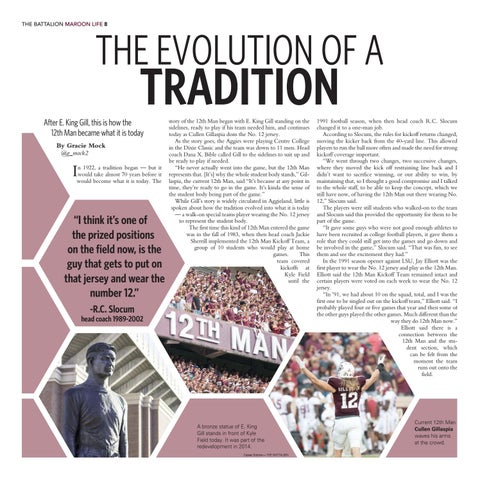
A bronze statue of E. King Gill stands in front of Kyle Field today. It was part of the redevelopment in 2014. Cassie Stricker— THE BATTALION
1991 football season, when then head coach R.C. Slocum changed it to a one-man job. According to Slocum, the rules for kickoff returns changed, moving the kicker back from the 40-yard line. This allowed players to run the ball more often and made the need for strong kickoff coverage important. “We went through two changes, two successive changes, where they moved the kick off restraining line back and I didn’t want to sacrifice winning, or our ability to win, by maintaining that, so I thought a good compromise and I talked to the whole staff, to be able to keep the concept, which we still have now, of having the 12th Man out there wearing No. 12,” Slocum said. The players were still students who walked-on to the team and Slocum said this provided the opportunity for them to be part of the game. “It gave some guys who were not good enough athletes to have been recruited as college football players, it gave them a role that they could still get into the games and go down and be involved in the game,” Slocum said. “That was fun, to see them and see the excitement they had.” In the 1991 season opener against LSU, Jay Elliott was the first player to wear the No. 12 jersey and play as the 12th Man. Elliott said the 12th Man Kickoff Team remained intact and certain players were voted on each week to wear the No. 12 jersey. “In ’91, we had about 10 on the squad, total, and I was the first one to be singled out on the kickoff team,” Elliott said. “I probably played four or five games that year and then some of the other guys played the other games. Much different than the way they do 12th Man now.” Elliott said there is a connection between the 12th Man and the student section, which can be felt from the moment the team runs out onto the field.
Current 12th Man Cullen Gillaspia waves his arms at the crowd.