bonfire edition
page 1b
thebattalion
tuesday 11.17.09
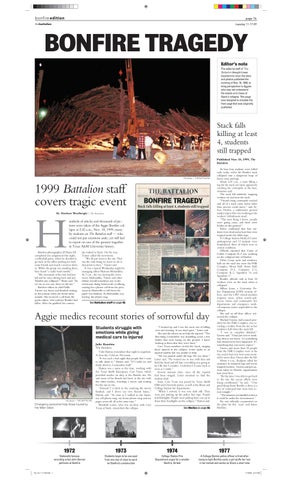
BONFIRE TRAGEDY Editor’s note The editorial staff of The Battalion thought it was important to rerun the story and photos published the morning of Nov. 18, 1999, to bring perspective to Aggies who may not understand the events and chaos of Stack’s collapse. This page was designed to emulate the front page that was originally published.
Stack falls killing at least 4, students still trapped Published Nov. 18, 1999, The Battalion
File photo — THE BATTALION
1999 Battalion staff covers tragic event By Matthew Woolbright | The Battalion
H
undreds of articles and thousands of pictures were taken of the Aggie Bonfire collapse at 2:42 a.m., Nov. 18, 1999, many by students on The Battalion staff — who could not put emotions aside, yet still had to report on one of the greatest tragedies in Texas A&M University history.
Battalion photographer JP Beato III completed one assignment that night, a volleyball game, when he decided to go back to the office parking lot with some friends and watch a meteor shower. While the group was standing there, they heard “a really loud rumble.” “My roommate at the time had just left and he came driving back and said ‘Bonfire just collapsed,’” Beato said. “So we ran to our cars, drove to the site.” Battalion editor-in-chief Sallie Turner was home and finished writing in her journal when she heard sirens outside. She received a call from the sports editor, who told her Bonfire had fallen. After she grabbed her camera,
she rushed to Stack. On the way, Turner called the newsroom. “We all just went to the site. That was the only thing we knew to do at that point in time,” Turner said. It was a typical Wednesday night for managing editor Marium Mohiuddin. At 3 a.m., she was leaving the newsroom. Mohiuddin, Turner and other editors would sometimes stay in the newsroom doing homework or talking, waiting for a phone call from the press room in Huntsville to tell them the paper was finished. As Mohiuddin was leaving, the phone rang. See Battalion staff on page 4b
Aggie medics recount stories of sorrowful day Students struggle with emotions while giving medical care to injured Julie Rambin
File photo — THE BATTALION
Emergency personnel help those injured by the fallen Stack.
Pg. 1b-11.17.09.indd 1
The Battalion Toby Hatton remembers that night in snapshots. A clear sky. Cold air. No moon. “It was such a bad night that people don’t want to talk about it,” Hatton said. “If I really try and think about it, I remember stuff.” Hatton was a nurse at the time, working with the Texas A&M Emergency Care Team, which provided medics on duty at the Bonfire site. He and some of his friends had been at the site with the other medics, watching a movie and waiting for the sun to rise. “Around 2 o’clock in the morning the movie finished, and I drove my two friends home,” Hatton said. “As soon as I walked in the house, my cell phone rang, my house phone rang and my pager went off, all at the same time.” Elizabeth Leiter, who was on-duty with Care Team at Stack, remembers the collapse.
“I looked up and I saw the stack sort of falling over and twisting. It was dead quiet,” Leiter said. She and the others ran to help the injured. “The first thing I remember was stumbling across a few bodies that were laying on the ground. I knew looking at them that they were dead.” Care Team members circled the Stack, triaging those injured in the collapse. Leiter spoke to an injured student but was unable to help. “He was pinned under the logs. He was alone,” Leiter said. “He wanted me to stay with him and hold his hand and tell him everything was going to be OK, but I couldn’t. I told him I’d come back as soon as I could.” Several minutes later, once all the injured had been triaged, Leiter returned to find the student dead. Soon, Care Team was joined by Texas A&M EMS and University police, as well as the Bryan and College Station fire departments. “When I arrived, it was very dark still. They were just putting up the police line tape. People had flashlights. People were pulling their cars up to shine their headlights on the collapse,” Hatton said. See Medics on page 6b
At least four students were killed early today when the Bonfire stack collapsed into a dangerous heap of heavy wire and logs. About 2:20 a.m., a crane lifting a log hit the stack too hard, apparently cracking the centerpole at the base, witnesses said. The stack fell suddenly, trapping workers on and near the stack. “I heard a snap, centerpole cracked and all of a stack came down faster than anyone could move,” said Aileen Dryden, a sophomore general studies major who was working at the workers’ refreshment stand. “The next thing I knew, people were going crazy, and there were bodies on the ground.” Police confirmed that four students were dead and at least four were trapped under the fallen logs. A College Station Medical Center spokesperson said 12 students were hospitalized, three of which were in critical condition. Officials reported that Corps of Cadets Company K-2 was working on the collapsed side of Bonfire. Other Corps units and residence halls on the stack site were the FHK Complex, Moses Hall, Aston Hall, Company D-2, Company C-2, Company K-2, Squadron 16 and Squadron 17. Bonfire officials said at least 24 workers were on the stack when it collapsed. Hillary Jones, a University Police Department (UPD) security officer, said the UPD critical-incident response team, urban search-andrescue teams and community fire departments and emergency medical-response teams responded to the collapse. She said an off-duty officer witnessed the collapse. Michael Guerra, hall council president for the FHK Complex, was escorting a worker from the site to her residence hall when the stack fell. “I was in complete disbelief,” Guerra said. “I had just seen it standing; then it was down. It’s something that should never have happened. It’s something that you never expect.” Guerra said more than 30 people from the FHK Complex were at the site, and at least two were unaccounted for more than 3 hours after the fall. About 4 a.m., Redpots called for assistance to transport logs and rescue trapped workers. Guerra said precautions taken by Bonfire organizations had saved lives. “By the time I was able to get back to the site, the rescue efforts were being coordinated,” he said. “One good thing about Bonfire is there is a line of command that went into action tonight.” “The situation was handled as best as it could be under the circumstances.” No one officially commented on the plans for this years’ and future Bonfires.
1972
1973
1974
1977
Nationally famous recording artist John Denver performs at Bonfire
Students begin to be excused from one day of class to work on Bonfire’s construction
College Station Fire Department urges for a smaller Bonfire, 55 feet
A College Station police officer is fired after trying to light Bonfire early; a girl stuffs her hair in her helmet and works on Stack a short time
11/16/09 9:12 PM