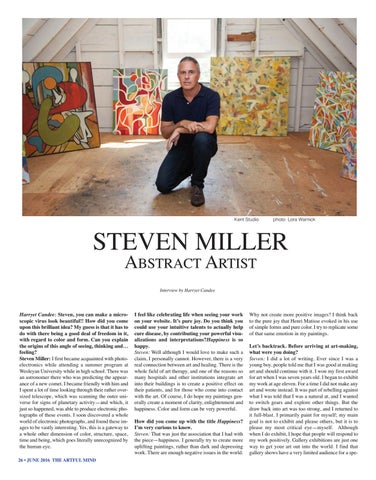
STEVEN MILLER Kent Studio
ABSTRACT ARTIST
photo: Lora Warnick
Interview by Harryet Candee
Harryet Candee: Steven, you can make a microscopic virus look beautiful!! how did you come upon this brilliant idea? My guess is that it has to do with there being a good deal of freedom in it, with regard to color and form. can you explain the origins of this angle of seeing, thinking and… feeling? Steven Miller: I first became acquainted with photoelectronics while attending a summer program at Wesleyan University while in high school. There was an astronomer there who was predicting the appearance of a new comet. I became friendly with him and I spent a lot of time looking through their rather oversized telescope, which was scanning the outer universe for signs of planetary activity—and which, it just so happened, was able to produce electronic photographs of these events. I soon discovered a whole world of electronic photographs, and found these images to be vastly interesting. Yes, this is a gateway to a whole other dimension of color, structure, space, time and being, which goes literally unrecognized by the human eye.
26 • June 2016 The ArTful Mind
i feel like celebrating life when seeing your work on your website. it’s pure joy. do you think you could use your intuitive talents to actually help cure disease, by contributing your powerful visualizations and interpretations?Happiness is so happy. Steven: Well although I would love to make such a claim, I personally cannot. However, there is a very real connection between art and healing. There is the whole field of art therapy, and one of the reasons so many hospitals and other institutions integrate art into their buildings is to create a positive effect on their patients, and for those who come into contact with the art. Of course, I do hope my paintings generally create a moment of clarity, enlightenment and happiness. Color and form can be very powerful.
how did you come up with the title Happiness? i’m very curious to know. Steven: That was just the association that I had with the piece—happiness. I generally try to create more uplifting paintings, rather than dark and depressing work. There are enough negative issues in the world.
Why not create more positive images? I think back to the pure joy that Henri Matisse evoked in his use of simple forms and pure color. I try to replicate some of that same emotion in my paintings.
let’s backtrack. Before arriving at art-making, what were you doing? Steven: I did a lot of writing. Ever since I was a young boy, people told me that I was good at making art and should continue with it. I won my first award for art when I was seven years old. I began to exhibit my work at age eleven. For a time I did not make any art and wrote instead. It was part of rebelling against what I was told that I was a natural at, and I wanted to switch gears and explore other things. But the draw back into art was too strong, and I returned to it full-blast. I primarily paint for myself; my main goal is not to exhibit and please others, but it is to please my most critical eye—myself. Although when I do exhibit, I hope that people will respond to my work positively. Gallery exhibitions are just one way to get your art out into the world. I find that gallery shows have a very limited audience for a spe-