Arts and Entertainment
Oct. 26, 2018
Black Panther
traveling exhibit features panel with former members Cadesha Clarke @ ׀theappalachian ׀A&E Reporter
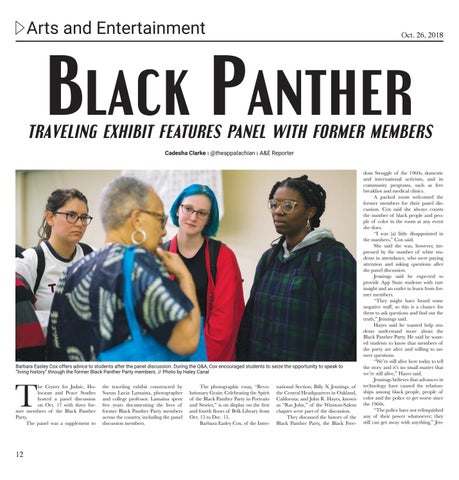
Barbara Easley Cox offers advice to students after the panel discussion. During the Q&A, Cox encouraged students to seize the opportunity to speak to “living history” through the former Black Panther Party members. // Photo by Haley Canal
T
he Center for Judaic, Holocaust and Peace Studies hosted a panel discussion on Oct. 17 with three former members of the Black Panther Party. The panel was a supplement to
12
the traveling exhibit constructed by Suzun Lucia Lamaina, photographer and college professor. Lamaina spent five years documenting the lives of former Black Panther Party members across the country, including the panel discussion members.
The photographic essay, “Revolutionary Grain: Celebrating the Spirit of the Black Panther Party in Portraits and Stories,” is on display on the first and fourth floors of Belk Library from Oct. 15 to Dec. 15. Barbara Easley Cox, of the Inter-
national Section; Billy X Jennings, of the Central Headquarters in Oakland, California; and John R. Hayes, known as “Ras John,” of the Winston-Salem chapter were part of the discussion. They discussed the history of the Black Panther Party, the Black Free-
dom Struggle of the 1960s, domestic and international activism, and its community programs, such as free breakfast and medical clinics. A packed room welcomed the former members for their panel discussion. Cox said she always counts the number of black people and people of color in the room at any event she does. “I was (a) little disappointed in the numbers,” Cox said. She said she was, however, impressed by the number of white students in attendance, who were paying attention and asking questions after the panel discussion. Jennings said he expected to provide App State students with rare insight and an outlet to learn from former members. “They might have heard some negative stuff, so this is a chance for them to ask questions and find out the truth,” Jennings said. Hayes said he wanted help students understand more about the Black Panther Party. He said he wanted students to know that members of the party are alive and willing to answer questions. “We’re still alive here today to tell the story and it’s no small matter that we’re still alive,” Hayes said. Jennings believes that advances in technology have caused the relationships among black people, people of color and the police to get worse since the 1960s. “The police have not relinquished any of their power whatsoever; they still can get away with anything,” Jen-