wednesday, january 25, 2012 3
The california aggie
Yolo Military Families group meets at Black Bear Diner Group meant to serve as comfort for military families
By ZANDER WOLD Aggie News Writer
For many Davis residents, the wars of recent years are a foreign issue not affecting their daily lives. For those with close relatives serving in the military, there is a support group helping to comfort them. The Yolo Military Families group met Monday night at Black Bear Diner. The group was founded almost 10 years ago by Cindy Schulze, whose son was in the Marines at the time. Bob Glynn, a former Marine, and whose son Matt flew a fighter pilot in the war in Iraq, was one of the first participants of the group. “The group started to form as a casual meeting of people,” Glynn said. “There were a couple of support the troop rallies, which helped meet other military families.” The group meets about six times a year, and have a yearly fundraiser in the fall to raise money to send troops packages. Linda Smith, who joined the group in 2006, now acts as the coordinator. Her son was deployed to Iraq twice, and she feels the war is completely different from the perspective of a family member. “There is emotional sacrifice you have to deal with day to day when they are gone,” Smith said. “You carry a stress daily about
Galaxies Cont. from page 5 they do not actually interact as the clusters pass through each other. However, the hot gas is the one component that does collide, remaining in the center of the collision as momentum carries the clusters away from each other. “The main purpose of studying merging clusters is to understand about dark matter,” said Perry Gee, a research specialist at UC Davis, who discovered the system. Researchers are particularly interested in how the dark matter interacts in the system — or more to the point, how it does not. The dark matter of both galaxy clusters has not interacted with each other and remains surrounding their respective galaxies post-collision. By study-
if they will come home.” The intention of the group is not just to provide comfort though. “[It is] a place to come and brag about our kids,” Smith said. Joni Klein is in a similar situation. Her son Matthew works in intelligence and helps train Iraqis, which made him realize Americans and Iraqis are similar. She feels the group helps support her a great deal too. “It’s been wonderful to have people in the same situation you are in,” Klein said. “They are almost like family.” While members of the group have close connections to troops serving in the military, for many Americans it is a foreign issue. Members of the group believe there are a few things many people do not realize about members of the military. “They teach them a lot of respect for each other,” Klein said. “[Also], they come back as a hero.” For Glynn, there is a different issue he feels is important that is going unnoticed. “[People] realize they are in harms way, but they don’t realize these kids are coming back and can’t find jobs,” he said. “Some have medical problems and have families; they need jobs.” Glynn believes that as more troops are withdrawing from Iraq and Afghanistan, the unemployment rate is going to keep increasing because of the veterans looking
ing the Musket Ball Cluster system, William Dawson, a fifth-year Ph.D. student and head of the project, hopes to contribute to the developing understanding of dark matter. Studying dark matter may seem abstract to some, but as one studies science, the future applications are not always clear. “The hope is that it will be like Einstein’s [theory of] General Relativity, which one hundred years ago, when he came up with it, there was no application for,” theorizes Dawson, “But now, we’re completely dependent upon his theoretical work — our GPS systems would not work without these corrections.” Scientists don’t yet know how knowing about dark matter could affect the future, but as Dawson said, “Maybe our grandchildren’s grandchildren will figure out some use for this dark matter, which
By Mary Posani
Apple, Inc. announced Thursday that it is tapping into the textbook industry with the new iBooks 2 application, with which users can download interactive textbooks to their iPad. The iBooks 2 app, the second generation app to Apple’s iBook, which allows users to download electronic books to their iPhone, iPad or iPod Touch, educates students through interactive textbooks on the iPad. Students will be able to read textbooks, make notes and turn them into flashcards, zoom in on detailed pictures or define unknown words immediately. Apple also announced iBooks Author, which allows users to create their own iBook and iTunes U, an app that allows those with iOS-capable devices to take high school and college-level courses for free. “Without question, this is the direction (textbooks are) moving.” said Ken Petri, Ohio State U.’s director of web access. Onlineeducation.net, a database for students to explore educational opportunities, reported in its latest blog post that on average, electronic textbooks are 53 percent cheaper than the hard copy. As of Thursday, students can download the app and buy textbooks through iTunes at $14.99 or lower. “Digital textbooks will dominate following a lifelong-learning subscription model; in essence an updatable ‘editionless’ text-
book,” Steve Acker, OSU research director on Ohio Digital Bookshelf, said in a press release. “The ‘net cost of use’ of digital should be 15 to 20 percent below costs available to students who purchase books.” Some OSU students said they would use the new app if it becomes accessible to college students. Edin Hadzic, a fifth-year in political science, said he would use the new app. “I think going toward more computer-based stuff, ebooks, stuff like (that) will be beneficial because more and more students are using it, especially if it is cheaper and more accessible,” Hadzic said. “Hopefully (textbook companies) will consider dropping their prices a little bit because textbooks are expensive, as everybody knows.” Yet it might be a while before OSU will be able to adapt to this form of ebook. Apple is targeting high school students and has partnered with high school textbook publishers McGraw-Hill, Pearson and Houghton Mifflin Harcourt. Some Ohio high schools have been using tablets for education. Columbus School for Girls, a K-12 private school, have used tablet PCs in the classroom for high school students since 2006, said Ben Liu, the IT Director at CSG. Liu said students use a stylus, which is an electronic pen, on the tablet’s screen for PC involvement during class. “(About) 70 to 80 percent
for jobs. He is grateful however, that no one within the group has lost a family member while serving in the recent wars. The group is appreciative of the community’s support, including Reserve Officers’ Training Corps (ROTC) who lends them a classroom to help pack boxes and The Grad where the group’s annual fundraiser is usually held. Even though it started as a Davis
makes up roughly 25 percent of the entire universe.” Besides constraining the ideas of dark matter, there are several other important applications of studying the Musket Ball Cluster. Observing this system could help us to understand the evolution of galaxies based on changes to their environment, cluster systems as accelerators of high energy cosmic rays and whether the universe is composed of only matter (or perhaps matter and antimatter). “If one [cluster] was composed of matter and the other antimatter, we would see lots of gamma rays as the matter and antimatter particles annihilate,” David Wittman, the project supervisor said. “The fact that we do not ... lends support to the idea that the entire universe is made of matter.” Actual discovery of this system
Apple takes bigger bite out of textbook industry with iBooks 2 The Lantern (Ohio State University)
Evan Davis / Aggie
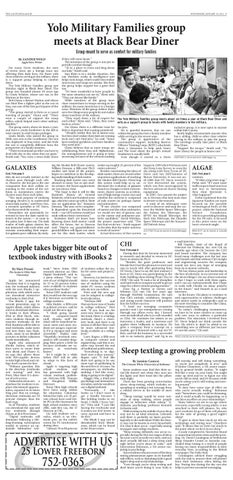
The Yolo Military Families group meets about six times a year at Black Bear Diner and acts as a support group to locals with family members in the military.
of students utilize the stylus for notes and projects,” Liu said. However, Liu had no statistics stating the success rate of students using the tablet PC versus students who do not use tablets. Petri said the new app can be adapted to collegelevel education. “McGraw-Hill and Pearson have tons of books in college editions,” Petri said. “If you look on the store now, there is an algebra book, there is a biology textbook, there’s a chemistry book, and there is no reason at all that these can’t be more advanced textbooks available at a college level.” Larry Rogers, a fifth-year in computer science and engineering, said this is another step toward the end of traditional publications. “Everything is so digitized now-a-days anyway,” Rogers said. “I feel like there isn’t going to be any more type of publishing in the next five to 10 years. No newspapers, no textbooks, nothing. I feel like everything is going to be digital.” Maggie Otto, a third-year psychology and international studies, said she would not use a digital textbook. “Personally, I like books so I don’t want to get a Kindle because I like holding books in my hand. I think I focus better,” Otto said. “I just like having the textbooks and it makes me feel better to carry around and have to do this.” The iBook 2 app can be downloaded from iBookstore, which can be found in the iTunes store.
exclusive group, it is now open to anyone within Yolo County. Smith highly recommends anyone who has a sibling, child or other close relative serving in the military to join the group. The meetings usually take place at Black Bear Diner. “Support the troops,” Smith said. “To show [them] the people at home care.” ZANDER WOLD can be reached at city@theaggie.org.
began in 1999 when Wittman used the Deep Lens Survey to scan the sky along with Tony Tyson of UC Davis and Ian Dell’Antonio of Brown University. It was not until 2006 that UC Davis researcher Gee discovered the system, which was first unrecognized by the less advanced cluster finding equipment. In 2007, Gee passed the project on to Dawson who had more time to devote to the research. A total of six telescopes were used to discover and map the system: the Hubble Space Telescope, the Subaru 8m Telescope, the KPNO 4m Mayall Telescope, the Keck 10m Telescope, the Chandra Space Telescope and the SunyaevZel’Dolvich Array.
algae
ALEX STANTON can be reached at science@theaggie. org.
BRIAN RILEY can be reached at science@ theaggie.org.
Cont. from page 5 contexts. “It’s like a big street map,” Fiehn said. “If I want more traffic to go to San Francisco and less to Sacramento, then close Interstate 5, what happens?” Fiehn explained that the Japanese funders are more focused on the possible technological fruits of the project, while the National Science Foundation, which is providing funding for the US side, is focused at this point more on the basic research angle.
e-mail interview. Bill Daniels, chair of the Board of Directors for Vitalwear, Inc, met Chi six months ago when Chi became the CEO and board member. The company has faced many challenges over the last year and Daniels said that without Chi’s insight and engineering acumen the company would not have any hope of emerging from its economic setbacks. “He has shown poise and leadership in the face of adversity. As an investor one of the nicest things I can say about someone is that I hope to work with them again, and I can say enthusiastically that I hope to work with Charlie on many projects in the future,” said Daniels in an e-mail interview. In the future, Chi plans to continue to seek opportunities to address challenges and unmet needs in orthopedics and to do more traveling to countries like China, Vietnam and Japan. “In today’s challenging environment, we have to be more creative to come up with new ways to address a particular problem. The education I received from UC Davis helped me think outside the box. My advice is: don’t be afraid to try something new or different just because it’s not the norm,” Chi said.
chi
Cont. from page 6 During that time he became interested in research and decided to return to UC Davis to obtain his Ph.D. “Besides the great professors and friends that I had the pleasure to meet and stay in touch with after graduating from UC Davis, I have to say the best memory I have at UC Davis was participating in the body building show during Picnic Day in 1998,” Chi said. “It took a lot of discipline and hard work to compare myself to get on stage for a three-minute posing routine.” Evan Ng, a Partner at Dorsey and Whitney LLP, met Chi five years ago through OtisMed Corporation. He said that Chi’s attitude, confidence, integrity and strong moral character will position him for further success. “I head our emerging companies practice and I see entrepreneurs coming through our offices every day. I haven’t seen an individual who is as well-rounded as [Chi]. He combines his talents as an innovator, a leader, and a motivator and applies them brilliantly in business. He grew a company from a concept on a napkin, got it financed with a top tier VC firm, and led the business to a successful sale to an industry giant,” said Ng in an PRISCILLA WONG can be reached at features@aggie.org.
Sleep texting a growing problem By Jasmine Cannon
The Crimson White (University of Alabama)
Some students may find that their social life doesn’t end when they turn out the lights and their head hits the pillow each night. There has been growing conversation about sleep-texting, which includes responding or sending a text message from a cellular device in the middle of one’s sleep. “[Sleep texting] would be some variation of sleep walking, where people engage in behaviors while asleep,” U. Alabama psychology professor Kenneth Lichstein said. While texting in the middle of your sleep may not be an ideal situation, Lichstein said there is probably no harm psychologically to the individual. While the theory may not be known in every household, it is clear it does occur – especially among teenagers and college students. “Sleep texting definitely can occur especially during the first two stages of sleep because you’re actually very alert, and you don’t actually fall into a deep sleep until right before you’re about to wake,” said FabryeAnne Robinson, a UA senior majoring in psychology. Some students who are aware of the sleep texting phenomenon agree on its harmful side effects, such as disturbing both a good night’s sleep and social relationships. “Even though you’re sleep texting and don’t know you’re doing it, your body is
still moving and still doing something, so you’re not completely at rest,” said D’Amber Chambers, a UA senior majoring in general health studies. “It might feel like a wear on your body. You might wake up tired and try to figure out why you’re still so tired, and it’s because while you’re asleep you’re still texting and moving around.” “It does have some type of effect on who you’re actually texting,” Robinson said. “Sometimes you could be dreaming, and it could actually be happening, so it can have an effect on your relationships.” Many believe we are in an age where everyone, especially young adults, is too attached to their cell phones. So, why can’t students let go of their cell phones for the sake of getting a good night’s sleep? “It goes to show how much we rely on technology and texting now,” Chambers said. “It shows that we [text] too much to the point where we do it in our sleep.” A study completed in November found a connection between stress and sleep texting. Dr. David Cunnington of Melbourne Sleep Disorder Centre in Australia concluded sleep texting is a result of people having too many responsibilities in their everyday lives, according to the British newspaper The Daily Mail. Cunnington advised those struggling with the task to remove their cell phones from their bedrooms when hitting the hay. Texting less during the day can also help to prevent unwanted messaging.