8 | THURSDAY, JUNE 1, 2017
THE CALIFORNIA AGGIE
SCIENCE+TECH Aggies secure top four playoff finish in collegiate eSport UC Davis Dota 2 team confident for next year
CRAIG BALLENGER / COURTESY
California salmon threatened by changing climates Population diversity key to salmon resiliency
DAVIS DOTA TEAM / COURTESY
BY G EORG E UG A RT E ME NDIA friend@theaggie.org
A recent report commissioned by California Trout — a San Francisco-based nonprofit — and completed by UC Davis reviewed the state of the 32 types of native California salmon, steelhead, trout and whitefish. The report, titled State of the Salmonids II: Fish in Hot Water, was a follow-up to a similar report completed in 2008. The newest findings indicate that nearly half of these fish populations are in danger of going extinct within 50 years. The bull trout, one of the 32 species native to California, has been extinct since 1975. “The big overarching threat, and the one we found threatened 84 percent of the species, is climate change,” said Dr. Robert Lusardi, a joint California Trout and UC Davis Wild and Coldwater Fish researcher and one of the authors of the paper. “The reason for that is climate change will affect and is affecting the magnitude and timing of the flow, so it’s changing what these fish are evolved to. But it also affects food web dynamics, how their food interacts, abundance [and] diversity. It can also alter species interactions.” Salmon are coldwater fish and struggle to survive in warm waters. Certain types of salmon are anadromous, or migratory, and travel from the frigid Pacific Ocean to California rivers for development and breeding. These species are most vulnerable to dams, which can cut off their traditional migration routes and spawning grounds. Other types of salmon stay in small watersheds higher up in the hills and mountains, where the water runs quick and chilly. Even slight warming of these sensitive waters could jeopardize entire species of inland fishes. In recent years, more precipitation has been reaching California peaks as rain instead of snow. Salmon rely on large snowpacks to slowly melt during the summer, providing the perfect coldwater brew for growth and maturation. According to Patrick Samuel, the Conservation Program coordinator for California Trout and one of the authors of the paper, everybody plays a role in revitalizing California’s native salmon. “Something we advocate for is trying to restore the logical function of our highly altered landscapes,” Samuel said. “We can protect our source waters, our springs, our natural reservoirs on the landscapes to help store water and keep it cold and then slowly release it during the warm summer months when the fish really need it.” The report is hopeful in regards to potential partnerships between competing water interests in California. An ongoing observational experiment involves agricultural entities and fisheries sharing seasons of land and water use. “We’re working with rice farmers,” Samuel said. “They flood their fields in the wintertime when they don’t need to grow rice. Juvenile salmon and steelhead have historically used those floodplain habitats to fatten up before migrating to the Pacific Ocean.” According to Lusardi, salmon are also indicators of watershed health. When coldwater fish are unable to thrive in their traditional waters, signs point to important links in the local ecosystem weakening. A sustainable California will strive to have high-quality water, and actions can be taken to improve the health of California’s native salmonids. The goal of these interventions will be “to help them return to abundance,” Samuel said. Climate change is the largest overarching threat to 84 percent of California’s native salmonids, but it is not the only danger facing these fish. Estuary alteration, major dams and agricultural water demands impact anadromous species, while invasive fish species, severe fires and hatcheries imperil inland species. Certain existing dams could be removed to recreate lost floodplains for fish to develop and thrive. Future construction projects that will permanently affect waterways should be mindful of the needs of watershed to keep ecosystems healthy. The proposed Bay Delta Conservation Plan reroutes water from above the San Joaquin Delta to huge pumps for agricultural usage and human drinking water. Scientists and wildlife experts are divided on how fish will be impacted by the construction project, which will lower the resting flow volume of the San Joaquin Delta. Dr. Peter Moyle, the associate director of the Center for Watershed Sciences at UC Davis and lead author of the paper, has mixed feelings about the project.
A second wind for desert tortoises
Design of wind energy facilities impacts predators, prey GENESIA TING / AGGIE
BY JACK CARRILLO CONCOR DI A science@theaggie.org
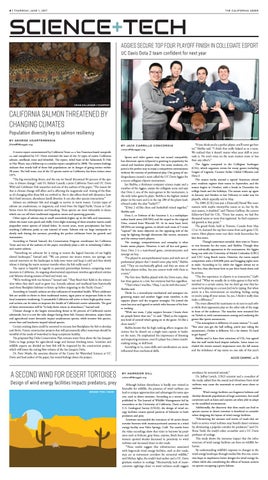
Sports and video games may not sound compatible, but electronic sports (eSports) is growing in popularity for casual and hardcore players alike. For some students, eSports is the perfect way to enjoy a competitive environment without the toxicity of professional play. One group of undergraduates created a team called the UC Davis Aggies for a recent collegiate eSports tournament. Ian Skebba, a third-year computer science major and a member of the Aggies, enjoys the collegiate scene and says that Dota 2, one of the main games in the tournament, is the only video game he plays. Skebba is the highest ranked player on his team and is in the top 200 of the player leaderboard under the alias “lucky57.” “[Dota 2 is] like chess and basketball mixed together,” Skebba said. Dota 2, or Defense of the Ancients 2, is a multiplayer online battle arena (MOBA) and the sequel to the original Dota, created from Warcraft III. At its most basic level, MOBAs are strategy games, in which each team of 5 must “capture” the main objective on the opposing side of the map by fighting through deterrents like turrets, monsters and the enemy team’s players. The strategy, competitiveness and teamplay is what hooks mosts players. However, it isn’t all fun and games. Since Dota 2 is a team-based game, communication and synergy are key. “I’ve played in semi-professional teams and with sort of professional players that I would never play with,” Skebba said. “They are mechanically gifted, and they are some of the best players online, but you cannot work with them as a team.” The first time Skebba played with the Davis team, they lost three games in a row, but everyone had fun regardless. “That’s when I was like, ‘Okay, I can be with this team,’” Skebba said. Thinh Le, a second-year mechanical and aerospace engineering major and another Aggie team member, is the support player and the in-game strategist. He joined the team last year and agreed to switch roles because of his lower ranking. “With our team, I play support because I know there are people better than me,” Le said. “[But] as the support, you kind of control what’s going on in the game. It’s like a chess match.” Skebba knows that his high ranking affects in-game decisions, but he doesn’t see a single team captain or leader on the team. He emphasized the importance of listening and respecting everyone, even if a player has a lower matchmaking rating, or skill level. According to Le, team skills and coordination are more influential than mechanical skills.
“If you think you’re a perfect player, you’ll never get better,” Skebba said. “I think that really helped us as a team. We realized that it doesn’t matter what your skill or your rank is. No one’s voice on the team matters more or less than any other’s.” The Aggies competed in the Collegiate Starleague (CSL), which organizes events for many games including League of Legends, Counter Strike: Global Offensive and Dota 2. The season works around a typical American school year: students register their teams in September, and the season begins in October, with a break in December for college finals and the holidays. The season starts up again in January and finishes in late February to make way for playoffs, which typically end in May. “In 2009, [CSL] was just a [Starcraft] Brood War tournament with maybe twenty-five teams or so, but by the next season, it doubled,” said Theresa Gaffney, the current Editor-in-Chief for CSL. “From last season, we had five thousand teams or more that registered. So that’s exponential growth at that point.” The grand finals, held in Toronto, Canada from May 12 to 14, featured the top four teams from each game CSL covers. Most players never met their rivals face-to-face before this event. Though sometimes stressful, their time in Toronto was fantastic for the team, said Skebba. Though they were technically opponents in the tournament, the Aggies hung out with the University of British Columbia (UBC) and CSU Long Beach teams. However, the teams stayed competitive with a $20,000 prize and bragging rights were at stake. According to Le, while the Aggies always try to have fun, they also know how to put their heads down and be serious. “The live experience in eSports is so interactive,” Gaffney said. “What we usually do in video games is that we’re involved to a certain extent, but we don’t go over that because we’re playing on a screen [or] we’re typing. But when you’re in a live environment — touching, feeling, seeing — you’re using all your senses. So, yes, I think it really does make a difference.” The event allowed for teammates to sit next to each other while their opponents play on the other side of the stage in front of the audience. The matches were streamed live on Twitch.tv, with commentators casting and analyzing the games like sports announcers. “The atmosphere is different; it’s more intense,” Le said. “But once you get the ball rolling, you’re just riding the momentum. Online is different. It’s a lot slower. It’s hard to get hyped.” Skebba and Le have their criticisms of CSL, but agreed that the staff works hard despite setbacks. Some issues included the winter season’s importance over the fall season and the imbalance of top teams on one side of this year’s AGGIE GAMING on 13
BY H ARNO O R G ILL science@theaggie.org
Although habitat disturbance is hardly ever viewed as favorable for wildlife, the presence of wind turbines can lead to unique opportunities and advantages for some species, such as desert tortoises. According to a recent study published in The Journal of Wildlife Management led by researchers at the University of California, Davis and the U.S. Geological Survey (USGS), the design of wind energy facilities creates special patterns of behavior in both predators and prey. Scientists surrounded the entrances of 46 active desert tortoise burrows with motion-activated cameras in a wind energy facility near Palm Springs, Calif. The results from the video recordings show that visits to burrows by predators such as bobcats, gray foxes, coyotes, black bears and western spotted skunks decreased in proximity to wind turbines and increased closer to dirt roads. “These results suggest that infrastructure associated with large-scale wind energy facilities, such as dirt roads, may act as movement corridors for terrestrial wildlife,” said Mickey Agha, the study’s lead author and a UC Davis graduate student in ecology. “Alternatively, lack of mesocarnivore sightings closer to wind turbines could suggest
avoidance by terrestrial animals.” Dr. Jeffrey Lovich, USGS scientist and a co-author of the study, added that the sound and vibrations from wind turbines may cause the mammals to avoid areas closer to turbines. Wind energy facilities can fragment habitats and thereby diminish populations of large carnivores, but small carnivores such as foxes and coyotes are often able to adapt to the modified environment. Additionally, the discovery that dirts roads can lead to species success in desert tortoises is beneficial to consider when designing the layout of wind energy facilities. “Minimizing the amount and extent of roads that are built to service wind turbines may benefit desert tortoises by eliminating a popular corridor for predators,” said Dr. Brian Todd, the study’s other co-author and a UC Davis professor of ecology. This study shows the immense impact that the infrastructure of wind energy facilities can have on wildlife behavior. By understanding wildlife’s response to changes in the wind energy landscape through studies like this one, scientists hope to implement better designs for wind energy facilities while also considering the effects of human actions on species occupying a given habitat.