OPINION
April 15, 2015
Page 9
The Fordham Ram
Rethinking Costly Resume Enhancers By MARGARITA ARTOGLOU OPINION EDITOR
As college students, we have a lot to do, a lot to think about and a lot to pay for. Student debt is constantly a hot topic of conversation. Despite more and more students being unable to foot the bills for college tuition, more and more expectations are being placed upon their shoulders. All colleges like to tout their study abroad programs and internship opportunities as selling points to prospective students, even though the real focus should be placed on the reason students go to college in the first place: the degree. However, in today’s world, completing a four-year degree is no longer enough to make students viable candidates for competitive jobs. Recently, there seems to be a surge in college students doing things for the experience. Things like traveling abroad, going on volunteer trips in foreign countries and working at unpaid internships are examples of things that cost time and money but have become so commonplace that a resume without them seems almost lackluster. Most students at Fordham have an unpaid internship at some point, providing companies with free labor in exchange for a few lines on their resume and maybe a recommendation. And service trips are increasingly popular: it
AL GOLDIS/AP
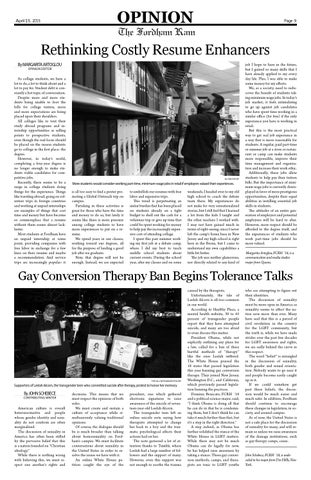
More students would consider working part-time, minimum wage jobs in retail if employers valued their experiences.
is all too easy to find a poster promoting a Global Outreach trip on campus. Partaking in these activities is great for those who have the time and money to do so, but lately it seems like there is more pressure among college students to have more experiences to put on a resume. We spend years in our classes, working toward our degrees, all for the purpose of landing a good job after we graduate. Now, that degree will not be enough. Instead, we are expected
to embellish our resumes with free labor and expensive trips. This trend is perpetuating an unfair burden that has been placed on students already on a tight budget to shell out the cash for a volunteer trip or give up time that could be spent working for money to help pay the increasingly expensive cost of attending college. I spent this past summer working my first job at a debate camp, where I did my best to teach middle school students about current events. During the school year, after my classes and on some
weekends, I headed over to my old high school to coach the debate team there. My experiences do not make for very sensationalized stories, but I still feel that I learned a lot from the kids I taught and the other teachers I worked with. I may not have gained much in terms of sight-seeing, since I never left the camp’s home base in New Jersey and my high school is right here in the Bronx, but I came to understand my own capabilities a little bit better. The job was neither glamorous, nor directly related to any kind of
job I hope to have in the future, but I gained so many skills that I have already applied to my every day life. Plus, I was able to make some money for my efforts. We, as a society, need to rediscover the benefit of students taking minimum wage jobs. In today’s job market, it feels intimidating to go up against job candidates who have spent time working in a similar office (for free) if the only experience you have is working in retail. But this is the most practical way to get real job experience in a way that is more reasonable for students. A regular, paid part-time or summer job at a store or restaurant or camp can make students more responsible, improve their time management and organization and increase their work ethic. Additionally, these jobs allow students to help pay their tuition bills. But the importance of minimum wage jobs is currently downplayed in favor of more prestigious opportunities, despite their equal abilities in instilling essential job skills in students. The attitudes of an entire generation of employers and potential employees will be hard to alter. However, more respect should be afforded to the degree itself, and the experiences of students who work part-time jobs should be more valued. Margarita Artoglou, FCRH ’18, is a communication and media studies major from Queens.
Gay Conversion Therapy Ban Begins Tolerance Talks
THE ALL-NITE IMAGES/FLICKR
Supporters of Leelah Alcorn, the transgender teen who committed suicide after therapy, protest to honor her memory.
By JOHN SCHEBECE CONTRIBUTING WRITER
American culture is overall heteronormative and people whose gender identity and sexuality do not conform are often marginalized. The discussion of sexuality in America has often been stifled by the pervasive belief that this is a nation founded on “Christian ideology.” While there is nothing wrong with believing this, we must respect one another’s rights and
decisions. This means that we must respect the opinions of both sides. We must create and sustain a culture of acceptance while simultaneously valuing traditional opinions. Of course, the dialogue should be is much broader than talking about homosexuality on Fordham’s campus. We must facilitate conversations about sexuality in the United States in order to resolve the issues we have with it. An online White House petition caught the eye of the
president, one which gathered electronic signatures to raise awareness of the suicide of seventeen-year-old Leelah Alcorn. The transgender teen left an online suicide note saying how therapists attempted to change her back to a boy and the traumatic psychological effects their actions had on her. The note garnered a lot of attention thanks to Tumblr, where Leelah had a large number of followers and the support of many. However, even this support was not enough to soothe the trauma
caused by the therapists. Unfortunately, the tale of Leelah Alcorn is all-too-common in our world. According to Healthy Place, a mental health website, 30 to 45 percent of transgender people report that they have attempted suicide, and many are too afraid to even discuss this matter. President Obama, while not explicitly outlining any plans for a law, called for a ban of these hurtful methods of “therapy” like the ones Leelah suffered. The White House praised the 18 states that passed legislation this year banning gay conversion therapy. They joined New Jersey, Washington D.C., and California, which previously passed legislation banning the practices. Dominic Brancato, FCRH ’18 and a political science major, said, “I think Obama is doing all that he can do in that he is condemning them, but I don’t think he can take it much further than that, but it’s a step in the right direction.” A step indeed, as Obama has further solidified the stance of the White House in LGBT matters. While there may not be much Obama can do legally for now, he has helped raise awareness by taking a stance. These gay conversion methods, camps, and therapists are toxic to LGBT youths
who are attempting to figure out their identities. The discussion of sexuality must be more open in America as sexuality seems to affect the nation now more than ever. Many have said that this is a period of civil revolution in the country for the LGBT community, but the truth is, while we have made strides over the past few decades for LGBT awareness and rights, we are sadly behind the curve in this respect. The word “belief ” is entangled in the discussion of sexuality, both gender and sexual orientation. Nobody wants to go near it and people become easily caught up in it. If we could somehow get past these beliefs, the discussion would be much easier and much safer. In addition, Fordham should continue to encourage these changes in legislature, in society, and around campus. As of now, the United States is not a safe place for the discussion of sexuality for many, and will remain so unless we raise awareness of the damage institutions, such as gay therapy camps, cause.
John Schebece, FCRH ’18, is undecided in his major from Dix Hillls, New York.