NEWS
February 6, 2013
Page 3
FORDHAM IN THE BRONX
Smell of HOPE Count Opens the Bronx for Students Gasoline Infiltrates Hoffman FROM HOFFMAN, PAGE 1
and said that his basement even smelled like gasoline,” Hayden said. It turned out so did Hayden’s as well as many other basements on the block. FDNY began coming into homes to check on the situations inside. “We had to cut all our gas lines for the time being,” Hayden said. “We weren’t asked to evacuate but we had to open all of our doors and windows.” “I was at work literally all day,” Caroline Barrientos, Hoffman resident, FCRH ’13, said via text. “My roomate called and told me they needed to [get out] so she was letting me know that she grabbed a sweatshirt of mine to put on my dog.” This was the case for many Fordham students on Hoffman who returned from either their classes or internships to see their street full of fire engines and crowds of people. Hayden said many neighbors convened outside for a while because the smell of gasoline in their houses was unbearable for a couple of hours. FDNY remained during this time to completely filter the sewers. Students such as Hayden were very glad the FDNY responded so quickly and completed their jobs thoroughly. After investigation, according to Carroll, security officials met with the landlord and asked him not to allow people to park their cars behind the buildings where students live. Hoffman St. is a very popular off-campus residential street for Fordham students as it is located only a short walk from campus and is near many popular attractions, such as Arthur Ave. The landlord and the owner of the car received summonses from the Environmental Protection Agency (EPA). According to envirolaw.com, pouring gasoline into the sewers is considered a “discharge into the natural environment.” This is a violation of Section 2 of the EPA. Also, earlier this year in July, according to an article on NJ.com, a man poured gasoline into the sewers in Northeast Philadelphia, which also caused them to catch fire. Around 8:30 p.m. on Monday, The Fordham Ram investigated the area as well and saw that the street had been reopened and cleaned. The covers were also already back in place. Hayden said that the street itself was fixed, but there were some other damages; luckily none were to any residents or passersby. “The street is fine now but some of our water pipes [in our basement] got knocked down from the impact,” Hayden said. According to Carroll, the landlord was very cooperative, and he had not known what the car owner was doing at the time.
COURTESY OF THE BRONX NYC WIKIMEDIA
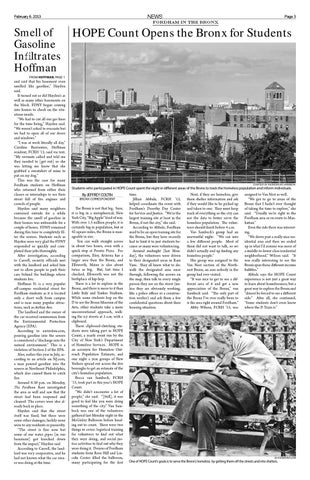
Students who participated in HOPE Count spent the night in different areas of the Bronx to track the homeless population and inform individuals.
By JEFFREY COLTIN BRONX CORRESPONDENT
The Bronx is not that big. Sure, it is big in a metaphorical, New York City, “Big Apple” kind of way. With over 1.3 million people, it is certainly big in population, but at 42 square miles, the Bronx is manageable in size. You can walk straight across in about two hours, even with a quick stop at Pronto Pizza. For comparison, Eloy, Arizona has a larger area than the Bronx, and Ellsworth, Maine is also about twice as big. But, last time I checked, Ellsworth was not the birthplace of hip-hop. There is a lot to explore in the Bronx, and there is more to it than Little Italy and Yankee Stadium. While some students hop on the D to see the Bronx Museum of the Arts, other students take a more unconventional approach, walking the icy streets at 3 a.m. with a clipboard. These clipboard-clutching students were taking part in HOPE Count, a yearly event run by the City of New York’s Department of Homeless Services. HOPE is an acronym for Homeless Outreach Population Estimate, and one night a year groups of New Yorkers spread out across the five boroughs to get an estimate of the city’s homeless population. Becca van Sambeck, FCRH ’15, took part in this year’s HOPE Count. “We didn’t encounter a lot of people,” she said. “[Still], it was good to feel like you were doing something of the city.” Van Sambeck was one of the volunteers gathered last Monday night in the McGinley Ballroom before heading out to count. There were two things to cover: logistical training for volunteers to find out what they were doing, and social justice activities to find out why they were doing it. Dozens of Fordham students from Rose Hill and Lincoln Center filled the ballroom, many participating for the first
time. Jillian Abbale, FCRH ’13, helped coordinate the event with Fordham’s Dorothy Day Center for Service and Justice. “We’re the largest training site at least in the Bronx, if not the city,” she said. According to Abbale, Fordham used to be an open training site for the Bronx, but they have recently had to limit it to just students because so many were volunteering. Around midnight [last Monday], the volunteers were driven to their designated areas in Ram Vans. They all knew what to do: walk the designated area once through, following the arrows on the map, then talk to every single person they see on the street (unless they are obviously working, like a police officer or a construction worker) and ask them a few confidential questions about their housing situation.
Next, if they are homeless, give them shelter information and ask if they would like to be picked up and taken to one. They must keep track of everything so the city can use the data to better serve the homeless population. The volunteers should finish before 4 a.m. Van Sambeck’s group had an uneventful night: “We ran into a few different people. Most of them did not want to talk, so we didn’t actually end up finding any homeless people.” Her group was assigned to the Van Nest section of the Northeast Bronx, an area nobody in the group had ever visited. “It was nice to get to see a different area of it and get a new appreciation of the Bronx,” van Sambeck said. “The only part of the Bronx I’ve ever really been to is the area right around Fordham.” Abby Wilson, FCRH ’15, was
assigned to Van Nest as well. “We got to go to areas of the Bronx that I hadn’t ever thought of taking the time to explore,” she said. “Usually we’re right in the Fordham area or en route to Manhattan.” Even the ride there was interesting. “We drove past a really nice residential area and then we ended up in what I’d assume was more of a middle-to-lower class residential neighborhood,” Wilson said. “It was really interesting to see the Bronx span those different income bubbles.” Abbale says the HOPE Count experience is not just a great way to learn about homelessness, but a great way to explore the Bronx and “almost be forced to see a different side.” After all, she continued, “Some students don’t even know where the D Train is.”
ED YOURDON/FLICKR
One of HOPE Count’s goals is to serve the Bronx’s homeless by getting them off the streets and into shelters.