OPINIONS
theramonline.com
The Left Lane Conor
SEPTEMBER 12, 2012 • THE RAM • PAGE 9
Colbert, Stewart Entertain and Inform
Righter’s Block
John P. Castonguay
Fucci
Clinton Invigorates DNC
DNC Disregards Pro-Lifers
The Democratic National Convention began in the twilight of the Republican National Convention (RNC), in Charlotte, N.C. on Sept. 4. The speakers at the threeday event were from all corners of the Democratic Party, including former presidents and even some celebrities. Most of the speeches were outstanding, including those by the first lady, Michelle Obama, and the president of the United States, Barack Obama. There was one speech, however, that stood out above all others. Former President Bill Clinton delivered a speech that contained everything that the RNC lacked: passion and relevant content. In recent years, President Clinton has become one of the most prominent figures in the Democratic Party. Since his successful two-term presidency, which ran from 1993 to 2001, Clinton has been associated with one of the greatest periods of American economic expansions in history. Since the main point of conflict in the 2012 election is the economy, Bill Clinton’s presidency is something the Obama campaign should emulate, an association that has caused a surge of Clinton publicity. Bill Clinton is also known as one of the more articulate presidents, certainly not one who would ask, “Is our children learning?” The Democrats’ ability to call upon a man who can galvanize not only the base of a party but also the undecided voters is so incredibly valuable and something that the Democrats are greatly utilizing. On the other hand when I sat around watching the RNC, there was not a single speaker with whom I was overly impressed. There were several who were well-spoken, but there was no singular outstanding figure. It is hard for me to provide all of this praise for Bill Clinton without pointing out the fact that he has not always been so chummy with President Obama. When Obama was running against Hillary Clinton in 2008, Bill Clinton actively opposed Obama, for obvious reasons. This change of heart may seem strange, but I would pin it on two different reasons. The first reason is that Barack Obama will not be running for president in 2016, and Hillary will be stepping down as secretary of state following this election. This all indicates that there may be a Clinton-family run for president starting in 2016. This rising publicity should be invaluable to garnering support for the Clinton name. The second reason ties into the first. In a time of heightening political party agitation, a figure such as Bill Clinton could be the force that the Democratic Party needs to stay together and avoid the fate of the shattering Republican Party. I know that Bill Clinton alone won’t be the saving grace of the Democratic Party, but a man of his stature and popularity can only be helpful in such a chaotic political climate. Bill Clinton’s galvanizing DNC speech could be what the Democratic Party needed to revitalize a sputtering campaign in these final two months.
The Democratic Party has its own crisis brewing. As Republicans struggle to maintain the support of the libertarian elements of their party, Democrats will have to contend with a splinter group of their own: pro-life Democrats. According to a Gallup Poll from May 2012, 70 percent of Republicans, 47 percent of Independents and 34 percent of Democrats describe themselves as pro-life. Overall, around 50 percent of Americans describe themselves as pro-life versus the 41 percent who describe themselves as pro-choice. This year, Democrats have isolated pro-lifers. Obama’s administration acted to prevent the state of Indiana from denying funds to Planned Parenthood and replaced the funds New Hampshire denied Planned Parenthood with a Health and Human Services (HHS) grant. Federal funds were extended to insurance plans that provide abortion, and the HHS mandate will require employers to cover abortifacients. The Obama administration rejected a grant request by the U.S. Conference of Catholic Bishops for victims of sex trafficking, because the Conference refuses to provide birth control and abortion services in its institutions. At the Democratic National Convention (DNC), pro-life Democrats were further isolated. No pro-life Democrats were invited to speak, while the platform committee included Nancy Keegan, the President of Planned Parenthood, Barney Frank and other prominent prochoice figures. The party platform explicitly supports governmentfunded abortions: “The Democratic Party strongly and unequivocally supports Roe v. Wade and a woman’s right to make decisions regarding her pregnancy, including a safe and legal abortion, regardless of ability to pay.” Attempts by pro-life Democrats to have more inclusive language regarding abortion were stifled. For example, the phrase “safe, legal and rare” was removed. In what may have been an effort to lessen the impact of this isolation, Democrats invited Timothy Cardinal Dolan to deliver the closing prayer at the DNC. In his prayer, Dolan endorsed an anti-abortion position in barely-veiled language: “Thus do we praise you for the gift of life. Grant us to defend it. Life, without which no other rights are secure. We ask your benediction on those waiting to be born, that they may be welcomed and protected.” Dolan’s benediction was not televised on NBC, ABC, CNN or MSNBC, mitigating any attempt to use Dolan to bring pro-life Democrats back into the fold. The DNC’s official live stream also cut off the prayer, making it difficult to see the decision to have Dolan speak as anything more than an attempt to soothe the consciences of pro-life Democrats. The Democrats will have to make a concerted effort to win back pro-life Democrats if they want to maintain their position in the White House and gain ground in Congress. Republicans, in turn, offer a firmly prolife position that may draw enough pro-life Democrats for them to reclaim the White House.
COURTESY OF WIKIMEDIA
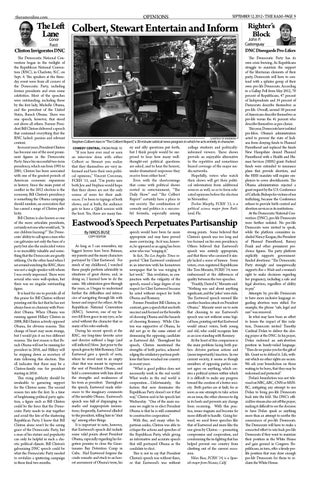
Stephen Colbert stars in “The Colbert Report,” a 30-minute satirical news program in which he acts entirely in character. COMEDY CENTRAL, FROM PAGE 10
“If you have ever read or seen an interview done with either Colbert or Stewart you realize that they themselves are very informed and have their own political opinions,” Vincent Corcoran, FCRH ’13, said. “I’m pretty sure both Jon and Stephen would hope that their shows are not the only source of news for their audiences. I’ve been to tapings of both shows, and at both, the audience gets to have a Q&A session with the host. Yes, there are many fun-
ny and silly questions put forth, but I think people would be surprised to hear how many wellthought-out political questions are asked, and to hear the honest, under-dramatized responses they receive from either host.” Even with the shortcomings that come with political shows rooted in entertainment, “The Daily Show” and “The Colbert Report” certainly have a place in our society. The combination of comedy and politics is a successful formula, especially among
college students and politicallyinformed viewers. These shows provide an enjoyable alternative to the repetitive and sometimes biased coverage of the major media networks. Hopefully, voters who watch their shows will get their political information from additional sources as well, so as to form educated opinions before the election in November. Declan Murphy, FCRH ’13, is a political science major from Parkland, Fla.
Eastwood’s Speech Perpetuates Partisanship By NIKOS BUSE COPY EDITOR
As long as I can remember, my biggest heroes have been Batman, my parents and the many characters portrayed by Clint Eastwood. For much of my childhood, I watched these people perform admirably in situations of great duress, and, in doing so, I learned how to do the same. My admiration grew through the years, as I began to understand further the difficulties and intricacies of navigating through life with honor and respect for others. At the Republican National Convention (RNC), however, one of my heroes fell from grace in my eyes, as he acted without the character that so many of his roles embody. During his recent speech at the RNC, my long-time favorite actor and director suffered a huge (and self-inflicted) blow. Just prior to the speech given by Mitt Romney, Clint Eastwood gave a speech of sorts, where he stood next to an empty chair that was meant to represent the seat of President Obama, and held a conversation with him about the strengths and weaknesses of his term as president. Throughout the speech, Eastwood made references to the imaginary comments of the invisible Obama. Eastwood’s speech was full of disparaging remarks and inappropriate insinuations; frequently, Eastwood alluded to the president, telling him to “shut up,” among other things. It is important to note, however, that Eastwood’s speech did include some valid points about President Obama, especially regarding his forgotten promise to close the Guantanamo Bay Detention Camp in Cuba. Had Eastwood forgone the crude remarks and stuck to an honest assessment of Obama’s term, his
speech would have been far more appropriate and may have proved more convincing. As it was, however, he appeared as an aging has-been actor who was “winging it.” In fact, The Los Angeles Times reported “Clint Eastwood confirmed in an interview with his hometown newspaper that he was winging it last week.” This revelation, in conjunction with the vulgarity of the speech, erased a large degree of my respect for Clint Eastwood because he acted without respect for both Obama and Romney. Former President Bill Clinton, in contrast, gave a speech that was both succinct and focused on the benefits of choosing Obama and the hazards of choosing Romney. While Clinton was supportive of Obama, he did not go to the same extent of demeaning the opposing candidate as Eastwood did. Throughout his speech, Clinton mentioned the strengths of both parties, acknowledging the retaliatory partisan problems that have wracked our country in recent years. “What is good politics does not necessarily work in the real world. What works in the real world is cooperation…Unfortunately, the faction that now dominates the Republican Party doesn’t see it that way,” Clinton said in his speech last Wednesday. “One of the main reasons we ought to re-elect President Obama is that he is still committed to constructive cooperation.” With this, and many other bipartisan asides, Clinton was able to critique the actions and speeches of the Republican Party, while giving an informative and accurate speech that still portrayed Obama as the candidate to elect. This is not to say that President Clinton’s speech was without flaws, or that Eastwood’s was without
strong points. Some believed that Clinton’s speech was too long and too focused on his own presidency. Others believed that Eastwood’s speech was entirely appropriate, and that those who censured it simply lacked a sense of humor. Some voters, even registered Republicans like Tom Merante, FCRH ’14, were embarrassed at the differences of quality between the two speeches. “Frankly, I hated it,” Merante said. “Nothing was said about anything significant, and the ‘jokes’ were stale. The Eastwood speech seemed like another baseless attack on President Obama.” Merante went on to note that choosing to use Eastwood’s speech was not without some logical base, pointing out that Eastwood would attract voters, both young and old, who could recognize him as an icon standing with Romney. At the heart of this comparison is the main problem facing both parties: divisive partisan actions and (more importantly) inaction. In our current society, it seems as though members of opposing parties cannot agree on anything, which creates a political system within which it is difficult to make any progress toward the creation of a better society. Both parties are at fault, for as soon as one attempts to take action on an issue, the other chooses to dig in its heels and prevents any change from occurring. With this practice, issues stagnate and become far more difficult to handle. Going forward, we need fewer speeches like that of Eastwood and more like the one given by Clinton — promoting compromise and cooperation, and condemning the in-fighting that has helped prevent our country from climbing out of the current recession. Nikos Buse, FCRH ’14, is a Spanish major from Nicasio, Calif.