features
the carillon | March 20 - 26, 2014
A one in four chance
How reporters and sexual assault cases mix
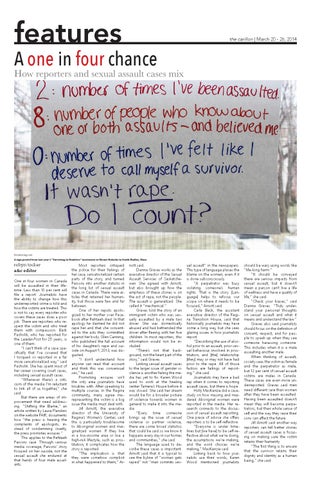
feministing.com A sign posted from last year’s “Surviving in Numbers” movement at Mount Holyoke in South Hadley, Mass.
robyn tocker a&c editor One in four women in Canada will be assaulted in their lifetime. Less than 10 per cent will file a report. Journalists have the ability to change how this underreported crime is told and how the victims are treated. This is not to say every reporter who covers these cases does a poor job. There are reporters who respect the victim and who treat them with compassion. Barb Pacholik, who has reported for the Leader-Post for 25 years, is one of them. “I can’t think of a case specifically that I’ve covered that I torqued or reported in a far more sensationalized way,” said Pacholik. She has spent most of her career covering court cases, including sexual assault cases. “Whenever there’s a criticism of the media I’m reluctant to link all of us together,” she said. But there are areas of improvement that need addressing. “Shifting the Blame,” an article written by Laura Flanders on the website FAIR, documents how “the press is hearing the complaints of apologists; instead of condemning cruelty, the press promotes excuses.” This applies to the Rehtaeh Parsons case. Through various media coverage, Parsons’ story focused on her suicide, not the sexual assault she endured at that hands of four male assailants.
Most reporters critiqued the police for their failings of her case, sensationalized certain parts of the story, and turned Parsons into another statistic in the long list of sexual assault cases in Canada. There were articles that retained her humanity, but those were few and far between. One of her rapists apologized to her mother over Facebook after Rehtaeh died. In that apology he claimed he did not rape her and that she consented to the acts they committed against her body. Glen Canning, who published the full account of his daughter’s rape and suicide on August 9, 2013, was disgusted. “I don’t understand how anyone can read that account and think this was consensual sex,” he said. Promoting excuses isn’t the only area journalists have troubles with. After speaking to multiple sources in the Regina community, many agree misrepresenting the victim is a big issue the media must deal with. Jill Arnott, the executive director of the University of Regina’s Women’s Center, said this is particularly troublesome to Aboriginal women and marginalized women. If they live in a low-income area or live a high-risk lifestyle, such as prostitution, it complicates how the story is reported. “The implication is that they were somehow complicit in what happened to them,” Ar-
nott said. Dianna Graves works as the executive director of the Sexual Assault Services of Saskatchewan. She agreed with Arnott, but also brought up how the emphasis of these stories is on the act of rape, not the people. The assault is generalized. She called it “mechanical.” Graves told the story of an immigrant victim who was sexually assaulted by a male taxi driver. She was domestically abused and had befriended the driver after fleeing with her five children. In most reporters, this information would not be included. “There’s not that background, not the heart part of the story,” said Graves. Linking sexual assault cases to the larger issue of gender violence is another failing the media has yet to fix. Karen Wood used to work at the healing center Tamera’s House before it was closed. She said her dream would be for a broader picture of violence towards women in general to make it into the media. “Every time someone brings up the issue of sexual violence or partner violence, there are some broad statistics that could be said so we know it happens every day in our homes and communities,” she said. The language used to describe these cases is important. Arnott said that it is typical to see the byline of “woman gets raped” not “man commits sex-
ual assault” in the newspapers. This type of language places the blame on the women, even if it is done subconsciously. “A perpetrator was busy violating someone’s human rights. That is the story. [Language] helps to refocus our scope on where it needs to be focused,” Arnott said. Carla Beck, the assistant executive director of the Regina Transition House, said that historically journalists may have come a long way, but she sees glaring issues in how journalists report. “Describing the use of alcohol prior to an assault, prior sexual behaviour, involved in prostitution, and [the] relationship [they] may or may not have had prior to the rape. All of those factors are failings of reporting,” she said. Journalists may have a bad rap when it comes to reporting assault cases, but there is hope. Holly MacKenzie did a casestudy on how missing and murdered Aboriginal women were reported in the media. Her research connects to the discussion of sexual assault reporting. One piece of advice she offers reporters is to be self-reflective. “Everyone is under timelines but [we have] to be self-reflective about what we’re doing, the assumptions we’re making, and the word choices we’re making,” MacKenzie said. Linking back to how journalists use their words, Karen Wood mentioned journalists
should be wary using words like “life-long harm.” “It should be conveyed there are serious impacts from sexual assault, but it doesn’t mean a person can’t live a life of wellness and have a quality of life,” she said. “Check your biases,” said Dianna Graves. “Truly understand your personal thoughts on sexual assault and what it means and understand the law.” Graves also said journalists should focus on the definition of consent, respect, and for people to speak up when they see someone harassing someone. This includes when it is a male assaulting another male. When thinking of assault, society sees the victim as female and the perpetrator as male, but 12 per cent of sexual assault victims are males in Canada. These cases are even more underreported. Graves said men need different care than women after they have been assaulted. Having been assaulted doesn’t mean they will become perpetrators, but their whole sense of self and the way they raise their sons can affect the future. Jill Arnott said another way reporters can tell better stories of sexual assault cases is focusing on making sure the victim retains their humanity. “The first thing is to ensure that the survivor retains their dignity and identity as a human being,” she said.