News From the Vatican
2
August 24, 2012
Pope says Christ’s life was one of sacrifice, not popularity
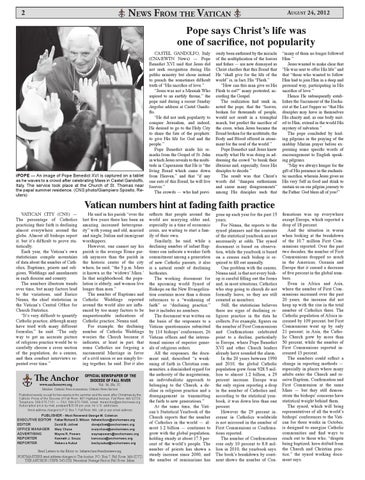
iPOPE — An image of Pope Benedict XVI is captured on a tablet as he waves to a crowd after celebrating Mass in Castel Gandolfo, Italy. The service took place at the Church of St. Thomas near the papal summer residence. (CNS photo/Giampiero Sposito, Reuters)
VATICAN CITY (CNS) — The percentage of Catholics practicing their faith is declining almost everywhere around the globe. Almost all bishops report it, but it’s difficult to prove statistically. Each year, the Vatican’s own statisticians compile mountains of data about the number of Catholics, Baptisms, priests and religious, Weddings and annulments in each diocese and country. The numbers illustrate trends over time, but many factors lead to the variations, said Enrico Nenna, the chief statistician in the Vatican’s Central Office for Church Statistics. “It’s very difficult to quantify Catholic practice, although many have tried with many different formulas,” he said. “The only way to get an accurate picture of religious practice would be to carefully choose a cross section of the population, do a census, and then conduct interviews repeated over time.”
The Anchor www.anchornews.org
Castel Gandolfo, Italy (CNA/EWTN News) — Pope Benedict XVI said that Jesus did not seek recognition during His public ministry but chose instead to preach the sometimes difficult truth of “His sacrifice of love.” “Jesus was not a Messiah Who aspired to an earthly throne,” the pope said during a recent Sunday Angelus address at Castel Gandoflo. “He did not seek popularity to conquer Jerusalem, and indeed, He desired to go to the Holy City to share the fate of the prophets: to give His life for God and the people.” Pope Benedict made his remarks from the Gospel of St. John in which Jesus reveals to the multitude in Capernaum that He is “the living Bread which came down from Heaven,” and that “if any one eats of this Bread, he will live forever.” The crowds — who had previ-
ously been enthused by the miracle of the multiplication of the loaves and fishes — are now dismayed as Christ clarifies that this Bread that He “shall give for the life of the world” is, in fact, His “Flesh.” “How can this man give us His Flesh to eat?” many protested, according the Gospel. The realization had sunk in, noted the pope, that the “loaves, broken for thousands of people, would not result in a triumphal march, but predict the sacrifice of the cross, when Jesus became the Bread broken for the multitude, the Body and Blood offered in atonement for the soul of the world.” Pope Benedict said Jesus knew exactly what He was doing in addressing the crowd “to break their illusions and, especially, force His disciples to decide.” The result was that Christ’s words did “dampen enthusiasm and cause many disagreements” among His disciples such that
“many of them no longer followed Him.” Jesus wanted to make clear that “He was sent to offer His life” and that “those who wanted to follow Him had to join Him in a deep and personal way, participating in His sacrifice of love.” Hence He subsequently establishes the Sacrament of the Eucharist at the Last Supper so “that His disciples may have in themselves His charity and, as one body united to Him, extend in the world His mystery of salvation.” The pope concluded by leading pilgrims in the praying of the midday Marian prayer before expressing some specific words of encouragement to English speaking pilgrims. “May we always hunger for the gift of His presence in the eucharistic sacrifice, wherein Jesus gives us His very Self as food and drink to sustain us on our pilgrim journey to the Father. God bless all of you!”
reflects that people around the world are marrying older and, especially in a time of economic crisis, are waiting to start a family of their own. Similarly, he said, while a declining number of infant Baptisms can indicate a weaker faith commitment among a generation of new Catholic parents, it also is a natural result of declining birthrates. The working document for the upcoming world Synod of Bishops on the New Evangelization contains more than a dozen references to a “weakening of faith” or “declining practice,” but it includes no numbers. The document was written on the basis of the responses to a Vatican questionnaire submitted by 114 bishops’ conferences, 26 Vatican offices and the international unions of superior generals of religious orders. All the responses, the document said, described “a weakening of faith in Christian communities, a diminished regard for the authority of the magisterium, an individualistic approach to belonging to the Church, a decline in religious practice and a disengagement in transmitting the faith to new generations.” At the same time, the Vatican’s Statistical Yearbook of the Church reports that the number of Catholics in the world — almost 1.2 billion — continues to grow with the global population, holding steady at about 17.5 percent of the world’s people. The number of priests has shown a steady increase since 2000, and the number of seminarians has
gone up each year for the past 15 years. For Nenna, the reports to the synod planners and the contents of the statistical yearbook are not necessarily at odds. The synod document is based on observation, while the yearbook is based on a census each bishop is required to fill out annually. One problem with the census, Nenna said, is that not every bishop is careful filling out the forms and, in most situations, Catholics who stop going to church do not formally leave, so they are still counted as members. Still, the statistician believes there are signs of declining religious practice in the data he collects. For example, figures on the number of First Communions and Confirmations celebrated point to a decline, particularly in Europe, where Pope Benedict XVI and other Church leaders already have sounded the alarm. In the 20 years between 1990 and 2010, the global Catholic population grew from 928.5 million to almost 1.2 billion, a 29 percent increase. Europe was the only region reporting a drop in the number of Catholics and, according to the statistical yearbook, it was down less than one percent. However the 29 percent increase in Catholics worldwide is not mirrored in the number of First Communions or Confirmations reported. The number of Confirmations rose only 10 percent to 8.8 million in 2010, the yearbook says. The book’s breakdown by continent shows the number of Con-
firmations was up everywhere except Europe, which reported a drop of 18 percent. And the situation is worse when looking at the breakdown of the 10.7 million First Communions reported. Over the past two decades, the number of First Communions dropped so much in the Americas, Oceania and Europe that it caused a decrease of five percent in the global numbers. Even in Africa and Asia, where the number of First Communions increased over the past 20 years, the increase did not keep up with the rise in the total number of Catholics there. The Catholic population of Africa increased by 109 percent, but First Communions went up by only 21 percent; in Asia, the Catholic Church grew by more than 50 percent, while the number of First Communions reported increased 13 percent. The numbers could reflect a change in reporting methods — especially in places where many adults enter the Church and receive Baptism, Confirmation and First Communion at the same Mass — but they still demonstrate the bishops’ concerns have statistical weight behind them. The synod, which will bring representatives of all the world’s bishops’ conferences to the Vatican for three weeks in October, is designed to energize Catholic communities and find ways to reach out to those who, “despite being baptized, have drifted from the Church and Christian practice,” the synod working document says.
Vatican numbers hint at fading faith practice
He said in his parish “over the last five years there has been an amazing increased heterogeneity” with young and old, married and single, Italian and immigrant worshippers. However, one cannot say his parish is the average Rome parish anymore than the parish in the historic center of the city where, he said, “the 5 p.m. Mass is known as the ‘widows’ Mass.’ In that neighborhood, the population is elderly, and women live longer than men.” The number of Baptisms and Catholic Weddings reported around the world also are influenced by too many factors to be unquestionable indications of Catholic practice, Nenna said. For example, the declining number of Catholic Weddings worries the Church because it indicates, at least in part, that some Catholics are forgoing a sacramental Marriage in favor of a civil union or are simply living together, he said. But it also OFFICIAL NEWSPAPER OF THE DIOCESE OF FALL RIVER Vol. 56, No. 32
Member: Catholic Press Association, Catholic News Service
Published weekly except for two weeks in the summer and the week after Christmas by the Catholic Press of the Diocese of Fall River, 887 Highland Avenue, Fall River, MA 02720, Telephone 508-675-7151 — FAX 508-675-7048, email: theanchor@anchornews.org. Subscription price by mail, postpaid $20.00 per year, for U.S. addresses. Send address changes to P.O. Box 7, Fall River, MA, call or use email address
PUBLISHER - Most Reverend George W. Coleman EXECUTIVE EDITOR Father Richard D. Wilson fatherwilson@anchornews.org EDITOR David B. Jolivet davejolivet@anchornews.org OFFICE MANAGER Mary Chase marychase@anchornews.org ADVERTISING Wayne R. Powers waynepowers@anchornews.org REPORTER Kenneth J. Souza k ensouza@anchornews.org REPORTER Rebecca Aubut beckyaubut@anchornews.org Send Letters to the Editor to: fatherwilson@anchornews.org
PoStmaSters send address changes to The Anchor, P.O. Box 7, Fall River, MA 02722. THE ANCHOR (USPS-545-020) Periodical Postage Paid at Fall River, Mass.