9 minute read
Addressing pandemicwide systematic errors in the SARS-CoV-2 phylogeny the gem - Feb 2026

full list of authors: https://www.nature.com/articles/s41592-025-02947-1
The majority of SARS-CoV-2 genomes obtained during the pandemic were derived by amplifying overlapping windows of the genome (‘tiled amplicons’), reconstructing their sequences and fitting them together. This leads to systematic errors in genomes unless the software is both aware of the amplicon scheme and of the error modes of amplicon sequencing. Additionally, over time, amplicon schemes need to be updated as new mutations in the virus interfere with the primer binding sites at the end of amplicons. Thus, waves of variants swept the world during the pandemic and were followed by waves of systematic errors in the genomes, which had significant impacts on the inferred phylogenetic tree.
Here we reconstruct the genomes from all public data as of June 2024 using an assembly tool called Viridian (https://github.com/iqbal-lab-org/viridian), developed to rigorously process amplicon sequence data. With these high-quality consensus sequences we provide a global phylogenetic tree of 4,471,579 samples, viewable at https://viridian.taxonium.org. We provide simulation and empirical validation of the methodology, and quantify the improvement in the phylogeny.
On the eve of the SARS-CoV-2 pandemic, had one commissioned a poll of phylogeneticists on whether their methods were adequate for current public health needs, the overall response would have been in the affirmative. At that point, most people were analysing relatively small datasets (n < 5,000), usually carefully curated and generally studied by people working closely with those obtaining and processing the clinical samples, or indirectly, via national public health organisations. Data were usually small and clean, and there was limited urgency. One year later, all of these statements would no longer be true. The SARS-CoV-2 pandemic placed unprecedented strains on the genomics and bioinformatics communities in terms of scale, turnaround time and coordination. In every dimension, tools and systems were pushed far beyond expectations. Despite significant efforts and innovations, numerous steps in the process (from patient to global phylogenies and dashboards) required prioritising speed and practicality over absolute accuracy.
This was the right thing to do at the time as it enabled real-time management decisions to be taken; however, as there was no unified genome assembly or quality control (QC) process, the end result has been that the set of SARS-CoV-2 genomes, on which future evolutionary and vaccine analyses will be based, contain a large number of systematic errors. The goal of this study was to re-assemble all publicly available SARS-CoV-2 raw sequence data with a single analysis workflow to remove the majority of these errors, thereby building a higher quality phylogenetic tree for all our benefit.
Unlike the sequencing of bacterial genomes after culture (where the details of sequencing and assembly can stay the same over reasonably long periods) the specifics of viral sequencing and assembly during the pandemic had to keep changing, as we describe below. This resulted in a myriad of inconsistencies across the globe and errors in consensus sequences.
A fundamental constraint on sequencing of SARSCoV-2 was the fact that viral load in patient samples was generally very low and highly variable, as a result of which the most common way to sequence was via tiled amplicons (as had been carried out previously for other viruses). Here, the genome is divided into overlapping ‘tiles’, each of which is independently PCR-amplified, guided by PCR primers at either end of the tile. That this was possible at all was thanks to two things: the early release of the genome sequence and
Quick’s rapid production of a set of primers, the first ‘ARTIC’ (acronym referring to a consortium) primer scheme. A feature of any tiled amplicon scheme is that, as the virus evolves, eventually mutations within primer binding sites will lead to failed amplification of the associated tile, creating gaps in the genome sequence data (‘dropouts’). This is to be expected and necessitates the development of an updated scheme with new primers; however, many genome assembly software pipelines implicitly made the false assumption that in the absence of data (no reads from an amplicon) one should infer the sequence as being that of the reference genome, which in the case of SARS-CoV-2 is also the ancestral sequence. Thus, at various points during the pandemic, researchers analyzing the phylogeny would find a sudden crop of genomes ‘reverting to the ancestor’.
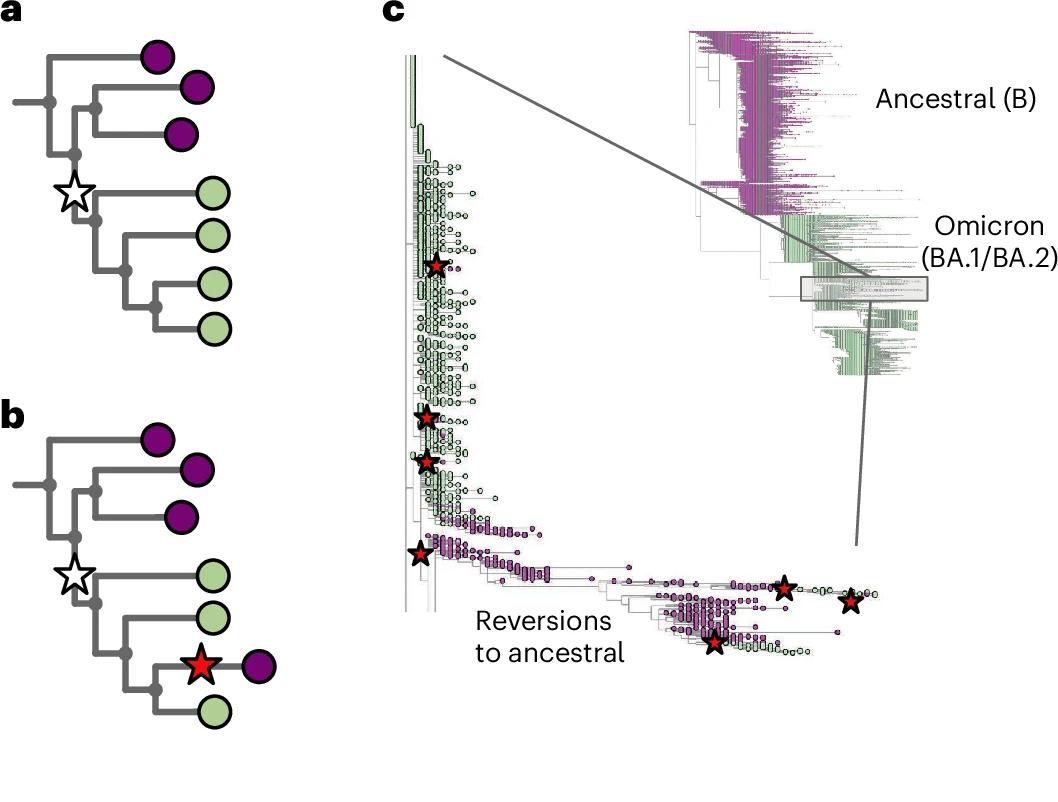
In Fig. 1a we show part of a tree with the leaves colored to show what base that genome has at a specific position (purple for the ancestral base and green for the derived (new) base caused by a mutation shown as a white star). One single mutation explains that data. In Fig. 1b we show the impact of wrongly assigning the ancestral base at the lowest-but-one leaf (fourth purple down). Here, the most parsimonious way to explain this is with a second mutation (red star) ‘reverting’ back to the ancestral purple. In Fig. 1c we show part of
the global SARS-CoV-2 phylogeny hosted at taxonium. org (accessed 9 April 2024), zoomed in to show where Omicron branches from the ancestor. Leaves are colored by the genotype of genome position 22813 (codon 417) in the spike gene (again purple is ancestral). In the blow-up we see within the green (Omicron) clade, a striking spray of purple that does not sit cleanly in any subclade. Patterns like this, caused by systematic assembly errors, have been previously shown to occur in the SARS-CoV-2 phylogeny1. Such errors can have a considerable effect on our inferences about the underlying biology—in this case, K417N is a mutation that affects antibody escape7 and systematic errors like this can lead to misinterpretation. However, although one can use a reversion count as a metric of whether we suspect there are assembly problems, reversions are not always errors. For example, SARSCoV-2 has a C-to-T mutation bias (strictly a C-to-U, as it is an RNA virus, but we convert to DNA space for phylogenetics), so if you have a T to C mutation on a phylogenetic branch leading to a large clade, you may expect to see multiple reversions back to T in that clade.
There are several other possible technical artifacts that can arise (for example, primer dimers, interactions between amplicons or primers binding in noncanonical sites), which should be expected and handled, otherwise additional errors will result. Unfortunately,
these errors often correlated with individual sequencing centers, which themselves correlated with local prevalence of particular lineages at particular times. In addition, where amplicon dropout was incomplete, the likelihood of wrongly imputing the reference genome at a particular position becomes a function of decreasing amounts of sample RNA, creating a false relationship between genotype and viral load.
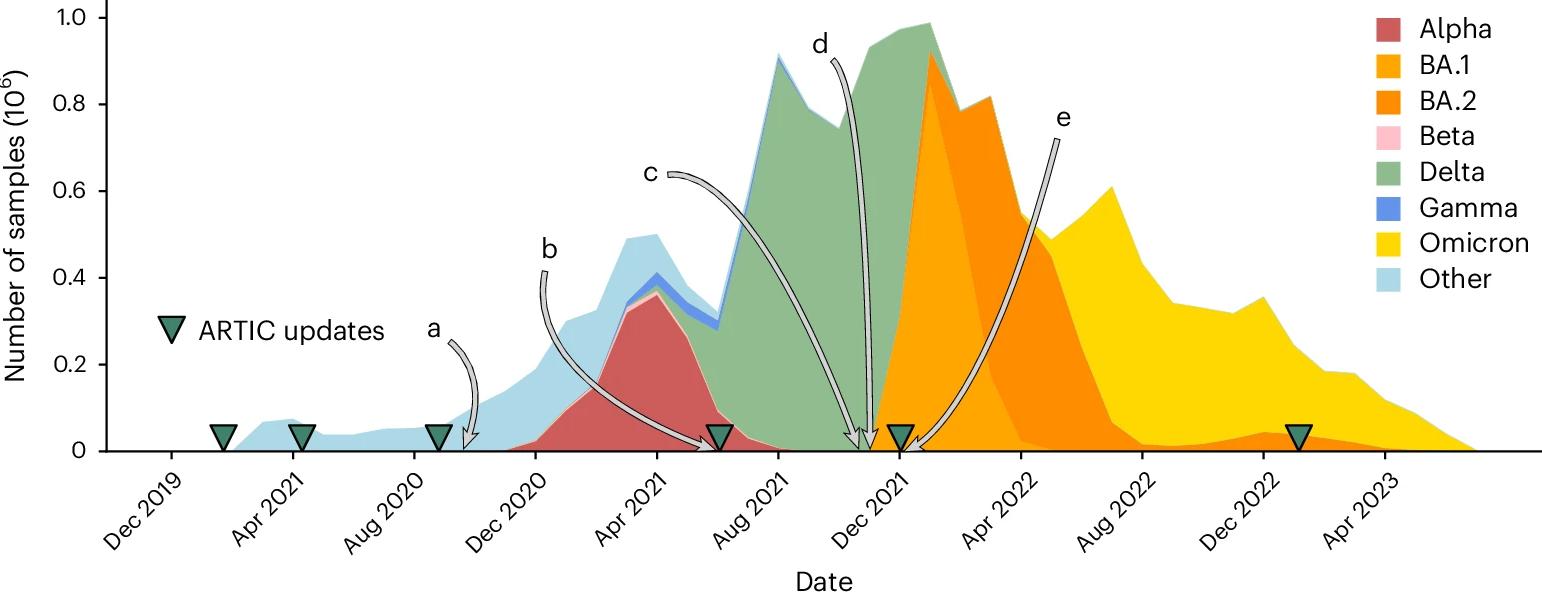
Because of amplicon dropouts, as the pandemic progressed and sequential waves of variants of concern (VOCs) arose, the ARTIC primer scheme was updated multiple times to restore amplification, as well as a slew of alternative options (for example, Midnight, AmpliSeq (Thermo Fisher Scientific) and VarSkip; https://github.com/nebiolabs/VarSkip). Each VOC wave brought mutations in primer bindings sites leading to amplicon dropouts, and a subsequent wave of artifacts in genomes as these were mishandled (Fig. 2). New amplicon schemes were then introduced, and gradually taken up, solving previous dropout problems, but also followed by smaller waves of new artifacts in the genomes, sometimes caused by primers not being correctly trimmed and being incorporated into assemblies. It is no exaggeration to say that since this issue was first raised, thousands of person-hours of time have been spent manually looking through trees and genomes trying to decide whether strange phenomena are artifacts or not. Some of the authors have been maintaining the global phylogenetic tree of SARS-CoV-2 since 2021, and the only way we have
been able to maintain the integrity of the tree has been to (1) completely mask 150 nucleotide positions in the genome, as they are systematically too often wrong to ever be trusted, and (2) systematically mask (ignore) certain mutations on specific branches of the tree. As artifacts ebbed and flowed, and were discovered by analysts, the masking had to be updated (Fig. 2). After the mammoth global efforts to sequence and collate these SARS-CoV-2 genomes, the richest dataset of any pathogen to date, it is critical to now reprocess and clean these data, providing a firm foundation for future discoveries.
As of June 2024, there were approximately 6 million SARS-CoV-2 raw sequence datasets deposited in the European Nucleotide Archive (ENA)/Sequence Read Archive (SRA), very few of which had metadata recording the primer scheme and the assembly pipeline used (data from COG-UK being a notable but geographically localised exception). In this paper we will describe our amplicon-aware assembly and QC processes, with which we reprocessed these genomes and measured the improvements in the genomes and phylogeny, and provide these data as a resource for the whole community.
*For a closer look at the results, and to read the full publication, visit: https://www.nature.com/articles/s41592-02502947-1