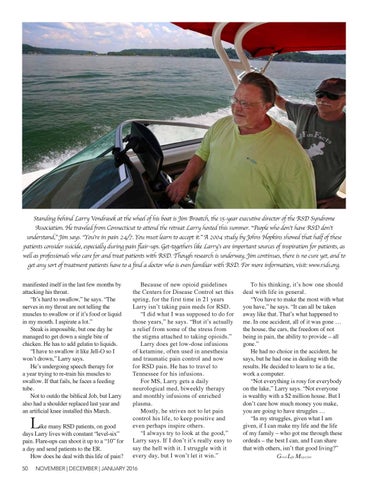
Standing behind Larry Vondrasek at the wheel of his boat is Jim Broatch, the 15-year executive director of the RSD Syndrome Association. He traveled from Connecticut to attend the retreat Larry hosted this summer. “People who don’t have RSD don’t understand,” Jim says. “You’re in pain 24/7. You must learn to accept it.” A 2004 study by Johns Hopkins showed that half of these patients consider suicide, especially during pain flair-ups. Get-togethers like Larry’s are important sources of inspiration for patients, as well as professionals who care for and treat patients with RSD. Though research is underway, Jim continues, there is no cure yet, and to get any sort of treatment patients have to a find a doctor who is even familiar with RSD. For more information, visit: www.rsds.org. manifested itself in the last few months by attacking his throat. “It’s hard to swallow,” he says. “The nerves in my throat are not telling the muscles to swallow or if it’s food or liquid in my mouth. I aspirate a lot.” Steak is impossible, but one day he managed to get down a single bite of chicken. He has to add gelatin to liquids. “I have to swallow it like Jell-O so I won’t drown,” Larry says. He’s undergoing speech therapy for a year trying to re-train his muscles to swallow. If that fails, he faces a feeding tube. Not to outdo the biblical Job, but Larry also had a shoulder replaced last year and an artificial knee installed this March.
L
ike many RSD patients, on good days Larry lives with constant “level-six” pain. Flare-ups can shoot it up to a “10” for a day and send patients to the ER. How does he deal with this life of pain? 50
Because of new opioid guidelines the Centers for Disease Control set this spring, for the first time in 21 years Larry isn’t taking pain meds for RSD. “I did what I was supposed to do for those years,” he says. “But it’s actually a relief from some of the stress from the stigma attached to taking opioids.” Larry does get low-dose infusions of ketamine, often used in anesthesia and traumatic pain control and now for RSD pain. He has to travel to Tennessee for his infusions. For MS, Larry gets a daily neurological med, biweekly therapy and monthly infusions of enriched plasma. Mostly, he strives not to let pain control his life, to keep positive and even perhaps inspire others. “I always try to look at the good,” Larry says. If I don’t it’s really easy to say the hell with it. I struggle with it every day, but I won’t let it win.”
NOVEMBER | DECEMBER | JANUARY 2016
To his thinking, it’s how one should deal with life in general. “You have to make the most with what you have,” he says. “It can all be taken away like that. That’s what happened to me. In one accident, all of it was gone … the house, the cars, the freedom of not being in pain, the ability to provide – all gone.” He had no choice in the accident, he says, but he had one in dealing with the results. He decided to learn to tie a tie, work a computer. “Not everything is rosy for everybody on the lake,” Larry says. “Not everyone is wealthy with a $2 million house. But I don’t care how much money you make, you are going to have struggles … “In my struggles, given what I am given, if I can make my life and the life of my family – who got me through these ordeals – the best I can, and I can share that with others, isn’t that good living?” Good Life Magazine