Community Service
Former Parent Profile
Yvon Chouinard Setting an Environmental High-Water Mark
by Jane D. McCarthy
eek. Dirt Bag. Fun Hog. Vagabond Out- Working with suppliers to develop more envidoorsman. Blacksmith. Deep Ecologist. ronmental-friendly products and components, including dyes; Nitpicker. Accidental Capitalist.
G
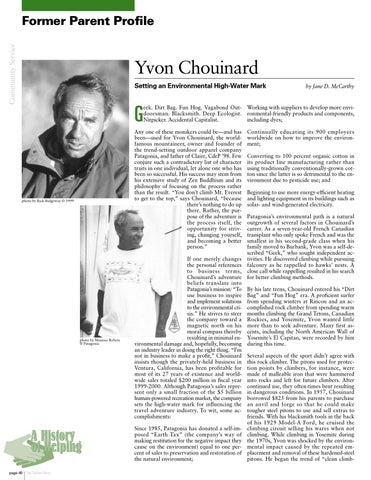
Any one of these monikers could be—and has been—used for Yvon Chouinard, the worldfamous mountaineer, owner and founder of the trend-setting outdoor apparel company Patagonia, and father of Claire, CdeP ’98. Few conjure such a contradictory list of character traits in one individual, let alone one who has been so successful. His success may stem from his extensive study of Zen Buddhism and its philosophy of focusing on the process rather than the result. “You don’t climb Mt. Everest to get to the top,” says Chouinard, “because there’s nothing to do up there. Rather, the purpose of the adventure is the process itself, the opportunity for striving, changing yourself, and becoming a better person.”
photo by Rick Ridgeway © 1999
photo by Maurice Rebeix © Patagonia
A History of Helping page 40
The Thacher News
Continually educating its 900 employees worldwide on how to improve the environment; Converting to 100 percent organic cotton in its product line manufacturing rather than using traditionally conventionally-grown cotton since the latter is so detrimental to the environment due to pesticide use; and Beginning to use more energy-efficient heating and lighting equipment in its buildings such as solar- and wind-generated electricity.
Patagonia’s environmental path is a natural outgrowth of several factors in Chouinard’s career. As a seven-year-old French Canadian transplant who only spoke French and was the smallest in his second-grade class when his family moved to Burbank, Yvon was a self-described “Geek,” who sought independent acIf one merely changes tivities. He discovered climbing while pursuing the personal references falconry as he rappelled to hawks’ nests. A to business terms, close call while rappelling resulted in his search Chouinard’s adventure for better climbing methods. beliefs translate into Patagonia’s mission: “To By his late teens, Chouinard entered his “Dirt use business to inspire Bag” and “Fun Hog” era. A proficient surfer and implement solutions from spending winters at Rincon and an acto the environmental cri- complished rock climber from spending warm sis.” He strives to steer months climbing the Grand Tetons, Canadian the company toward a Rockies, and Yosemite, Yvon wanted little magnetic north on his more than to seek adventure. Many first asmoral compass thereby cents, including the North American Wall of resulting in minimal en- Yosemite’s El Capitan, were recorded by him vironmental damage and, hopefully, becoming during this time. an industry leader in doing the right thing. “I’m not in business to make a profit,” Chouinard Several aspects of the sport didn’t agree with insists though the privately-held business in this rock climber. The pitons used for protecVentura, California, has been profitable for tion points by climbers, for instance, were most of its 27 years of existence and world- made of malleable iron that were hammered wide sales totaled $200 million in fiscal year into rocks and left for future climbers. After 1999-2000. Although Patagonia’s sales repre- continued use, they often-times bent resulting sent only a small fraction of the $5 billion in dangerous conditions. In 1957, Chouinard human-powered recreation market, the company borrowed $825 from his parents to purchase sets the high-water mark for influencing the an anvil and forge so that he could make travel adventure industry. To wit, some ac- tougher steel pitons to use and sell extras to friends. With his blacksmith tools in the back complishments: of his 1929 Model-A Ford, he cruised the Since 1985, Patagonia has donated a self-im- climbing circuit selling his wares when not posed “Earth Tax” (the company’s way of climbing. While climbing in Yosemite during making restitution for the negative impact they the 1970s, Yvon was shocked by the environcause on the environment) equal to one per- mental impact caused by the repeated emcent of sales to preservation and restoration of placement and removal of these hardened-steel pitons. He began the trend of “clean climbthe natural environment;