More often it worked like this: when Allen’s pickers found an “old” house with stained glass windows they would knock on the door and offer to buy the “old, leaky, faded out” leaded glass windows for a few dollars and to replace them with new, clear, aluminum sash windows. It worked like a charm. “Through a lot of dirty work and extraordinary good tim-
for the most part an un-alloyed lead that possesses a lifespan of 80 to 100 years. Thus, by the 1970’s and 1980’s, virtually all of the vintage leaded glass windows, doors, and ceilings created during the golden age of American stained glass were due to be restored. The time was auspicious for the emergence of a fledgling glass restoration firm.
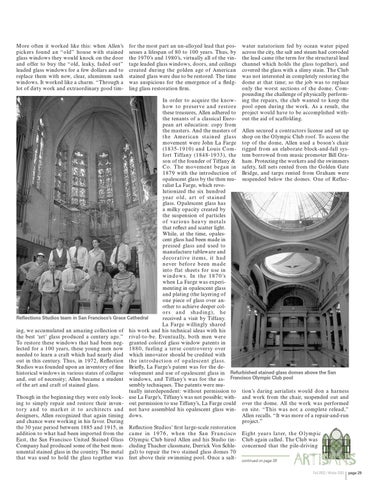
water natatorium fed by ocean water piped across the city, the salt and steam had corroded the lead came (the term for the structural lead channel which holds the glass together), and covered the glass with a slimy stain. The Club was not interested in completely restoring the dome at that time; so the job was to replace only the worst sections of the dome. Compounding the challenge of physically performing the repairs, the club wanted to keep the pool open during the work. As a result, the project would have to be accomplished without the aid of scaffolding.
In order to acquire the knowhow to preserve and restore these treasures, Allen adhered to the tenants of a classical European art education: copy from the masters. And the masters of Allen secured a contractors license and set up the American stained glass shop on the Olympic Club roof. To access the movement were John La Farge top of the dome, Allen used a boson’s chair (1835-1910) and Louis Com- rigged from an elaborate block-and-fall sysfort Tiffany (1848-1933), the tem borrowed from music promoter Bill Grason of the founder of Tiffany & ham. Protecting the workers and the swimmers Co. The movement began in safety, fall nets rented from the Golden Gate 1879 with the introduction of Bridge, and tarps rented from Graham were opalescent glass by the then mu- suspended below the domes. One of Reflecralist La Farge, which revolutionized the six hundred year old, art of stained glass. Opalescent glass has a milky opacity created by the suspension of particles of various heavy metals that reflect and scatter light. While, at the time, opalescent glass had been made in pressed glass and used to manufacture tableware and decorative items, it had never before been made into flat sheets for use in windows. In the 1870’s when La Farge was experimenting in opalescent glass and plating (the layering of one piece of glass over another to achieve deeper colors and shading), he Reflections Studios team in San Francisco’s Grace Cathedral received a visit by Tiffany. La Farge willingly shared ing, we accumulated an amazing collection of his work and his technical ideas with his the best ‘art’ glass produced a century ago.” rival-to-be. Eventually, both men were To restore these windows that had been neg- granted colored glass window patents in lected for a 100 years, these young men now 1880, fueling a terse controversy over needed to learn a craft which had nearly died which innovator should be credited with out in this century. Thus, in 1972, Reflection the introduction of opalescent glass. Studios was founded upon an inventory of fine Briefly, La Farge’s patent was for the dehistorical windows in various states of collapse velopment and use of opalescent glass in Refurbished stained glass domes above the San and, out of necessity; Allen became a student windows, and Tiffany’s was for the as- Francisco Olympic Club pool sembly techniques. The patents were muof the art and craft of stained glass. tually interdependent: without permission to tion’s daring aerialists would don a harness Though in the beginning they were only look- use La Farge’s, Tiffany’s was not possible; with- and work from the chair, suspended out and ing to simply repair and restore their inven- out permission to use Tiffany’s, La Farge could over the dome. All the work was performed tory and to market it to architects and not have assembled his opalescent glass win- on site. “This was not a complete relead,” designers, Allen recognized that again timing dows. Allen recalls. “It was more of a repair-and-run and chance were working in his favor. During project.” the 30 year period between 1885 and 1915, in Reflection Studios’ first large-scale restoration addition to what had been imported from the came in 1976, when the San Francisco Eight years later, the Olympic East, the San Francisco United Stained Glass Olympic Club hired Allen and his Studio (in- Club again called. The Club was Company had produced some of the best mon- cluding Thacher classmate, Derrick Von Schle- concerned that the pile-driving umental stained glass in the country. The metal gal) to repair the two stained glass domes 70 that was used to hold the glass together was feet above their swimming pool. Once a salt- continued on page 39 Fall 2002 / Winter 2003
page 29