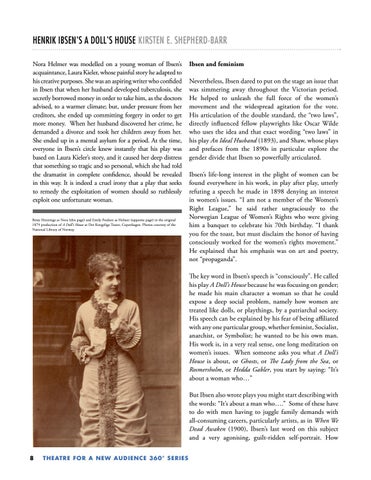
HENRIK IBSEN'S A DOLL'S HOUSE KIRSTEN E. SHEPHERD-BARR Nora Helmer was modelled on a young woman of Ibsen’s acquaintance, Laura Kieler, whose painful story he adapted to his creative purposes. She was an aspiring writer who confided in Ibsen that when her husband developed tuberculosis, she secretly borrowed money in order to take him, as the doctors advised, to a warmer climate; but, under pressure from her creditors, she ended up committing forgery in order to get more money. When her husband discovered her crime, he demanded a divorce and took her children away from her. She ended up in a mental asylum for a period. At the time, everyone in Ibsen’s circle knew instantly that his play was based on Laura Kieler’s story, and it caused her deep distress that something so tragic and so personal, which she had told the dramatist in complete confidence, should be revealed in this way. It is indeed a cruel irony that a play that seeks to remedy the exploitation of women should so ruthlessly exploit one unfortunate woman. Betty Hennings as Nora (this page) and Emily Poulsen as Helmer (opposite page) in the original 1879 production of A Doll's House at Det Kongelige Teater, Copenhagen. Photos courtesy of the National Library of Norway.
Ibsen and feminism Nevertheless, Ibsen dared to put on the stage an issue that was simmering away throughout the Victorian period. He helped to unleash the full force of the women’s movement and the widespread agitation for the vote. His articulation of the double standard, the “two laws”, directly influenced fellow playwrights like Oscar Wilde who uses the idea and that exact wording “two laws” in his play An Ideal Husband (1893), and Shaw, whose plays and prefaces from the 1890s in particular explore the gender divide that Ibsen so powerfully articulated. Ibsen’s life-long interest in the plight of women can be found everywhere in his work, in play after play, utterly refuting a speech he made in 1898 denying an interest in women’s issues. “I am not a member of the Women’s Right League,” he said rather ungraciously to the Norwegian League of Women’s Rights who were giving him a banquet to celebrate his 70th birthday. “I thank you for the toast, but must disclaim the honor of having consciously worked for the women’s rights movement.” He explained that his emphasis was on art and poetry, not “propaganda”. The key word in Ibsen’s speech is “consciously”. He called his play A Doll’s House because he was focusing on gender; he made his main character a woman so that he could expose a deep social problem, namely how women are treated like dolls, or playthings, by a patriarchal society. His speech can be explained by his fear of being affiliated with any one particular group, whether feminist, Socialist, anarchist, or Symbolist; he wanted to be his own man. His work is, in a very real sense, one long meditation on women’s issues. When someone asks you what A Doll’s House is about, or Ghosts, or The Lady from the Sea, or Rosmersholm, or Hedda Gabler, you start by saying: “It’s about a woman who…” But Ibsen also wrote plays you might start describing with the words: “It’s about a man who….” Some of these have to do with men having to juggle family demands with all-consuming careers, particularly artists, as in When We Dead Awaken (1900), Ibsen’s last word on this subject and a very agonising, guilt-ridden self-portrait. How
8
T HEAT RE F O R A N E W A UD I E N C E 3 60 ° S E RIE S