EDITORIAL LETTER
Message from the
Executive Director C
limate change is a latent threat for the world and is present everywhere, regardless of those who don’t acknowledge it as a threat. Some countries seek to adapt to the effects of climate change and mitigate it with agreements such as the Paris Climate Agreement; but what about the vulnerable species that depend directly on temperatures, like reptiles? When discussing climate change and mitigation actions, the subject of carbon credits comes up. While they are indeed the result of a natural process that has always been ongoing, they represent the participation of nature in the economic outlook. Voluntary carbon credits have been operating in Mexico for a few years now. These are payment of environmental services that companies fulfill to compensate their CO2 productions. However, these credits are not included in the regulated market by Mexican Stock Exchange. This is about to change and it will offer a window of opportunities for companies to formalize their commitment to sustainability. The forest extension in Sierra San Pedro Martir is an important carbon sink; in the case of San Quintin Bay, the wetlands capture even more carbon than the forests. The areas we protect in San Quintin Bay are naturally highly productive, but with the intervention and conservation actions of Terra Peninsular, we will guarantee the increase of the quantity of captured carbon and the environmental services provided by the bay. Hence the importance of continuing the conservation of natural areas like Sierra San Pedro Martir and San Quintin Bay.
César Guerrero
The vision we have for a near future is the professionalization of our monitoring and carbon capture measurements to take part in the regulation of carbon credits. This is the reason why we keep our interest in collaborating with formal research centers like CICESE, UABC, UNAM, CIBNOR and SDSU, to mention a few. These collaborations justify our “Ponte Guapo!” fundraising campaign that seeks to prepare the nature reserves so they can receive more students and researchers. In the pages of this issue of Mediterranews, you will learn about the research project conducted by CIBNOR in the Punta Mazo Nature Reserve to evaluate reptile vulnerability and climate change mitigation actions that have been taken for these species; the admirable conservation work that Sierra San Pedro Martir National Park has been doing for 70 years and the research carried out by CICESE and California University scientists in the San Quintin Bay about carbon capture that Zostera marina ecosystems do. As well as other interesting subjects.
Have a great reading!
César Guerrero Executive Director of Terra Peninsular
AUGUST 2017 02
CONTENTS
Contents TERRA NEWS ¡PONTE GUAPO! Learn about our fundraising campaign
05
2017 Waterkeeper Alliance Conference
09
FLORA
Blue carbon and its value for society
11
TERRA MOMENT Shorebird monitoring in Ensenada
21
TERRA FACTS Valle Tranquilo Nature Reserve
25
ENVIRONMENTAL DATES AND EVENTS
27
TERRA ACTIONS
SPECIAL ARTICLE Sierra San Pedro Mártir National Park celebrates 70th anniversary
FAUNA Reptiles and climate change
13
A-Z
How to separate your waste correctly?
28
GLOSSARY
29
20
Mediterranews is a free publication distributed in February, April, June, August and December by Terra Peninsular, a non-profit environmental organization that works in Baja California since 2001. Address: Calle Tercera 1282, Zona Centro, 22800. Ensenada, Baja California, México. 03 MEDITERRANEWS
Read and download the digital version of this newsletter on
www.terrapeninsular.org/en/ @TerraPeninsular @terrapeninsular @TerraPeninsular
CREDITS
CREDITS COVER PHOTO Aspens (Populus tremuloides) on the side of the road in the national park. Photo: Daniela López. EDITOR-IN-CHIEF Bárbara Ramírez MANAGING EDITOR Antonieta Valenzuela ART AND DESIGN Laura Tamayo EDITORIAL BOARD César Guerrero Mauricio Guerrero Alan Harper WRITERS Patricia Galina Andrew Gray Rafael A. Lara Felipe O. León Keith Lombardo Daniela López Fausto R. Méndez Bárbara Ramírez Jorge H. Valdez Antonieta Valenzuela Jonathan Vargas Elizabeth Watson TRANSLATION Marianna Gámez Bárbara Ramírez Antonieta Valenzuela
For more information or subscription inquiries, please contact info@terrapeninsular.org
AUGUST 2017
04
TERRA NEWS
Learn about our fundraising campaign By Bárbara Ramírez
I
magine a natural area where you can camp at night and sleep under the stars, surf the Pacific waves at sunrise, learn about the flora and fauna of the region, take a workshop of nature photography, bird watching and hiking. These are some of the activities that can be done in the nature reserves managed by Terra Peninsular in San Quintin Bay.
Punta Mazo Nature Reserve
Terra Peninsular protects and manages up to 4,000 acres in Monte Ceniza and Punta Mazo nature reserves located within the San Quintin Lagoon Complex, in addition to the 9,000 acres of the Valle Tranquilo Nature Reserve. The landscapes and biodiversity found in these areas represent a natural heritage for all Mexicans, and it is everyone’s job to protect them. This is why at Terra Peninsular we would like you to visit the reserves, learn about its flora, fauna and the importance of its conservation, and be part of the protection efforts. For this reason, we want to have a space to receive researchers and schools to carry out their projects in the reserves and promote the importance and ecological and cultural value of San Quintin Bay.
Punta Mazo Nature Reserve 05 MEDITERRANEWS
4035
acres protected in San Quintin Bay
TERRA NEWS
To achieve all of this, we created our campaign:
Brigham Young University studied lichens in the Punta Mazo Nature Reserve.
Associated researchers of the Cabrillo National Monument visited the Punta Mazo Nature Reserve to explore the intertidal rocky shore and search for Black Abalone (Haliotis cracherodii). Photo: Michael Ready.
AUGUST 2017
06
TERRA NEWS
Last year, we collaborated in research projects with: National Institute of Anthropology and History of Mexico National School of Anthropology and History of Mexico Brigham Young University University of Leeds National Autonomous University of Mexico Cabrillo National Monument University of Baja California Northwest Biological Research Center University of California Center for Scientific Research and Higher Education of Ensenada
Internship program students from Biology UNAM work on a project to study the rocky intertidal shore of the Punta Mazo Nature Reserve.
HOW TO JOIN THE TRANSFORMATION? We know that this is a very ambitious project and to do this we need your help. Please contact us if you would like to know more about our fundraising campaign. You can make your tax-deductible contribution from our website: www.terrapeninsular.org/en/
Subscribe to our mailing list on the website and follow us on social media to follow the progress of this project!
07 MEDITERRANEWS
The College of Professional Architects of Ensenada and Architecture students from Xochicalco and CUT visited the interpretive trails and stations in San Quintin Bay together with the Terra Peninsular team.
TERRA NEWS
Waterkeeper Alliance is a global movement that unites more than 300 organizations around the world to ensure clean water. Architects and students during a guided visit in San Quintin Bay.
Terra Peninsular has been a member of the Waterkeeper Alliance since 2016 with the program Waterkeeper San Quintin Bay As a Waterkeeper member, Terra Peninsular is committed to: - Monitor different sites in San Quintin Bay using protocols already established by other organizations that are also part of the Waterkeeper Alliance in Baja California. - Patrol the bay area to detect environmental irregularities and present them to the according authorities. - Publish the monitoring program results on the Swim Guide website.
Archaeologist of the National Institute of Anthropology and History of Mexico and students identified 37 archaeological sites in the nature reserves protected by Terra Peninsular.
The Waterkeeper San Quintin Bay program seeks to involve local communities to ensure that the activities in the bay are carried out in a sustainable way and conserving natural resources, as well as to guarantee clean water that allows healthy habitats for wildlife and the development of aquatic activities, such as fishing and oyster farming.
Archaeologist in the Monte Ceniza Nature Reserve. AUGUST 2017
08
TERRA NEWS
2017 WATERKEEPER Alliance conference
O
ver 300 people from 300 organizations and 35 countries participated in the international Waterkeeper Alliance Conference. Including Latin American organizations from Mexico, Colombia, Brasil and Chile to name a few.
The annual event was held in Deer Valley, Utah, USA from June 7 to 11, 2017. The Executive Director, César Guerrero, and the Field and Operations Officer, Enrique Alfaro, attended the conference as Terra Peninsular’s representatives. Terra Peninsular is a member of Waterkeeper Alliance since 2016 through the program San Quintín Bay Waterkeeper, which seeks to monitor the water quality to guarantee a clean bay to make productive and recreational activities. The Baja Waterkeepers of Baja California and Baja California Sur were also in the event: Tijuana, Bahia de Los Angeles, Santa Rosalia, Los Cabos, Todos Santos, Loreto, La Paz, Bahía Magdalena and Cabo Pulmo.
Donate online to the Baja California Waterkeeper fund:
http://donate.icfdn.org/#npo/waterkeepers-baja-californias-regional-fund
Photo: John Wathen
09 MEDITERRANEWS
FLORA
Blue carbon
and its value for society By Andrew Gray and Elizabeth Watson
“
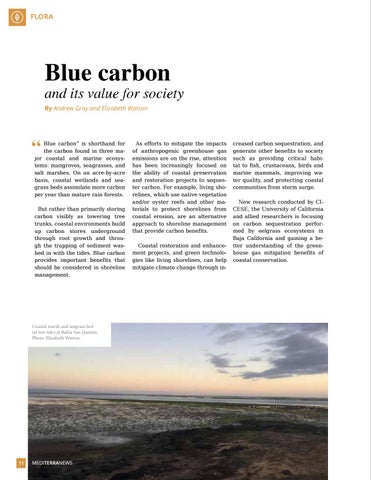
Blue carbon” is shorthand for the carbon found in three major coastal and marine ecosystems: mangroves, seagrasses, and salt marshes. On an acre-by-acre basis, coastal wetlands and seagrass beds assimilate more carbon per year than mature rain forests. But rather than primarily storing carbon visibly as towering tree trunks, coastal environments build up carbon stores underground through root growth and through the trapping of sediment washed in with the tides. Blue carbon provides important benefits that should be considered in shoreline management.
Coastal marsh and seagrass bed (at low tide) at Bahía San Quintín. Photo: Elizabeth Watson.
11
MEDITERRANEWS
As efforts to mitigate the impacts of anthropogenic greenhouse gas emissions are on the rise, attention has been increasingly focused on the ability of coastal preservation and restoration projects to sequester carbon. For example, living shorelines, which use native vegetation and/or oyster reefs and other materials to protect shorelines from coastal erosion, are an alternative approach to shoreline management that provide carbon benefits. Coastal restoration and enhancement projects, and green technologies like living shorelines, can help mitigate climate change through in-
creased carbon sequestration, and generate other benefits to society such as providing critical habitat to fish, crustaceans, birds and marine mammals, improving water quality, and protecting coastal communities from storm surge. New research conducted by CICESE, the University of California and allied researchers is focusing on carbon sequestration performed by eelgrass ecosystems in Baja California and gaining a better understanding of the greenhouse gas mitigation benefits of coastal conservation.
FLORA
Volcano marsh. Photo: Elizabeth Watson.
tant insights into dynamic natural processes and coastal geomorphology. We plan to publish the results of this research in an academic journal soon. Collection of sediment core samples. Photo: Elizabeth Watson.
One important area of focus for us is on the implications of changing climate to carbon sequestration in eelgrass beds. Eelgrass is at the most southern part of its range in Baja California and there is some evidence that warming conditions is causing its decline. What happens to carbon sequestered in sediments that are no longer stabilized by seagrass beds? Does it remain sequestered? Or is it reworked and mineralized back to atmospheric carbon dioxide? Our research team has also looked at carbon sequestration in Baja California wetlands and how changes in the extent of coastal wetlands in the state might influence carbon storage. We have found that the wetlands in Baja California are highly pristine compared to coastal wetlands in the United States, and most other regions of Mexico. Our analysis of historical aerial photographs thus provides impor-
This research represents a unique collaboration between scientists with CICESE and University of California researchers that is focused on coastal blue carbon, an emerging global nexus of environmental scien-
ce, conservation, and policy. Our goals are to expand understanding of carbon sequestration occurring in Baja California lagoons and to raise awareness of the greenhouse gas mitigation benefits of coastal habitats.
ABOUT THE AUTHORS Elizabeth Watson Elizabeth is an assistant professor of environmental sciences and the Wetland Section Leader at the Patrick Center for Environmental Research at the Academy of Natural Sciences in Philadelphia, Pennsylvania. She lived in Ensenada and studied Baja California wetlands at CICESE from 2008 to 2009. E-mail: ebw49@drexel.edu Andrew Gray Andrew is an assistant professor of environmental sciences at the Environmental Sciences Department of the University of California Riverside. E-mail: Andrew.gray@ucr.edu
12 AUGUST 2017 10
SPECIAL ARTICLE
70 09 MEDITERRANEWS 13
Sierra San Pedro Martir National Park celebrates
th anniversary By Daniela Lรณpez and Felipe O. Leรณn
SPECIAL ARTICLE ARTร CULO ESPECIAL
Overview from the fire watchtower known as Torre de Piedra during the summer. Photo: Felipe Leรณn.
AUGUST 2017 14 10
SPECIAL ARTICLE
A
rchaeological evidence shows that nomadic hunter tribes inhabited the region 10,000 years ago. Nowadays, it is known that the Kiliwa tribes inhabited the forest during the good seasons of the year (spring, summer and part of autumn), since the winter in these 6,561.6 feet-high mountains is too harsh: the coldest temperature recorded is -18.4°F. The Kiliwa were a nomadic tribe that, during these seasons, came to the forests to hunt deers, rabbits and other animals, as well as to collect seeds, particularly pine nuts, which they used to prepare atole (cornflower drink), among other things. During the Spanish colonization in Mexico, explorers such as Francisco de Ulloa and Eusebio Kino registered the sighting of great snowed mountain ranges and reported about them from the shoreline or the sea, mentioning the white peaks of our mountains. It was in 1766 when the Jesuit monk, Wenceslao Link, left the San Borja Mission and entered deep into our national park. In his diary, Wenceslao Link mentioned they met with other tribes who spoke a different language from the Cochimi tribe that accompanied them. Once the Jesuit order was expelled, the Dominican continued the evangelization and founded a mission in the south of the park named in honor of Saint Peter Martyr of Verona; and therefore, our mountain range received the same name. At the beginning of the 20th century, the inhabitants of the region took an economical interest on the forest due to the great amount of timber resources within it, but by presidential decree and to remove validity to certain exploitation agreements, it was declared a Natural Protected Area on February 21st of 1947 in the category of National Park for flora and fauna conservation. This designation was made official in April of the same year.
15
MEDITERRANEWS
La Grulla is an area in the center of the natural protected area where endemic species can be found, such as the California red-legged frog (Rana draytonii) and the Baja California rainbow trout (Oncorhynchus mykiss nelsoni). Photo: Felipe Léon.
70 years after its designation, the coordinator of the Sierra San Pedro Martir National Park, Gonzalo de León Girón, expresses: “The objective is clear: biodiversity conservation. The journey to achieve it is complicated, but counting on the commitment of the staff, society and institutions, Sierra San Pedro Martir National Park will be conserved and admired for many Baja Californian generations.”
WHY IS IT IMPORTANT? In this forest rain falls during summer and it snows in winter, with an annual average of 4.14 billion cubic feet of water that supplies the main watersheds in the region. Also, the great number of trees within the area of 281.5 square miles of this park captures large amounts of carbon emissions; these two are the main services the mountain ecosystem gives us. Additionally, the site is a habitat for unique species in the world, for both plants and animals. To this moment, 142 species have been described, among which the following stand out: incense cedar (Calocedrus decurrens), Jeffrey’s pine (Pinus jeffreyi), quaking aspen (Populus tremuloides), sugar pine (Pinus lambertiana) and lodgepole pine (Pinus contorta). Regarding fauna, the Sierra San Pedro Mártir National Park is home to several protected
SPECIAL ARTICLE
Mearns’s squirrel (Tamiasciurus mearnsi). Photo: Felipe León
AUGUST 2017 16
SPECIAL ARTICLE
flagship species, such as the California condor (Gymnogyps californianus) and the golden eagle (Aquila chrysaetos); as well as a great number of endemic species like the Mearns’s squirrel (Tamiasciurus mearnsi) and the mountain quail (Oreortyx pictus). It is also a refuge for big mammals such as the mule deer (Odocoileus hemionus), the peninsular bighorn sheep (Ovis canadensis cremnobates) and the puma (Puma concolor). Likewise, the Sierra San Pedro Mártir National Park is considered the third-best location for astronomical observation. This due to the low light pollution from the surrounding cities and, also, because the weather allows clear-sky nights. For this reason, the Autonomous National University of Mexico (UNAM in Spanish) decided to build there telescopes in the 70’s, which provide relevant information about the outer space. Currently, the National Commission of Natural Protected Areas (CONANP in Spanish) and the government of Baja California co-manage the national park and perform conservation actions, such as: monitoring of medium-sized mammals and endemic species, as well as the consolidation of the California condor reintroduction program. A work team has been formed with forest rangers and technicians who conduct the prevention and firefighting program, visitors´ service and surveillance against environmental crimes.
The California Condor (Gymnogyps californianus) is a priority species for conservation in Mexico. Photo: Felipe León.
On your next visit to this wonderful natural protected area stop by the Semeel Jak Culture and Natural History Museum (located in the park) and ask for a forest ranger for a guided tour to learn more about the characteristics and importance of the Sierra San Pedro Martir National Park.
17 09 MEDITERRANEWS
Mule deer (Odocoileus hemionus), a protected species that moves through our forest. Photo: Felipe León.
ARTÍCULO SPECIAL ARTICLE ESPECIAL
ABOUT THE AUTHORS Daniela López Acosta Daniela is a biologist graduated from the Sciences Faculty of the University of Baja California (UABC) specialized in Fauna Resources Management, she has a Master’s Degree in Natural Resources Use, Management and Conservation Sciences and specialized in Arid Zone Ecology from the Northwestern Center of Biological Research (CIBNOR in Spanish). She has professional experience in the native flora and fauna of Baja California, with a focus in flora and reptiles. She currently works in Pronatura Noroeste —a nonprofit organization— where she manages funds, coordinates conservation projects and execute productive projects in different communities in northwestern Mexico. Email: daniela.la55@gmail.com
Aspens (Populus tremuloides) on the side of the road in our national park. Photo: Daniela López.
Coyotes (Canis latrans) in the snow. Photo: Felipe León.
Entrance to the national park in the winter. Photo: Felipe León.
Felipe Otoniel León Ángel He graduated from the Sciences Faculty of the University of Baja California with a degree in Biology. He worked in the reintroduction project of the California condor in Sierra San Pedro Martir, and he also collaborated with UABC in a species sampling manual of hunting interest for the government of Baja California. Currently, he is a forest ranger in the Sierra San Pedro Martir National Park where he provides environmental education, among other tasks. He was also part of the Mexican delegation in the World Ranger Congress of 2016 in Colorado, U.S.A. Felipe is a certified photographer from UABC and nowadays he is sponsored by Idea Wild to capture images for dissemination and conservation of the national park. Email: leon195@gmail.com
AUGUST 2017 18 10
TERRA MOMENT
Bird monitoring in
Ensenada By Jonathan Vargas
Snowy plover (Charadrius nivosus).
By the end of June, a bird monitoring was performed in Estero de Punta Banda, in Ensenada, by Jonathan Vargas, Jorge Andrade and Laura Tamayo, staff members of Terra Peninsular. The team observed active nests, copulation and courtship activities, as well as some shorebirds defending their nests. They also watched marked Least Terns (Sternula antillarum) probably from California, as well as banded Snowy Plover (Charadrius nivosus) and four families with chicks between 1 and 4 weeks old. The amount of disturbance on that beach is a concern. Even when it is not allowed the entrance of vehicles, that day the team registered one ATV, one pickup and several families walking just by the nesting zone. These activities can reduce shorebird breeding success, and therefore increase the risk of extinction.
Least tern (Sternula antillarum).
Terra Peninsular is currently taking actions to inform beach users about the species that nest during summer so that they help taking the necessary precautions, such as leashing dogs during breeding season, avoid driving vehicles and not littering.
Birds can fail to successfully reproduce due to human disturbance. AUGUST 2017
20
FAUNA
Common side-blotched lizard (Uta stansburiana). Species of wide distribution in North America. Photo: Patricia Galina.
Reptiles
and climate change By Patricia Galina, Rafael A. Lara, Jorge H. Valdez and Fausto R. MĂŠndez
C
limate change effects are reflected in the increase of air and ocean temperatures, changes in the frequency and intensity of hurricanes, and other extreme climate events are phenomena documented for the effects inflicted on living organisms (IPCC, 2013). Ectotherms (for example, insects or reptiles) have been the most affected for their direct dependence from environmental temperatures (Huey et al., 2013). Several studies have focused on explaining the mechanisms that have affected amphibians and reptiles because of the evident decline or disappearance of their populations (Sinervo et al., 2010; Wake and Vredenburg, 2008; Winter et al., 2016).
21 MEDITERRANEWS
Reptiles need to obtain heat to carry out their vital biological processes (feeding, digestion and reproduction) by exposing themselves directly to sunrays or being in contact with the surrounding objects. Therefore, any alteration in the environmental temperature affects their activity hours, physiological performance, behavior, distribution and reproduction. (Sinervo, 2010). Also, if we take into consideration other current environmental problems such as habitat modification, vegetation loss and, consequently, the reduction of shadow and refuge availability, perch and nesting sites, reptiles are targeted for sudden local extinction of their populations due to the alterations of their thermic environments. The vulnerability degree of the species will depend on their life history characteristics, for example, the time of the year in which they reproduce, reproduction mode (oviparous or viviparous), habits (diurnal, nocturnal, arboreal, terrestrial, etc.), the types of environment they inhabit and temperature sensitivity.
FAUNA Baja California legless lizard (Anniella geronimensis). Endemic species of Mexico and study model to research how climate change will affect this type of species. Photo: Saul Domínguez.
Searching for lizards in the dunes. Photo: Jorge H. Valdez.
RESEARCH PROJECT
For example, species with temperature-dependent sex determination, like tortoises, crocodiles and some lizards are vulnerable because of the temperature’s effect on the sex ratio of the population, as the incubation temperature determines whether females or males are born. Another example are those species that depend of particular environment conditions, either humidity, water availability, or species linked to extreme places such as the desert which, besides the thermal fluctuations, can be severely affected by prolonged droughts (Westphal et al., 2016).
Cedros Island horned lizard (Phrynosoma cerroense). Endemic species of Mexico with thermoregulation characteristics and unique for their study. Photo: Saul Domínguez.
Due to the necessity of this information in Mexico, the project “Climate change effects on reptiles in northwestern Mexico: conservation and mitigation measures” begins and is financed by the National Commission of Science and Technology (in Spanish: CONACYT) and the Northwestern Center of Biological Research (in Spanish: CIBNOR), with the participation of researchers, technicians and students from several institutions. The objective of the project is to study the thermal ecology of different reptile species who have adapted to diverse environments and have various reproduction types, this will allow to understand and evaluate their vulnerability to climate change, as well as to look out for management strategies to conserve and maintain the ideal habitats for wildlife populations besides the thermal refuge areas. This study about thermal ecology in first instance, consists in learning the species’ body temperatures (taken in field ) and preferred temperatures under controlled laboratory conditions (taken in a temperature gradient). It also consists in monitoring the environmental temperature for long periods with temperature sensors (data-loggers) connected to models that emulate reptiles, which are located in the microhabitats occupied by the organisms.
AUGUST 2017 22
FAUNA
Temperature gradient, where the environmental temperature conditions are simulated to know which optimal temperatures the species would prefer in an optimal environment. Photo: Rafael A. Lara.
Taking the preferred temperatures during the gradient. Photo: Jorge H. Valdez.
HoBo temperature data logger of two sensors used to monitor the microenvironmental temperature where reptiles live. Photo: Patricia Galina.
All this information from the organism’s perspective (requirements) and habitat (offer), altogether with the species distribution will be integrated in predictive models under different climate change scenarios to evaluate their vulnerability and to finally propose conservation measures to mitigate it and to define zones that can function as thermal refuges. Some of the selected sites are found within natural protected areas like the Punta Mazo Nature Reserve, which presents a particular habitat (coastal dunes) and it is an important conservation zone of a microendemic species (of restricted distribution) the Baja California legless lizard (Anniella geronimensis), a viviparous species with snake-appearance that lives in the sand. This lizard is considered microendemic and highly vulnerable because it is distributed only in a coastal dune strip of approximately 54 miles, from Colonia Guerrero to Punta Baja, in the northwest of Baja California (Analis-GarcĂa and Valdez-Villavicencio, 2008). Punta Mazo is also an excellent place to study other species, such as the Cedros Island horned lizard (Phrynosoma cerroense), the common side-blotched lizard (Uta stansburiana) and the Baja California spiny lizard (Sceloporus zosteromus), which is mainly found in the volcanic rock area. Besides the beauty of its coastal dunes and volcanic areas, the Punta Mazo Nature Reserve is important for being a shelter for species of biological relevance,
23
MEDITERRANEWS
FAUNA
which we still do not know much of their ecology and evolution; therefore, the preservation of this reserve in Baja California is highly appreciated. We thank the nature reserve’s staff, especially Enrique Alfaro, for his valuable support during our stay; to our colleague Abelino Cota and to the students Yaredh Ramírez, Isaí Valle, Ana Pérez, Saúl Domínguez, Diego Arenas, Fabiola Gandarilla and Christian Valdez for their company and invaluable contribution to this project.
Patricia Galina Tessaro
ABOUT THE AUTHORS
Biology graduate from Metropolitan Autonomous University (UAM in Spanish), with a Master’s Degree in Sciences from the Autonomous University of Mexico (UNAM in Spanish) and a doctorate from the Northwestern Center of Biological Research (in Spanish: CIBNOR). She has collaborated in several projects focused on fauna, particularly reptiles and amphibians of the Baja California peninsula. She is currently responsible for the “Climate change effects on reptiles” project, working in the Environmental Planning and Conservation Program of the Northwestern Center of Biological Research in La Paz, Baja California Sur.. E-mail: pgalina04@cibnor.mx
Work team. From right to left, in the front: Enrique Alfaro, Jorge Valdez, Patricia Galina, Rafael Lara, Fausto Méndez, Saul Domínguez, Christian Valdez, Isai Valle; behind: Yaredh Ramírez, Fabiola Gandarilla, Ana Pérez, Diego Arenas and Abelino Cota. Photo: Jorge Simancas.
Jorge H. Valdez Villavicencio Biologist from the Autonomous University of Baja California (in Spanish: UABC), he concluded his master’s degree in the Northwestern Center of Biological Research in La Paz, Baja California Sur. He is interested in amphibian and reptile diversity, ecology and conservation in the northwest of Mexico, mainly the Baja California peninsula and Sonora. He is an associated curator of the Herpetological collection of the Science Faculty of UABC and is currently the Project Coordinator and founding member of the non-profit organization “Conservación de Fauna del Noroeste.” E-mail: j_h_valdez@yahoo.com.mx
Rafael A. Lara Reséndiz
Fausto R. Méndez de la Cruz
He concluded his bachelor’s degree, master’s and doctorate in Biological Sciences in the Autonomous University of Mexico. He is currently doing a post doctorate in the University of California, Santa Cruz with the project “Thermal ecology and extinction risk of amphibians and reptiles in the northwest of Mexico and southwest of the United States.” He is interested in the study of thermoregulatory mechanisms and the way herpetofauna interacts with its biotic and abiotic environment, as well as the ecological effects climate change has on herpetofauna. He is renowned in the SNI (Mexican National System of Researchers) as level I. E-mail: rafas.lara@gmail.com
He studied his bachelor’s, master’s and doctorate degrees in Biological Sciences at UNAM. He is a C-level researcher in the Biology Institute of UNAM. Currently, his researches are focused in viviparity evolution and lizard parthenogenesis; his most recent is about amphibian and reptile vulnerability in face of climate change in North and South America. He is recognized with a II level in the SNI. E-mail: faustomendez6@gmail.com
References Alaniz-García, J. and Valdez-Villavicencio, J. H. (2008). Anniella geronimensis data sheet. In: Alaniz-García, J. (compiler). Actualización de las fichas de información para los reptiles incluidos en la Norma Oficial Mexicana-059-SEMARNAT-2001, para Baja California. Vertebrae Laboratory, Faculty of Sciences, Autonomous University of Baja California. SNIB-CONABIO Data base. Project No. CK013. México, D.F.
on Climate Change [Stocker, T.F., D. Qin, G.K. Plattner, M. Tignor, S.K. Allen, J. Boschung, A. Naeuels, Y. Xia, V. Bex and P.M Midgley (eds)]. Cambridge University Press, Cambridge, United Kingdom and New York, USA.
Bickford, D., Howard, S.D., Ng, D.J.J., Sheridan, J. A. (2010). Impacts of climate change on the amphibians and reptiles of Southeast Asia. Biodiversity and Conservation, 19:1043-1062
Wake, D.B. and Vredenburg, V.T. (2008). Are we in the midst of the sixth mass extinction? A view from the world of amphibians. Proceedings of the National Academy of Sciences, 105: 11466-11473.
Huey, R.B., Kearney, M. R., Krockenberger, A., Holtum, J.A.M., Jess, M.y Williams, S.E. (2012). Predicting organismal vulnerability to climate warming: roles of behavior, physiology and adaptation. Philosophical Transactions of the Royal Society 367:1665-1679.
Westphal, M.F., Stewart, J.A.E., Tennant, E.N., Butterfield, H.S. and Sinervo, B. (2016). Contemporary drought and future effects of climate change on the endangered blunt-nosed leopard lizard, Gambelia sila. Plos One, 11: e0154838.
IPCC (Intergovernmental Panel on Climate Change). (2013). Sumary for Policymarkers. In: Climate Change 2013: The Physical Science Basis. Contribution of Working Group I to the Fifth Assessment Report of the Intergovernmental Panel
Sinervo, B. et al. (2010). Erosion of Lizard Diversity by Climate Change and altered thermal niches. Science, 328: 894-899.
Winter, M., Fiedler W., Hochchka, W.M., Koehncke A., Meiri S., De la Riva. (2016). Patterns and biases in climate change research on amphibians and reptiles: a systematic review. Royal Society Open Science, 3:160158.
AUGUST 2017 24
TERRA FACTS
25 MEDITERRANEWS
TERRA FACTS
AUGUST 2017 26
ENVIRONMENTAL DATES AND EVENTS
Environmental dates August
12
September
30
International Air Quality Day
International Whale Shark Day
22
29
World Car Free Day
World Maritime Day
10 National Cactus Day (Mexico)
15 World Clean Air Day
15 Establishment of the United Nations Environment Programme (UNEP)
November 2017
27 MEDITERRANEWS
12
6
World Shorebirds Day
16
International Day for the Preservation of the Ozone Layer
3 Octubre
World Habitat Day
18
Columbus Day
World Day for Wildlife Protection
20
27
Revolution Day (Mexico)
International Conservation Day
24 Christmas Eve
25 Christmas
18
World Beaches Day
4 World Animal Day
1 November
December
29 International Day for Biological Diversity
World Day of Ecology
11 International Mountain Day
31 New Year’s Eve
TERRA ACTIONS
AUGUST 2017
28
A-Z
GLOSARIO
Glossary of terms
A Area Voluntarily Destined for Conservation: It is a conservation tool within the category of Natural Protected Area of federal jurisdiction. This certification is obtained through the Mexican Secretariat of Environment and Natural Resources (SEMARNAT in Spanish), through the National Commission of Natural Protected Areas (CONANP in Spanish), and consists of voluntarily allocating land for conservation actions.
N Natural Protected Area: Areas of the national territory where the original environments have not been significantly altered by human activity or that need to be preserved and restored.
G Garbage It refers to everything that cannot be given a second use and is usually generated by mixing waste. For example, if cardboard and organic waste are mixed in a container, the carton can no longer be reused, so it is garbage.
H Human disturbance In general, the disturbance refers to any event that may affect bird’s natural behavior. It is considered to be equivalent to disturbance caused by a predator, as the birds alter their behavior or the activities they normally do in the absence of any predator.
E Ectotherm Animals that depend mainly on external heat sources and their body temperature changes with the environment temperature.
K
M Microhabitat It refers to the smallest part of an ecosystem that contains flora and a distinctive fauna. Maritime succulent scrub Shrub vegetation with dominance of plants with leaves in rosette and other shrubs. It grows under the influence of sea winds and mist. It is found only on a coastal strip in the north of Baja California.
W Waste It refers to everything that we generate and that can be reused or recycled if it is properly separated.
Kiliwa The Kiliwa tribe is an indigenous ethnic group from northern Baja California.
O Oviparous Animal which reproduction mode includes the deposit of eggs in the external environment where they complete their embryonic development before hatching.
V Viviparous Animal whose embryo develops into a specialized structure inside the female’s belly after fertilization, where it will receive the necessary food and oxygen to form its organs, grow and mature until its birth.
References: · Modernization of the geographic activity of the National Institute of Statistics, Geography and Informatics (INEGI). (2007). [PDF] p.17. Available at: http://www.inegi.org.mx/ geo/contenidos/recnat/usosuelo/doc/dd_usyv_v1_250k.pdf [Retrieved on July 3, 2017]. · Oviparity and viviparity. 19. Wikipedia [Online] Available at: https://es.wikipedia.org/wiki/Oviparidad [Retrieved on August 2, 2017]. · Khan Academy. (2017). Endotherms and ectotherms. [Online] Available at: https://www.khanacademy.org/science/biology/ principles-of-physiology/metabolism-and-thermoregulation/a/endotherms-ectotherms [ Retrieved on August 2, 2017].
29
MEDITERRANEWS