No. 3 Ensenada, Baja California August 2016
Flora and Fauna Study and protection of Baja California’s vernal pool ecosystems Frazar’s American oystercatcher
Terra News Use of camera traps for conservation actions Desalination plants and their potential effect in San Quintín Bay
My Life in Terra My homeland peninsular, by Eduardo Palacios
Mission
Terra Peninsular is a Mexican nonprofit organization committed to conserve and protect the natural landscapes in Baja California since 2001; to achieve this, we work with three strategies: • Land Protection • Adaptive Habitat Management • Social Awareness and Participation
Terra Peninsular conserves and protects the natural ecosystems and wildlife of Baja California.
Vision The natural resources of Baja California are protected and managed for sustainable uses that are compatible with ecological processes.
Find out about our work here: www.terrapeninsular.org/en/
Follow us on
SOCIAL MEDIA! Find out about our environmental conservation work in Baja California. https://www.facebook.com/TerraPeninsular/ https://twitter.com/terrapeninsular https://www.youtube.com/channel/UCLp4E2hxdfvnZG6K2StUeHQ
Message from the director The Baja California peninsula has historically been described as a “forgotten corner” of Mexico, a border zone perceived as remote, semi-arid and with low population numbers; however, what many people don’t know is that the region actually has natural characteristics that make this corner a unique and important site for conservation. Baja California is home to species of flora and fauna that cannot be found anywhere else in the world, some areas of the region are a part of the California Floristic Province, a biodiversity hotspot, and also, the only region with Mediterranean climate in the country and the type of vegetation known as maritime succulent scrub are present in a part of our state. In order to show these unique qualities of the spectacular landscapes of Baja California, we have decided to create Mediterranews: through its pages you will be invited to discover along with us the beauty of the peninsula and the importance of protecting its landscapes and wildlife. We are often asked why we do what we do, and everyone who takes part in environmental conservation knows the challenges that we face each day: we know that actions must keep rising, and even if the road seems rough, we are engaged in continuing to accomplish our mission. In Terra Peninsular, we believe in our environmental conservation actions, and we work every day to protect the beautiful natural spaces of Baja California, just as we have done in the last 15 years.
César Guerrero Executive director of Terra Peninsular A. C.
Credits
DIRECTOR César Guerrero
EDITOR-IN-CHIEF Bárbara Ramírez
MANAGING EDITOR Antonieta Valenzuela
WRITERS César Guerrero Eduardo Palacios Matt Guilliams Antonieta Valenzuela Miriam Lerma Alfredo Castillo
COPY EDITOR Andrea Savín Antonieta Valenzuela Paulina Llano
EDITORIAL BOARD Alan Harper César Guerrero Mauricio Guerrero Rosi Bustamante
ART AND DESIGN Seis Grados Víctor Flores Ingrid Ramos Paty Viramontes
COVER PHOTO Alan Harper
TRANSLATION Andrea Savín
Contents TERRA NEWS Use of camera traps for conservation actions Desalination plants and their potential effect in San Quintín Bay
FLORA AND FAUNA Study and protection of Baja California’s vernal pool ecosystems Frazar’s American oystercatcher
MY LIFE IN TERRA
WHAT DO WE ACTUALLY DO? Adaptive Habitat Management Program
GLOSSARY
4
6
TERRA MY LIFENEWS IN TERRA
Events and environmental days
FLORA AND FAUNA
WHAT AND WHERE?
QUÉ SÍ NEWS TERRA Y QUÉ NO
My homeland peninsular by Eduardo Palacios
12 7
USE OF
CAMERA TRAPS
for conservation actions
1
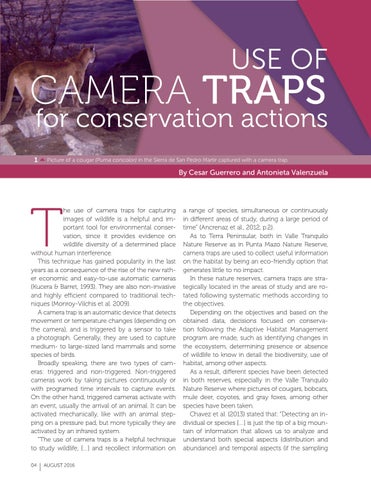
Picture of a cougar (Puma concolor) in the Sierra de San Pedro Martir captured with a camera trap.
By Cesar Guerrero and Antonieta Valenzuela
T
he use of camera traps for capturing images of wildlife is a helpful and important tool for environmental conservation, since it provides evidence on wildlife diversity of a determined place without human interference. This technique has gained popularity in the last years as a consequence of the rise of the new rather economic and easy-to-use automatic cameras (Kucera & Barret, 1993). They are also non-invasive and highly efficient compared to traditional techniques (Monroy-Vilchis et al. 2009). A camera trap is an automatic device that detects movement or temperature changes (depending on the camera), and is triggered by a sensor to take a photograph. Generally, they are used to capture medium- to large-sized land mammals and some species of birds. Broadly speaking, there are two types of cameras: triggered and non-triggered. Non-triggered cameras work by taking pictures continuously or with programed time intervals to capture events. On the other hand, triggered cameras activate with an event, usually the arrival of an animal. It can be activated mechanically, like with an animal stepping on a pressure pad, but more typically they are activated by an infrared system. “The use of camera traps is a helpful technique to study wildlife, […] and recollect information on 04
AUGUST 2016
a range of species, simultaneous or continuously in different areas of study, during a large period of time” (Ancrenaz et al., 2012, p.2). As to Terra Peninsular, both in Valle Tranquilo Nature Reserve as in Punta Mazo Nature Reserve, camera traps are used to collect useful information on the habitat by being an eco-friendly option that generates little to no impact. In these nature reserves, camera traps are strategically located in the areas of study and are rotated following systematic methods according to the objectives. Depending on the objectives and based on the obtained data, decisions focused on conservation following the Adaptive Habitat Management program are made, such as identifying changes in the ecosystem, determining presence or absence of wildlife to know in detail the biodiversity, use of habitat, among other aspects. As a result, different species have been detected in both reserves, especially in the Valle Tranquilo Nature Reserve where pictures of cougars, bobcats, mule deer, coyotes, and gray foxes, among other species have been taken. Chavez et al. (2013) stated that: “Detecting an individual or species […] is just the tip of a big mountain of information that allows us to analyze and understand both special aspects (distribution and abundance) and temporal aspects (if the sampling
TERRA NEWS
2 3 4 5 6 7 8 9
2
3
4
5
6
7
8
9
In nature reserves, camera traps are located strategically and rotated following a systematic methodology. Peninsula Bobcat (Lynx rufus peninsularis). Coyote (Canis latrans clepticus) in the Valle Tranquilo Nature Reserve, near El Rosario, Baja California. Gray fox (Urocyon cinereoargenteus peninsularis) in the Punta Mazo Nature Reserve, San Quintin, Baja California. Gray fox (Urocyon cinereoargenteus peninsularis). Mule deer (Odocoileus hemionus fuliginatus). Camera traps are an important tool in nature reserves managed by Terra Peninsular. According to the objectives, the team of Conservation works meticulously to place the camera traps and collect information.
is done in several seasons) related to the changes in land mammals populations (p.45). Even if camera traps are relatively easy to use, it is worth highlighting that the demand of installment and review camera traps are considerable, and depends on the size and logistics of the sampling areas. Methods applied are just as important as the device: it requires logistic efforts, knowledge of the equipment, clear definition of objectives, delimitation of the area of study, consideration of the position of the sun, installment, etc. and after that, the download and detailed review of the photographic material obtained. Just as Ancrenaz et al. (2012) explained: “The use of camera traps has enormous potential for the surveying and consequent management of wildlife and can be used to answer a number of important questions; […] a successful camera trap project is very rewarding and may return results no other survey method would have provided” (p.5). Camera trapping has resulted in a helpful tool for nature reserves managed and protected by Terra Peninsular A.C. since it is a non-invasive option that allows collecting information and decision-making following the Adaptive Habitat Management program that is aligned to the objectives of conservation in Baja California.
References • Ancrenaz, M., Hearn, A.J., Ross, J., Sollmann, R., y Wilting, A. (2012). Handbook for wildlife monitoring using camera traps. Recuperado de http://www.bbec.sabah.gov.my/japanese/downloads/2012/ april/camera_trap_manual_for_printing_final.pdf • Chávez, C., De la Torre, A., Bárcenas, H., Medellín, R.A., Zarza, H. y Ceballos, G. (2013). Manual de fototrampeo para estudio de fauna silvestre. El jaguar en México como estudio de caso. Alianza WWF-Telcel, Universidad Nacional Autónoma de México, México. • Kucera, T. E., y Barrett, R. H. (1993). The Trailmaster camera system for detecting wildlife. Wildlife Society Bulletin, 21: 505-508. • Las trampas cámara (s.f.). Recuperado de http://www. semahn.chiapas.gob.mx/portal/descargas/guardaparques/articulos/LAS_TRAMPAS_CAMARAS_extensos.pdf • Monroy-Vilchis, O., Rodríguez-Soto, C., Zarco-González, M., y Urios V. (2009). Cougar and jaguar habitat use and activity patterns in Central Mexico. Animal Biology, 59: 145-157. • Naves, J., Fernández, A., Gaona, J. F., y Nores C. (1996). Uso de cámaras automáticas para la recogida de información faunística. Doñana, Acta Vertebrata, 23: 189-199. • O’Connell, A. F., Nichols, J. D. y Karanth, K. U. (Eds.) (2011). Camera traps in animal ecology: Methods and analyses. First edition. Springer, New York, New York, USA.
AUGUST 2016
05
Desalination
and their PLANTS potential effect in San Quintín Bay The salt and chemical concentration in brine can be toxic for marine species and the environment. Photo: Enrique Alfaro.
1
By César Guerrero and Antonieta Valenzuela
O
ne of the main primary food supply sources in Northwestern Mexico and Southwestern United States is the agricultural area of Baja California, especially the San Quintín Valley, where water is undoubtedly the fundamental resource for agriculture. Quality standards required in water available for agriculture are not met due to the absence of atmospheric precipitation and the excessive groundwater extraction in the San Quintín Valley. The effects of saltwater intrusion into the groundwater levels—from which water for agriculture is extracted—are irreversible; water with high concentrations of salts is not ideal for agriculture and it reduces (or even prevents) the performance of agricultural production. Due to the undeniable need of maintaining agricultural production and the inability of providing faster methods of groundwater recharge, the technology of desalination plants is now being used to solve the problem in the short term, but with negative—and sometimes irreversible—effects when is not appropriately managed. The desalination process using reverse osmosis consists in withdrawing large volumes of seawater of the ocean or coastal saline aquifers (as is the case in San Quintín) and filtering it for irrigation, industrial 06
AUGUST 2016
processes, agriculture or human use. On average, a desalination plant withdraws 2 gallons of seawater, from which it produces 1 gallon of desalinated water. Wastewater (brine) with high salinity is a result of this process and is later discharged back into the sea (Cooley et al. 2013). Brine has a much higher saline concentration than that of the sea, and it can even present higher temperatures. It is composed of large quantities of suspended solids, variable pH and dissolved salts, as well as chemicals used during the desalination process like detergents, coagulants (ferric chloride), anti-scaling agents (polyacrylate), anticorrosive agents (sodium bisulfite) and biocide (sodium hypochlorite) (Mauguin et al. 2005). It results evident that this salt and chemical concentration in brine can be toxic for marine species and the environment. Currently, there are at least 11 brine discharge locations registered in San Quintín Bay and Laguna Figueroa (a water body located north of the bay). Their salinity levels reach up to 62 mg/L, almost duplicating the average seawater salinity of 35 mg/L. The impact on the marine environment can be negative when brine discharge zones coincide with sensitive ecosystems, closed and shallow sites with a high concentration of marine life (Latterman & Höpner, 2008). Likewise, marine resources in the
TERRA NEWS
2
The impact on the marine environment can be negative when the brine discharge zones coincide with sensitive ecosystems like the San Quintín Bay. Photo: Enrique Alfaro. Waste water discharge into the
3 ocean near Laguna Figueroa, Baja California. Photo: Enrique Alfaro.
areas close to desalination plants can be affected by the quantity and quality of the brine. The osmotic shock caused by the elevated difference in salinity inside and outside of the cells lead to massive mortality in organisms that are found near the discharge areas, sessile species or species of limited mobility like demersal fish, algae, plankton, larvae and eggs of different species; as a result jeopardizing the ecological processes and the transfer of energy in the different trophic levels (Arreguin & Martin, 2000). Seagrass beds in San Quintín Bay are especially vulnerable to salinity changes. Studies conducted in the southeast coast of Spain in Mediterranean seagrass beds (similar to San Quintín) demonstrate the significant effects on the health of seagrass with variations of barely 1-2 g/L and morality above of 50% with variations of above 5 g/L (Buceta et al., 2003; Sánchez-Lizaso et al., 2008). This not will only cause the reduction of primary productivity in the bay and capture dioxide carbon from the atmosphere (Arreguín & Martín, 2000), but it also has an impact on the productive activities within the bay, such as oyster farming, synergetic activities, sport and commercial fishing. All these activities depend on a healthy bay with feeding, protection, breeding, nesting and reproduction areas. Good management of wastewater (brine) should not have any consequence, but bad management has a significant negative effect that has to be taken into account in the decision-making process, especially regarding a semi-closed water body like San Quintín Bay. In the next months there is a potential increase of discharge locations on the bay and the surrounding areas; with the accumulation of brine discharges in the bay, the negative impact on water quality would be immediate.
When brine is discharged on the
4 ground, it forms salt crusts that make any type of plant growth impossible.
AUGUST 2016
07
5 Currently, there are at least 11 brine
discharge locations registered in the San Quintín Bay.Photo: Enrique Alfaro.
The problem lies in the mismanagement of brine disposal, since most of it is discharged back into the sea or directly to the ground, where it accumulates and dries up, creating salt crusts that make any type of plant growth impossible in those grounds. Although this has still not happened in San Quintín Bay, other of the most significant threats to the environment related to the desalination of seawater is the entrainment and impingement of organisms in the desalination process (Cooley et al. 2006), because as Correa (n.d.) states: “Seawater is not just a simple saline solution, it is actually an active biological environment that, besides containing salts, it also presents different types of molecules, particles and living organisms.” There are different technologies, techniques and recommendations that allow adequate management and disposal of reverse osmosis brine (Sánchez-Lizaso et al., 2008; Abessi & Roberts, 2014); however, given that the technology used in desalination plants is relatively new in Baja California and Mexico, there are no current regulations that control them, which results in bad practices, no mitigation actions and, mainly, no preventive measures for their impact. Desalination plants are a practical solution to face the lack of water in San Quintín Bay and the region. Terra Peninsular does not oppose development nor the implementation of these solutions, but we refuse to accept those that do not consider potential effect on the environment. For this reason, it is crucial to take preventive and protection measures for the areas of ecological importance that are being affected by the inappropriate use of reverse osmosis technology and for not taking its ecological repercussions into account.
08
AUGUST 2016
References • Abessi, O., & Roberts, P. J. W. (March 2014). Multiport diffusers for dense discharges. Journal of Hydraulic Engineering. Retrieved from http://ascelibrary.org/doi/abs/10.1061/(ASCE) HY.1943-7900.0000882 • Arreguín, F, & Martín, A. (2000). Desalinización del agua. Ingeniería Hidráulica en México, vol. XV, núm. 1, p. 27-49. Retrieved from http://repositorio.imta.mx:8080/cenca-repositorio/bitstream/123456789/720/1/0206.pdf • Cooley, H., Ajami, N., & Heberger, M. (December 2013). Key Issues in Seawater Desalination in California Marine Impacts. Retrieved from www.pacinst.org/publication/desal-marine-impacts • Cooley, H., Gleick, P.H., & Wolff, G. (June 2006). Desalination With a Grain of Salt A California Perspective. Retrieved from http:// pacinst.org/app/uploads/2015/01/desalination-grain-of-salt.pdf • Correa, F. (n.d.). Impacto social y económico de la desalación de agua de mar. Biblioteca Jurídica Virtual del Instituto de Investigaciones Jurídicas de la UNAM. Retrieved from http:// bibliohistorico.juridicas.unam.mx/libros/6/2524/11.pdf • Lattermann, S., & Höpner, T. (March 2008). Environmental impact and impact assessment of seawater desalination. Retrieved from https://www.researchgate.net/publication/222564177_ Environmental_impact_and_impact_assessment_of_seawater_desalination • Maugin, G., & Corsin, P. (2005) Concentrate and other waste disposal from SWRO plants: characterization and reduction of their environmental impact. Desalination 182 (1-3). • Sánchez-Lizaso, J.L., Romero, J., Ruiz, J., Gacia, E., Buceta, J.L., Invers, O., Fernández Torquemada, Y., Mas, J., Ruiz-Mateo, A., & Manzanera, M. (June 2007). Salinity tolerance of the Mediterranean seagrass Posidonia oceanica: recommendations to minimize the impact of brine discharges from desalination plants. Retrieved from http://www.sciencedirect.com/science/ article/pii/S0011916407007461 • Vásquez, J.A., Vega, J.M.A., Piaget, N., Luna, G., Morales, M.C., Stotz, W., … Sepúlveda, A. (2008). Análisis de los potenciales efectos ambientales de la operación de proyectos termoeléctricos en ambientes marinos de la cuarta región. Departamento de Biología Marina Universidad Católica del Norte Coquimbo. Retrieved from https://sociotecnicadelaenergia.files. wordpress.com/2014/10/informe-ucn-final-cts-cne.pdf
AGOSTO 2016
09
1
Pogogyne sp. nov., an undescribed vernal pool species known only from Valle de Las Palmas, SE of Tecate. Photo: César García Valderrama.
Study and protection
of Baja California’s vernal
POOL ECOSYSTEMS By: Matt Guilliams, PhD
I
n the not so distant past, when the footprint of humans was less heavy on the landscape, the marine terraces, mesas, and valley bottoms of parts of the Californias (Baja California, Mexico and California, USA) would have looked quite different than they do today. In these areas where urban and agricultural landscapes now dominate, vast swathes of flat to gently undulating terrain would have been the natural condition. These landscapes would have been blanketed with a rich cover of shrubs, wildflowers, and grasses. When certain soil conditions were present, wa10
AUGUST 2016
ter from mild winter rains would gather in the numerous low lying areas, yielding a vast, shimmering constellation of short-lived winter pools. Over time, an endemic flora and fauna evolved in these temporary ponds, contributing to a distinctive ecosystem called a vernal pool. What makes a vernal pool? Vernal pools are rare and endangered wetland ecosystems that occur in all five Mediterraneantype climates of the world (Keeley & Zedler, 1998).
FLORA AND FAUNA
Large vernal pool in flowering phase, Mesa El Descanso.
2 Photo: Susan Fawcett.
These marvelous ecosystems occur in shallow depressions that fill with water during the cool winter months, when they are essential habitat for gracefully swimming fairy shrimp, amphibians, and scores of migratory bird species. As the water evaporates in spring, the once dominant aquatic biota yields to a dazzling and multihued procession of annual wildflowers, many of which occur in the vernal pools of the Californias and nowhere else on earth. Upon the arrival of hot summer temperatures, vernal pools dry completely and their rich host of plants and animals retreats underground to await the next winter rains. Exquisitely adapted to our Mediterranean-type climate, vernal pools and the plants and animals they support are truly among our most precious natural resources. Our heritage at risk The vernal pools of the Californias harbor tremendous endemic plant and animal diversity, yet despite their critical biological importance, a large percentage of vernal pools have been destroyed (e.g., see Holland, 2011). Our team of Baja California vernal pool researchers has calculated that 96% of vernal pool landscapes have been lost in Baja California (Guilliams et al. in review). This estimate is among the highest reported for vernal pool loss in western North America, with only San Diego County, California having a greater percent loss (96-98%; Bauder & McMillan, 1998).
Gigantic vernal pool or vernal “lake�, Colonet Mesa.
3 Photo: Seth Kauppinen.
The rapid pace of loss in northwestern Baja California has inspired the formation of a bi-national team of biologists and conservationists to learn more about the remaining pools so that they can be better understood and protected. Research and advocacy focusing on Baja California vernal pools The vernal pool landscapes of Baja California require urgent intervention to protect those pools that remain. In partnership with Terra Peninsular and Sociedad de Plantas Nativas de Baja California, our vernal pool team has been active in research and conservation in northwestern Baja California since 2010. With a team of nearly 20 biologists, our efforts have been collaborative and multi-faceted. Our initial efforts were geared toward understanding present day and historical distributions of vernal pools in Baja California. The results of this study, presently in review, include a systematic report of the distribution of vernal pools in Baja California and the first assessment of vernal pool loss in the region. This work sets an important baseline for biologists, conservationists, and land managers, allowing prioritization of future conservation and research efforts. Beyond mapping of vernal pools, we are documenting and studying the plants and animals that live within them. Although Baja California vernal pools are somewhat less diverse than pools to the north, there are a number of fascinating vernal pool AUGUST 2016
11
4 Jorge Montiel Molina, former graduate student at
CICESE, taking microelevation data in vernal pools. Photo: Seth Kauppinen.
plants that occur predominantly or wholly in northwestern Baja California and nowhere else; some Baja California vernal pool plants occur just north of the international border and are often considered rare in the USA, e.g., San Diego button celery (Eryngium aristulatum var. parishii; Apiaceae), California Orcutt grass (Orcuttia californica, Poaceae), and spreading navarretia (Navarretia fossalis; Polemoniaceae). The Baja California populations of these species are often more numerous than those in the USA, and thus the protection of Baja California vernal pools will contribute importantly toward the long-term persistence of these plants in the wild. At least four species of plants are endemic to Baja California vernal pools, and three of these are new to science. The Valle de Las Palmas region supports a highly localized mesa mint (Pogogyne sp. nov. “mexicana”; Lamiaceae) related to but distinct from relatives in the San Diego area. The entire distribution of this yet-to-be-described plant is two small river terraces in single, rapidly developing valley. The Colonet region to the south supports two narrow endemics, Centromadia perennis (Asteraceae), and one yet-tobe-described popcorn flower (Plagiobothrys sp. nov. “colonetensis”; Boraginaceae). Finally, the San Quintín region is the home of an undescribed button celery (Eryngium sp. nov., Apiaceae), which -until our team discovered two new populations earlier in 2016- was 12
AUGUST 2016
thought to have been driven to extinction before it could be formally described. Our team has also initiated region-wide genetic studies of the endemic fairy shrimp of Baja California (Branchinecta; Crustacea), with a focus on regional endemic, B. sandiegonensis. This work, led by Dr. María Clara Arteaga Uribe and her graduate student Nayeli Escudero Castelán at the Center for Scientific Research and Higher Education at Ensenada (CICESE), has revealed interesting genetic patterns between coastal and inland vernal pool regions in northwestern Baja California. In particular, fairy shrimp from the Valle de Las Palmas area appear to be genetically distinct from fairy shrimp from coastal locations (EscuderoCastelán et al., 2014). This pattern is similar to that of the undescribed mesa mint species, with isolated, interior populations in Valle de Las Palmas appearing distinct from close relatives in coastal San Diego County. What’s next? Although much has been accomplished in recent years, we still know relatively little about Baja California’s vernal pools. Therefore, it is imperative that we continue to study and attempt to protect the remaining vernal pool landscapes. In the coming field seasons, biologists will continue to study the floristics of the Baja California vernal pools and will work toward formally recognizing the three undescribed vernal pool plant species.
FLORA AND FAUNA 6
References • Bauder, E. T. & McMillan, S. (1998). Current distribution and historical extent of vernal pools in southern California and northern Baja California, Mexico. Pages 56-70 in Witham, C. W., Bauder, E. T., Delk, D., Ferren, W. R. J., & Ornduff, R. (Eds.) (1998). Ecology, conservation, and management of vernal pool ecosystems, proceedings from a 1996 conference. California Native Plant Society, Sacramento, CA. • Escudero-Castelán, N., Arteaga, M. C. & Guilliams, C. M. (2014). Diversidad de anostracos de las pozas vernales en el Norte de Baja California. First Annual International Symposium of Environmental Biology, CICESE. Ensenada, B.C., Mexico. • Guilliams, C. M., Hasenstab-Lehman, K., Delgadillo Rodríguez, J. & Baldwin, B. G. in review. Vernal pool landscapes of Baja California, México: an ongoing project to assess vernal pool loss and protect what remains.
Some of the Baja California Vernal Pool Conservation
6 Team. Photo: Dr. María Clara Arteaga.
• Holland, R. F. (2011). Great Valley vernal pool distribution rephotorevised 2005 in Alexander, D. G, & Schlising, R. A. (Eds.) Research and Recovery in Vernal Pool Landscapes. Studies from the Herbarium, Number 16, California State University, Chico, CA.
5 Maritime succulent scrub on Colonet Mesa, adjacent to vernal pools. Photo: Seth Kauppinen.
• Keeley, J. & Zedler, P.H. (1998). Global distribution of vernal pools in Witham, C. W., Bauder, E. T., Belk, D., Ferren, W. R. Jr., & Ornduff, R. (Eds.). Ecology, Conservation, and Management of Vernal Pool Ecosystems - Proceedings from a 1996 Conference. California Native Plant Society, Sacramento, CA.
About Matt Guilliams 5
Matt is a botanist at the Santa Barbara Botanic Garden, where he holds the Ken and Shirley Tucker Plant Systematist endowed chair and is the Curator of the Clifton F. Smith Herbarium. His research focuses on themes in plant evolutionary biology, including the inference of evolutionary relationships using morphological and molecular data, biogeographic inference, and study of adaptive radiation in the California Floristic Province. In Baja California, Matt has been active as the leader of a long-term project focusing on the study and conservation of vernal pool ecosystems in the region. Matt completed a bachelor’s degree in Biology at San Diego State University, worked for various private and public organizations as a botanist, and then completed a master’s degree in Evolutionary Biology (also at SDSU). Matt completed his dissertation at the University of California Berkeley in 2015.
AUGUST 2016
13
FRAZAR’S
AMERICAN
OYSTERCATCHER Banded-bird reports provide valuable information about the American oystercatcher. Place: J.A. Castillo Guerrero Photo: Miriam Lerma
1
By: Miriam Lerma and José Alfredo Castillo Guerrero
T
he American oystercatcher (Haematopus palliatus) is a medium-sized shorebird with a bright red-orange peak and pink legs. It is found in both of the American coasts and there are at least five subspecies. The Frazar’s American oystercatcher (Haematopus palliatus frazari) inhabits Northwestern Mexico. It is different from other subspecies for being larger and darker, and for having very little or no white in the feathers on its wings and a mottled breast. There are approximately 3000 individuals in the coasts and islands of Northwestern Mexico, between Nayarit and Baja California; although, most of them are in the states of Sinaloa and Baja California Sur. Distribution and reduced population size, and the increased threat to their habitat has caused the Mexican government to classify the Frazar’s American oystercatcher as an endangered species. Frazar’s American oystercatcher breeding season is between April and July. It begins with the selection of a place for their nest, which is later defended from other couples of oystercatchers. The oystercatcher’s first mating takes place when they are 3 or 4 years old and they will use the same spots to nest each year. Their bond as couples can be maintained for several years, even a lifetime. The nest consists in a small scrape in the ground with rocks, shells or vegetation; 1 to 4 eggs are laid (2 on average) and incubated for 27 days. Once they hatch, fledglings leave the nest after just a few hours. They follow their parents and are fed by both 14
AUGUST 2016
of them for 35 days, until they begin to fly and start to feed themselves. After the breeding season, oystercatchers leave their breeding sites, stop being aggressive with other oystercatchers and gather in communal places to feed and rest. Since their main source of food consists in oysters and clams, tide limits the access to their feeding places. Therefore, when tide is low, they feed in mires; while when tide is high, they rest in safer places. Current research is aimed at helping to protect this subspecies. In the areas where larger numbers of oystercatchers live, a monitoring program was launched to evaluate their population state, survival, and reproductive success. Among the activities that are taking place, there is bird ringing. In Northwestern Mexico, metal bands are attached to oystercatchers, one in the right lower leg and a green band in the upper left leg. The report of banded individuals provides valuable information about movement, survival and demography of the species. Human activities have caused changes in the coastal zone of Northwestern Mexico. Habitat degradation is a result of the construction of different types of infrastructure, such as marinas, decks, breakwaters, houses, shrimp farms, among others. Increase in use of the coastal areas, like the rise of disturbance levels, pollution and habitat degradation, is implicitly threatening the conservation of the American oystercatcher.
FLORA AND FAUNA
References
About Miriam
• Clay, R. P., Lesterhuis, A. J.,Schulte, S., Brown, S., Reynolds D. & Simons, T. R. (2014). A global assessment of the conservation status of the American Oystercatcher Haematopus palliatus. International Wader Studies, 20: 62-82.
Miriam Lerma graduated from the University of Guadalajara, holds a master’s degree from the National Autonomous University of Mexico, and is currently a graduate student. She is a bird enthusiast and has worked in different monitoring projects of shorebirds and seabirds.
• Ens, B. J. & Underhill, L.G. (2014). Synthesis of oystercatcher conservation assessments: general lessons and recommendations. International Wader Studies, 20: 5-22. • Norma Oficial Mexicana NOM-059-SEMARNAT-2010 [Official Mexican Norm NOM-059-SEMARNAT-2010]. Diario Oficial de la Federación, volume DCLXXXVII no. 23 (2nd section), Mexico City, Mexico, December 30, 2010.
About José Alfredo José Alfredo Castillo Guerrero is a Marine Biologist from the UABCS. He holds a master’s degree and a PhD from CICESE. He has collaborated with Terra Peninsular in monitoring oystercatchers in Northwestern Mexico. He is currently working in the Coastal Zone Sustainable Development Studies Department at the University of Guadalajara.
American oystercatcher (Haematopus palliatus) fledgling
2 Place: El Rancho Island, Sinaloa. Photo: J.A. Castillo Guerrero
3 A nest of the American oystercatcher (Haematopus palliatus) Place: El Rancho Island, Sinaloa. Photo: J.A. Castillo Guerrero
The American oystercatcher (Haematopus palliatus) is
4 an endangered species in Mexico. Place: Topolobampo Bay, Sinaloa. Photo: J.A. Castillo Guerrero
5 American oystercatcher (Haematopus palliatus). Place: El Rancho Island, Sinaloa. Photo: J.A. Castillo Guerrero
AUGUST 2016
15
My Homeland
PENINSULAR
By: Eduardo Palacios Castro. Founder and Board Member of Terra Peninsular
T
he more I travel, the more I love the Baja California peninsula. The most beautiful part of this land is that when you visit a place that is isolated from the Transpeninsular Highway, it seems that you are the first person ever in that spot. That same feeling of discovering and rediscovering the little-known landscapes of the peninsula fascinates both natives and visitors. My land feels like a large island; which it is for political, cultural and economic purposes, but that is a different topic. Isolation caused by water scarcity and warm weather has resulted in large natural spaces of uninhabited mountains, valleys and coasts, unlike the continental massif. “May God save this place from irregular settlements� a lady said while contemplating the beautiful landscape that extends from the Sierra de San Francisco to the San Ignacio Lagoon. Our fascination for the peninsula drives some of us to want to show it to the world, or treasure it, or both. For me, the need of preserving nature in this land emerged in 1988 due to a project of touristic development at the Punta Banda coastal lagoon, close 16
AUGUST 2016
to Ensenada. The project intended to dredge the lagoon to build a marina and flatten the sand bar dunes in order to build beachfront houses. Several researchers from the Center for Scientific Research and Higher Education at Ensenada (CICESE) and the Autonomous University of Baja California (UABC) of Ensenada gathered in multiple occasions to discuss the pros and cons of the project. Even if there were many researchers who supported the project, most of them agreed that the negative consequences put the ecological integrity and environmental services of the Punta Banda coastal lagoon at stake. That same year, the Mexican Environmental Legislation created the General Law on Ecological Balance and Environmental Protection (LGEEPA, in Spanish), which was of high relevance in conservation activities in Mexico since it introduced the concept of Environmental Land Management, environmental impact assessment, and protection of natural areas. In this context, Pro Esteros was founded. A binational citizen organization dedicated to the preser-
MY LIFE IN TERRA
vation of wetlands of the peninsula of Baja California, of which some of us are members. Touristic development of the Punta Banda coastal lagoon took place partially. Even if several arguments against it were made, these were not enough and only a third part of the sandbar was left undeveloped. This was a lesson for all of us, including authorities, developers and organized civil society. For me, as a first year student of Ecology in CICESE, all these events and expert discussions taught me firsthand and defined my conservationist vocation. In the mid-90s, another hard test for the conservationist organizations was presented. At that moment, the site that was planned to develop was the San Quintin Bay. This time, our victory was decisive: a group of academic people developed a technical opinion that contrasted sustainable development of the bay with the negative consequences of the touristic development project. With that document, conservationist organizations reached Mexico City and, environmental authorities, led by Julia Carabias, ruled against poorly planned development in the San Quintin Bay. This successful case encouraged some of us participants of that technical opinion to form an organization dedicated to the preservation of the habitats of Baja California’s Mediterranean region. Consequently, in the spring of 2001 Terra Peninsu-
lar A.C. was founded. Its origins and first years as an organization were uncertain, to say the least, but after very hard lessons, a learning curve that was paused by recurrent financial crisis in the organization and change of staff, Terra Peninsular has rapidly become established. In the last five years Terra Peninsular has discovered and started to deploy its potential for preservation, not only in this corner of Baja California, but in the northwest of Mexico. Now, Terra Peninsular conducts projects of habitat protection, research for preservation, legal and biological monitoring, and education for preservations from national marshes in Nayarit to the Alto Golfo de California in Sonora, and, of course, in all of the peninsula of Baja California. Terra Peninsular is now formed by a serious and committed Board, a young, professional and dedicated staff, generous friends that support our cause and associated consultants and researchers that give a legal and scientific support to preservation actions. A challenge for Terra Peninsular is to maintain its reserves and preservation actions. Nonetheless, it has the structure and operation needed to accomplish its mission: contribute to the region’s sustainable development by preserving and protecting the natural ecosystems and wildlife of Northwestern Mexico. AUGUST 2016
17
AugustDecember 2016 Events Terra Peninsular’s 2nd Annual Bird Festival DESCRIPTION:
For the second consecutive year, Terra Peninsular organizes its Annual Bird Festival in San Quintin to inform the community about the importance of shorebirds and migratory birds through games, activities and birdwatching at the beach.
DATE:
Saturday, November 5th.
LOCATION:
San Quintin, Baja California.
FREE ENTRY
Expo-Ambiente Ensenada 2016 DESCRIPTION:
The Environmental Protection Department of Baja California is organizing the Expo-Ambiente whose slogan this year will be “Agua y Trabajo” (Water and Work). The free entrance event aims to promote environmental awareness in children and adults.
DATE AND TIME:
September 28th and 29th, from 9:00 to 17:00 (both days).
LOCATION:
CEARTE, Ensenada, Baja California.
FREE ENTRY
For more information, please contact us at: info@terrapeninsular.org 18
AUGUST 2016
WHAT AND WHERE?
DECEMBER
NOVEMBER
OCTOBER
SEPTEMBER
AUGUST
Environmental Days 12 30
Inter-American Air Quality Day International Whale Shark Day
6
18 22 27 29
World Shorebirds Day Independents Day of Mexico International Day for the Preservation of the Ozone Layer World Beaches Day World Car Free Day Environmental Awareness Day World Maritime Day
3 4 10 12 18
World Habitat Day World Animal Day National Cactus Day (Mexico) Columbus Day World Day for Wildlife Protection
16
World Beaches Day
World Animal Day
1 15 20 27
World Day of Ecology World Clean Air Day Revolution Day (Mexico) International Conservation Day
11 15
International Mountain Day Establishment of the United Nations Environment Programme (UNEP) Christmas Eve Christmas International Day for Biological Diversity New Year’s Eve
24 25 29 31
International Mountain Day
AUGUST 2016
19
WHAT DO WE ACTUALLY DO?
Did you know that you can help Terra Peninsular A.C. while shopping online for free?
Helpfreely makes this possible! Every time you shop online, Terra Peninsular A.C. will receive a percentage directly from your expenses.
Many stores collaborate with Helpfreely: eBay, Groupon, Fnac, Zooplus, Booking.com, Vueling and many others.
What are you waiting for? You can now help for free! Sign up at Helpfreely (http://helpfree.ly/j15265) or scan the QR code. 22
AGOSTO 2016
TERRA ACTIONS
Protecting the environment
during VACATIONS Leave the place BETTER than how it was when you got there. It is everyone’s responsibility to take care of the natural areas that we use.
Up to 101 ounces of water can be polluted by just one cigarette! If you smoke, make sure to carry an ashtray with you or use a container so that you can dispose them later in a garbage can.
Carry your own plastic bags and separate the trash. If you can’t find a nearby container, take your trash with you to dispose it in a more adequate place.
Noise pollution is just as damaging as other types of pollution. It is important to respect others and the nature that surrounds you.
Carry your food in reusable containers instead of disposable ones, this way you won’t produce more trash.
If you have a pet, don’t forget to bring your own plastic bags to pick up its feces.
Take the time to pick up the trash around you and your own. You can teach others to respect the environment by doing what’s right.
Respect nature, do not pick plants or plant parts listed as endangered or threatened, and do not allow others to do it either.
When carrying glass containers, be extremely careful not to break them. That could be dangerous and even if they are recyclable, glass takes thousands of years to degrade.
Minimize use and impact of campfires. If you decide to make one, make sure it is in a place already used for that purpose and leave the area clean when you are done. Also, follow the caution measures in high risk areas.
AUGUST 2016
23
GLOSSARY
GLOSSARY
ADAPTIVE HABITAT MANAGEMENT: one of the three programs of Terra Peninsular that comprise the conservation actions of protected spaces, it has the objective of monitoring, evaluating, studying and applying different measures of management for landscape conservation and functionality of habitats. ANOSTRACA: in Zoology, they are one of the orders of crustaceans in the class Branchiopoda. They are characterized by their lack of carapace. SOURCE: text from www.enciclonet.com BIOTA: plant and animal life of a particular region. CALIFORNIAS: region and covers both Baja California and Baja California Sur in Mexico, along with the state of California, U.S.A.
GRASS: plants that have great ecological amplitude, so they are usually found as part of the natural, ornamental or agronomic vegetation of human population. Species that are important sources of food for humans and livestock are part of this botanical family. PUNTA MAZO NATURE RESERVE: it is a nature reserve protected and managed by Terra Peninsular since 2014. It is located in the San Quintin Bay, in Baja California and it’s described as a sandbar of 4.97 miles of length and 2057.05 acres of surface. SESSILE ORGANISMS: organisms, usually marine, that grow attached to a substrate and that do not move from one place to another. For example, marine sponges or corals. VALLE TRANQUILO NATURE RESERVE:
ENDEMIC SPECIES: the species that inhabit and have their origin in a determined place that for their nature are not possible to find elsewhere in the world.
it is a nature reserve protected and managed by Terra Peninsular since 2016, with an extension of 9121.15 acres and it is located in the south of Ensenada, between San Quintin and El Rosario, in Baja California.
FOOD WEB: the set of food chains of an ecosystem, interconnected through feeding relationships.
WATER TABLE: water body in the subsoil located in a low profundity, generally a few meters from the surface.
24
AUGUST 2016
Meaningful Giving. Inspired Change Visit our friends of the International Community Foundation at www.icfdn.org , and learn how you can help us protect the natural beauty of Baja California. Or visit our webpage www.terrapeninsular.org/en/ and click on Donate now! to ďŹ nd out more about how to make your tax-deductible contribution!