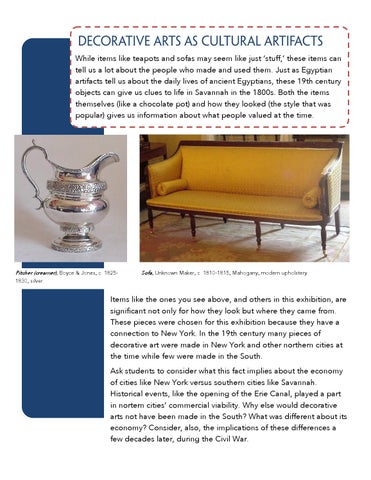
While items like teapots and sofas may seem like just „stuff,â€&#x; these items can tell us a lot about the people who made and used them. Just as Egyptian artifacts tell us about the daily lives of ancient Egyptians, these 19th century objects can give us clues to life in Savannah in the 1800s. Both the items themselves (like a chocolate pot) and how they looked (the style that was popular) gives us information about what people valued at the time.
Pitcher (creamer), Boyce & Jones, c. 1825-
Sofa, Unknown Maker, c. 1810-1815, Mahogany, modern upholstery.
1830, silver.
Items like the ones you see above, and others in this exhibition, are significant not only for how they look but where they came from. These pieces were chosen for this exhibition because they have a connection to New York. In the 19th century many pieces of decorative art were made in New York and other northern cities at the time while few were made in the South. Ask students to consider what this fact implies about the economy of cities like New York versus southern cities like Savannah. Historical events, like the opening of the Erie Canal, played a part in nortern citiesâ€&#x; commercial viability. Why else would decorative arts not have been made in the South? What was different about its economy? Consider, also, the implications of these differences a few decades later, during the Civil War.