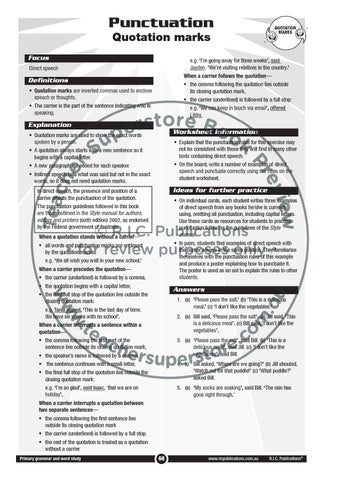
Punctuation Quotation marks
Focus
e.g. ‘I’m going away for three weeks’, said Jayden. ‘We’re visiting relatives in the country.’ When a carrier follows the quotation— • the comma following the quotation lies outside its closing quotation mark, • the carrier (underlined) is followed by a full stop: e.g. ‘We can keep in touch via email’, offered Libby.
Direct speech
Definitions • Quotation marks are inverted commas used to enclose speech or thoughts. • The carrier is the part of the sentence indicating who is speaking.
Explanation
r o e t s Bo r e p ok u S
Worksheet information • Explain that the punctuation rules for this exercise may not be consistent with those they will find in many other texts containing direct speech. • On the board, write a number of examples of direct speech and punctuate correctly using the rules on the student worksheet.
ew i ev Pr
Teac he r
• Quotation marks are used to show the exact words spoken by a person. • A quotation always starts with a new sentence so it begins with a capital letter. • A new paragraph is needed for each speaker. • Indirect speech tells what was said but not in the exact words, so it does not need quotation marks.
Ideas for further practice
In direct speech, the presence and position of a carrier affects the punctuation of the quotation. The punctuation guidelines followed in this book are those outlined in the Style manual for authors, editors and printers (sixth edition) 2002, as endorsed by the Federal government of Australia.
• On individual cards, each student writes three examples of direct speech from any books he/she is currently using, omitting all punctuation, including capital letters. Use these cards as resources for students to practise punctuation following the guidelines of the Style manual. • In pairs, students find examples of direct speech with the carrier always in the same position. They familiarise themselves with the punctuation rules of this example and produce a poster explaining how to punctuate it. The poster is used as an aid to explain the rules to other students.
w ww
. te
Primary grammar and word study
Answers
m . u
© R. I . C.Publ i cat i ons •f orr evi ew pur posesonl y•
When a quotation stands without a carrier— • all words and punctuation marks are enclosed by the quotation marks: e.g. ‘We all wish you well in your new school.’ When a carrier precedes the quotation— • the carrier (underlined) is followed by a comma, • the quotation begins with a capital letter, • the final full stop of the quotation lies outside the closing quotation mark: e.g. Tania sighed, ‘This is the last day of term. We have six weeks with no school’. When a carrier interrupts a sentence within a quotation— • the comma following the first part of the sentence lies outside its closing quotation mark, • the speaker’s name is followed by a comma, • the sentence continues with a small letter, • the final full stop of the quotation lies outside the closing quotation mark: e.g. ‘I’m so glad’, said Isaac, ‘that we are on holiday’. When a carrier interrupts a quotation between two separate sentences— • the comma following the first sentence lies outside its closing quotation mark • the carrier (underlined) is followed by a full stop. • the rest of the quotation is treated as a quotation without a carrier.
1. (a) ‘Please pass the salt.’ (b) ‘This is a delicious meal.’ (c) ‘I don’t like the vegetables.’
2. (a) Bill said, ‘Please pass the salt’. (b) Jill said, ‘This is a delicious meal’. (c) Bill said, ‘I don’t like the vegetables’.
3. (a) ‘Please pass the salt’, said Bill. (b) ‘This is a delicious meal’, said Jill. (c) ‘I don’t like the vegetables’, said Bill.
4. a) Bill asked, ‘Where are we going?’ (b) Jill shouted, ‘Watch out for that puddle!’ (c) ‘What puddle?’ asked Bill.
5. (a) ‘My socks are soaking’, said Bill. ‘The rain has gone right through.’
o c . che e r o t r s super
68
www.ricpublications.com.au
R.I.C. Publications®