Sub-strand: Patterns and Algebra—P&A – 1
HANDS-ON ACTIVITIES Number patterns • Photocopy onto card, cut out and laminate the number cards from pages 186 to 196. Separate the cards to create patterns. • Create patterns using fractions, decimals and whole numbers. Use addition (plus) and subtraction (minus) moves in your pattern. Include single-step and multi-step patterns with addition or subtraction, and multi-step patterns with a mixture of addition and subtraction.
Partner patterns
r o e t s Bo r e p ok u S
• In pairs students create number patterns. Swap patterns for partner to solve. Write the solution on a record sheet (page 182). Record patterns on a number line (pages 184–185) for others to continue by using the rule. Reverse the numbers in the pattern and its record the reverse rule and generalisation.
Number patterns concentration
Teac he r
ew i ev Pr
• Lay the laminated number cards required for a specific number line facedown on a table. With a partner, take turns picking a card to place on the number line. Cards must be placed in sequence. If the card chosen is not the next in the pattern, it must be replaced facedown on the table. The game ends when all the cards have been placed. The person to have picked the greater number of cards to complete the sequence is the winner.
Dice patterns
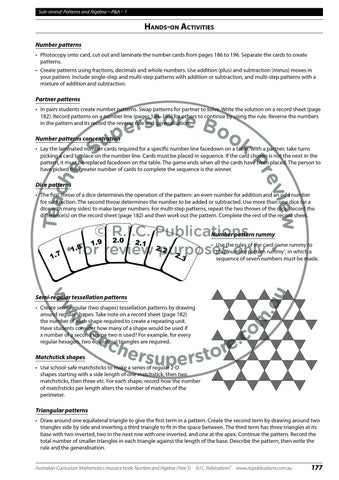
• The first throw of a dice determines the operation of the pattern: an even number for addition and an odd number for subtraction. The second throw determines the number to be added or subtracted. Use more than one dice (or a dice with many sides) to make larger numbers. For multi-step patterns, repeat the two throws of the dice. Record the difference(s) on the record sheet (page 182) and then work out the pattern. Complete the rest of the record sheet.
© R. I . C.Publ i cat i on srummy Number pattern •f orr evi ew pur posesonl y•
w ww
m . u
• Use the rules of the card game rummy to play ‘number pattern rummy’‚ in which a sequence of seven numbers must be made.
Semi-regular tessellation patterns • Create semi-regular (two shapes) tessellation patterns by drawing around regular shapes. Take note on a record sheet (page 182) the number of each shape required to create a repeating unit. Have students consider how many of a shape would be used if x number of a second shape two is used? For example‚ for every regular hexagon, two equilateral triangles are required.
. te
Matchstick shapes
o c . che e r o t r s super
• Use school-safe matchsticks to make a series of regular 2-D shapes starting with a side length of one matchstick, then two matchsticks, then three etc. For each shape, record how the number of matchsticks per length alters the number of matches of the perimeter.
Triangular patterns • Draw around one equilateral triangle to give the first term in a pattern. Create the second term by drawing around two triangles side by side and inverting a third triangle to fit in the space between. The third term has three triangles at its base with two inverted, two in the next row with one inverted‚ and one at the apex. Continue the pattern. Record the total number of smaller triangles in each triangle against the length of the base. Describe the pattern, then write the rule and the generalisation.
Australian Curriculum Mathematics resource book: Number and Algebra (Year 5)
R.I.C. Publications®
www.ricpublications.com.au
177