03 | news
April 06, 2016
NEWS CAMPUS NEWS
PHOTO BY JAKE BULLINGTON | DIGITAL EDITOR
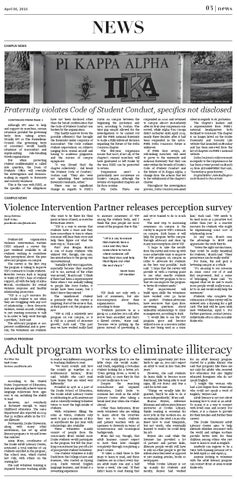
Fraternity violates Code of Student Conduct, specifics not disclosed CONTINUED FROM PAGE 1 Although IFC aims to help and support its members, certain situations prohibit the governing body from taking action. Usually IFC or The Panhellenic Council (the governing body of sororities) would handle situations of misconduct and reprimanding rule-breaking Greek organizations. But when protecting student confidentiality is called into question, the Dean of Students Office will overtake the investigation and decisionmaking in regards to fraternity and sorority violations. This is the case with PIKE, as the specifics of the allegations
have not been disclosed other than the broad confirmation that the Code of Student Conduct was broken by the organization. This hardly narrows down the possible offense(s) that brought the fraternity under suspicion of misconduct. The Code outlines student expectations on subjects ranging from sexual assault and hazing to academic plagiarism and the misuse of campus equipment. “It was (found that) the chapter collectively … did break the Student Code of Conduct,” Jordan said. “They also were not upholding their national fraternity standards, either.” There was no significant change in regards to PIKE’s
status on campus between the beginning the probation and now, according to Jordan. The time gap simply allowed for the investigations to be carried out and the PIKE national fraternity to make a fully informed decision regarding the future of the Delta Omicron chapter. The five-year suspension means that most, if not all, of the chapter’s current members will have graduated or left Drake by the time PIKE can be permitted to return. Suspensions aren’t a particularly new occurrence on Drake’s campus, although the returns of suspended chapters are far from routine. Phi Delta Theta was
suspended in 2010 and returned to campus almost immediately after its four-year suspension was served, while Alpha Tau Omega didn’t recharter until April 2015, nearly three decades after it had been suspended in the 1980s. PIKE Delta Omicron’s future is unknown. If PIKE does return, its refounding members will need to prove to the university and national fraternity that they can exist within the bounds of Drake’s Code of Student Conduct and the bylaws of Pi Kappa Alpha, a change from the actions that led to the withdrawal of the chapter’s charter. Throughout the investigation process, Delta Omicron remained
silent in regards to its probation. The chapter’s leaders and a representative from PIKE’s national headquarters both declined to comment. The chapter is no longer listed on the Drake Fraternity and Sorority Life website that launched on Monday and has been removed from the list of chapters on PIKE’s national website. Delta Omicron’s only comment in regards to the suspension so far has been a tweet posted on March 29 from @DrakePIKES that says, “Yesterday is gone forever…” Digital Editor Jake Bullington contributed to this article.
CAMPUS NEWS
Violence Intervention Partner releases perception survey Jenny DeVries Staff Writer jennifer.devries@drake.edu
Student-led organization Violence Intervention Partner (VIP) released a survey this past weekend available to all students wishing to contribute their perceptions about the peer advocacy program on campus. The survey is the first step the program is taking to improve VIP’s outreach to Drake students. Member Jessica Rick is hoping to build off VIP’s base of student support, all with the help of Alysa Mozak, coordinator for sexual violence response and healthy relationship promotion. “VIP is a 24/7 resource for any Drake student to use when they are struggling with any sort of relationship — from domestic violence, sexual assault, stalking, to just wanting someone to talk to in order to help work through a problem,” Rick said. The advocacy program is 100 percent confidential and is peerrun; the volunteers are students
who want to be there for their peers in times of need, as member Kevin Kane attests. “VIP is a way to ensure that students have a voice and they have somewhere to turn to where someone will hear their story and help them figure out what the next step is,” Kane said. First year Megan Marsh is one of many students who utilized VIP, though, she says, her introduction to the group was unconventional. “Initially I felt very supportive, especially because they reached out to me, instead of the other way around,” Marsh said. “I think if there had been a representative there when I was initially talking to people like Jerry Parker, it would have been easier, but I didn’t know they existed.” The uninformed student is precisely who this survey is targeting. Part of the issue is that, as Rick points out, the program is new. “VIP is still a relatively new program on our campus, so it is still in a period of immense growth,” Rick said. “This past year we have worked really hard
to increase awareness of VIP among the student body, and I think this year people are more aware of the program due to this.”
“VIP is a way to ensure that students have a voice and they have somewhere to turn to where someone will hear their story and help them figure out what the next step is.” Kevin Kane VIP member
VIP deals not only with a lack of awareness, but also misconceptions about their organization’s function, according to Kane. “Students perceive us as a group or a number you call after you’ve been assaulted and that’s a flawed system,” Kane said. “Because we’re picking up the pieces instead of preventing it,
and we’re trained to do so much more.” The next step to increasing awareness on campus is the survey to improve VIP’s outreach on campus. Rick hopes it will help the program better campus through advocacy and clear up many misconceptions about VIP. “I hope to take the results from the survey and come up with some achievable ways to improve the VIP program on campus in order to advocate for students in the best way possible,” Rick said. “I hope that the survey will provide us with a starting point to see what exactly students perceive the VIP program to be so that we can improve the program to better fit student needs.” That improvement will build upon skills the volunteers have worked over 30 hours to perfect. Student-advocates have resources that span from answering questions about unhealthy relationships to crisis management, according to Rick. “I would like to see the VIP program grow and become utilized more as a resource rather than just being used as a crisis
line,” Rick said. “VIP needs to be used more as a proactive tool rather than just as a reactive resource for students who might be experiencing some sort of relationship issue.” In any case, Marsh sees the advantage to MVP and appreciates the work they do. “Given the right circumstance, they could be really beneficial for students,” Marsh said. “Their persistence can be really useful.” For Kane, the end goal is bettering campus as a whole. “It’s amazing to see someone in crisis come out of it and feel empowered, feel a sense of belonging,” Kane said. “To expand what we do and to reach more people would really mean a lot to us and would really help the university.” Students who complete the submission of their survey will be entered into a drawing for a gift card. The link will be open until next Wednesday, April 6. For further questions, contact jessica. rick@drake.edu or alysa.mozak@ drake.edu.
CAMPUS PROGRAM
Adult program works to eliminate illiteracy Hoi Mun Yee Staff Writer hoimun.yee@drake.edu
According to the United States Department of Education, humans generally achieve various language milestones from ages zero to six, including the ability to read. However, not everybody is fortunate enough to enjoy childhood education. The same department also reported in 2013 that 32 million adults in the U.S. are illiterate. Fortunately, Drake University, along with many other institutions, has set up adult literacy programs to try and lower this number. Anne Murr, coordinator of the Drake Adult Literacy Center, estimated a total number of 115 students enrolled in the program, this school year, which started last July, with others on the waiting list. She said volunteer training is required because teaching adults
to read is very different compared to teaching children to read. “We teach sounds and how the sounds go together in a multisensory fashion,” Murr said. “Adults who can’t read have brains that are wired very differently.” Founded in 1976 as a part of the Drake School of Education, the Drake Adult Literacy Center is celebrating its 40th anniversary and is currently seeking volunteer tutors to meet the high intake of students. With volunteers filling the roles as tutors, students only need to pay a maximum of $50 as enrollment fee per year with scholarships also available. These volunteers mainly consist of people from the community. Murr wished more Drake students would participate in the program but felt the yearlong commitment has put off a lot of prospective student volunteers. One student volunteer is Sally Diehl from the College of Arts and Sciences, who started in Spring 2015. Diehl tutored English language learners, and found it a rewarding experience.
“It was really great to see the little steps she would make,” said Diehl, regarding a Somalian student looking for a better job. “Even getting down a vowel is really hard, so once they do that it’s just really nice to see.” Despite the year-long commitment and required dedication, Diehl looks to continue her work in the Adult Literacy Center after taking a break next year when she studies abroad. Other than dedication, Murr seeks volunteers who are willing to learn about the structure they use to teach students and patient teachers with an openness to diversity in terms of socioeconomic and sociological backgrounds. Murr did say, though, that adult learners cannot expect to have their lives changed completely through completing a year’s course. “It takes a child three to five years to learn to read, and those children are in school every day. An adult reads one and a half hours a week,” she said. “If they didn’t learn to read during that
windowed opportunity just from birth to age 10, you can’t expect an adult to read in less than five years.” However, she said students do learn skills to become more functional, like being able to read signs, fill out forms and buy a card for loved ones. “Things we usually take for granted, they’ll be able to do it more independently,” Murr said. Marcia Keyser, reference librarian and information literacy instructor at Cowles Library, thinks reading is essential for most jobs in this modern era. As an example, she cited a man who knew how to read blueprints, but not words, who eventually learned to readso he could keep his job. Keyser also said while the Internet has provided a lot of pictures and picture links, illiterate people would still have to rely on other people to get the information they need as opposed to just reading articles, books or newspapers. While Cowles Library is set up mainly for students and faculty, Keyser had worked
for an adult literacy program started by a public library. She said that programs like these are not only for adults who received low education but also highly educated foreigners who do not speak English. “I taught this woman who had a law degree from Venezuela who could not speak a word of English,” Keyser said. Adult literacy is not just about learning how to read as an adult. To many, it is a way to connect with loved ones and society. For others, it is a chance to provide for their families and further their careers. The Drake University Adult Literacy Center aims to help illiterate elderlies reconnect with the world and refugee mothers provide better lives for their children among others who just want to learn to read in English. Anybody can register to be a tutor with training sessions set to be held April 22 and April 23. Anyone looking to volunteer with the adult literacy program can contact Murr at anne.murr@ drake.edu.