DRAWINGS EXPLORE CULTURE ‘High’ and ‘low’ society was exhibited at the College through black and white art. tcnjsignal.net
RAT HERE, RAT NOW
Students are buzzing that the new menu at the Rat is gRATifying!
See Features page 13 See Arts & Entertainment page 17 The College of New Jersey Student Newspaper since 1885
Visit us online! The Signal @tcnjsignal Get up-to-the-minute news and exclusive content.
February 1, 2012
No. 3
Vol. CXXXVI.
Student honored by Ewing after stopping burning van By Kelly Johnson News Editor
She thought it would be just another average Monday. At 11:15 a.m. on July 11, junior business major Christy Wham noticed flames coming from the undercarriage of a mail van as she was jogging on Metzger Drive. Wham flagged down the driver, and within minutes the van was engulfed in flames. Wham was recognized by the Ewing Township Fire Company with its first ever Citizen’s Hero Award on Saturday, Jan 28.
Ashley Long / Photo Editor
Junior business major Christy Wham received the first-ever Citizen’s Hero Award given by Ewing Fire Company.
“You’re a special person never to be forgotten in my mind,” Joe Conti, Pennington Road Fire Comapny’s Deputy Chief told Wham. Wham, who was a bit taken aback by all of the requests for pictures and congratulations, said that on the day of her heroic act “it didn’t seem like I did so much. I just went with my instinct.” The driver, junior physics major Andrew Bruccoleri, had just finished his deliveries and was about to pull into the Administrative Services parking lot. He noticed the smell of gas coming from the air conditioner but could not see the smoke because of his position in the driver’s seat. Upon seeing the fire, Wham said that she waved her arms and was not going to let the van drive any farther. Wham is a Robbinsville resident and lives in an off-campus house with a few of her field hockey teammates during the semester. “I wasn’t going to be on campus that day,” Wham said as she recalled that day’s events. She planned on jogging along Pennington Road and Green Lane, but something made her decide to cut through the Campus Police parking lot. Wham had never met Bruccoleri prior to that day and did not get a chance to speak to him other than informing him of the engine fire. “He was very shaken up,” she recalled. Bruccoleri, however, is grateful that Wham waved him down before he entered the parking lot with all of the other cars and people. He can only imagine what would have happened had Wham not be jogging around the loop that day. “I feel so honored,” Wham said upon receiving the award, and said she credits what she did that day as simply being in the right place at the right time. Stacy Schuster, executive director of college relations, and Magda Manetas, assistant vice president for student services, also received the Special Recognition Award at the dinner. “We needed to give special recognition to The College of New Jersey,” Chief Conti said.
AP Photo
Ben Stein spoke to students about the economy and the current job market last Thursday.
Stein uncertain about future of job market
By Julia Corbett Arts & Entertainment Editor
“Bueller, Bueller, Bueller,” Ben Stein monotonously recited to an audience of economic spectators and pop culture enthusiasts. Aside from this brief deviation because of an audience member’s request for “the line” from “Ferris Bueller’s Day Off,” Ben Stein stuck to the script at his lecture on Thursday, Jan. 26 in Kendall Hall, sponsored by the College Republicans. The economist, actor and political pundit spoke about the current financial state and its effects on college students and graduates. “We just cannot go on having budget deficits of this size,” he said in an interview. “It’s going to be a disaster.” According to Stein, current college students will witness a default on the national debt at some point. A former speechwriter for Presidents Richard Nixon and Gerald Ford, Stein is a Republican and stressed the importance of balancing the budget — something that has not been done since the Nixon see STEIN, page 4
Parking at the College not so cheap in comparison
By Brianna Gunter Editor-in-Chief
At $112.35 a year for commuters and $314 a year for residents, parking decals at the College are not cheap — specifically when compared to other N.J. state colleges. Although many students complain about the cost and what they’re getting in return, the administration has said these fees have a purpose, and actually do not cover all expenses associated with parking. “Unfortunately, the parking decal revenue is insufficient to cover the full cost of providing student parking and the College contributes the balance,” said Matt Golden, associate vice president for communications and college relations. The College treasurer’s office
Lindsey Hardifer / Staff Photographer
Commuters and residents at the College pay considerably different prices for parking, especially compared to some other colleges. and the facilities department collaborate to determine the cost, Golden said, and the decal revenue is “intended to cover the cost of providing student parking, which includes debt service, operations, and maintenance of the student parking
facilities.” Faculty and staff are not required to pay any fee for parking. As listed on the parking services website, they are eligible to receive up to two decals. The College’s fee for commuter
parking, as well as the policy regarding faculty and staff parking, is comparable to some other N.J. state schools that are similar in size. However, the residential fee is noticeably pricier. According to officials at Rowan University, commuters paid $100 for the 2011-2012 academic year. However, resident students paid only slightly more than that (when compared to the ratio at the College) at $160 for the year. At New Jersey City University, parking officials said the fee for the academic year is currently set at $200 for commuters, but is $270 for residents. On the other hand, commuters pay more than residents at Ramapo College of New Jersey. However, again the
Inmates share stories with students
Giants as the confident underdogs
Current and former inmates speak to the College through Project P.R.I.D.E.
The Signal analyzes why the Giants are the team to follow this Super Bowl.
See News page 4
See Sports page 21
see PARKING, page 3
INSIDE Nation & World Editorial Opinions Features Arts & Entertainment Fun Stuff Sports
7 9 11 13 17 18 28
page 2 The Signal February 1, 2012
February 1, 2012 The Signal page 3
SFB approves disco-themed Latenighter By Christopher Rightmire Correspondent
The Student Finance Board allocated $21,995 of College Union Board’s request for $27,995 to hold its annual Spring Latenighter during its meeting on Wednesday, Jan. 25. According to CUB’s event description, this year’s latenighter theme will be “Friday Late Night Fever,” and it will be a ‘70s disco and roller rink extravaganza. According to SFB executive director and senior accounting major Alexa Kaminsky, “$6,000 for food was tabled so that (CUB) can come up with a more appropriate and cost effective option.” The spring latenighter is one of the bigger legacy events for CUB and utilizes the entire Brower Student Center, according to the CUB representatives who presented. The latenighter will be held on Feb. 24. SFB also voted to fully fund Senior Class Council’s request for $150 to host a Party Appetizer Cooking Class on Jan. 30. This is the latest cooking class offered by the Senior Class Council. Previous classes have featured chefs from the Eickhoff dining hall,
who gave lessons on making appetizers and holiday desserts. PRISM requested $4,500 to host a lecture with Michael Kimmel, an author and sociologist. Kimmel specializes “in examining the social construction of male gender identity,” according to PRISM’s event description. Kimmel released a book in November titled “The Guys Guide to Feminism,” and also wrote “Guyland: The Perilous World Where Boys Become Men,” among many other books. He also holds the position of Distinguished Professor of Sociology at Stony Brook University. PRISM’s lecture was fully funded with the stipulation that it be held in either the Mildred and Ernest E. Mayo Concert Hall or the student center room 202. Kimmel will speak on either Jan. 22 or 23. The Haitian Student Association requested $1,700 for their Haiti Remember Café Night. The funds will cover the cost of a band and sound tech. SFB fully funded the request and the event will occur on Feb. 8. HSA’s goal is to celebrate Haitian culture and assist Haitian students. Wednesday’s SFB meeting was also election day for the
open positions of junior representative and representative at large. Junior accounting major Amy Lis was appointed as junior representative and freshman finance major Nicholas Rubino was appointed representative at large.
Matthew Mance / Staff Photographer
SFB debated cutting funding for CUB’s Latenighter until they get a cheaper option.
Smokers arrested, girl can’t recall name
By Brendan McGrath Features Editor
being underage.
Police arrested three people on the upper level of Lot 9 at 2:30 a.m. on Saturday, Jan. 21 for possession of marijuana, according to reports. After observing suspicious activity, officers approached the accused, who admitted they were “smoking pot.” All were issued summonses. … A student was found covered in vomit in the Centennial Hall lobby at approximately 10:30 p.m. on Saturday, Jan. 21, Campus Police said. When police arrived they observed a strong odor emanating from her breath and she was unable to recall her name, residence or location. The student was transported to Capital Health Systems in Hopewell. … A black Samsung Galaxy S2 smartphone was stolen from the weight room in Packer Hall between 8:30 p.m. and 10:30 p.m. on Thursday, Jan. 19, according to police. As the student was leaving the weight room he noticed it was missing, and upon returning the following morning to check the lost and found, he found nothing. The student reported the phone stolen at that time, reports said. … A student vomited in a trash can and had trouble keeping his head upright in the Decker Hall main lounge at 11:45 p.m. on Friday, Jan. 20, police said. A Campus Police officer observed his speech to be highly slurred and incoherent. The student was transported and issued a summons for consumption of alcoholic beverages while
… An unknown person entered the Eickhoff Hall main office on Sunday, Jan. 22 and removed a room swipe access key, reports said. The Community Adviser on duty reported that the office door was locked when they arrived at 8:00 p.m., and reported the missing key to the Assistant Residence Director on duty, according to reports. The ARD contacted campus police, and no further information has been gathered. … A Vera Bradley ID case containing a school ID and N.J. driver’s license was stolen from Wolfe Hall’s first floor lounge on Thursday, Jan. 19, according to police. The victim was attending the New Jersey Christian Festival between 8:10 p.m. and 10:45 p.m. As she went to leave, she could not find her ID. According to police, she reported it missing after searching the area and checking Wolfe Hall’s main office. … A black wallet and its contents, including an American Express Gold Card and two Dunkin Donuts gift cards, were stolen from a student’s backpack in the Recreation Center basement between 4:30 p.m. and 5 p.m. on Friday, Jan. 20. The victim left the items unattended and does not believe them to be misplaced, according to police. … An unknown person used a stolen “Get-It” card four times, spending a total of $71.15 on the night of Wednesday, Jan. 18, according to reports. The card belonged to a student who believed to have lost it in Eickhoff Hall that night. Upon getting a replacement the next morning, the original was deactivated, but the purchases had already been made.
Parking / Problems persist with high costs
Vicki Wang / Staff Photographer
Parking decals are not cheap and are supposed to help cover the costs of parking, but students still report problems in the lots. continued from page 1 difference in prices is not nearly as great as it is at the College. As posted on Ramapo’s website, commuters paid $214 for the 2011-2012 academic year while residents paid $200. Meanwhile, at William Paterson University the parking fee is only $100 — for all students — and is included in their tuition bills, according to the university’s
website. Students only have to register their vehicles at the beginning of the year, for no extra charge. Some students at the College, however, have expressed concerns that there are plenty of parking problems despite the price they are paying for a decal. “I think it’s outrageous that the school has continued to bumble the parking situation for commuters. They allow the on-campus parkers to occupy
the best spots while the commuters, who use their car every day, have to park on the roof,” said Miguel Vasquez, senior finance major. “TCNJ doesn’t want to fix it because they make more money off the residents, and that’s all they care about.” Another off-campus resident shared similar feelings. “(The fee is) ridiculously expensive, especially considering that the spot you will get will usually be awful,” said William Hubbard, senior finance major. According to Golden, the College’s traffic appeals board has occasionally received comments about the lack of available parking spaces. However, Golden said, “Many of the appeal comments do not match daily parking survey information, which indicates parking spaces being available.” He went on to say that “the issues more likely relate to the convenience of the parking space and/or not wanting to spend time trying to find a space. This has been particularly noted for those who park in Lots 3-6, as the upper level(s) in the Lot 6 garage rarely fill.” Some students choose to risk getting a ticket instead a purchasing a decal. At $50, the fine for not having one is much cheaper for both commuters and residents. Others, however, have
different reasons for not registering their vehicles. “(The decal price) is pretty extreme, but I have a roommate who chooses to not get the decal because she’d have to pay a bunch of tickets if she registered her car,” said senior journalism major Julia Ireland. “However, her tires get locked if she gets one more (ticket).” Both Vasquez and Hubbard commented on a lack of security in the campus lots. “There is nothing stopping anyone from going into one of our parking garages and looking around,” Hubbard said. “This only affects people with expensive cars though.” On the other hand, Vasquez said his car has been hit twice while parked on campus, but he chose not to notify police because he knew they “wouldn’t follow up on it.” Nevertheless, Golden said Campus Police conducts regular patrols in the parking lots, and regular surveys of the parking spots are performed to monitor capacity. Furthermore, according to Golden, video surveillance is an aspect of campus security procedures that “has and will continue to increase.” However, Golden did not say if this technology is currently being used in the College’s parking lots, and said he could not give security specifics “without compromising its effectiveness.”
page 4 The Signal February 1, 2012
Former Penn State VP hired by the College By Tom Ciccone News Editor
A former vice president of student affairs for Penn State has joined the College’s administrative ranks. R. Barbara Gitenstein, president of the College, announced in a campus-wide email on Jan. 23 that Vicky Triponey will be serving as interim vice president for student affairs. The position was originally vacated by Jim Norfleet, according to the email, and last Thursday, Jan. 26, Triponey officially assumed Norfleet’s position. “(Triponey) comes to TCNJ with extensive and impressive credentials,” Gitenstein wrote. Triponey has held the student affairs position at multiple academic instituitions before coming to the College, including at the University of Connecticut, Wichita State University and Pennsylvania State University. Triponey has also been a board member of the National Association of Student Personnel Administrators and was honored by NASPA with a distinguished service award. Her name was drawn from NASPA’s own registry of highly qualified student affairs administrators, said Matt Golden, Vice President of College Relations and
Advancement. Triponey has however been criticized for her “aggressive” management style, and on Sept. 27, 2007, ended her tenure at Penn State University after having multiple disagreements over disciplinary actions with the late-Nittany Lions coach, Joe Paterno. Triponey also received criticism for cutting funding for Penn State’s radio station, changing the allocations of student fees and for reorganizing the student government. Since the recent developments at Penn State concerning the arrest of Jerry Sandusky — the Nittany Lions’ former defensive coordinator and alleged child molester — Triponey has been spotlighted by the media to attempt to delve into the inner-workings of Penn State. Triponey spoke to The Daily Beast about the politics of working at Penn State, and what may have prompted Sandusky to go without punishment for his salacious behavior for such a long period of time. When asked to describe the culture of the university, Triponey said,“I think people, in order to keep their jobs, have had to turn a blind eye.” Despite her controversial tenure at Penn State, Gitenstein spoke warmly of Triponey’s extensive experience. “During her visit to campus, Vice President for Hu-
man Resources Gregory Pogue and I had our initial impressions, that (Triponey) will be a wonderful addition to our community, confirmed. (Triponey) has shared with me her very positive feelings about the Division of Student Affairs and its leadership, even though she was able to meet with only a limited number of individuals and is anxious to get to campus to meet more members of the student body and the division,” Gitenstein said. Triponey spoke on behalf of her new position at the College, saying, “I am honored to be joining the remarkable leadership team that has been assembled, nurtured and inspired by President Gitenstein. It is clear that while becoming one of the top comprehensive colleges in the nation, (the College) has also become a genuinely cohesive and caring community determined to prepare students for a life of learning while cultivating an unwavering commitment to service for the greater good.” Triponey also expressed her excitement to begin working as vice president of student affairs at the College. “I look forward to collaborating with the talented and highly motivated students and with the passionate and dedicated student affairs staff and college faculty who work tirelessly on behalf of students every day,”
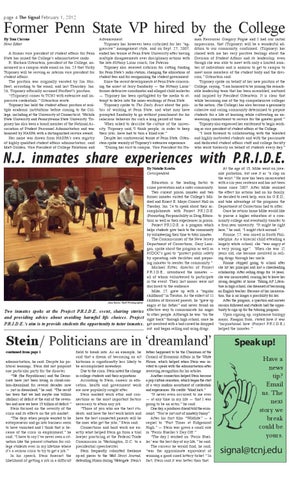
N.J. inmates share experiences with P.R.I.D.E. By Natalie Kouba Correspondent
Jess Davis / Staff Photographer
Two inmates spoke at the Project P.R.I.D.E. event, sharing stories and providing advice about avoiding harmful life choices. Project P.R.I.D.E.’s aim is to provide students the opportunity to tutor inmates.
Education is the leading factor to crime prevention and a safer community. Two current prison inmates and two former inmates visited the College’s Mildred and Ernest E. Mayo Concert Hall on Tuesday, Jan. 24 to speak about their accomplishments with Project P.R.I.D.E. (Promoting Responsibility in Drug Education) as well as their experiences in prison. Project P.R.I.D.E. is a program which helps students give back to the community by volunteering their time to tutor inmates. The Commissioner of the New Jersey Department of Corrections, Gary Lanigan, spoke about the program as well as NJDOC’s goal to “protect public safety by operating safe facilities and preparing inmates to reenter the community.” Michael Ritter, director of Project P.R.I.D.E., introduced the inmates — all of whom volunteered to participate in the event. Their last names were not disclosed to the audience. Mike, 27, grew up with a “regular childhood” in Trenton. As the eldest of 11 children of divorced parents, he “grew up angry at his father” and never found an effective way to communicate his anger to other people. Although he was “on the right track” through high school, once he got involved with a bad crowd he dropped out and began selling and using drugs.
Stein/ Politicians are in ‘dreamland’
continued from page 1
administration, he said. Despite his political leanings, Stein did not pinpoint one particular party for the disaster. “We (the Republicans) and the Democrats have just been living in cloud-cookoo-dreamland for several decades now — just in dreamland,” he said. “The result has been that we had maybe one trillion (dollars) of deficit at the end of the seventies and now we have 15 trillion of deficit.” Stein focused on the severity of the crisis and its effects on the job market. “The days when people wanted to be entrepreneurs and go into business seem to have vanished and I think that is because of the crisis in employment,” he said. “I have to say I’ve never seen a situation like the present situation for college students ever in my lifetime where it’s a serious crisis to try to get a job.” In his speech, Stein forecast the likelihood of getting a job in a difficult
field to break into. As an example, he said that a dream of becoming an art historian is significantly less likely to be accomplished nowadays. Due to the crisis, Stein noted the change in college students and their aspirations. According to Stein, careers in education, health and government work are now popularly sought after. Stein marked work ethic and connections as the most important factors necessary to attain any job. “Those of you who are the best students, and have the best work habits and have the best connected parents will be the ones who get the jobs,” Stein said. Connections and hard work are exactly what helped Stein go from a trial lawyer practicing at the Federal Trade Commission in Washington, D.C. to a presidential speechwriter. Stein frequently submitted freelance op-ed pieces to the Wall Street Journal, defending Nixon during Watergate. Stein’s
father happened to be the Chairman of the Council of Economic Affairs in the White House, which helped when Stein was invited to speak with the administration after receiving recognition for his articles. Another connection helped Stein become a pop culture sensation, which began the start of a very random assortment of credentials and experiences. He credits “blind luck.” “It never even occurred to me ever — at any time in my life — that I was going to be an actor,” he said. One day, a producer-friend told the economist, “You’re just sort of innately funny” After his first film “Wildlife” — a sequel to “Fast Times at Ridgemont High,” — Stein was given a small role in “Ferris Bueller’s Day Off.” “The day I worked on ‘Ferris Bueller’ was the best day of my life,” he said. The success he would find, he said, “was the approximate equivalent of winning a good sized lottery ticket.” In fact, Stein said it was better than that.
At the age of 15, Mike went on juvenile probation, but saw it as “a slap on the wrist.” He now has been incarcerated with a six-year sentence and has not been home since 2007. After Mike realized the effect his actions had on his family, he decided to seek help, earn his G.E.D., and take advantage of the programs the Department of Corrections had to offer. Once he returns home Mike would like to pursue a higher education at a community college and eventually transfer to a four-year university. “It might be right here,” he said, “I might stick around.” Ronnie, 27, was raised in South Philadelphia. As a biracial child attending a largely white school, she “was angry at a very young age”. When she was 12 years old, she became involved in selling drugs through her uncle. Ronnie stopped going to school after she hit her principal and lost a cheerleading scholarship. After selling drugs for 14 years, she was incarcerated, causing her to leave her young daughter at home. Taking AP Literature in high school, she dreamed of becoming an English teacher. Because of her incarceration, this is no longer a possibility for her. After the program, a question and answer session followed and students had the opportunity to sign up for the tutoring program. Upon signing up, sophomore biology major, Raagini Som, stated how it was “inspirational how (Project P.R.I.D.E.) helped the inmates.”
Speak up! Have a news tip? Email us. The next story we break could be yours.
signal@tcnj.edu
February 1, 2012 The Signal page 5
Nursing majors volunteer in rural El Salvador
By Tom Ciccone News Editor
Eight students of the College, in conjunction with the Student Nurses’ Association (SNA) and the Federation of International Medical Relief of Children, embarked on a week-long trip to San Salvador, El Salvador, where they performed vaccinations, provided medical supplies and examined babies and pregnant mothers at a FIMRC clinic in Las Delicias. “Every day we did something different,” said senior nursing major Nicole Feldman in an email interview. From Jan. 8 to 15, the students volunteered with the community health nurse of Las Delicias in performing a multitude of services while going door to door to help local El Salvadorians with their medical needs. “She took us all under her wing and taught us nursing students how she practiced nursing going door to door,” Feldman said. “It was eye opening to see how the people of El Salvador lived and cared for themselves.” They visited local homes, which were usually very small and constructed from cement and sheets of aluminum. Dusty, unpaved roads frequently inflicted the young children of San Delicias with asthma and other respiratory problems, Feldman said. At one point the students helped remove a young worker’s stitches from a cut on his hand that he incurred from working in a coffee bean field. Other days were spent examining pregnant mothers and newborn babies. “One of the biggest challenges was the language barrier,” Feldman said. “By the end of the trip I found myself understanding so much more Spanish than when I got there.” Allison Lazzaro, junior nursing major and history minor, was another student who helped volunteer at the FIMRC clinic in San Delicias. “I helped repaint the rooms and outside of the clinic,” Lazzaro said in an email interview.
Photo courtesy of Nicole Feldman
The nursing students pose with the community nurse of Las Delicias who took the students from door to door helping locals. The clinic was very low on medical supplies, so while patients could be given acetimenophen and vitamins, blood sampling and other lab tests were not available to them, said Lazzaro. The Student Nurses Association provided $1,000 for the students to provide medical supplies for the crowded, undersupplied health center. “The amount of supplies we brought surpassed the amount in the clinic,” Lazzaro said. Aside from repairing the clinic, Lazzaro and the other nursing students gave educational health lessons about hygiene to the locals of San Delicias, explaining proper ways to clean food and prevent the spread of viruses. Lazzaro also gave birth control injections to women. At a house built by volunteers, Lazarro saw the decrepit living conditions of a pregnant woman and
her family. “We didn’t get to learn everyone’s stories, but just seeing the conditions they endure to survive day-to-day life could really tell a lot,” Lazzaro said. “I learned how lucky I am to be blessed with the things I have in my life.” When the clinic closed for the day, the nursing students went to local fruit markets, visited a volcano in San Salvador named “El Boqueron,” observed the Joya de Ceren ruins, embarked on a hiking trail dubbed “La Puerta del Diablo” (The Devil’s Door), dined at restaurants and even swam in a waterfall. Ankita Patel, junior nursing major and psychology minor, helped organize and plan the trip when she was elected to be SNA’s director of multicultural awareness during her sophomore year. “This is something I’ve dreamed about doing since my freshman year at (the College),” Patel said in an email interview. “The most important thing that I learned was getting a perspective on the needs of third world countries and the conditions that some people have to live in,” Patel said. “It’s difficult to really understand the extent of poverty and its effects until you’re standing there surrounded by it all.” “I would absolutely recommend a volunteer trip like this to anyone, but especially nursing students,” said Amanda Blizard, junior nursing major. “We were able to experience first hand what an impact primary preventative programs can have on a population, and were able to help implement such programs.” Other nursing majors that attended the week-long trip were Brittany Boyle, Colleen Rindt, Brielle Roller and Kelly Thompson. “We are all so proud of these eight young women who volunteered a week of their winter break to do something so amazing,” said Maggie Allen, director of public relations for the SNA, in an email interview. “They represent TCNJ Nursing, the Student Nurses’ Association, and what we all stand for, in such a positive way.”
Professor leads lecture on corporate propaganda By Melisa Easaw Copy Editor College philosophy professor Pierre Le Morvan talked about the unsavory techniques corporations use to control public knowledge and opinion as he led this semester’s first politics forum on Thursday, Jan. 26 in Social Sciences Building room 223. Le Morvan’s talk, titled “Corporate Interests and the Manufacture of Unhealthy Skepticism,” focused on the ways in which corporate entities attempt to alter public opinion through the use of skepticism. “The public needs to be made much more aware of how skepticism is being actively used by corporate interests as a tool to manipulate public opinion,” Le Morvan said. The main example he cited was the tobacco industry’s campaign to dispute scientific evidence of the harmful health effects of tobacco. “By the 1950s, it was clear that tobacco was carcinogenic. Tobacco industry executives realized this was a threat to their viability,” Le Morvan said. According to Le Morvan, the tobacco industry hired a “very slick public relations firm” called Hill + Knowlton Strategies to help them impugn the evidence. Le Morvan described the techniques that Hill + Knowlton and other product defense firms use to manufacture skepticism. The first such technique is to “attack scientific findings that threaten corporate interests.” Methods of doing this include repeatedly claiming that the science is not settled and that there is scientific controversy, disputing cause and effect relationships, reanalyzing statistical data and arguing that more research is needed, Le Morvan said. The next technique he described is to “fund controverting studies and cherrypick the findings.” By doing this, corporate interests can divert attention away
from their own product. Product defense firms may do this by supporting research on alternatives and creating think tanks with hired “experts,” Le Morvan said. The third technique the professor spoke about is to “manipulate journalistic values of objectivity, fairness and balance by arguing for equal time in the media for skeptics on the corporate side.” Le Morvan explained that equal reporting of general science and corporate interests’ alternative theories may lead the public to assume that both sides are equally valid. According to Le Morvan, the tobacco industry is only one of many corporate interests that have tried to manufacture skepticism; others include the lead, mercury, chromium 6 and dioxin industries. One of the most important examples today, Le Morvan said, is the campaign to dispute human-caused global warming. Le Morvan described healthy skepticism as a virtue. As Aristotle defined it, a virtue is a “mean between extreme of excess and extreme of deficiency.” Le Morvan applied the Aristotelian view of virtue to skepticism. “Healthy skepticism is a mean between gullibility on the one hand, and cynicism or close-mindedness on the other,” he said. Le Morvan gave several examples of unhealthy personal skepticism. For people who are excessively and unhealthily skeptical “their denial of knowledge comes insufficiently tempered by a genuine desire for truth,” Le Morvan said. The Holocaust denier, the conspiracy theorist and partisan are all excessively skeptical, he continued. For people whose skepticism is unhealthily deficient, “their receptivity to belief comes insufficiently tempered by an aversion to error,” he said. According to Le Morvan, the easy seductee, the email scamee and the evidence-blind parent are deficient in their skepticism.
Tim Lee / Staff Photographer
Professor Le Morvan spoke to students of the College about the disreputable techniques used by corporations to influence consumers’ judgements, such as “cherry-picking” data and manipulating journalism.
Want to write for News? It’s pretty cool. Email tomcasey@live.com and johns244@tcnj.edu.
page 6 The Signal February 1, 2012
February 1, 2012 The Signal page 7
Nation & W rld
Euro, rich-poor gap proved key issue at Davos N.J. News DAVOS, Switzerland (AP) — Europe’s crippling debt crisis dominated the world’s foremost gathering of business and political leaders, but for the first time the growing inequality between the planet’s haves and have-nots became an issue, thanks largely to the Arab Spring uprisings, the Occupy movement and other protests around the globe. The mood at the end of the five-day meeting in Davos was somber, and more than 2,500 VIPs headed home Sunday concerned about what lies ahead in 2012. Despite some guarded optimism about Europe’s latest attempts to stem the eurozone crisis, fears remain that turmoil could return and spill over to the rest of the world. And there were no answers to the widening inequality gap, but a mounting realization that economic growth must include the poor, that job creation is critical and that affordable food, housing, health care and education need to part of any solution. Just before the forum began, the International Monetary Fund reduced its forecast for global growth in 2012 to 3 percent from the 4 percent pace it projected in September. Asia is expected to remain the engine for global growth though at a slower rate, with China leading the way at more than 8 percent, followed by India and Indonesia. IMF Managing Director Christine Lagarde warned that the eurozone crisis is not the region’s problem alone. “It’s a crisis that could have collateral effects, spillover effects, around the world,” she said. The IMF is the traditional world’s lender-of-last-resort and Lagarde is trying to increase its resources by $500 billion so it can help if more lending is needed in Europe or elsewhere. European countries have said they are prepared to give the IMF $150 billion, but that means the rest of the world will have to come up with $350 billion. At a closing panel Sunday, Paul Polman,
Gay marriage bill approved
AP Photo
The mountain resort of Davos pictured during the 42nd Annual Meeting of the World Economic Forum, WEF, in Davos, Switzerland.
CEO of Unilever, said a readjustment in Europe is essential “we’ve lived above our means for too long, and the moment of truth has arrived.” Vikran Pandit, CEO of the global bank Citi, said the euro crisis “is costing us about 1 percent in GDP around the world. You do the math and say: ‘How many people are not working because of that?’” The world needs 400 million new jobs between now and the end of the decade, not counting the 200 million needed just to get back to full employment, so “that should be our number one priority,” he said. To keep the spotlight on jobs and poverty at the forum, the Occupy movement that began on Wall Street and spread to dozens of cities around the world set up a protest camp in igloos in Davos. They demonstrated in front of City Hall. Citi’s Pandit said to create the conditions for growth, economic uncertainty must end and that means quickly resolving the eurozone crisis, ending regulatory uncertainty and getting the public and private sector together to build infrastructure that can create jobs. Unilever’s Polman said it’s unacceptable that
News Bits
Iran’s foreign minister expressed optimism Sunday that a visit by U.N. inspectors to Iran’s nuclear facilities would produce an understanding, despite world concerns that Iran is trying to build nuclear weapons. ... For decades, farmers and fishermen along the Gulf of Mexico watched as their sensitive ecosystem’s waters slowly got dirtier and islands eroded, all while the country largely ignored the destruction. It took BP PLC’s well blowing out in the Gulf for the nation to turn its attention to the slow, methodical ruin of an ecosystem vital to the U.S. economy. ... A professor from American University in Cairo says discovery of prostate cancer in a 2,200-year-old mummy indicates the disease was caused by genetics, not environment. The genetics-environment question is key to understanding cancer. ... Haiti and the neighboring Dominican Republic could be in for a period of frequently occurring powerful earthquakes, according to a scientific study released Thursday. The study said Haiti’s 7.0-magnitude earthquake two years ago is likely to be the first of several quakes of a similarly powerful magnitude. Courtesy of the Associated Press
more than 1 billion people are hungry every day while another billion are obese. When the forum opened, founder Klaus Schwab welcomed critics’ ideas of how to fix capitalism — including from the Occupy protesters, though they walked out of a side event where a representative had been invited to talk. This year for the first time, the forum invited about 60 “Global Shapers” — young leaders under 30 — to the forum to try to address issues confronting the generation that will be running the world in decades to come. The possibility of Iran developing nuclear weapons was among top concerns at Davos. There were also several follow-up panels on the Arab Spring and a session moderated by Schwab with Israeli President Shimon Peres and Palestinian Prime Minister Salam Fayyad, which demonstrated the deep divisions over getting peace negotiations back on track. But although the conflict in Syria — where the U.N. estimates a crackdown on anti-government protesters has killed some 5,400 people over the past year — came up in the Arab Spring panels, it wasn’t a hot issue.
TRENTON, N.J. (AP) — Despite Gov. Chris Christie’s pleas to allow the people to decide whether or not New Jersey should allow gay marriage, a New Jersey Senate panel approved a same-sex marriage bill the same day Christie vowed to veto it. Christie said Tuesday he’d veto a gay marriage bill if it reaches his desk, threatening to upend Democrats’ efforts to push through the Legislature a bill legalizing the same-sex unions. Christie told a town hall audience in Bridgewater that an issue of such magnitude deserves to be voted on by residents, and he urged Republican lawmakers to support a constitutional amendment that would appear on a statewide ballot. “This is a huge societal change ... it needs a lot of consideration,” the firstterm Republican governor said during the event at a Jewish community center. “There are very passionate people on both sides, so let’s have at it. Let them make their opinions known and I’ll make mine known.” Christie’s statement, his most explicit on the issue, came as Democrats in the Senate were holding a hearing on gay marriage legislation. While campaigning for office, he said he thought voters should decide on any such major change in law. Senate President Stephen Sweeney, a Democrat who sponsored the bill, said civil rights issues like the right to marry are guaranteed under the state constitution and do not require a public vote.
Revealing slain victims’ rap sheets draws fire NEW ORLEANS (AP) — As Mike Ainsworth walked his two sons to a school bus stop, he heard a woman being carjacked scream, and ran to help. The woman was not hurt, police said, but the Good Samaritan was shot to death by a suspect who fled. When police gave out the details of Ainsworth’s killing, they also announced he had been arrested for drugs and other non-violent crimes, keeping with a year-old policy in which criminal records for slain victims are released — sometimes before they’ve been publicly identified. New Orleans police say revealing a victim’s rap sheet lets the public know that much of the violence is happening between people with similar criminal backgrounds. Families of the slain victim’s say the practice is insensitive, and others outraged with the policy say it has racial overtones and sends a message that the victims got what was coming to them. “I don’t understand why they want to do it,” said Kathryn White, whose 25-year-old son was gunned down in what she said was a case of mistaken identity. White said her son was arrested just once for a small amount of marijuana. “You are already in so much pain and then you have to see people saying bad things about your dead child. What good does that do anyone,” she said. In a city often cited as the nation’s murder capital — more than 20 people have been slain so far in
AP Photo
Ainsworth attempted to be a good samaritan, but was murdered and slandered. January — police are hard-pressed to find solutions. Police Superintendent Ronal Serpas said publicizing arrest records gives a better picture of the killing, which authorities said usually involves young men who are killing people with similar backgrounds. Serpas estimated 62 percent of those killed in 2011 had prior felony arrests. He said 40 percent of people arrested for murder in 2011 — and 39 percent of those killed — had previous arrests for illegal possession of a firearm. Mayor Mitch Landrieu and Serpas acknowledge New Orleans’ per capita murder rate is 10 times the national average. In 2011, there were 199 murders in a city of 344,000, up from 175 in 2010. However, those numbers are far less than the 400plus killings during some years in the 1990s when the pre-Hurricane Katrina population was higher.
Many big-city police departments avoid a blanket policy of releasing criminal information on victims. In Baltimore, for example, police track whether homicide victims had criminal histories, but people who inquire are referred to online court records. In 2011, 80 percent of murder victims had criminal records, according to Baltimore police. “We may confirm whether the person was known to the police if we’re asked, but we try not to disclose too much information about victims for their privacy and security,” said department spokesman Anthony Guglielmi. Whether a murder happened in New Orleans, New York or Nashville, there often are common threads, experts said. “What the New Orleans department is responding to and is true everywhere, is the nature of criminal homicide is that both the offender and the victim tend to have robust criminal records,” said David Kennedy, a professor at New York’s John Jay College of Criminal Justice. “Today’s victim is very likely to be yesterday’s perpetrator.” Releasing crime records selectively might have unintended consequences, said Charles Ewing of the University of Buffalo Law School. “One of which is to say to the average citizen that this is not going to happen to you,” Ewing said. “You are a law-abiding citizen so you are safe, which is not always true.”
page 8 The Signal February 1, 2012
February 1, 2012 The Signal page 9
Editorial Why can’t people speak for themselves? Free speech is a wonderful thing, and a given right for everyone — unless of course that person’s employer prohibits it. Back when I was news editor for The Signal, I turned to my co-editor one night and said something along the lines of “Someday I’m going to hang a plaque in the newsroom that says ‘All Roads Lead to College Relations.’” That was two years ago, and I never did hang Illustration by Brianna Gunter such a plaque, but my proposed slogan would be just as According to Editor-in-Chief Brianna Gunter, when attempting to gather quotes from faculty or staff, “All roads lead to College Relations.” true today as it was then. As you may notice from reading Signal articles, a certain few people tend to be quoted A LOT. I have no issue at all with the department of College Relations. On the contrary, I very much appreciate the work What was Ben Stein’s best gig? those people do. After all, I know it isn’t easy having to speak for so many different people each week. • Economics teacher in ‘Ferris Bueller’ What is frustrating, however, is that there seems to • Clear Eyes commercials “The day I worked be very few faculty or staff members, or even student • Hosting ‘Win Ben Stein’s Money’ on ‘Ferris Bueller’ employees, who are permitted to speak freely to the • He’s done so much! I can’t decide. was the best day media. Instead, Signal staffers seeking opinions or • Who’s Ben Stein? of my life.” comments while on article assignments are almost immediately directed to College Relations. — economist and cast your vote @ tcnjsignal.net ! This often happens for even the lightest of stories. pop culture On countless occasions, someone has agreed to talk phenomenon with our writers, only to later back out. The explanaBen Stein Previous poll’s results tion that follows is usually sparse, and of course, reWhat was your first job? sults in the writer being directed to the office of College Relations. • Babysitting. 50% So, I can’t help but question just why is it that the “It didn’t seem like • Retail. 17% administration does not seem to trust its own employI did so much. I • Working at a restaurant. 33% ees. Sure, I understand that people everywhere cringe • An office job. 0% just went with my at the “big, bad media” and the College only wants to • I’ve never been employed. 0% make sure that it is always seen in a positive light. Hey, instinct.” we all want to be liked, don’t we? However, the situ— junior business ation often just appears worse (for the administration) major Christy Wham, when doors suddenly slam shut and the only open one who stopped a burning leads to a small group of people, albeit well-meaning, van and was awarded tcnjsignal.net who only “represent” the situation and are not actually Ewing’s “Citizen’s Mailing Address: Telephone: part of it. Again, this is particularly aggravating when Hero Award” The Signal Production Rm - (609) 771-2424 the story is on the lightest and least-probing of subc/o Brower Student Center Business Office - (609) 771-2499 The College of New Jersey Fax: (609) 771-3433 jects. Although really, I suppose I should throw it out P.O. Box 7718 Email: signal@tcnj.edu there that The Signal is not now, nor has it ever been, Ewing, NJ 08628-0718 Ad Email: signalad@tcnj.edu out to “get” anyone. “Honey, those Editorial Staff Some may point out at this point that this is what the shoes are real world is like, and such practices are followed by Brianna Gunter Ashley Long large corporations, the government and others, but in Editor-in-Chief Photo Editor beautiful! How the gunter2@tcnj.edu longa1@tcnj.edu my college career I’ve learned that free speech is one of hell do you walk Jamie Primeau Sydnee Weinbaum the best things about this country and trusting someone Managing Editor Production Manager in them?” primeau2@tcnj.edu Andrew Miller is a sign of respect. So, if the real world really is one Tom Ciccone Nation & World Editor where people aren’t trusted to speak for themselves, I — senior journalism News Editor Melissa Easaw major Chloe Nouvelle, must say I’m not looking forward to graduation. tomcasey@live.com Copy Editor Kelly Johnson Chris Molicki quoting a stranger’s News Editor Sports Assistant reaction to her – Brianna Gunter, Editor-in-Chief johns244@tcnj.edu Matthew Mance rhinestone heels Alex Wolfe Photo Assistant
The Weekly Poll:
Editorial Content Unsigned editorial opinions are those of the Editorial Board, which consists of the Editor-in-Chief, the Managing, News, Features, Arts & Entertainment, Opinions, Photo and Sports editors and the Business Manager, unless otherwise noted. Opinions expressed in signed editorials and letters to the editor are those of the author and not necessarily those of The Signal.
Sports Editor wolfea1@tcnj.edu Brendan McGrath Features Editor mcgrat28@tcnj.edu Julia Corbett Arts & Entertainment Editor corbetj3@tcnj.edu Frank Orlich Opinions Editor orlichf1@tcnj.edu
Quotes of the Week
Emilie Lounsberry Advisor Business Staff Dan Lisi Business/Ad Manager Natalie Schiavi Business Assitant
“We’re Lion Strong.” — head wrestling coach Joe Galante
page 10 The Signal February 1, 2012
February 1, 2012 The Signal page 11
Opinions The Signal says ... Stop: using larger fonts on periods to elongate essays, letting your laptop die, caring about the Pro Bowl. Caution: Madonna halftime show (what happened to Bruce Springsteen and The Who?), Bill Belichick’s cutoff hoodie. Go: for a run while the weather allows it, watch a funny movie, get a full night’s sleep, get that cough checked out, listen to a new song.
Policies
The Signal is published weekly during the academic year and is financed by the Student Activities Fee (SAF) and advertising revenue. Any student may submit articles to The Signal. Publication of submitted articles is at the discretion of the editors. The letters section is an open forum for opinions. Submissions that announce events or advertise in any way will not be printed. All letters should be sent via e-mail to signal@tcnj.edu. Handwritten letters should be sent to The Signal, c/o The Brower Student Center, The College of New Jersey, PO Box 7718 Ewing, N.J. 08628 or placed in our mailbox in the Student Life Office. Letters must be received by the Friday before publication and should not exceed 300 words. The Signal reserves the right to edit letters for space and clarity. All letters must be signed, with a phone number and address of the author. Requests to withhold the author’s name will be honored only if there is a legitimate reason. All materials submitted become the sole property of The Signal. The editors reserve the right to edit or withhold all articles, letters & photographs. The Signal willingly corrects factual mistakes. If you think we have made an error, please contact The Signal at (609) 771-2424, write to the address listed above or e-mail us at signal@tcnj.edu.
Actions speak louder than words
By Frank Orlich Some three years ago, I was sitting in the auditorium of my high school watching the inauguration of President Barack Obama. Many students had fought to ensure we would be able to watch the first African-American President in American history get sworn in. I was younger then, only midway through my junior year of high school. I was just starting to develop my appreciation for politics, and 2008 was really the first election I participated in. Unfortunately, I couldn’t vote yet, but I was able to watch as the primaries unfolded and the race heated up. I wasn’t sure who I particularly liked in the election. Growing up in a conservative household, I’d always considered myself something of a Republican, but after eight years of failed policy in the Bush administration, it was difficult to support the same ideals that got us into such a big mess. Still, I was wary to support Barack Obama. A young, ideological Democrat, Obama had a very limited service on the national level. His political inexperience and leftist voting tendencies made me at least question if he could handle the pressure of being the face of the nation. In many ways, I was somewhat happy I couldn’t vote in 2008. In his inaugural speech, Obama projected an optimistic tone, matched by his charisma and coherency. He spoke with conviction, comparing his new administration to classic stories within our nation’s history. He spoke of a bright future for America, made promises to the people, and led a surge to restore responsibility in Washington. About half way through the speech I leaned over to one of my friends and said, “If he can lead as well as he can speak, we’re in for a good four years.” Unfortunately, as Obama proved once
AP Photo
Obama delivered his third State of the Union since the start of his presidency. The question is, will his words evoke real change?
again last week during his State of the Union address, talking about positive change and actually instilling positive change are two wildly different things. In the speech, Obama talked about “the American within our reach,” a romantic term to describe a land that leads the world in education and personal prosperity. He pulled from our country’s history, touching upon World War II and the Great Depression, as pivotal situations America has gotten through. He spoke about bring manufacturing back, financial regulation and education. And each line was wonderfully crafted, inspirational, and enthusiastic. But that’s where my praise ends. The unemployment rate is still dastardly high. The economy is still stagnant. The country still faces a debt crisis that threatens to destroy us from within. We’re still spending more than we take in. We still have 900 bases in 130 countries. And we’ve just announced
that the Fed has destroyed 95 percent of the purchasing power of the dollar since 1913. Ronald Reagan earned the moniker “The Great Communicator” for his public speaking skills. But equally as good was his ability to lead. Being the president isn’t just about being at home in front of a microphone. It’s about maintaining a good relationship with congress. It’s about being respected around the international arena. It’s about passing sensible legislation that solves the myriad of problems plaguing our country today. This election has a much different feel for me than 2008 did. I’m older, hopefully wiser, and at 19, I can actually cast a vote. I don’t know who is going to win, but I hope whoever does places precedent on doing rather than saying. Presidents are never remembered for what they say, but rather what they do. Because as we all know, actions will always speak louder than words.
imdb.com
“In all matters of opinion, our adversaries are insane.” Opinions, Groucho Marx has one. Email yours to Orlichf1@tcnj.edu! imdb.com
page 12 The Signal February 1, 2012
February 1, 2012 The Signal page 13
Features
The Rat responds to requests, freshens up old menu By Jamie Primeau Managing Editor
Up until last semester, food options in the Rathskeller mostly meant various items topped with mozzarella sticks. Now the Rat has ditched the sticks, and has insteadswitched to fresh mozzarella cheese and tomato bruschetta atop their Margherita burgers and cheesesteaks. Why? Its menu has gotten a makeover. Though mozzarella sticks still appear among the appetizers, they are joined by 11 new pre-meal options, according to Joanna Brunell, marketing manager of Dining Services. These include popcorn chicken, flatbread bruschetta and mac & cheese bites. Another surprise: Curly fries are no longer a staple at the Rat. Instead, the potatoes are now are served as waffle fries. This change in spud shape is a direct result of students’ comments regarding what they wanted to see in this dining facility that doubles as a pub. “We love getting feedback from students and we take survey results
Matthew Mance / Photo Assistant
The bright new Rat menu offers some of the same, but might have a fresh twist. and comment cards seriously,” Brunell explained in an email, adding that employees’ opinions are also considered. “Based on student input … we knew that there was a desire for change.” “After looking at what products sold well at The Rat, we decided that we had some opportunities to remove or rework some of the items,” she said. Additionally, a new executive chef George Miliaresis joined the College’s dining team and Brunell classified him as “a real catalyst for change.” “Prior to this hire, we had one
executive chef for all dining operations on campus, but now Chef Miliaresis focuses solely on our retail dining operations and is therefore able to dedicate much of his time to the food we offer,” she said. The menu now includes “standard pub fare,” according to Brunell, such as sausage, peppers and onions, fish & chips and turkey burgers. There is also a new line of “Naan-inis,” which are flatbread sandwiches grilled in a panini press, including Mediterranean grilled chicken or falafel. “We have definitely seen a positive jump in customer counts that
was not expected,” Brunell said, who noted an 18 percent increase in sales since this time last year. While the eatery still experiences the madness of meal equiv, this is not its only busy time. “We have found that students are coming back through the afternoon and bringing life to The Rat in the evening, where in the past, it was a ghost town,” she said. Though the increase is good for business, not all customers are pleased. Some admitted to waiting for over an hour or more to receive food on busy days. Nevertheless, students appear to
Dancing dragons, astrology and Stud Push specials ring in Chinese New Year
By Samantha Sorin Columnist
Tim Lee / Staff Photographer
The Stud came to life with a traditional dragon dance celebrating Chinese New Year. By Amy Reynolds Staff Writer Chinese food, music and culture filled the Brower Student Center on Thursday, Jan. 26 in celebration of the Chinese New Year. The festivities included a demonstration of the traditional dragon dance, festive decorations, fortune cookies and Chinese astrological calendars. “It was an interesting change of pace. It’s nice to celebrate a different culture,” said Tom Leonhardt, freshman history and secondary education double major. “Most days, the Stud is boring and slow-paced.” In addition to the drumming and decorations, the Lion’s Den also had special Chinese selections. “It was nice to have a change in the dining,” freshman finance major Nick Rubino said. “The same food gets boring after a while.” In addition to the new cuisine, astrological calendars also gave insight to the traditional Chinese culture. The Chinese Zodiac is based on a 12-year cycle, with each year represented by a different animal. The traditional Chinese belief is that the
year in which a person was born holds the key to his personality and well-being. For example, those who are born in 2012, the year of the dragon, are said to be full of vitality and enthusiasm. These people are typically intelligent, gifted and perfectionists. They would do well as an artist, priest or politician. “I liked reading about my own personality,” said Nina Ventresco, freshman psychology major. Although the food was delicious and the music enjoyable, the most interesting part for many was reading their fortunes. Freshman history and special education double major Diane Iannacone’s fortune read, “You will be attracted to an older and more experienced person.” Other fortunes included “New and rewarding opportunities will soon arise” and “You will get more secure and confident in your relationships with coworkers.” Overall, the celebration was a success. Freshman economics major, Matt Scapardine stated, “I appreciate the presence and the awareness of the Chinese new year. It was festive and fun.”
appreciate the new options overall. “I like the new selections,” said Rosanna Percontino, junior psychology and special education double major. “It’s great we have different choices.” “Even if you want to eat healthy, there’s the new paninis,” she continued. “And the popcorn shrimp is really good. You want something different — after a while you’re going to get bored if you’re eating in the same place.” Not only can students grab a bite for lunch or dinner, but the Rat also opens every Saturday and Sunday at 9 a.m., offering new omelets and breakfast sandwiches. Expanding upon early morning eating, Brunell said, “Every last Sunday of each month, we’ll have a special breakfast called the Last Sunday Jazzy Breakfast that includes an endless stack of specialty pancakes and live jazz music. This event is co-sponsored by (College Union Board).” Dining Services encourages students to offer input by attending their committee meetings, which are held every other Wednesday in BSC 239 at 2 p.m. The next meeting will be on Feb. 8.
your limits
It is said that though the risk takers do not live long, the cautious never live at all. Fear stops many people from pursuing passion over practicality, uncertainty over security, the unknown over the familiar. And though we may have roadblocks that do not allow us to follow our desires no matter how much courage we possess, our minds may be the biggest obstacles of all. Yes, there are limitations in life, but we need to distinguish our physical limitations from how we are limiting ourselves mentally. In yoga, many people are told that they can do anything. In reality, this is not always the case. Though yoga is — and can be — for everyone, every pose is not for everyone. Specifically, some people’s bones are fused so that they may never be able to do a full split. This shouldn’t take away from the pursuit of the pose, but we must understand that everyone has their own blueprint, their own body, that can be used in certain ways. Recognizing these boundaries can help reduce injury. Shying away from a full split because it is a long road for someone with tight hamstrings, on the other hand, is the
mind’s work at play. For the longest time, I could not do a handstand. I told myself my arms weren’t strong enough. Once my arms were able to hold myself up, I said my core was too weak, and that I needed to work on it before I could ever even think about popping into a handstand. I excused myself from the pose every time it was offered in yoga class. I would pick another pose to do, get a drink of water or fix my ponytail. What I did not realize was that my body was strong enough — it was my mind that was holding me back. It was my mind that needed the work. I had a fear of going upside down, and until I acknowledged it, it wouldn’t matter how strong I was or how great I was at handstands. My mind would always bring me down in the end. Today, when handstands are offered in class, I don’t back down. I plant my hands at the top of my mat, I look forward, and levitate on up. Furthermore, if I were to look down or back, I will never be able to get my feet off the ground. It is only when you look forward—when you look past the line you have drawn for yourself—that you will truly see growth, magic and happiness. It is only then, you will see that you have started your path on the right foot … or maybe even the right hand.
page 14 The Signal February 1, 2012
INTERNATIONAL FILM FESTIVAL Rated by Rotten Tomatoes 7 February 2012 6:00 PM Library Auditorium “Good Bye, Lenin!” follows Alexander Kerner, a young Berliner who watches his mother fall into a coma during anti-government protests just prior to the fall of the Berlin Wall. She is not conscious of the radical political change of ’89 and now Alexander and his family must create an alternate reality to protect their ailing mother. We witness the birth of a new East Germany, one that is contrary to many of our assumptions regarding communism. Both a challenge to standard binary views of the Cold War and a seminal piece of Ostalgie (nostalgia for the East), this charming film swept the 2003 German Film Awards.
Discussion led by John Benjamin, German Professor. If you have questions or comments please contact the Department of World Languages & Cultures @ 609.771.2235. The International Film Festival is sponsored by: Department of World Languages and Cultures The School of Humanities and Social Sciences The School of Arts and Communication The Center for Global Engagement TCNJ Center for the Arts
February 1, 2012 The Signal page 15
‘Rush’ out for recruitment
Campus Style never wear pants to my internship. Where do you gain inspiration? I absolutely love Topshop and J Crew. I gain inspiration from their racks (always ignoring the price tags, of course!).
Victoria Moorhouse / Columnist
By Victoria Moorhouse Columnist Chloe Nouvelle, senior journalism major What are you wearing and from where? A blue and nude panel dress from Topshop, with nude rhinestone-heeled pumps from Shoedazzle. Interns usually get trapped in black dress pants and colored oxford shirts, but I find those choices tedious. I love fashion, and I feel I can still express my interest in trends while maintaining a professional, conservative style. What’s your favorite piece in your outfit and why? My shoes, because they actually made a stranger stop crying and say, “Honey, those shoes are beautiful! How the hell do you walk in them?” How would you describe your style? Simple, classic and feminine. I love fit-and-flare dresses as well as shift dresses. I
Have you always been interested in fashion and if so, why? I’ve always had an interest in fashion. As juniors and seniors taking on internships, it’s important to fill our closets with sturdy, wearable pieces that are classic and can be updated with accessories to keep in trend or season. In an entry-level position, you need to be sure to leave a good impression. To do that, you need to be noticed! What is one article of clothing or an accessory you can’t leave the house without? A big, sturdy bag. It makes every outfit look more put together. What stylish celebrity do you admire the most? If I could raid anyone’s closet it would definitely be Kate Middleton. Who doesn’t want to dress like a princess?
By Igor Ponomarev Columnist
Remember sitting with your high school friends, watching college classics like “Old School” and “Animal House” as you prepared for your journey into four years of what you thought was going to be just like one of those films? I bet it surprised you when you arrived and saw no red Solo cups scattered across the fields or any passedout students in front of Travers and Wolfe Halls. Though the College doesn’t possess the stereotypical Greeks portrayed in the media, our Greek community still consists of more than 16 percent of men and 13 percent of women on campus. With recruitment season coming up, it can be difficult to pinpoint reasons to join or avoid Greek life, but everyone tends to find his or her own motivation. It allows students to develop a social base and meet new people in other organizations, as Greek life often operates as its own small community. Also, connections with brothers, sisters and alumni absolutely last past graduation, as many of our chapter’s alumni continually meet up around N.J. for sport games and weekend barbecues. On top of that, an overwhelming majority of the student body tends to be from the state, which helps keep these bonds from dissolving. When meeting the members, students will find that over 80 percent of Greeks have other roles around campus, including members of athletic teams, ambassadors, community advisors and really anything there is to be involved in. Some do join Greek life for the good times, and I won’t hold that against anyone. If able to push aside the stereotypical image of the “party Greek,” one will find that most organizations perform hundreds of hours of community
What is one trend that you will never try again? Cut up tees. I looked like I just fought a Somali pirate. Any fashion or style tips for students at the College? Invest in your professional attire. Buy something you love, and that will last. In the long run, you’ll be saving time, money and frustration.
Tim Lee / Staff Photographer
Greek life will begin recruiting soon, as freshmen and others decide to rush.
service and donate thousands of dollars to various charities. Recruitment events highlight what makes each organization different. For example, one sorority may be more about community service while another fosters deep sisterhood bonds. Or a particular fraternity has great intramural teams while another is dedicated to progressing their education. Small things like this ultimately push a person to find his or her best fit. One sister recommends going “through rounds with an open mind instead of listening to all of the stereotypes you hear about each sorority.” Now, onto the gritty details of the process leading up to your eventual membership. For sororities in the Panhellenic Council, the process is long, but offers the best chance for potential new members to meet each organization’s sisters. Interested students will participate in a two weekend long round robin process of mutual selection. A group of Rho Gammas — or recruitment guides — composed of sisters from each sorority, stays neutral during the process to help each student make an educated decision. This all culminates with a Bid Day party, where sorority sisters sport their colors and each new member is revealed. Fraternities in the Interfraternal Council tend to have a slightly less-planned recruitment process, where the individual interested is more open to step out and look for an organization. Flyers and banners advertise each fraternity’s interest session times and locations, and it is up to the student to choose which sessions he will attend. Personally, I attended rushes for four fraternities before ultimately coming to my decision, and I encourage every student to go even further and look anywhere they have the slightest interest in. Upon completing the round robin for sororities or rush sessions for fraternities, some will be invited back for preference rush, often abbreviated as “pref,” where they are given a more personal chance to meet the brothers and sisters, and in return present their desire to join the organization. Once that concludes, organizations decide who matches up with their ideals and members, and they then hand out bids, or formal invitations to join their organization. By then, students begin pledging, which is a whole different subject. That is still weeks away, but until then, I encourage you to attend recruitment events, meet brothers and sisters and see where you belong and why you are looking to join the Greek community. After all, you will be spending years of college with them, and after graduation you will experience the benefits of your decision.
A walk through Spain is pleasant and rewarding By Juliana Fidler Foreign Correspondent
To be honest, I was a little nervous (OK, a lot nervous) before I left for my semester abroad — going to a completely unfamiliar place with not one person I knew was pretty daunting. But I have been in Granada, Spain for about three weeks, and I already
have enough to say about it to fill the entire Signal Features section. What I found when I got here was worth the worry on the flight over — and I still have four months’ worth of things to see! I could write all about the truly incredible, vast yet intricately-designed Alhambra (the fortress, palace of Muslim kings and residential city of the final kingdom to be
Juliana Fidler / Foreign Correspondent
The Spanish street is light on traffic as college students make their way to class and back home on foot.
conquered by the Catholic Monarchs, Ferdinand and Isabel, in order to unite Spain), or the Albaicín (the old, beautiful Arab district, complete with winding narrow streets and breathtaking views of the Alhambra) or the grand Cathedral. I’ll save them for my blog, though, and write about the little things that have defined my experience so far. Probably the most distinctive characteristic of daily life in Granada is that the people walk everywhere, pretty much all the time. There are cars, of course, but you would never see a college student driving to school. My house is a 25-minute walk from the University of Granada’s Center of Modern Languages, where I have my classes, and for a college student on a budget, this is the perfect situation: It’s close enough so that I don’t have to pay for a bus to take me to and from school. As far as my residential situation goes, living in a “homestay” with a family is probably the best decision I made when preparing to study abroad. I’m so much less homesick than I thought I would be, and I’m pretty sure it’s because I’m staying in an actual home. I still miss my family and friends, but being with my host family has helped a lot. My Spanish has been improving a lot because of them, too. When
my roommate and I don’t understand what they’re saying (often a result of the Andalusian accent, which drops almost every “s” and “d” from the middle and end of words), one of our host sisters will speak more slowly and enunciate for us. But even in just three weeks, understanding has gotten easier for us both. One of my favorite parts of living here has been helping my younger host sisters (twins, age 15) with their English homework. It can be a challenge to explain concepts of English grammar in Spanish, but it’s basically an ideal situation for an English major and Spanish minor such as myself, and I’ve actually been fairly successful. I have fun bonding with them over shared mockery of their English textbook, which uses words like “swimming costume” (it’s British). It’s just one of the little things that makes me feel more at home. I guess the point of all my rambling and musings is that I’m glad and grateful that I’m here, at this time, with these people, and I know the next five months will be some of the most exciting of my life. And seeing the snow-covered Sierra Nevada Mountains on my way to and from school is not so bad, either.
page 16 The Signal February 1, 2012
SUMMER JOBS! CSMS has open positions as a: GUEST SERVICES STAFF MEMBER For the SUMMER 2012 Camp and Conference Program ********* COME JOIN A DYNAMIC TEAM OF YOUR PEERS GAIN VALUABLE AND MARKETABLE EXPERIENCE IN LEADERSHIP, CUSTOMER SERVICE, OPERATIONS, COMMUNICATION AND INTERPERSONAL RELATIONS
Advance with The Signal
Advertise with us
******** ●Full Time & Part Time Positions Available! ●Competitive Salary! ●40-hour Work Week Guaranteed! HOUSING AND PARTIAL MEAL PLAN INCLUDED!!!! Work involves many weekend and night hours. ****************************************** INTEREST SESSIONS (Detailed info. about the job)
googleimages
Email us at signalad@tcnj.edu
Arts & Entertainment
February 1, 2012 The Signal page 17
Black and white images pop in kickoff art exhibition By Emily Van Malden Correspondent
Black and white drawings jumped off the vanilla walls of the TCNJ Art Gallery. These were the dark-noir, never-before-seen works of Raymond Pettibon, an ex-drummer turned powerful artist. The “Raymond Pettibon: Early Drawings” exhibition opened on Wednesday, Jan. 25. This private collection features the early works of Pettibon, who started his drawing career by creating album art for his punk rock band, Black Flag. From afar, these works appear harmless, simple depictions of everyday life. It isn’t until a viewer gets up close and personal with the art that one can read the words etched onto the paper in ink. “You don’t expect (the artwork) to be as provocative as it is,” said Emily Croll, director of the gallery and coordinator of the exhibit. An example of this provocativeness is a drawing of Jesus that hangs on the far left wall. At first glance, it appears to be a simple portrait, but closer inspection reveals the words “Cross and have done with it, you are safe — and I am desolate.”
Kate Stronczer / Staff Photographer
Raymond Pettibon’s black and white drawings will be on display until the end of February.
President of the Art Student Association and senior graphic design major, Lindsey Hardifer, said that because Pettibon uses jarring text and images in all of his works, he “forces the viewer to find a relationship between the words and the drawing.”
Croll agreed and further described Pettibon’s style as a “disjuncture of words and images and meaning.” “If anything, his message is that there shouldn’t be one message,” she said. This theme is supported by the fact that all of Pettibon’s drawings are left untitled, leaving viewers to come up with their own explanation. According to Croll, this theme is reinforced by the presence of many different symbols throughout the exhibition, ranging from violence and unrest to religion and mobility. Croll noticed one common thread connecting this — Pettibon’s love of infinite motion, which can be seen in his drawings of stark moving trains as well as his surfers and baseball players, always in mid-stride. The exhibition also includes a video projected on the wall, made by Pettibon. For this, Pettibon animated some of his earlier works together, with words thrown onto the screen. The narration of the video creates even more discord with the simultaneously presented images “The Raymond Pettibon: Early Drawings Exhibit” will be open until Feb. 29 after which the “Illuminating Date: Visualizing the Information that Moves Our World” will open in mid-March.
Brown Bag Series: aid to 9/11 memorial
Photo by Andrew Bak
A new online forum and an iPhone application enhance a media design firm’s 9/11 commemoration project. By Thalia Ortiz Staff Writer Technology made its way into everyday public spaces in the first Brown Bag event of the semester. Ian Curry, director of Interaction Design for Local Projects, a media design firm, spoke about the firm’s recent work on Friday,
Jan. 27 in the Mildred & Ernest E. Mayo Concert Hall. Local Projects is responsible for several award-winning designs, including the 9/11 Memorial, which opened this past September. Curry explained that the firm took a storytelling approach to the memorial and through this commemorated the victims of the tragedy through an interactive museum. By sitting down with a software visualization expert, Curry and his team were able to create the basis for the memorial’s final layout. Aside from typical information gathering approaches, in order to effectively tell the story of the event, the company was able to incorporate an audio picture slide show into the museum of people who spoke about their reactions to first finding out about the tragedy that morning. Local Projects also created a 9/11 app for the iPhone called “Explore 9/11.” The app has several distinct features, such as allowing its users to search for pictures that were submitted by people to the Make History section of the museum’s website. Anyone is able to upload images of the event as it happened or its aftermath, and through this, users can see the various parts and places of Manhattan where the images were captured. “You can kind of get a sense of what it
was like to be there that day,” Curry said. Recently, Local Projects was able to revamp the arena of online discussion forums. The firm also created a series of interconnected touch screen devices called “The Wall: The Great Civil Debate.” This interactive Wall was incorporated into the Bob Graham Center of the University of Florida, where students, teachers and citizens could voice their opinions on various topics. According to Curry, every two weeks questions are posted for users to comment on or discuss. For example, the most recent question asked whether or not children of illegal immigrants should be in school, to which over 200 people replied with their opinions. “The big change between this and online forums is that this isn’t anonymous and people are very visible,” Curry said. “We try to ask questions that are hard to answer.” The flat screen panels even contain highresolution cameras, which take pictures of people participating in the discussion so that other people can visualize and see who they are speaking to. This week’s Brown Bag Series also incorporated social media through Twitter where during the presentation, screen projectors were used to display live tweets from audience members about the lecture.
This week in photos
Tim Lee / Staff Photographer
The Mixed Signals kept students entertained at their first show of the semester on Sunday, Jan. 29 in the library auditorium.
Nada Surf fails to impress with newest album By Matthew Jannetti WTSR Music Director
Nada Surf “The Stars Are Indifferent to Astronomy”
nadasurf.com
Nada Surf has been around since the the early ’90s, releasing their debut album, “High/Low,” in 1996. The group’s early albums had some critical success and Nada Surf became one of the bigger indie bands. However, “The Stars Are Indifferent to Astronomy” has some serious problems. First, Nada Surf seems to be stuck in the ’90s because their
sound hasn’t changed much over the years. It seems like time is finally catching up with them. This time around, they play a little faster and louder, but that’s pretty much the extent of their variation. The major problem with the album is the lyrics, which are mostly, simply put, cheesy. It’s not something that is apparent when you first listen, but when you start paying attention to what frontman Matthew Caws is actually saying, it becomes hard to take the track seriously. However, there are a few bright spots on this album. “Let The Fight Do The Fighting” and “The Future” show that Nada Surf can still create more serious and mature tracks. “The Stars Are Indifferent to Astronomy” is not a good album, but there is nothing on this album that cannot be fixed. Nada Surf isn’t dead, but they do need to take a serious look at themselves after this release. Focus Tracks: “Let The Fight Do The Fighting” and “The Future” Additional Info: Nada Surf Hailing From: New York, New York Genre: Similar to ’90s Pop
Vicki Wang / Staff Photographer
CUB Rat’s first Student Band Night of the semester had an interesting blend of songs and instruments on Friday, Jan. 27.
page 18 The Signal February 1, 2012
Fun Stuff Yeah, this is Pokémon-themed Fun Stuff. It was bound to happen sometime.
GOTTA CATCH ’EM ALL! ...except these losers.
Magikarp
The original stupid ass Pokémon that nobody wanted. Redeeming quality: he turns into badass Gyarados.
Skuntank
I get the skunk part, but where’s the tank? Also, it’s just a normal animal masquerading as a Pokémon.
Pachirisu
Pikachu. Ripoff. Pretty much looks like the lovechild of Pikachu and an overexcited squirrel.
Vanillite
This is an ice cream cone. This is not a Pokémon. He also moonlights as an ice cream truck topper.
These Pokémon are powered by great coloring skills! Coloring inside the lines gives them an HP boost! I know, I treat you all like you’re five. Just humor me.
Bidoof
This pretty much looks like one of the graphic designers shat on a piece of paper and gave it beaver teeth.
Garbador
Guess what his first form is? Yeah, a trash bag. This is what Pokémon have come to.
Litwick
This little guy evolves into a lamp. Named Lampent. Inanimant objects seem to be all the rage right now.
Gurdurr
Designer: Hey, this one has a girder. What sounds like girder? Friend: Gir... Durr, I dunno. Designer: Perfect!
Shout out to Digimon. They were pretty awesome, too. And they weren’t restricted to just saying their name over and over.
February 1, 2012 The Signal page 19
Email signal@tcnj.edu to help us name our new beta fish! You can name it whatever you want! However, I suggest Fishbob Finpants.
Word find. Super Bowl style. Giants Patriots Rematch Super Bowl Field Goal Football Indianapolis Touchdown
The most thoroughly misleading and stupid holiday of the year is coming up!
Remember Vince? Me too! I think I just saw him on TV again. Therefore, here are the best Vince quotes.
Groundhog Day! Enjoy this groundhog!
“You’re gonna love my nuts!” “You know the Germans always make good stuff.” “Olympic divers, they use it as a towel.” “There’s your mildew, that is gonna smell! You see that?” “We’re gonna do this in real time.” “You followin’ me camera guy?” “Sham Wow, you’ll be saying ‘Wow!’ every time.”
page 20 The Signal February 1, 2012 Premier Dedicated Off-campus Housing Serving TCNJ
ATTN: UPPER CLASS STUDENTS
WE’VE GOT HOUSING FIRST MONTH FREE RENT! Assigned Parking Only 1.9 Miles from Campus 4.3 Acres of Wi-Fi Access Tranquil Setting - Safe Area Laundr y Room On-Site Fire Pit - BBQ Sites
DEVON: 516-236-0269 FACEBOOK.COM/CLUBTCNJ WWW.CLUBTCNJ.COM
TCNJ Study Abroad Fair Wed Feb 8, 11am-2pm Social Science Building Atrium Our study abroad partners and peer advisors will be available to talk about your study abroad options for Maymester 2012, Summer 2012, Fall 2012, and Academic Year 2012/2013. For application materials and program options, please go to
www.tcnj.edu/global Green Hall 111
E-mail goglobal@tcnj.edu to set up an advising appointment
Men’s Basketball
Women’s Basketball
February 1, 2012 The Signal page 21 Track and Field
B-ball / Team drops two Women’s basketball Top-10 falls to Montclair
Ashley Long / Photo Editor
Matlock went off vs. Montclair.
continued from page 28
points of his own while also dishing four assists and nabbing three steals. Shooting percentage was the Lions’ Achilles’ heel in the game, especially in the first half. The team shot 33 percent for the game, but a paltry 20 percent in the first half on seven-of-35 shooting. “We struggled shooting,” Williams said. “Right now, we have to make shots down the stretch of the season. I believe
we are due for shots to start falling.” The team also had a tough loss on Wednesday, Jan. 25 to Eastern Connecticut State University, currently No. 18 in the country, by a score of 76-53. No Lion scored in double figures in the game. The Lions, while sitting at 8-13, still have a chance at the NJAC playoffs with four games remaining on their schedule. This is due to the fact that they play in the weaker NJAC South division. Their important stretch begins with a tough home game against the 14-6 Richard Stockton College Ospreys. “Our energy and execution must be at its highest level at this time of year,” Williams said. “We have a chance to make the playoffs, so we must play desperate and defend for a complete game.” Williams believes that the upperclassmen really need to give it their all in these final weeks if the team hopes to make the NJAC playoffs shorthanded. “We need our seniors to step up down the stretch,” Williams said. “We have to depend on (Donovan) Smalls, (Al) Matlock, and (Kyle) Rawson to pick their production up offensively and defensively.”
continued from page 28
Lisa Nitzsche / Staff Photographer
The women’s basketball team dropped an inconference game to rival Montclair State University by a score of 67-56, the team’s second loss in as many games last week. The team did, however, maintain its second place status in the NJAC South, where they will hope to stay in the coming weeks. No member of the team finished in double figures. However, freshman guard Kylie O’Donnell did lead the team in scoring with nine.
the help of Kathy Goncalves, who ran to victory in the 5,000 meters at 8:12.84, an ECAC qualifying time. Other top running finishes for the Lady Lions included freshman Michelle Cascio finishing third in the 400-meters with 1:02.64, freshman Kaite Johnston getting third in the 500-meters at 1:22.93, sophomore Megan Flynn scoring a second place finish in the 5,000 meters at 8:15.82 and sophomore Julie Jablonski grabbing second in the mile with a time of 5:19.33. Sophomore Erica Roberts was also second in the triple jump with a distance of 10.57 meters, while junior Mary Chismar received third in the shot put with a throw of 10.89 meters. With strengths in varying areas, the Lions are proving that they have the success and depth to compete with just about anyone. “Our main objective was to run fast, but scoring was definitely a nice bonus,” explained Jiggetts. The College is back on the track on Saturday in the TCNJ/Rider Dual meet in Lawrenceville.
Wrestling
Wrestling takes four of five for the week
By Peter Fiorilla Staff Writer
The College’s wrestling team rode its depth to four wins last week, including a momentous victory over fellow Metro Conference heavyweight No. 23 Delaware Valley College, before falling to No. 10 Springfield College on Sunday amidst an injury epidemic. “We had a pretty solid week,” head coach Joe Galante said. “I think it’s great what our guys are doing for us … It’s encouraging to watch how they’re handling (adversity).” The 30th-ranked Lions (11-5) narrowly edged Delaware Valley at home, 20-19, before routing Williams College, Roger Williams University and United States Coast Guard Academy in the New England/MET Duals by a combined score of 98-30. The wrestlers were just minutes away from going 5-0 on the week in Springfield MA, but they had a slim lead erased in the final two bouts of a 24-18 defeat. “After the match we talked about how even though we were banged-up and a little hurt, we were a match
(away from winning) … about how we’re going to use our skills and strategy to beat any opposition,” Galante said. During the meets, second-stringers stepped up and several starters wrestled in unfamiliar weight classes to help cover holes in a team still recovering from injury losses. “Our health is key, and we’re still trying to get guys back,” said Galante, who started 15 different wrestlers during the week. Three of these Lions won at every opportunity, including senior Mike Denver (184, 197), who is ranked No. 1 in Division III in the 184-pound weight class. Denver won five of five bouts, including the meetwinner against Delaware Valley where he wrestled in the 197-pound weight class, en route to extending his win streak to 25 and scoring a team-high 26 points in the process. Junior John Darling (157) also earned his 25th win after going 5-0 on the week, and freshman P.J. Schmidt’s (133) five wins improved his stellar rookie record to 24-3.
Other big contributions included freshman Joey Dicarlo (125) picking up a pair of wins, senior Brian Bollette (141) winning three bouts, junior Dan Herr (141, 149) going 3-2, sophomore KC Murphy (165) taking four of five and junior Dan Brill (197) doubling his season win total by finishing the week 3-1. The Lions hope to continue their good form and grind out another victory on Friday, when they end their home season against Wilkes University at 7 p.m. in Packer Hall. “As I always tell our guys: ‘We’re Lion Strong’,” Galante said. “Even after the loss (to Springfield), we’re looking forward to Wilkes on Friday.”
Lauren Del Turco / Staff Photographer
Denver has been a force so far this season.
Cheap Seats
Silent swagger takes the G-Men towards Super Bowl glory AP Photo
The Giants have proven themselves.
By Brandon Gould Staff Writer
Four years ago the New York Giants knocked off the unbeatable — or so it seemed — New England Patriots in a culmination of a season that began with fans and media wondering if head coach Tom Coughlin and quarterback Eli Manning might be on their last legs as members of Big Blue. Fast forward to the summer of 2011 and the duo, along with the Giants’ front office, was dealing with criticism yet again. The Giants were coming off back-toback seasons without making the playoffs, and the debate began once again on whether or not this season would be Coughlin’s last year leading the New York Football
Giants, but Coughlin held his ground and began preparing for 2011. If that wasn’t bad enough, the Giants faithful sat back and watched as tight end and fan favorite Kevin Boss slipped away to the Oakland Raiders. Then, they took another blow as reliable wide receiver Steve Smith skipped town, to sign with the Philadelphia Eagles no less. Fans were at a loss for words as the Giants essentially did nothing while the Eagles made Smith the cherry on the top of their “Dream Team.” The Giants’ front office didn’t shutter one bit though, feeling comfortable that the team’s biggest offseason move would be bringing in punter Steve Weatherford to replace Matt “I can’t believe he kicked it to DeSean Jackson” Dodge. They saw something to believe in with the pieces they already had. That belief was taken to the next level about a week after losing out on Smith, when Manning came out and put himself in the upper echelon of quarterbacks along with his brother, Peyton, and Patriots superstar Tom Brady. It wasn’t a statement out
of cockiness or swagger. Rather, it was a declaration of confidence in himself. It was met with laughter by those who thought Eli wasn’t even one of the top two quarterbacks in his division, but just like his front office and his head coach, Eli did not waver. And that has really been the identity of this Giants team all year. They’ve let the media, the fans and, of course, Rex Ryan do the talking, while they’ve been busy showcasing that no matter what happens, they’ve always believed. It started during all the preseason chatter and continued when the Giants defensive players were being put on injured reserve so often that it seemed that news of a torn ACL was as consistent as death and taxes. But while his defense struggled with injuries and the absence of a reliable middle linebacker, Manning started hooking up with the likes of Victor Cruz and Jake Ballard, making household names out of them. He made believers out of everyone as he led fourth quarter comeback after fourth quarter comeback — his most impressive win coming against Brady in a regular season 24-20 W. Even after the great run that the Giants had though, the belief outside of the locker room.
that seemed so easy to come across, vanished after the Giants came out flat in the middle of a four-game losing streak, suffering a 49-24 beat down courtesy of the New Orleans Saints. Yet, just when it seemed like they had nothing left, the Giants had faith inside their locker room that the season was far from over. They pushed forward and when the games mattered most, they got the job done. The defense, riddled by aches and pains all year, has come on strong late, channeling their inner 2007 while holding their opponents to an average 13.4 points over the last five games. And even though some will say it took a fumble in overtime to finally get the Giants past the San Francisco 49ers and even though there has been plenty of talk about how rookie wide receiver Kyle Williams was the MVP of that game … for the Giants, the G-Men’s confidence has not taken a hit. They may not have the “Dream Team,” you can say they don’t have the better quarterback or that they got lucky — they’ve heard it all season long — but they’ve got one more game to go and no matter what anyone says, just like in 2007, they believe that they can once again be Super Bowl Champions. Can you blame them?
page 22 The Signal February 1, 2012
Be daring... Check us out on Facebook & at tcnjsignal.net! googleimages
Write for The Signal!
Date Wednesday 2/1 Thursday 2/2 Friday 2/3 Monday 2/6 Tuesday 2/7 Wednesday 2/8 Thursday 2/9 Friday 2/10 Monday 2/13
Time
Location
4:00 pm
Roscoe West 201
1:00 pm
Biology Commons
11:30 am
Roscoe West 201
2:00 pm 5:00 pm 2 pm
Roscoe West 201 Roscoe West 202 Roscoe West 201
6:00 pm
Roscoe West 202
2 pm
Biology Commons
· Schedule team prac�ces
11 am 3:30 pm 1 pm 2 pm
Roscoe West 202 Roscoe West 202 Roscoe West 201 Roscoe West 201
Tuesday 2/14
11:30 am
Roscoe West 202
· Stay up-to-date with game cancella�ons via team text messages
Thursday 2/16
11:30 am 6 pm
Roscoe West 201 Roscoe West 202
Friday 2/17
10 am
Roscoe West 202
S:\\tutoring\Recruitment\Information Sessions for Fall 2012
Please check our web site, www.tcnj.edu/~tutoring for updates on future locations.
· Easy to create a team or register as a free agent · View schedules and league standings · Manage team rosters
·Much more! www.imleagues.com/tcnj Contact Deborah Simpson at 609-771-2190 or dsimpson@tcnj.edu or Ed Dean at 609-771-2190 or deane@tcnj.edu with any ques�ons.
4 6
February 1, 2012 The Signal page 23
LIONS
AROUND THE
DORM 5 3
Bryan Bellanca “The Ref”
Alex Wolfe Sports Editor
Peter Fiorilla Staff Writer
Mark Barroso Staff Writer
In this week’s Around the Dorm, the “Ref,” Bryan Bellanca, challenges Sports Editor Alex Wolfe, Staff Writer Peter Fiorilla and Staff Writer Mark Barroso to answer questions about the Super Bowl (duh), who will come out on top in a close NHL President’s Cup race, and what the biggest surprise has been in the young NBA season to this point. on his tight ends to provide more pass protection, which will eliminate them from the scoring picture. Star tight end Rob Gronkowski seriously sprained his ankle during the AFC Championship, which should limit his ability to make perfect cuts and get yards after contact. Kicker Lawrence Tynes booted the Giants to the Super Bowl in 2007 in Green Bay and again this year in San Francisco. Tynes will rise to the occasion if given the opportunity to secure a Super Bowl victory. BB: Alex gets 3 points for stating Hernandez’s production could be affected by Gronk’s injury. Peter gets 2 points for pointing out the Patriots’ weak secondary. Mark gets 1 point for saying that the Giants’ defense forces a bunch of turnovers.
AP Photo
1. Let’s start this off right. Who do you think will win the Super Bowl and why? AW: I’m going to go with the New York Giants. I’m not thrilled with this matchup (I mean, c’mon, this rematch? Although I’m sure it’s really exciting for Giants fans), but it should be entertaining nonetheless. The reason that I think the G-Men take it is because they’ll be able to put pressure on Tom Brady. Brady is a great quarterback, but even the great ones are susceptible to a good pass rush. The Giants have three players in the top 10 in sacks this postseason (Osi Umenyiora, Michael Boley and Justin Tuck), and they are a team that picks on the quarterback. On top of that, Tom Brady may be without his most reliable weapon, Rob Gronkowski. Now, granted, Aaron Hernandez is also a very talented tight end, but most of the success of the two of them can be attributed to the fact that they are usually both on the field. Without Gronk, Hernandez will likely become less effective, and those two accounted for the No. 2 and 3 highest receiving totals for the Pats this season. Oh yeah, and that guy Manning on the Giants has been pretty good, as well as his all-star cast of WRs, and he gets to face one of the worst defenses from this past season in the Pats’. Advantage: Giants. PF: This is a game football analysts will use to support the old sports cliché “defense wins championships.” Both teams have good offenses with players that broke multiple records this year, and both teams have all the intangibles (experience, confidence and so on), so the key difference here will be on the defensive side of the ball. And while this Giants’ D has proven it can stymie the best of the best (just ask Aaron Rodgers), there are a lot of questions to be asked about the Patriots’ secondary, which has struggled significantly throughout the year. The Patriots have also had a much easier road to the Super Bowl — getting there despite a 2-2 season record against teams above .500 (both in the playoffs, admittedly). Eli and his terrific receiving corps of Victor Cruz, Hakeem Nicks and Mario Manningham will mercilessly abuse the Pats’ secondary to give the Giants yet another Super Bowl win over the Patriots. MB: The New York Giants will win Super Bowl XLVI against the New England Patriots because they will contain the run and pressure the quarterback. The Giants’ defensive line, led by Jason Pierre-Paul, Justin Tuck and Osi Umenyiora has contributed to the team’s nine sacks in the postseason, which is one more than the Patriots’ defense. The Giants have also forced and recovered more fumbles than the Patriots during the postseason. New England quarterback Tom Brady will have to rely
2. With the NHL All-Star game just passing by, there are a bunch of teams competing for the President’s Trophy, or most points in the NHL at the end of the season. Who do you think will be the No. 1 team at the end of the season? AW: It’s really tough to say, because the NHL is such a close race this year. However, as much as my casual Devil fandom is making me want to say otherwise, I’m going to say the Rangers. For one, they’re currently second in the NHL with 66 points, but that’s with having played three less games than the Red Wings (with 67 points) have to this point. That three-game cushion should give them plenty of opportunities to finish higher than Detroit (or some of the other teams high in the standings who have played more games). Also, the Rangers have the better goalie of the two teams in Henrik Lundqvist. Lundqvist is third in the league in both goals allowed average (1.87) and save percentage (.937), numbers that Detroit goalie Jimmy Howard can’t touch (especially save percentage). Because of that, I think the Rangers will take it. However, it’s a very tight race this year, and I think it’ll be close ’til the end. PF: As much as it pains me to say this, I think that the New York Rangers’ years of building through the draft will pay off this year when they win the 2011-12 Presidents’ Trophy. The Rangers are no slouches on offense, but they will be the No. 1 team at the end of the season because of their No. 1 defense, the only defense that has allowed fewer than 100 goals through the All-Star Break. They have a mature and tough corps of defensemen willing to get dirty to grind out wins, have the third-best penalty kill unit in the league, and have a goalie in Henrik Lundqvist who continues to add to his legacy in N.Y. with stellar performance after stellar performance (he currently has a career-high .937 save percentage). There will be some fierce competition from the Bruins, Red Wings and Canucks, but expect John Tortorella’s squad to be the best in the NHL at the
end of this year. MB: The Boston Bruins, 2011 Stanley Cup Champions, will finish the 2011-2012 season with the most points in the NHL because of their ability to score more goals and play better defense than anyone else in the NHL. Led by head coach Claude Julien, who is used to winning under pressure (most playoffs wins for any Bruins coach), the Bruins are the most well-rounded team in the NHL. On average, the Bruins score the most goals in the league with 3.5 goals per game. The Bruins, 3114-2 with 64 points, are currently first place in the Northeast Division and second in the Eastern Conference. The New York Rangers have two more points than the Bruins and the Detroit Red Wings have a league-high 67 points. The Bruins’ talented goaltending tandem of Tim Thomas and Tuukka Rask make the team hard to score against. Although the Red Wings may be seen as favorites to win the Trophy, they have to play better on the road to come out on top. BB: Peter gets 3 points for pointing out the Rangers are the only team to have given up less than 100 goals so far. Alex gets 2 points for pointing out that Lundqvist’s numbers are elite this year. Mark gets 1 point for stating that the Bruins can put the puck in the net with the best of them. 3. Since the NBA season is about a third of the way through, what has been the biggest surprise, good or bad, so far this season? AW: I think it’s the huge discrepancy between teams that stayed pretty much intact versus teams that added new players. There are teams like the Thunder, Bulls, Heat, Sixers, Hawks and Nuggets who are starting really strong out of the gate, while teams like the Knicks, Mavericks and Celtics have been struggling. While something like this was to be expected, given that there was all of about a week of training camp this year, most people expected the teams I mentioned above to be at least as good if not better than they were last season. The Celtics pretty much swapped Glen Davis for a better, younger player in Brandon Bass, the Mavs added some wily veterans in Vince Carter and Lamar Odom, and the Knicks finally added a defensive presence in Tyson Chandler, luring him away from the Mavs. I guess the reason why it’s so surprising is because the NBA is the league that usually experiences the most change (the trade deadline is practically a holiday) and this year teams seem to need perfect chemistry to come out on top. I’m sure it’s going to turn itself around, but I was very surprised at how teams like the Sixers and Hawks that were very mediocre last year have taken the league by storm while some championship favorites have limped out of the gate. PF: For me, the New York Knicks’ offensive woes are the biggest shock in the NBA. At the
Alex wins this week’s AtD, 8 - 6 - 4.
“If I go undefeated and don’t win the championship again this semester, I’m retiring from AtD.” — Alex AP Photo
AP Photo
time of writing, the Knicks are on the outside looking in of the playoff hunt in an anemic Eastern Conference, and not just because of a poor defense — despite bringing in offensive institutions Mike D’Antoni, Carmelo Anthony and Amare Stoudemire, the Knicks just aren’t efficient in the offensive facet of the game. Maybe they need a real point guard, maybe there is a clash of styles on the team, or maybe D’Antoni is just managing the team poorly, but the numbers are pretty terrible: the Knicks shoot 41.9 percent from the floor (27th in the NBA), only score 95 points per game (15th), and force too many three balls (10th in three point attempts but just 25th in three point percentage). This was a team that was considered to be a playoff dark horse last year because of its offensive explosiveness, and now, an ineffective offense might keep N.Y. out of the postseason altogether. MB: The start of the season for the Philadelphia 76ers, 13-6, is the biggest surprise in the NBA so far. The 76ers are first place in the Atlantic Division and three games behind the best team in the Eastern Conference, the Chicago Bulls. After finishing the 2010-11 season with a record of 41-41, the 76ers have utilized a team effort philosophy to share the ball and let multiple players, such as forwards Andre Iguodala and Elton Brand, contribute to the victory. While many believe that it is a big surprise that the Los Angeles Clippers are ahead of the Lakers in the Western Conference, the Clippers made far-reaching moves to be in the position that they are in. The 76ers do not have many recognizable, highly paid players but they are building their talent rapidly. The only team in the Eastern Conference to allow fewer points per game than Philadelphia (87.6 PA) is the Chicago Bulls (87.0 PA). If the strong defense continues, the 76ers are looking at an improved roster across the board. BB: Alex gets 3 points for stating the big discrepancy between teams that changed a lot to those that stayed together. Mark gets 2 points for stating the Sixers’ strong defense could keep them towards the top of the Eastern Conference all year. Peter gets 1 point for stating the Knicks’ surprising offensive woes.
page 24 The Signal February 1, 2012
THE COLLEGE OF NEW JERSEY
THE COLLEGE OF NEW JERSEY
THE COLLEGE OF NEW JERSEY
INTRAMURALS AND RECREATION SERVICES
INTRAMURALS AND RECREATION SERVICES
INTRAMURALS AND RECREATION SERVICES
BOWLING SPRING 2012
CO-REC VOLLEYBALL SPRING 2012
FLOOR HOCKEY SPRING 2012 (MEN’S & CO-REC)
ENTRY CARDS:
MAY BE PICKED UP AT THE STUDENT RECREATION CENTER FRONT DESK OR TEAM MAY REGISTER ON LINE AT IMLEAGUES.COM
ENTRY CARDS:
MAY BE PICKED UP AT THE STUDENT RECREATION CENTER FRONT DESK OR TEAM CAN REGISTER ON LINE AT IMLEAGUES.COM
ENTRY CARDS:
MAY BE PICKED UP AT THE STUDENT RECREATION CENTER FRONT DESK OR TEAMS MAY REGISTER ON LINE AT IMLEAGUES.COM
ENTRY DEADLINE:
ENTRY CARDS MUST BE DROPPED OFF AT THE STUDENT RECREATION CENTER FRONT DESK BY FRIDAY, FEBRUARY 17, 2012 BY 6:00PM. ALL CARDS MUST INCLUDE A $30.00 ENTRY/FORFEIT FEE. IF TEAM DOES NOT FORFEIT THEY WILL RECEIVE $15.00 BACK AT END OF THE SEASON. LATE ENTRIES WILL NOT BE ACCEPTED! NO EXCEPTIONS!
ENTRY DEADLINE:
ENTRY CARDS MUST BE DROPPED OFF AT THE STUDENT RECREATION CENTER FRONT DESK BY FRIDAY, FEBRUARY 17, 2012 BY 6:00PM. ALL CARDS MUST INCLUDE A $30.00 ENTRY/FORFEIT FEE. TEAMS WHO DO NOT FORFEIT WILL RECEIVE $15.00 AT END OF SEASON. LATE ENTRIES WILL NOT BE ACCEPTED! NO EXCEPTIONS!
ENTRY DEADLINE:
ENTRY CARDS MUST BE DROPPED OFF AT THE STUDENT RECREATION CENTER FRONT DESK BY FRIDAY, FEBRUARY 17, 2012 BY 6:00PM.
ACTION STARTS:
WEDNESDAY, FEBRUARY 29, 2012
DAYS AND TIMES:
WEDNESDAY 1:00PM-4:00PM
ACTION STARTS:
WEDNESDAY, MARCH 14, 2012
ACTION STARTS:
WEDNESDAY, MARCH 14, 2012
LEAGUES:
A MAXIMUM OF THREE PLAYERS PER TEAM
DAYS AND TIMES:
MONDAY AND WEDNESDAY 6:00PM-10:00PM
DAYS AND TIMES:
MONDAY & WEDNESDAY 5:00PM-10:00PM
RULES:
MAY BE FOUND ON THE INTRAMURAL WEB SITEWWW.TCNJ.EDU/~INTRAMUR. IT IS THE CAPTAIN’S RESPONSIBILITY TO KNOW THE RULES.
LEAGUES:
CO-REC AND MEN’S
LEAGUES:
MEN’S A & B LEAGUE, CO-REC
RULES:
MAY BE FOUND ON THE INTRAMURAL WEB SITEWWW.TCNJ.EDU/~INTRAMUR. IT IS THE CAPTAIN’S RESPONSIBILITY TO KNOW THE RULES.
RULES:
MAY BE FOUND ON THE INTRAMURAL WEB SITEWWW.TCNJ.EDU/~INTRAMUR. IT IS THE CAPTAIN’S RESPONSIBILITY TO KNOW THE RULES.
ANY INDIVIDUAL SEEKING PLACEMENT ON A TEAM WILL BE RESPONSIBLE FOR CONTACTING TEAM CAPTAINS. CAPTAIN’S PHONE NUMBER AND E-MAIL ADDRESS WILL BE GIVEN BY INTRAMURAL STAFF MEMBERS ONLY. ELIGIBILITY:
ALL THE COLLEGE OF NEW JERSEY STUDENTS, STAFF, AND FACULTY ARE ELIGIBLE. ALUMNI ARE NOT ELIGIBLE.
ANY INDIVIDUAL SEEKING PLACEMENT ON A TEAM WILL BE RESPONSIBLE FOR CONTACTING TEAM CAPTAINS. CAPTAIN’S PHONE NUMBER AND E-MAIL ADDRESS WILL BE GIVEN BY INTRAMURAL STAFF MEMBERS ONLY. ELIGIBILITY:
ALL THE COLLEGE OF NEW JERSEY STUDENTS, STAFF, AND FACULTY ARE ELIGIBLE. ALUMNI ARE NOT ELIGIBLE.
ANY INDIVIDUAL SEEKING PLACEMENT ON A TEAM WILL BE RESPONSIBLE FOR CONTACTING TEAM CAPTAINS. CAPTAIN’S PHONE NUMBER AND E-MAIL ADDRESS WILL BE GIVEN BY INTRAMURAL STAFF MEMBERS ONLY. ELIGIBILITY:
ALL THE COLLEGE OF NEW JERSEY STUDENTS, STAFF, AND FACULTY ARE ELIGIBLE. ALUMNI ARE NOT ELIGIBLE.
FOR MORE INFORMATION CONTACT:
FOR MORE INFORMATION CONTACT:
FOR MORE INFORMATION CONTACT:
DEBORAH SIMPSON, PROGRAM DIRECTOR, 771-2190
DEBORAH SIMPSON, INTRAMURAL AND SPORT CLUB DIRECTOR, 771-2190 DSIMPSON@TCNJ.EDU
DEBORAH SIMPSON, INTRAMURAL AND SPORT CLUB DIRECTOR, 771-2190 DSIMPSON@TCNJ.EDU
DANNY ZANE, BOWLING SUPERVISOR, ZANE6@TCNJ.EDU
ED DEAN, INTRAMURAL AND SPORT CLUB ASSISTANT, 771-2190 DEANE@TCNJ.EDU
ED DEAN, INTRAMURAL AND SPORT CLUB ASSISTANT, DEANE@TCNJ.EDU
THE COLLEGE OF NEW JERSEY
THE COLLEGE OF NEW JERSEY
THE COLLEGE OF NEW JERSEY
INTRAMURALS AND RECREATION SERVICES
INTRAMURALS AND RECREATION SERVICES
INTRAMURALS AND RECREATION SERVICES
INDOOR SOCCER SPRING 2012
SOFTBALL SPRING 2012
TENNIS SPRING 2012
(MEN’S, WOMEN’S & CO-REC)
(MEN’S, WOMEN’S & CO-REC) ENTRY CARDS:
MAY BE PICKED UP AT THE STUDENT RECREATION CENTER FRONT DESK OR TEAMS MAY REGISTER ON LINE AT IMLEAGUES.COM.
ENTRY DEADLINE:
ENTRY CARDS MUST BE DROPPED OFF AT THE STUDENT RECREATION CENTER FRONT DESK BY FRIDAY, FEBRUARY 17, 2012 BY 6:00PM. ALL CARDS MUST INCLUDE A $30.00 ENTRY/FORFEIT FEE. TEAMS WHO DO NOT FORFEIT WILL RECEIVE $15.00 AT END OF SEASON. LATE ENTRIES WILL NOT BE ACCEPTED! NO EXCEPTIONS!
ACTION STARTS:
THURSDAY, MARCH 15, 2012
DAYS AND TIMES:
TUESDAY, WEDNESDAY, & THURSDAY 5:00PM-10:00PM
LEAGUES:
MEN’S A & B LEAGUE, WOMEN’S, CO-REC
RULES:
MAY BE FOUND ON THE INTRAMURAL WEB SITEWWW.TCNJ.EDU/~INTRAMUR. IT IS THE CAPTAIN’S RESPONSIBILITY TO KNOW THE RULES.
ENTRY CARDS:
MAY BE PICKED UP AT THE STUDENT RECREATION CENTER FRONT DESK OR YOU MAY REGISTER ON LINE THROUGH IMLEAGUES.COM
ENTRY DEADLINE:
ENTRY CARDS MUST BE DROPPED OFF AT THE STUDENT RECREATION CENTER FRONT DESK BY FRIDAY, FEBRUARY 17, 2012 BY 6:00PM. ALL CARDS MUST INCLUDE A $30.00 ENTRY/FORFEIT FEE. TEAMS WHO DO NOT FORFEIT WILL RECEIVE $15.00 AT END OF SEASON. LATE ENTRIES WILL NOT BE ACCEPTED! NO EXCEPTIONS!
ALL THE COLLEGE OF NEW JERSEY STUDENTS, STAFF, AND FACULTY ARE ELIGIBLE. ALUMNI ARE NOT ELIGIBLE.
ENTRY CARDS:
MAY BE PICKED UP AT THE STUDENT RECREATION CENTER FRONT DESK OR PARTICIPANTS MAY REGISTER ON LINE AT IMLEAGUES.COM
ENTRY DEADLINE:
ENTRY CARDS MUST BE DROPPED OFF BY FRIDAY, FEBRUARY 17, 2012 @ 6:00PM
DAYS AND TIMES:
DAYS AND TIMES VARY
ACTION STARTS:
WEDNESDAY, MARCH 14, 2012
LEAGUES:
MEN’S, WOMEN’S, & CO-REC
DAYS AND TIMES:
MONDAY, TUESDAY, WEDNESDAY & THURSDAY 6:00PM10:00PM
RULES:
MAY BE FOUND ON THE INTRAMURAL WEB SITEWWW.TCNJ.EDU/~INTRAMUR. IT IS THE CAPTAIN’S RESPONSIBILITY TO KNOW THE RULES.
LEAGUES:
MEN’S A & B LEAGUE, WOMEN’S, CO-REC
ELIGIBILITY:
RULES:
MAY BE FOUND ON THE INTRAMURAL WEB SITEWWW.TCNJ.EDU/~INTRAMUR. IT IS THE CAPTAIN’S RESPONSIBILITY TO KNOW THE RULES.
ALL THE COLLEGE OF NEW JERSEY STUDENTS, STAFF, AND FACULTY ARE ELIGIBLE.
ANY INDIVIDUAL SEEKING PLACEMENT ON A TEAM WILL BE RESPONSIBLE FOR CONTACTING TEAM CAPTAINS. CAPTAIN’S PHONE NUMBER AND E-MAIL ADDRESS WILL BE GIVEN BY INTRAMURAL STAFF MEMBERS ONLY. ELIGIBILITY:
(MEN’S, WOMEN’S, & CO-REC)
ANY INDIVIDUAL SEEKING PLACEMENT ON A TEAM WILL BE RESPONSIBLE FOR CONTACTING TEAM CAPTAINS. CAPTAIN’S PHONE NUMBER AND E-MAIL ADDRESS WILL BE GIVEN BY INTRAMURAL STAFF MEMBERS ONLY. ELIGIBILITY:
ALL THE COLLEGE OF NEW JERSEY STUDENTS, STAFF, AND FACULTY ARE ELIGIBLE. ALUMNI ARE NOT ELIGIBLE.
FOR MORE INFORMATION CONTACT:
FOR MORE INFORMATION CONTACT:
DEBORAH SIMPSON, INTRAMURALS AND SPORT CLUB DIRECTOR, 771-2190 DSIMPSON@TCNJ.EDU
DEBORAH SIMPSON, INTRAMURAL AND SPORT CLUB DIRECTOR, 771-2190 DSIMPSON@TCNJ.EDU
MATT KARSH, INTRAMURAL SOCCER ASSISTANT, 771-2190 KARSH5@TCNJ.EDU
ED DEAN, INTRAMURAL AND SPORT CLUB ASSISTANT, 771-2190 DEANE@TCNJ.EDU
FOR MORE INFORMATION CONTACT DEBORAH SIMPSON, PROGRAM DIRECTOR, 771-2190 DSIMPSON@TCNJ.EDU EMILY PETERSACK, PROGRAM SUPERVISOR, 771-3021
February 1, 2012 The Signal page 25
LIONS ROUNDUP Lion of the Week
This Week’s Picks Super Bowl Chris Molicki (5-3)
Nets vs. Knicks Connecticut vs. Georgetown
Kansas vs. Missouri
Ryan Clark
Alex Wolfe (2-6)
Swimming & Diving
Brandon Gould (2-6)
Ryan Clark, senior on the Men’s Swimming & Diving team, helped the College to its fourth straight NJAC title. Clark played a huge roll in capturing the championship. He won both the 200-yard freestyle and the 100-yard freestyle. He was also on the winning 200-medley relay team.
Joe Caputo (3-5)
Men’s Basketball
—Chris Molicki, Sports Assistant
This Week In Sports Men’s Basketball
Feb. 1 vs. Richard Stockton College, 8 p.m. Feb. 4 @ Rowan University, 3 p.m.
Women’s Basketball
Women’s Basketball Feb. 1 vs. Richard Stockton College, 6 p.m. Feb. 4 @ Rowan University, 1 p.m.
Track & Field
Trivia Question
Feb. 4 @ TCNJ/Rider Dual (Hosted by the Lawrenceville School), TBA
Last Week’s Answer: Terry Bradshaw, Jim Plunkett, Troy Aikman, John Elway, Peyton Manning and Eli Manning
Wrestling
The Murray State Racers have had a fantastic run so far, starting their season with a 21-0 record. The Racers are the only team still undefeated and have seven games left in the regular season. Who was the last Men’s NCAA Division I team to go undefeated in the regular season, and did they win the NCAA title?
Feb. 3 vs. Wilkes University, 7 p.m. Feb. 4 @ Elizabethtown College, 2 p.m. AP Photo
Feb 4. @ York College, 4 p.m.
page 26 The Signal February 1, 2012
• Please reserve your order early for The Big Game •
Mama Flora’s Tratoria
Parkside Plaza ~ 1750 Olden Ave. ~ Ewing, New Jersey
tel: 609-434-1188 ~ fax: 609-434-1511 www.mammafloras.com
wings ~ buffalo, honey bbq, teriyaki & garlic parmesan 20 for $13.75 • 50 for $28.00 100 for $50.00 Includes Bleu Cheese & Celery
large pizza & 10 jumbo wings $15.95
Includes Bleu Cheese & Celery
2 Large Brick Oven Pizzas Only $18.50 Toppings Extra
Tray of assorted wraps 10 for $62.50
3 foot hoagies
Assorted Varieties starting at $39.95 Feeds up to 12 • Includes All The Fixins'
large brick oven pizza plus your choice of 2 regular cheesesteaks or 2 regular subs & a 2 liter soda Only $23.95
OR, ASK ABOUT ANY OF OUR OTHER FANTASTIC CATERING!
February 1, 2012 The Signal Page 27
Signal
Sports
Both swim teams win, take NJAC titles
Lions also bring down highly-ranked Stevens teams By Mike Pietroforte Staff Writer
The women’s swimming and diving team (ranked 11th) edged Stevens with a final score of 133-129. The match came down to the final event, and with the strong team performance in the 400-yard freestyle relay, senior Laura Pierce, senior Melissa Hessler, junior Kayleigh Shangle and junior Caroline Kelly touched the wall half of a second before the 10th ranked Ducks. Pierce continued her hot streak, taking first in the 50-yard freestyle and the 100-yard butterfly, and Hessler won the 100-yard freestyle with a final time of 10:52.64. Shangle took first in the 100-yard breaststroke with a time of 1:06.77, and the 200-yard breaststroke. Freshman Brennah Ross won the 200-yard butterfly with a 2:11.12 final time. The team preceded the win against Stevens with an NJAC-clinching win against Rowan University. The 194-97 win marked the 16th straight time that the women’s team has won the conference. Seniors Melissa Hessler and Laura Pierce took two events apiece, guiding the Lions to the title. Hessler took the distance events, winning the 1,000-freestyle and the 500-free, while Pierce took the 50-free and 100-butterfly. The Lions won’t return to the pool until Feb. 17-19 when they compete at Rutgers University in the Metropolitan Championship, an event that they’ve won the past five times.
Lions (men) 169 Profs 103 After winning their con- Lions (women) 194 ference championship the Profs 97 previous day, the College’s swimming and diving teams stepped up and topped the highly-ranked Stevens Institute of Technology teams. The men’s team (ranked seventh) upset the Stevens Institute of Technology (ranked sixth) 154-108. They swam tough in the team events, taking first in the 200-yard medley relay and the 400-yard freestyle relay, and had a number of strong individual performances. Senior Jesse Taylor took first in the 200yard freestyle while junior Brian Giacopelli finished second — only three-tenths of a second behind. Taylor also took second in the 100-yard freestyle. Aleks Burzynski continued his stellar freshman year, winning the 100-yard backstroke with a final time of 52.87, and the 200-yard backstroke. Adam Schneider, junior, also notched two first-place finishes, taking the 50-yard freestyle and the 100-yard butterfly events, with times of 21.57 and 52.74 respectively. The men’s team took on the Rowan University Profs before their trouncing of Stevens. The team won the matchup by a score of 169103, a dominant showing. Senior Ryan Clark took two individual events, winning the 100-free and 200-free. The team as a whole took 13 of 16 events.
Lisa Nitzsche / Staff Photographer
Both teams trounced Rowan to win the NJAC title. The teams have been dominant.
Lions lose a team leader Track teams grab top-10 finishes Johnson out for season with torn ACL By Alex Wolfe Sports Editor
Lions Warriors Lions Red Hawks
53 76 57 68
The men’s basketball team lost both games they played last week, but in an even more unfortunate turn of events, they lost senior guard Brandon Johnson for the season to a torn ACL. Johnson was averaging 2.8 points, 1.3 assists, 0.8 rebounds and 0.9 assists per game before his injury. His season high in points came in a Jan. 20 matchup with Hunter College, when he dropped 15 points on the Hawks in a resounding win for the College. The Signal was not able to get any further information on Johnson’s injury other than a brief statement from head coach Kelly Williams, who said that he has “been dealing with a major injury to our team,” and confirmed that Johnson tore his ACL. More information about Johnson’s injury will be shared as it is learned. In their most recent game, on Saturday, Jan. 29 against Montclair State University, the College unfortunately dropped to the Red Hawks by the score of 68-57.
Lions’ Lineup February 1, 2012
I n s i d e
Ashley Long / Photo Editor
Johnson was a solid contributor.
However, the score doesn’t tell the whole story, as the team made a big comeback after being down 18 points at the half. “Our energy against Montclair in the second half was excellent and we can carry it over for the next two weeks,” Williams said. Senior guard Al Matlock went off, dropping 17 against the Red Hawks and having one of his best games of the season. Matlock’s brother, Emmanuel, dropped four see B-BALL page 21
By Chris Molicki Sports Assistant
Both of the College’s track & field teams excelled this weekend at the Thomson Invitational at the University of Delaware by grabbing top 10 finishes. The men finished in sixth overall in a field of 22 teams, while the women received fourth place in a field of 24 teams. For the men, the Lions were all over the place, scoring in the sprinting events. They had runners in four of the eight scoring places in both the 60-meter and the 200 meter sprints. Senior Christopher Medina led the way in the 60-meters with a time of 7.06 seconds, while senior Robert Jiggetts, sophomore Scott Lisa and junior Kyle Magliaro were not far behind with times of 7.21, 7.27 and 7.27, respectively. Sophomore Michael Spekhardt came in third in the 200-meter at 23.09, while sophomore Kevin Mulcahey, Magliaro and Jiggetts were sixth, seventh and eighth with times of 23.38, 23.49 and 23.49 respectively. “Going into the meet, we knew we were going to see good competition and had the ability to score with both Division II and Division III schools,” Jiggetts said. “It was awesome to see so much depth in scoring in the sprinting events.”
The College scored other top finishes as well. Lisa won the high jump at a height of 1.89 meters and freshman James O’Connor was third at 1.84 meters. Spekhardt was second in the 400-meter at 52.08. There were also a few third place finishes for the Lions. Freshman Erik Moutenot was third in the 500-meter race at 1:07.65. Junior Andy Gallagher got the bronze in the 3,000-meters with a time of 9:13.89 and junior Mark Sidebottom paced a third place in the 5,000 meter at 15:58.21. These performances, as well as many others by the team, enabled the College to finish so highly against the competition. “Sixth overall was definitely an accomplishment,” said Jiggetts. “I’d say we met our team’s goals and objective for sure. We went into the meet ready to represent the best that the College’s track and field has to offer.” The women had some memorable performances, most notably in the 800-meters. Freshman Katelyn Ary won the event with a time of 1:21.84, while senior Katie Nestor came in second at 2.22.70. Sophomore Anginelle Alabanza was fourth with a time of 2:25.14. The College also won another event with see TOP-10 page 21
46 53 Around the Dorm page 23
Women’s basketball drops two page 21
Wrestling wins big page 21
Cheap Seats page 21