PAGE A30 • THE VILLAGE BEACON RECORD • JUNE 28, 2018
OPINION Editorial
Letters to the editor
Zeldin on reducing drug prices KYLE BARR
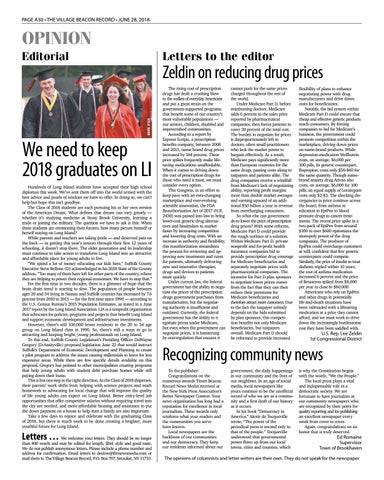
We need to keep 2018 graduates on LI Hundreds of Long Island students have accepted their high school diplomas this week. We’ve sent them off into the world armed with the best advice and pearls of wisdom we have to offer. In doing so, we can’t help but hope this isn’t goodbye. The Class of 2018 students are each pursuing his or her own version of the American Dream. What defines that dream can vary greatly — whether it’s studying medicine at Stony Brook University, learning a trade or joining the military. The question we have to ask is this: When these students are envisioning their futures, how many picture himself or herself staying on Long Island? While parents and teachers are taking pride — and deserved pats on the back — in getting this year’s seniors through their first 12 years of schooling, it doesn’t stop there. The older generation and its leadership must continue to take action to transform Long Island into an attractive and affordable place for young adults to live. “We spend a lot of money educating our kids here,” Suffolk County Executive Steve Bellone (D) acknowledged in his 2018 State of the County address. “Too many of them have left for other parts of the country, where they are helping to power their regional economies. We have to stop that.” For the first time in two decades, there is a glimmer of hope that the brain drain trend is starting to slow. The population of people between ages 20 and 34 living in Nassau and Suffolk counties has increased by 7.6 percent from 2010 to 2015 — for the first time since 1990 — according to the U.S. Census Bureau’s 2015 Population Estimates, as stated in a June 2017 report by the Long Island Association. LIA is a nonprofit organization that advocates for policies, programs and projects that benefit Long Island and support economic development and infrastructure investments. However, there’s still 100,000 fewer residents in the 20 to 34 age group on Long Island than in 1990. So, there’s still a ways to go in attracting and keeping bright, young professionals on Long Island. To this end, Suffolk County Legislature’s Presiding Officer DuWayne Gregory (D-Amityville) proposed legislation June 22 that would instruct Suffolk’s Department of Economic Development and Planning to create a pilot program to address the issues causing millennials to leave for less expensive areas. While there are few specific details available on this proposal, Gregory has pointed to other municipalities creating programs that help young adults with student debt purchase homes while still paying down their loans. This is but one step in the right direction. As the Class of 2018 disperses, their parents’ work shifts from helping with science projects and math homework to advocating for local change that will improve the quality of life young adults can expect on Long Island. Better entry-level job opportunities that offer competitive salaries without requiring travel into the city are needed, and more affordable housing and assistance to put the down payment on a house to help start a family are also important. Take a few days to rejoice and celebrate with the graduating Class of 2018, but there is much work to be done creating a brighter, more youthful future for Long Island.
Letters … We welcome your letters. They should be no longer than 400 words and may be edited for length, libel, style and good taste.
We do not publish anonymous letters. Please include a phone number and address for confirmation. Email letters to desiree@tbrnewsmedia.com or mail them to The Village Beacon Record, P.O. Box 707, Setauket, NY 11733.
The rising cost of prescription drugs has dealt a crushing blow to the wallets of everyday Americans and put a great strain on the government-supported programs that benefit some of our country’s most vulnerable populations — our seniors, children, disabled and impoverished communities. According to a report by Express Scripts, a prescription benefits company, between 2008 and 2015, name brand drug prices increased by 164 percent. These price spikes frequently make lifesaving medications unaffordable. When it comes to driving down the cost of prescription drugs for those who need it most, we must consider every option. This Congress, in an effort to keep pace with an ever-changing marketplace and ever-evolving scientific innovation, the FDA Reauthorization Act of 2017 (H.R. 2430) was passed into law to bring lower-cost generic drug alternatives and biosimilars to market faster by increasing competition and lowering drug costs. With an increase in authority and flexibility, this reauthorization streamlines the process for reviewing and approving new treatments and cures for patients, ultimately delivering new and innovative therapies, drugs and devices to patients more quickly. Under current law, the federal government has the ability to negotiate the prices of the prescription drugs government purchases from manufacturers, but the negotiating authority is insufficient and outdated. Currently, the federal government has the ability to n egotiate prices under Medicare, but even when the government can negotiate prices, it is hamstrung by overregulation that ensures it
cannot push for the same prices charged throughout the rest of the world. Under Medicare Part D, before reimbursing doctors, Medicare adds 6 percent to the sales price reported by pharmaceutical companies, then forces patients to cover 20 percent of the total cost. The burden to negotiate for prices is disproportionately left to doctors, often small practitioners who lack the market power to bargain effectively. As a result, Medicare pays significantly more than European countries for the same drugs, passing costs along to taxpayers and patients alike. The drug companies receive a windfall from Medicare’s lack of negotiating ability, reporting profit margins more than double market averages and earning upward of an additional $50 billion a year in revenue from overcharging consumers. So what else can government do to lower the price of prescription drug prices? With some reforms, Medicare Part D could provide the rough outlines of a solution. Within Medicare Part D, private nonprofit and for-profit health insurance companies bid to provide prescription drug coverage for Medicare beneficiaries and separately negotiate prices with pharmaceutical companies. The incentive for Part D plan sponsors to negotiate lower prices comes from the fact that they can then reduce their premiums for Medicare beneficiaries and therefore attract more customers. Due to the fact the taxpayer subsidy depends on the bids submitted by plan sponsors, this competition benefits not only Medicare beneficiaries, but taxpayers overall. Medicare Part D should be reformed to provide increased
flexibility of plans to enhance negotiating power with drug manufacturers and drive down costs for beneficiaries. Notably, the bid system within Medicare Part D could ensure that cheap and effective generic products reach consumers. By forcing companies to bid for Medicare’s business, the government could promote competition within the marketplace, driving down prices on name-brand products. While depression-medication Wellbutrin costs, on average, $6,000 per 100 pills, its generic counterpart, Bupropion, costs only $50-$60 for the same quantity. Though namebrand anxiety drug Ativan also costs, on average, $6,000 for 100 pills, an equal supply of Lorazepam costs only $2-$3. The shocking discrepancies in price continue across the board, from asthma m edication to EpiPen to blood pressure drugs to cancer treatments. The recent price spike in a two-pack of EpiPen from around $100 to over $600 epitomizes the monopoly power of the drug companies. The producer of EpiPen could overcharge customers at will, confident that few generic counterparts could compete. Similarly, the price of insulin to treat diabetes tripled within 10 years, the cost of asthma medication increased 6 percent and the price of Betaseron spiked from $8,000 per year to close to $60,000. Americans who rely on EpiPen and other drugs in potentially life-and-death situations have been railroaded with a lifesaving medication at a price they cannot afford, and we must work to drive down the increasingly burdensome cost they have been saddled with.
U.S. Rep. Lee Zeldin 1st Congressional District
Recognizing community news To the publisher: Congratulations on the numerous awards Times Beacon Record News Media received at the New York Press Association’s Better Newspaper Contest. Your news organization has long had a reputation for excellence in local journalism. These awards only reinforce what your readers and the communities you serve have known. Local newspapers are the backbone of our communities and our democracy. They keep our residents informed about our
government, the daily happenings in our community and the lives of our neighbors. In an age of social media, local newspapers like yours continue to be the unofficial record of who we are as a community and a first draft of our history as it occurs. In his book “Democracy in America,” Alexis de Tocqueville wrote, “The power of the periodical press is second only to that of the people.” Tocqueville understood that governmental power flows up from our local towns, cities and counties, which
is why the Constitution begins with the words, “We the People.” The local press plays a vital and indispensable role in a democratic society. We are fortunate to have journalists at our community newspapers who are recognized by their peers for quality reporting and for publishing an excellent newspaper every week from cover to cover. Again, congratulations on an honor that is truly deserved.
Ed Romaine Supervisor Town of Brookhaven
The opinions of columnists and letter writers are their own. They do not speak for the newspaper.