LIMITED EDITIONS 2020
New titles
2020, Julian Schnabel
Edition of 1,000 + 100 APs
2020, Julian Schnabel Art Edition with 11-color pigment print
$ 1,000
$ 15,000
2020, Neil Leifer. Homage to Ali Ali Invents the Double-Clutch Shuffle, 1966
Edition of 40 + 8 APs
Edition of 1,000 + 200 APs
$ 1,000
2020, Neil Leifer. Homage to Ali Ali vs. Patterson I, 1965
$ 8,000
2020, Neil Leifer. Homage to Ali Ali vs. Folley, 1967
Edition of 40 + 8 APs
$ 4,000
2020, Neil Leifer. Boxing
2020, Julian Schnabel Art Edition with individually overpainted cover
Edition of 35 + 15 APs
Edition of 100 + 20 APs
Edition of 40 + 8 APs
$ 4,000
2020, Neil Leifer. Homage to Ali Clay vs. Liston I, 1964
$ 4,000
Edition of 40 + 8 APs
$ 4,000
2020, Neil Leifer. Homage to Ali Ali Victorious, Ali vs. Liston II, 1965
Edition of 40 + 8 APs
2020, Neil Leifer. Homage to Ali Ali vs. Liston II, 1965
$ 4,000
2020, Neil Leifer. Homage to Ali The Mouth That Roared, 1970
Edition of 40 + 8 APs
$ 4,000
Edition of 40 + 8 APs
$ 4,000
2020, Neil Leifer. Homage to Ali Ali vs. Young, 1976
$ 4,000
Edition of 40 + 8 APs
$ 4,000
2020, Ai Weiwei China Bag Cats and Dogs (red)
2020, Neil Leifer. Homage to Ali Fit for a King, Ali vs. Bugner, 1973
Edition of 40 + 8 APs
$ 4,000
2020, Neil Leifer. Homage to Ali Ali vs. Foster, 1972
2020, Neil Leifer. Homage to Ali The Champ’s Corner, Ali vs. Lyle, 1975
Edition of 40 + 8 APs
Edition of 40 + 8 APs
$ 4,000
Edition of 2,500
$ 500
2020, Ai Weiwei China Bag Zodiac (white)
2020, Ai Weiwei Scarf Cats and Dogs (red)
$ 500
Edition of 2,500
Edition of 2,500
$ 300
2020, Ai Weiwei Scarf Haircut (blue)
2020, Ai Weiwei Scarf Citizens’ Investigation (black)
$ 300
Edition of 2,500 2020, Helmut Newton. BABY SUMO
BABY
2020, Walton Ford. Pancha Tantra Art Edition Granary
$ 1,500
Edition of 100 + 30 APs
SUMO
Edition of 10,000
Edition of 2,500
2020, David Hockney. My Window
$ 300
$ 9,500
2020, David Hockney. My Window Art Edition No. 610, 23rd December 2010
BABY
SUMO
Edition of 1,000 + 40 APs
$ 2,000
Edition of 250 + 10 APs
$ 12,000
2019, The Definitive Jacques Tati
Edition of 112 + 12 APs 2019, Steve McCurry. Animals Art Edition Chang Mai, Thailand, 2010
FEW LEFT
$ 895 New price 2021: $ 1,000
FEW LEFT
Edition of 100 + 30 APs
$ 2,500
$ 700
Edition of 62 + 10 APs 2019, Steve McCurry. Animals Art Edition Chennai, India, 1996
$ 5,000
FEW LEFT
Edition of 100 + 30 APs
$ 2,500
Edition of 100 + 20 APs
$ 1,750
2019, Buzz Aldrin. Apollo 11 Earthrise Sequence
2019, Patti Smith. Lynn Goldsmith. Before Easter After Art Edition NYC, 1976
Edition of 100 + 20 APs
FEW LEFT
2019, Patti Smith. Lynn Goldsmith. Before Easter After Art Edition NYC, 1977
2019, Patti Smith. Lynn Goldsmith. Before Easter After
Edition of 1,300 + 100 APs
2019, Linda McCartney. The Polaroid Diaries Art Edition Sussex, England, 1980s
$ 1,750
Edition of 150
$ 7,500
2019, Buzz Aldrin. Apollo 11 A Man on the Moon
Edition of 475
2019, Buzz Aldrin. Apollo 11 Flag on the Moon
$ 4,500 New price 2021: $ 6,000
2019, Buzz Aldrin. Apollo 11 Inspecting the Eagle
Edition of 75
2019, Buzz Aldrin. Apollo 11 Solar Wind Composition Experiment
$ 4,500 New price 2021: $ 6,000
2019, Stephen Wilkes. Day to Night Art Edition Brooklyn Bridge, New York City, 2016
Edition of 100 + 25 APs
Edition of 150
Edition of 75
$ 4,500 New price 2021: $ 6,000
FEW LEFT
$ 4,500 New price 2021: $ 6,000
2019, Stephen Wilkes. Day to Night Art Edition Grand Canyon, Arizona, 2015
$ 5,000
2019, Sebastião Salgado. Gold
$ 5,000
Edition of 100 + 25 APs 2019, David Bailey
SUMO
Edition of 1,000 + 180 APs
$ 1,000
Edition of 2,700 + 260 APs
$ 3,000
2019, David Bailey Art Edition Jean Shrimpton, 1965
Edition of 75 + 10 APs
2019, David Bailey Art Edition Andy Warhol, 1965
$ 12,500
Edition of 75 + 10 APs
$ 12,500
Life on the Big Canvas Wildly immersive and often larger than life, Julian Schnabel’s works speak to us directly: in paintings created on everyday objects such as broken plates, market stall covers, or boxing ring floors, in sculptures that carry the paintings into space, or in movies on artists and other heroes unbowed by any turns of fate.
Julian Schnabel Art Edition No. 1–35
XXL Edition of 35 Individually overpainted cover 33 × 44 cm (13 × 17.3 in.) Signed by Julian Schnabel
12
TASCHEN LIMITED EDITIONS 2020
Art Edition No. 36–135 The Fall of Tyll Edition of 100 11-color pigment print on rag paper, 100% cotton, with torn edges h 135 × w 97 cm (53.1 × 38.2 in.) Print shown here in proportion to the XXL book. Signed by Julian Schnabel
Collector’s Edition No. 136–1,135
XXL JULIAN SCHNABEL Hans Werner Holzwarth, Louise Kugelberg (eds.) Collector’s Edition No. 136–1,135 Hardcover in clamshell box, 570 pages 33 × 44 cm (13 × 17.3 in.) Signed by Julian Schnabel
13
I Barely Knew Him and Then or The Migration of the Duck-Billed Platypus to Australia By Laurie Anderson
16
TASCHEN LIMITED EDITIONS 2020
Now It’s early June and the world is shredding. We’re on the phone talking about the latest murder by police, of Rayshard Brooks in Atlanta, and all the Black Lives Matter marches and rallies around the country and the world. Julian sends me a layout for some work he’s putting together about crime, including a text about van Gogh, “The Man Suicided by Society” by Antonin Artaud, with an image of Julian’s first plate painting, The Patients and the Doctors. We ask each other: What can we do? It’s June 2020 and New York City is still closed because of the coronavirus pandemic. Many of the stores and restaurants in our neighborhood are boarded up. Lots of people are still masked and the future of the city veers almost daily from guardedly positive to dire. I’m finding it hard to write this short story about my friend. I keep getting overwhelmed by the emergencies that continue to unfurl. Is it the pandemic that makes me see life as if from a great distance, a panorama of lost places and long gone people? The phone rings and it’s Julian and he’s reading a section from his script “In the Hand of Dante.” The pandemic is going on but Julian is writing, revising scripts, painting. “I miss Shooter, I haven’t seen him for months,” he says and sends me a video of his six-year-old son Shooter slowly falling asleep as he reads to him on FaceTime. This summer a new blind big girl painting no longer has a purple streak over her eyes. This time around she has no eyes. There’s just a long scar across her face where her eyes would be. I saw the new blind girl painting a few days ago at his outdoor studio in Montauk that he built when he moved out there. It’s a painting not only about the blindness of white people but the lack of any eyes at all.
The old days I must have run into Julian around the time he was doing the Whitney Independent Study Program with Ron Clark and Yvonne Rainer. I remember the circles of folding chairs and people sitting on windowsills and intense discussions about politics, the meaning of pure ideas like “the edge.” Julian had just arrived from Texas and was the only painter in the program who didn’t seem bothered by the notion that painting was dead. He was just rediscovering New York and the rest of his education started at 1 a.m. every night at Mickey Ruskin’s bar Max’s Kansas City, an artists’ bar where through his first and best friend in New York, Bob Williamson, young Julian was introduced to a world of New York artists with a capital A. In those days there he met Robert Smithson, Richard Serra, Willem de Kooning, Blinky Palermo, Brice Marden, Neil Williams, Larry Poons, and John Chamberlain, to list a few. We were in different worlds, I was recovering from minimal sculpture at the time. We swirled around each other, in and out of scenes of mutual friends—Gordon Matta-Clark and Susan Ensley, Dickie Landry, at the Leo Castelli and Sonnabend galleries, at 420 West Broadway, Trisha Brown, Phil Glass, John Chamberlain, Vito Acconci, and Malcolm Morley. It was the late ’70s and New York, like now, was dark and mysterious. In SoHo we lived in abandoned buildings—the future was uncertain. Artists, however, were beginning
“I want my life to be in my work, crushed into my painting like a pressed car. If it’s not, my work is just some stuff.” Julian Schnabel
Untitled (The Sky of Illimitableness), 2015. 17
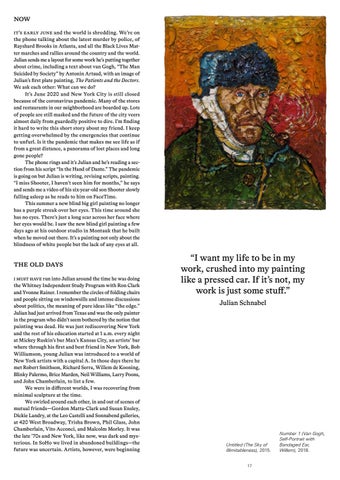
Number 1 (Van Gogh, Self-Portrait with Bandaged Ear, Willem), 2018.
This oversized limited-edition book, made in close collaboration with the artist, offers the most generous opportunity to experience Schnabel’s art outside of seeing it in person.
to think big. Very big. It seemed like everybody I knew was making an opera. You’d walk down West Broadway and see other artists, always dressed in work boots and painters clothes: “How’s your opera going?” “Good, how’s yours?” Not many of us actually made operas although we called them that anyway. Julian was one of the artists at that moment who was inventing a whole new scale, his own iconography, wild imagery, and an energy that was blasting off. At that moment he wasn’t showing in a gallery and very few people had seen his work. Our paths crossed now and then but it wasn’t until about twenty-five years later, when my husband Lou Reed and I moved to the West Village across the street from Julian, that he and I became real friends. Lou and I had moved to Julian’s street in 1998 and felt lost in the looming space we’d found to live, formerly a women’s prison. Lou, who had really good design ideas, had chosen lots of unusual lamps. He asked for Julian’s advice. Julian brought over a mast that became a stair railing, Moroccan doors that formed a balcony and created a bedroom, turning the living room into a Shakespearean courtyard, and several thick sets of two-story red velvet curtains that opened onto the silent Hudson River. Living across the street from Julian has made the West Village feel like home. Now that I’ve been away for months in isolation I think about how much I love walking home at night in New York and seeing bright lights shining up in the huge rose-colored Palazzo Chupi. I r emember seeing Julian’s model of the new building made from stacked-up cardboard boxes. As the building materialized with its balconies, arcades, crenellated arches—a fanciful fairy tale—it kept its feeling of a child’s idea of a Venetian palace. The neighbors were poised to hate it until they realized it wasn’t another monster condo—the kind that were beginning to wedge their ways into the neighborhood—but was instead some kind of painting, some kind of vision, that was also a building. Now it’s a treasured landmark. Julian could look down from the balcony and wave to Lou practicing Tai Chi on our roof. “Come by and see the new paintings,” says Julian, and every time I stop by there’s something new to see. Sometimes there are enormous red drawings on the floor, sometimes new roses on fractured plates. Next time I stop by there’s an installation of van Gogh plate paintings; in some Willem Dafoe is van Gogh, and in others van Gogh is van Gogh.
Julian Schnabel in his 23rd Street studio with The Mutant King, New York, 1981. Photo by Hans Namuth. Courtesy Julian Schnabel Archive. 18
TASCHEN LIMITED EDITIONS 2020
Last Attempt at Attracting Butterflies, 1994.
“I see paintings everywhere.” Julian Schnabel
19
XL LEIFER. BOXING. 60 YEARS OF FIGHTS AND FIGHTERS Collector’s Edition of 1,000 numbered copies Hardcover in slipcase, 424 pages 36 × 38.7 cm (14.2 × 15.2 in.) Signed by Neil Leifer
Neil Leifer Boxing
60 Years of Fights and Fighters
Neil Leifer has shot almost every important boxing match for the last 60 years, from the first Patterson-Johansson fight in 1959 right through to the 2020 Wilder-Fury rematch.
24
TASCHEN LIMITED EDITIONS 2020
Dick Tiger vs. Roger Rouse: Las Vegas Convention Center, 1967. Mike Tyson vs. Trevor Berbick: Las Vegas Hilton, 1986.
Neil Leifer took his first important boxing photo from a five-dollar seat at Yankee Stadium. The year was 1959 and Leifer, aged 16, captured Floyd Patterson versus Ingemar Johansson in the ring in the center of the stadium, dramatically floodlit and surrounded by mesmerized crowds. The picture was granular, shot from a distance with a $75 Yashica-Mat, “a poor man’s Rolleiflex,” but it had the unmistakable Leifer touch—powerful, nuanced, and adept at finding openings others would never see. From that shot on, Leifer was in love with photographing boxing. One year later, he covered the Patterson-Johansson rematch, where Floyd Patterson regained the title. In 1961, as a credentialed shooter for Sports Illustrated working alongside idols Hy Peskin and John Zimmerman, he shot their Miami rubber match—and one of his photographs was featured as the magazine’s cover. By the age of 25, he had created the most enduring images of Muhammad Ali, setting the spectacular tone for both his and Ali’s careers. His 1965 and 1966 photographs of a triumphant Ali standing over Sonny Liston and a bird’s-eye view of a knocked-out Cleveland Williams are considered two of the greatest sports photographs of all time.
The indubitable champion of the boxing photography genre, Leifer has since shot almost every important fight of the last 60 years. He was ringside at the “Rumble in the Jungle,” the “Thrilla in Manila,” and “The Clash on the Dunes.” He saw the first matchup between Joe Frazier and Ali, both undefeated heavyweight champions, and Floyd Mayweather raining dollar bills on Conor McGregor at the press tour for their 2017 fight. Nobody has seen the sport and its spectacle through more revealing eyes, from black-and-white images of the old Madison Square Garden to pay-per-view Las Vegas pyrotechnics. In 2014, Leifer became the only photographer ever to be inducted into the International Boxing Hall of Fame. With hundreds of his finest photographs, an introduction assembled from the best boxing columns of the era by famed journalist Gay Talese, and incisive captions from sports writer Gabriel Schechter, detailing the pageantry, personalities, and action inside the ring, Leifer. Boxing. 60 Years of Fights and Fighters is the culmination of Leifer’s unprecedented achievement, his lasting legacy to the sport he loves.
25
Neil Leifer (left) with Muhammad Ali at LIFE magazine’s New York studio, 1966.
ALI INVENTS THE DOUBLE-CLUTCH SHUFFLE, 1966
Edition of 40 Two panels, each h 80 × w 165 cm (31.5 × 65 in.) Signed by Neil Leifer
Neil Leifer Pays Tribute to the Legendary Muhammad Ali
THE MOUTH THAT ROARED, 1970
Edition of 40 h 100 × w 100 cm (39.4 × 39.4 in.) Signed by Neil Leifer
ALI VS. BUGNER, 1973
ALI VS. LISTON II, 1965
ALI VS. FOLLEY, 1967
Classic photographs, each in an edition of 40Â signed dye-sublimation prints on ChromaLuxe aluminum panels, ready to hang.
ALI VS. PATTERSON I, 1965
ALI VICTORIOUS, ALI VS. LISTON II, 1965
Powerful, nuanced, and adept at finding openings others would never see: the unmistakable Leifer touch!
ALI VS. FOSTER, 1972
Edition of 40 h 100 × w 100 cm (39.4 × 39.4 in.) Signed by Neil Leifer
© Authentic Brands Group
CLAY VS. LISTON I, 1964
Limited Edition Bags and Scarves by Ai Weiwei
CATS AND DOGS
AI WEIWEI. THE CHINA BAG Edition of 2,500 64.5 × 47 cm (25.4 × 18.5 in.)
ZODIAC
Wearable Work of Art
36
TASCHEN LIMITED EDITIONS 2020
Papercutting is a traditional Chinese art going back 2,000 years. The colored, intricately cut papers are used as a storytelling medium in festivities, for prayers, and as everyday decoration. 37
HAIRCUT
CITIZENS’ INVESTIGATION
CATS AND DOGS
The bags and scarves take their motifs from papercuts created by Ai Weiwei as part of his Papercut Portfolio, published by TASCHEN in 2019.
All images courtesy of Ai Weiwei studio.
AI WEIWEI. THE SILK SCARF Edition of 2,500 90 × 90 cm (35.4 × 35.4 in.)
“Can’t wrap your head around the Chinese dissident artist Ai Weiwei? Wrap it in his twill silk scarf instead.” theartnewspaper.com
The Making of Helmut Newton’s
SUMO
44
TASCHEN LIMITED EDITIONS 2020
Photo: © Alice Springs / Maconochie Photography
Previous: June and Helmut Newton outside TASCHEN’s headquarters, Cologne, 1999.
Over a period of two years, Helmut Newton and Benedikt Taschen exchanged letters, faxes, and phone calls to work out the details of the SUMO production. At some point, not amused by the prospect of having to sign the entire print run of 10,000 copies, Newton tried to wrestle out of the agreement, suggesting to “maybe sign a few dozen” printing sheets.
Helmut Newton signing the pages which were subsequently bound into SUMO, Monte Carlo, 1999. Photo by Alice Springs. 45
Helmut Newton checks a printing sheet during Frankfurt Book Fair, 1999.
“ That book was an outrageous idea— totally crazy!” Helmut Newton
Helmut Newton, Benedikt Taschen, and auctioneer Simon de Pury after the auction of SUMO copy number one, signed by over 100 celebrities portrayed in the book. At 620,000 deutschmarks it made the world record price for a book published in the 20th century, Berlin, 2000. Photo by Alice Springs. © The Helmut Newton Estate / Maconochie Photography; © Alice Springs / Maconochie Photography
Benedikt Taschen with the handmade dummy of SUMO when first presenting his idea of producing a gigantic book to a stunned Helmut and June Newton in his suite at the Sunset Marquis Hotel, Hollywood, 1997. Photo by Helmut Newton.
48
TASCHEN LIMITED EDITIONS 2020
49
At 620,000 deutschmarks SUMO made the world record price for a book published in the 20th century.
Exhibition view from Helmut Newton SUMO at the Helmut Newton Foundation, Berlin, 2009. Photo by Gerhard Kassner.
SUMO: A Landmark Revisited by Philippe Garner
Karl Lagerfeld, Paris, 1992. Rue Aubriot, Yves Saint Laurent, French Vogue, Paris, 1975. Following: Villa d’Este, Lake Como, Italy, 1975. 52
TASCHEN LIMITED EDITIONS 2020
Helmut always demonstrated a healthy disdain for easy or predictable solutions. SUMO—a bold and, certainly within the traditions of photography, an unprecedented publishing venture—was an irresistible project. The idea of a spectacular compendium of images, reproduced to exceptional page size and to state-of-the-art origination and printing standards, emerged from an open, exploratory dialogue between photographer and publisher. Helmut liked to probe possibilities, ever eager to rethink the ways in which he could develop and extend the all-important interface between his work and his audience. The magazine page had been the constant on which he had built his career; from the mid-1970s, books and exhibitions offered further opportunities, allowing him to exploit more extended picture sequences and significant changes of print scale. Here, with the physically commanding SUMO, weighing in—boxed and shrink-wrapped—at 35.4 kilos, Helmut created, at the close of the 20th century, a landmark book that would stand head and shoulders above anything that had been attempted conceptually or technically before. SUMO, complete with its bespoke lectern, set an ambitious new standard—a book with the dimension of a private exhibition. SUMO might also be interpreted as a triumph of another order, with a very particular political and cultural significance that made it a singularly emotive and gratifying achievement. For here was a forceful statement, implicit rather than baldly stated—and all the stronger for that— confirming the authority of an unusually gifted individual’s perspective and emphatically marking his determination to engage an audience on his terms—in short, a statement about freedom of expression. Helmut ranks among the foremost figurative artists of his era. A social commentator of exceptional insight, his was a distinct and surprising sensibility—perverse, with a sharp and insistent curiosity, perfectly leavened by wry humour. Helmut’s talent was uniquely personal and he had the ability to turn into a valuable creative resource everything that he experienced, including the turmoil of those formative years in which brutal and traumatic political realities disrupted all that had been agreeable and stable in his life. An at-first reluctant exile, he adapted imaginatively to his itinerant destiny. Helmut developed a finely calibrated sensitivity to the atmosphere of place and to everything he observed— notably to the subtleties of social codes and rituals and to the visual language of seduction and of style. He took inspiration from his nostalgic fondness for the evocative symbols of old Europe, the Europe of his youth; and he embraced with fascination the vulgar New Babylons of the U.S., particularly Los Angeles. As he matured, he learned to use that matchless eye and twisted perception to create a body of work that is to its age as significant a document as are, for instance, the satirical caricatures of William Hogarth to the excesses of 18th-century Britain, the drawings of Honoré Daumier to the social nuances of French life in the mid-19th century or the savage visual dissections of George Grosz to the decadence of that very Berlin into which Helmut was born. Helmut truly found his form once he settled in Paris. There, he defined for himself a creative role within a chic high Bohemia, the milieu of interlinked friends and professional associates in the worlds of fashion, the media and the arts that was the stimulating crucible for his
53
56
TASCHEN LIMITED EDITIONS 2020
“ To the question: ‘What people do you like to photograph?’ my answer is: ‘Those I love, those I admire and those I hate.’ ”
Photos pp. 52–57: Helmut Newton © The Helmut Newton Estate / Maconochie Photography
Helmut Newton
work. In his rue Aubriot studio in the 1970s, he stored his Kodachrome transparencies in small cabinets labelled “Fashion”, “Erotic subjects” and “Portraits mondains”; but of course his genius was to wilfully blur these distinctions, building a multilayered social portrait in which subtle allusions and telling undercurrents lent every picture intrigue and reverberation. Helmut travelled widely, but always carried with him the precious and poignant memories of his native Germany; and these feelings drew him back with increasing regularity to the country and culture that had shaped him. There was an irresistible logic in the fact that the four issues of Helmut Newton’s Illustrated that he produced between 1985 and 1995 should take their inspiration from then-new photo-illustrated journals that had inspired him in the 1930s. Germany could boast a long and significant tradition in the story of publishing, since the flowering of printing in the pioneering era of Johannes Gutenberg; and Helmut had, at first hand, witnessed its tragic corollary with the repression and the book burning of the Nazis. This observation calls to mind Helmut’s cool-headed response some years ago to the report that a lecture he had been invited to deliver to a university audience would be disrupted by a group of students planning to throw raw meat at this speaker, whose work they were only prepared to perceive through the prism of their own rigid prejudices. Helmut’s judicious opening remarks situated him immediately as one who was lucky to have escaped the increasingly vicious purges of the late 1930s and who had surely earned the right to freedom of artistic expression—and the right, as a working photographer, to challenge and to provoke. The student anger was defused and by the end of his talk all were ready to offer up their resounding applause for an artist with the courage and tenacity to pursue his creative instinct to the full and who, through his witty, sophisticated and confrontational images, was determined to throw down the gauntlet against the mediocre, the safe and the superficial. SUMO, appropriately published in Germany, has made its memorable statement as a piece of photo-book history.
Elizabeth Taylor, Vanity Fair, Los Angeles, 1989. Debra Winger, Los Angeles, 1983. 57
BABY SUMO, the ultimate collectible: Published in a limited edition of 10,000 numbered copies, it is exactly half the size of the famous 1999 original. Created on the occasion of Helmut Newton’s 100th birthday and TASCHEN’s 40th anniversary.
HELMUT NEWTON. BABY SUMO Edited and revised by June Newton Edition of 10,000 numbered copies 74 cm (29.2 in.) (height of book on stand) 464 pages BABY SUMO comes with a stainless-steel bookstand designed by Philippe Starck, including a pedestal and a booklet documenting the making of this legendary publication.
Walton Ford Pancha Tantra
At first glance, Walton Ford’s life-size bestial tableaux recall the prints of 19th-century illustrators John James Audubon and Edward Lear. A closer look reveals a complex and disturbingly anthropomorphic universe, full of symbols and allusions to the “operatic” quality of traditional natural history. In this stunning but sinister visual world, beasts and birds are not mere aesthetic objects but dynamic actors in allegorical struggles. In dazzling watercolor, the images impress as much for their impeccable realism as they do for their complex narratives.
Ars Gratia Artis 62
TASCHEN LIMITED EDITIONS 2020
This time I had to lie on the floor and remain absolutely still. I would ruin the scene if I couldn’t control my breathing. My back was bare to the waist. I could hear a lion’s claws scratching the floor as the trainer led him in on a leash. Then I could hear another trainer whisper to Mr. De Mille, who came and knelt beside me. “I must ask you something for your own safety,” he whispered. “You’re not menstruating, are you?” “No,” I replied very softly. He stood up and said to the trainer, “We can proceed. Everything’s fine.”
Ars Gratia Artis, 2017, watercolor, gouache, and ink on paper.
Then I could hear the lion breathing near me. They put a piece of canvas on my back to keep the lion’s manicured claws from making the slightest scratch. Then they brought the lion up to me and put his paw on the canvas. Ever so slowly they pulled the canvas aside until I could feel his paw on my skin. Every hair on my head was standing on end. I could hear the camera grinding and then the crack of the trainer’s whip. Every cell in my body quivered when the animal roared. His hot breath seemed to go up and down my spine. For an instant I opened my eyes a slit. Without raising my head, I saw lines of people ringing the set, motionless absolutely silent. Among them, in his uniform, his eyes popping almost out
of his head, was Daddy. His mouth hung open with horror at the sight of his one and only child with a man holding a gun beside her and a roaring lion standing over her. It was our first glimpse of each other in five years. When the scene was over, I could tell that Mr. De Mille was ecstatic. He said we would not reshoot it. He could tell it was perfect. He said if I had any energy left, he would like me to get into the moleskin evening gown so that he could redo one or two close-ups. Then the shooting would be finished. From 1920s film star Gloria Swanson’s autobiography SWANSON ON SWANSON, Pocket Books, 1981. 63
Walton Ford Art Edition No. 1–100 Granary
XL WALTON FORD. PANCHA TANTRA Art Edition No. 1–100 Hardcover in slipcase, 424 pages 28 × 37.4 cm (11 × 14.7 in.) with the six plate aquatint etching Granary h 30.5 × w 22.9 cm (12 × 9 in.) on h 46.8 × w 35.5 cm (18.5 × 14 in.) Rives BFK paper Signed by Walton Ford
“ Walton Ford’s draftsmanship has Dürer’s woodcut muscularity, and his ambitious compositions have the sweep of Delacroix or Géricault.” Men’s Vogue
A signed and numbered artist’s book by David Hockney, My Window follows the course of the seasons through the window of Hockney’s Yorkshire home in 120 iPhone and iPad drawings.
David Hockney: Window to the World 66
TASCHEN LIMITED EDITIONS 2020
my window describes flowers and the sunrise in Bridlington, East Yorkshire. I started on the iPhone in 2009 (twenty o’nine). There was great advantage in this medium because it’s backlit and I could draw in the dark. I didn’t ever have to get out of bed. Everything I needed was on the iPhone. From about April to August when the sun is in the north, if I didn’t pull the curtains or lower the venetian blind down, the sun would wake me up —at about 4:30 a.m. on 21st June. I would never have thought to do a sunrise without the iPhone. My friend John would put different flowers there every two or three days. I drew on the iPhone with my thumb, but when the iPad came out in 2010 I immediately got one from California, probably the first one in Bridlington. Ever since I’ve used the iPad, as I could draw with a stylus and get more details in.
“If you would like to be given a bouquet by Hockney, here is your chance.”
Previous: David Hockney, Los Angeles, 2020. Photo by Mark Mahaney. Above: Sketch by David Hockney of his bedroom. Left: Hockney with a copy of My Window, in his Hollywood Hills studio, 2019. 68
TASCHEN LIMITED EDITIONS 2020
For the works of David Hockney: © 2020 David Hockney
—david hockney, 17th August 2019
David Hockney Art Edition No. 501–750 iPad drawing ‘No. 610’, 23rd December 2010
Edition of 250 8-color inkjet print on cotton-fiber archival paper h 56 × w 43.2 cm (22 × 17 in.) Signed by David Hockney
69
SUMO DAVID HOCKNEY. MY WINDOW Collector’s Edition No. 1,001–2,000 Hardcover in clamshell box, 248 pages 38.5 × 50 cm (15.2 × 19.7 in.) Signed by David Hockney In this artist’s book of 120 iPhone and iPad drawings, David Hockney follows the course of the seasons through the window of his Yorkshire home. Each image depicts a fleeting moment—from the colorful sunrise and lilac morning sky to nighttime impressions, snow-covered branches, and the arrival of spring. Printed in large format, this is a highly perceptive and poetic body of work.
Patti Smith @ TASCHEN Beverly Hills
“I wanted to tell you about an amazing show I saw the other night. Patti Smith did a five song set at the TASCHEN bookstore in Beverly Hills. It’s easily one of the best shows I’ve ever seen. It was less than half an hour but the impact was total. It was just her and a man who played piano, guitar and also supplied backing vocals. He sang great. Ms. Smith, it was like all of the accumulated wisdom of human history was dispensed. She’s coming from a completely unique place.” Henry Rollins
XL PATTI SMITH. LYNN GOLDSMITH. BEFORE EASTER AFTER Collector’s Edition No. 201–1,500 Hardcover in clamshell box, 296 pages 26.9 × 37.3 cm (10.6 × 14.7 in.) Signed by Patti Smith and Lynn Goldsmith
Lynn Goldsmith Art Edition No. 1–100 NYC, 1977
Edition of 100 Archival pigment print on Epson Legacy Baryta paper h 46 × w 30.5 cm (18 × 12 in.) Signed by Lynn Goldsmith
Lynn Goldsmith Art Edition No. 101–200 NYC, 1976
Edition of 100 Archival pigment print on Epson Legacy Baryta paper h 46 × w 30.5 cm (18 × 12 in.) Signed by Lynn Goldsmith
“She was a paragon of cool; always with a trace of philosophy in her sensuality.” Lynn Goldsmith
Sebastião Salgado’s Portfolio of the Brazilian Gold Rush
“The mine at Serra Pelada is now closed, yet the intense drama of the gold rush leaps out of these images.� Alan Riding
XXL SEBASTIÃO SALGADO. GOLD Collector’s Edition No. 101–1,100 Hardcover in clamshell box, 196 pages 45 × 41 cm (17.7 × 16.1 in.) Signed by Sebastião Salgado
Over 300 of the greatest portraits of our time, printed big and bold.
SUMO DAVID BAILEY Collector’s Edition No. 301–3,000 Hardcover, 440 pages 50 × 70 cm (19.7 × 27.6 in.) Each edition comes with a bookstand designed by Marc Newson and a set of four book jackets featuring John Lennon and Paul McCartney, Jean Shrimpton, Mick Jagger, and Andy Warhol. Signed by David Bailey
David Bailey SUMO
The David Bailey SUMO is the culmination of the incredible career of one of the world’s greatest post-war photographers. Through penetrating pictures of the beautiful and the notorious, the idolized and the powerful, friends and family, writers, artists, and fellow photographers, Bailey presents a sweeping cultural history of the last 60 years. Featured subjects include Andy Warhol, Salvador Dalí, Nelson Mandela, Francis Bacon, Queen Elizabeth II, Zaha Hadid, the Rolling Stones, John Lennon, Paul McCartney, Bob Dylan, Jack Nicholson, Robert De Niro, Brigitte Bardot, Margaret Thatcher, Helmut Newton, Kate Moss, David Hockney, and hundreds more.
David Bailey Art Edition No. 76–150 Jean Shrimpton, 1965
Edition of 75 Fiber-based silver gelatin on Ilford paper h 61 × w 51 cm (24 × 20 in.) Signed by David Bailey 90
TASCHEN LIMITED EDITIONS 2020
David Bailey Art Edition No. 226–300 Andy Warhol, 1965
Edition of 75 Fiber-based silver gelatin on Ilford paper h 61 × w 51 cm (24 × 20 in.) Signed by David Bailey 91
Soul Power. The Beat Goes On
XXL BRUCE W. TALAMON. SOUL. R&B. FUNK. PHOTOGRAPHS 1972–1982 Hardcover in a plexiglass slipcase, 378 pages 31.5 × 44 cm (12.4 × 17.3 in.) Art Edition of 500 copies with four prints in a portfolio case Signed by Bruce W. Talamon
Bruce W. Talamon Art Edition No. 1–500 STEVIE WONDER, INGLEWOOD, CALIFORNIA, 1980
JAMES BROWN, ABC TELEVISION CENTER, CALIFORNIA, 1973
PARLIAMENT-FUNKADELIC, LOS ANGELES SPORTS ARENA, 1977
“For ten glorious years, I had the best seat in the house.” Bruce W. Talamon
THE JACKSONS, LOS ANGELES, 1976
Apollo 11 50th Anniversary Print Editions
SOLAR WIND COMPOSITION EXPERIMENT Edition of 75 h 101.6 × w 101.6 cm (40 × 40 in.)
LEFT FEW
A MAN ON THE MOON Edition of 475 h 101.6 × w 101.6 cm (40 × 40 in.)
Signed by Buzz Aldrin
FLAG ON THE MOON Edition of 150 h 101.6 × w 101.6 cm (40 × 40 in.)
INSPECTING THE EAGLE Edition of 75 h 101.6 × w 101.6 cm (40 × 40 in.)
Limited edition of 1,000 dye-sublimation prints on ChromaLuxe aluminum panel. Six different images, ready to hang.
EARTHRISE SEQUENCE Edition of 150 Diptych, h 80 Ă— w 240 cm (31.5 Ă— 94.5 in.)
On July 20, 1969, the world was transformed by a historic event of epic proportions as Neil Armstrong and Buzz Aldrin took their first steps on the Moon. To commemorate the 50th anniversary of Apollo 11, TASCHEN presents six photographs from the mission for an exclusive set of 1,000 fine-art prints signed by Buzz Aldrin.
Photographs Courtesy of NASA
Each authorized, limited edition print is signed by Buzz Aldrin.
David LaChapelle
© David LaChapelle
Lost and Found & Good News
David LaChapelle Art Edition No. 1–500
XL DAVID LACHAPELLE. LOST AND FOUND & GOOD NEWS Art Edition of 500 copies Hardcover, 554 pages total 27.8 × 35.5 cm (10.9 × 14 in.) Two volumes with three signed prints in an artist box: Archangel Uriel, 1985 h 40.5 × w 30.7 cm (16 × 12 in.) She Stood by Him till the End His Loving Friend. Elizabeth Taylor, 2002 h 26.4 × w 40.5 cm (10 × 16 in.) Earth Laughs in Flowers. Rite of Spring, 2008–2011 h 40.5 × w 31 cm (16 × 12.2 in.) Signed by David LaChapelle
The Definitive Jacques Tati
LEFT FEW THE DEFINITIVE JACQUES TATI Collector’s Edition of 112 copies Box with five volumes, 1136 pages 29.2 × 24.5 cm (11.5 × 9.6 in.)
This extensive exploration of Tati’s life and work features hundreds of photographs and film stills, the complete screenplays, interviews, original essays, and a vast selection of documents, letters, sketches, and notes spanning five volumes. As a Collector’s Edition this box also includes a build-it-yourself model of the villa from Mon Oncle, complete with figurines, a sound box, a film poster, and more.
“When you watch his films, you realize how much he knows about—and loved—human nature, and it can only be an inspiration to do the same.” David Lynch
XXL STEPHEN WILKES. DAY TO NIGHT Hardcover with two fold-outs in clamshell box, 262 pages 42 × 33 cm (16.5 × 13 in.) Signed by Stephen Wilkes
Stephen Wilkes’s Day-to-Night Portraits
Art Edition No. 1–100 Brooklyn Bridge, New York City, 2016 Edition of 100 Inkjet print on Legacy Baryta 310 smooth satin paper h 49.2 × w 67.9 cm (19.4 × 26.7 in.) Signed by Stephen Wilkes
Stephen Wilkes Art Edition No. 101–200 Grand Canyon, Arizona, 2015
Edition of 100 Inkjet print on Legacy Baryta 310 smooth satin paper, h 46 × w 76.8 cm (18.1 × 30.2 in.) Signed by Stephen Wilkes
The Tribute in Light installation on the 10th anniversary of the September 11 attacks. Flatiron District, New York, 2011.
Art Edition No. 1–100 Chiang Mai, Thailand, 2010
110
TASCHEN LIMITED EDITIONS 2020
Steve McCurry Turns His Lens on Creatures around the World
STEVE MCCURRY. ANIMALS Hardcover in clamshell box, 252 pages 24 × 33.3 cm (9.4 × 13.1 in.)
Edition of 100 FEW Digital C-print on FujiFlex Crystal Archive Supergloss paper, h 50.8 × w 40.6 cm (20 × 16 in.) Signed by Steve McCurry 111
LEFT
Steve McCurry Art Edition No. 101–200 Chennai, India, 1996
Edition of 100 FEW Digital C-print on FujiFlex Crystal Archive Supergloss paper, h 50.8 × w 40.6 cm (20 × 16 in.) Signed by Steve McCurry 112
LEFT
TASCHEN LIMITED EDITIONS 2020
Mumbai, India, 2010.
Christo and Jeanne-Claude. The Floating Piers
Christo and Jeanne-Claude at the TASCHEN Store New York, 2006.
THE FLOATING PIERS Collector’s Edition No. 161–1,000 Hardcover in slipcase, with a swatch of the original dahlia yellow fabric, 846 pages 29 × 27 cm (11.4 × 10.6 in.) Signed by Christo and Wolfgang Volz
WRAPPED REICHSTAG. BERLIN 1971–1995 Collector’s Edition No. 1–5,000 Hardcover in slipcase, with piece EFT of original fabric, 700 pages EW L F 29 × 27 cm (11.4 × 10.6 in.) Signed by Christo, Jeanne-Claude, and Wolfgang Volz
THE GATES. NEW YORK CITY 1979–2005 Collector’s Edition No. 1–5,000 Hardcover in slipcase, with piece LEFT FEW of original fabric, 968 pages 29 × 27 cm (11.4 × 10.6 in.) Signed by Christo, Jeanne-Claude, and Wolfgang Volz
117
Christo and Jeanne-Claude Art Edition No. 1–1,000 Wrapped Trees. Basel 1997–1998 “ The 500,000 square feet of black and white polyester mesh had to be transparent enough so that when the sun was behind the trees every branch was visible. Our fabrics are full of motion, they’re not static.” Christo and Jeanne-Claude
118
TASCHEN LIMITED EDITIONS 2020
WRAPPED TREES. BASEL 1997–1998 Art Edition No. 1–1,000 With Cibachrome print and piece of original fabric, 136 pages FEW 23.5 × 30 cm (9.3 × 11.8 in.) Signed by Christo, Jeanne-Claude, and Wolfgang Volz 119
LEFT
Sylvester Stallone Rocky
XXL ROCKY. THE COMPLETE FILMS Collector’s Edition No. 51–1,976 Hardcover in clamshell box with notebook facsimile, 380 pages 29 × 44 cm (11.4 × 17.3 in.) Signed by Sylvester Stallone
Neil Leifer Art Edition No. 26–50 Rocky II, 1979
“ A journey into the heart of the Rocky archives that revives the myth of the inimitable Italian Stallion through the voice of its protagonist.” GQ
Edition of 25 Pigment print on Fine Art Fotorag h 50 × w 50 cm (19.7 × 19.7 in.) Signed by Neil Leifer and Sylvester Stallone
Annie Leibovitz SUMO
SUMO
LEFT FEW
ANNIE LEIBOVITZ Collector’s Edition No. 1,001–10,000 Hardcover with a bookstand by Marc Newson Available in one of four different covers 476 pages, 50 × 69 cm (19.7 × 27.2 in.) Signed by Annie Leibovitz
Take your pick! Book jacket available in four iconic shots.
Patti Smith
Keith Haring
Whoopi Goldberg
David Byrne
126
TASCHEN LIMITED EDITIONS 2020
Annie Leibovitz Art Edition No. 1–1,000 Keith Haring (contact sheet), New York City, 1986
Edition of 1,000 Leather-bound with all four book jackets Archival pigment print on Canson Platin h 51 × w 51 cm (20 × 20 in.) Signed by Annie Leibovitz 127
David Hockney SUMO SUMO DAVID HOCKNEY. A BIGGER BOOK Collector’s Edition No. 1,001–10,000 Hardcover, 498 pages, 50 × 70 cm (19.7 × 27.6 in.) With a 680-page chronology book and an adjustable bookstand designed by Marc Newson Signed by David Hockney Art Editions No. 1–1,000 are sold out.
Murals of Tibet SUMO
Signed by His Holiness the 14th Dalai Lama
“ A significant contribution not just to Asian art, but to the humanities.� Maxwell K. Hearn The Metropolitan Museum of Art
SUMO THOMAS LAIRD. MURALS OF TIBET Collector’s Edition No. 81–998 Hardcover, 498 pages 50 × 70 cm (19.7 × 27.6 in.) With a modular bookstand designed by Shigeru Ban and an illustrated 528-page scholarly companion book.
How a TASCHEN Book Is Made
Behind the scenes of our production process and the challenges of creating some of the biggest books in the world.
“TASCHEN has turned the book as collectible sculptural object from avant-garde oddity into luxury commodity.”
During the binding process, the book block is pressed several times at different stages. The sewing of the book block is a semiautomatic process. For oversized books, the quality of a machine-sewn book block is s uperior to one that is hand-sewn. This one-of-a-kind machine can sew signatures measuring up to 70 cm (27.5 in.) in height. Mauro Loce, director of the bindery, presents the final art edition of Ferrari, which comes with a bookstand d esigned by Marc Newson.
The leather application on the case is done by hand. The socalled Oxford hollow is added to strengthen the spine. Finishing touch: the iconic Cavallino emblem is applied to the book’s cover.
The signatures (sheets of paper printed and folded) of the books are gathered manually.
“Superlatives lose their luster, their power, and their meaning in describing TASCHEN’s latest triumph... A veritable bible of everything you’ve ever wanted to know about the vision of a little boy named Enzo Anselmo Ferrari.” Force One
XXL FERRARI Collector’s Edition No. 251–1,947 Each signed by Piero Ferrari Leather cover, in an aluminum engine-inspired case designed by Marc Newson 514 pages, 32.4 x 43.2 cm (12.8 x 17 in.) Art Editions No. 1–250 are sold out.
Two Legendary Collaborations: The Stan Lee Story Publication price 2018: $ 1,500
Value today: $ 5,000
“TASCHEN books are almost designed to be collectible. It’s very common for a TASCHEN book to gain value almost instantly.” Richard Davies, AbeBooks, the world’s most popular platform for antiquarian books
The Rise of David Bowie
Publication price 2015: $ 700
Value today: $ 4,000
London Claridge’s
“An interior so expertly curated you’ll want to move in.” GQ
Brussels
TASCHEN Stores Berlin Beverly Hills Brussels Cologne Hollywood Hong Kong
London Madrid Miami Milan Paris Tokyo
Visit us online at taschen.com
All titles
2020, Ai Weiwei China Bag Cats and Dogs (red)
Edition of 2,500
2020, Ai Weiwei China Bag Zodiac (white)
$ 500
2020, Ai Weiwei Scarf Cats and Dogs (red)
Edition of 2,500
$ 500
2020, Ai Weiwei Scarf Citizens’ Investigation (black)
$ 300
2020, Ai Weiwei Scarf Haircut (blue)
Edition of 2,500 2019, Ai Weiwei. The Papercut Portfolio
Edition of 2,500
$ 300
2014, Ai Weiwei
SOLD OUT
Edition of 1,000 + 200 APs
Edition of 2,500
$ 3,000
Edition of 250 + 24 APs 2014, Ai Weiwei. Art Edition
Edition of 100 + 20 APs
$ 300
SOLD OUT
$ 40,000
SOLD OUT
$ 25,000
2011, The Pedro Almodóvar Archives Art Edition
FEW LEFT
2014, Darren Almond. Fullmoon Art Edition Moonbow
SOLD OUT BABY
SUMO
Edition of 500 + 50 APs 2014, Darren Almond. Fullmoon Art Edition Porto Mosquito
$ 1,000
SOLD OUT BABY
Edition of 60 + 15 APs 2014, Darren Almond. Fullmoon Art Edition Horseshoe Bend
SUMO
Edition of 60 + 15 APs 2018, Ando. Complete Works 1975–Today Art Edition Walter de Maria, Naoshima
Edition of 100 + 10 APs
SOLD OUT BABY
SUMO
$ 4,000
SOLD OUT
$ 1,500
2019, Buzz Aldrin. Apollo 11 Earthrise Sequence
Edition of 150
$ 4,000
Edition of 60 + 15 APs 2010, Tadao Ando. Art Edition
Edition of 300 + 30 APs
$ 4,000
SOLD OUT
$ 3,000
2019, Buzz Aldrin. Apollo 11 A Man on the Moon
$ 7,500
Edition of 475
$ 4,500 New price 2021: $ 6,000
2019, Buzz Aldrin. Apollo 11 Inspecting the Eagle
2019, Buzz Aldrin. Apollo 11 Flag on the Moon
Edition of 150 2019, Buzz Aldrin. Apollo 11 Lunar Module Ascent
Edition of 75 + 10 APs 2012, Nobuyoshi Araki. Bondage
Edition of 845 + 150 APs 2012, Nobuyoshi Araki. Bondage Art Edition Untitled, 1992
Edition of 50 + 10 APs
$ 4,500 New price 2021: $ 6,000
SOLD OUT
$ 4,500
FEW LEFT
$ 1,250 New price 2021: $ 1,500
SOLD OUT
$ 4,000
Edition of 75 2019, Buzz Aldrin. Apollo 11 Solar Wind Composition Experiment
Edition of 75 2012, Nobuyoshi Araki. Bondage Art Edition Untitled, 1990
Edition of 50 + 10 APs 2012, Nobuyoshi Araki. Bondage Art Edition Untitled, 1994
Edition of 50 + 10 APs
$ 4,500 New price 2021: $ 6,000
FEW LEFT
$ 4,500 New price 2021: $ 6,000
SOLD OUT
$ 6,000
SOLD OUT
$ 3,500
2002, Araki
BABY
2019, David Bailey
SUMO SUMO
Edition of 2,500 + 200 APs 2019, David Bailey. Art Edition John Lennon and Paul McCartney, 1965
Edition of 75 + 10 APs 2019, David Bailey. Art Edition Mick Jagger, 1964
Edition of 75 + 10 APs 2017, James Baldwin. The Fire Next Time Photographs by Steve Schapiro
Edition of 1,813 + 220 APs
$ 4,000
SOLD OUT
$ 15,000
SOLD OUT
$ 15,000
SOLD OUT
$ 1,250
Edition of 2,700 + 260 APs
$ 3,000
2019, David Bailey. Art Edition Jean Shrimpton, 1965
Edition of 75 + 10 APs
$ 12,500
2019, David Bailey. Art Edition Andy Warhol, 1965
Edition of 75 + 10 APs 2017, James Baldwin. The Fire Next Time Art Edition Dr. Martin Luther King Jr.
Edition of 50 + 10 APs
$ 12,500
SOLD OUT
$ 1,750
2017, James Baldwin. The Fire Next Time Art Edition James Baldwin
SOLD OUT
$ 3,000
Edition of 50 + 10 APs 2010, Shigeru Ban Complete Works 1985–2010. Art Edition
SOLD OUT
Edition of 50 + 10 APs
Edition of 50 + 5 APs
SOLD OUT
2006, Peter Beard Art Edition Fayel Tall
SOLD OUT
$ 3,000
SOLD OUT
1991, Georg Baselitz
$ 3,000
Edition of 200 + 20 APs 2006, Peter Beard
2017, James Baldwin. The Fire Next Time Art Edition Selma March
$ 4,000
BABY
SUMO
SOLD OUT
BABY
SUMO
$ 12,500
Edition of 2,250 + 200 APs 2006, Peter Beard Art Edition 965 Elephants
SOLD OUT
Edition of 125 + 15 APs 2012, Harry Benson. The Beatles
$ 25,000
FEW LEFT
BABY
SUMO
Edition of 125 + 15 APs
$ 25,000
Edition of 1,764 + 200 APs
$ 1,000 New price 2021: $ 1,500
2012, Harry Benson. The Beatles Art Edition George V Hotel Suite
Edition of 100 + 20 APs 2012, James Bond Archives. Golden Edition Goldfinger by Sir Ken Adams
Edition of 250 + 20 APs
SOLD OUT
$ 4,000
SOLD OUT
$ 3,500
2017, Christo and Jeanne-Claude. The Floating Piers. Art Edition
Edition of 20
Edition of 100 + 20 APs 2012, James Bond Archives. Golden Edition You Only Live Twice by Sir Ken Adams
Edition of 250 + 20 APs 2017, Christo and Jeanne-Claude. The Floating Piers. Art Edition
2017, Christo and Jeanne-Claude. The Floating Piers
Edition of 840 + 380 APs
2012, Harry Benson. The Beatles Art Edition Cassius Clay
$ 1,250
SOLD OUT
$ 35,000
Edition of 20 + 20 APs 2017, Christo and Jeanne-Claude. The Floating Piers. Art Edition
Edition of 20
SOLD OUT
$ 4,000
SOLD OUT
$ 3,500
SOLD OUT
$ 35,000
SOLD OUT
$ 35,000
SOLD OUT
2017, Christo and Jeanne-Claude. The Floating Piers. Art Edition
Edition of 100
$ 5,500
2010, Christo and Jeanne-Claude. Art Edition Project for Jewelry on Jeanne-Claude’s Hand
Edition of 94 + 10 APs 1999, Christo and Jeanne-Claude. Wrapped Trees. Basel 1997–1998
Edition of 1,000 + 300 APs 1996, Christo. Wrapped Reichstag. Berlin 1971–1995
Edition of 5,000
SOLD OUT
$ 5,500
FEW LEFT
$ 700
FEW LEFT
$ 1,000 New price 2021: $ 1,250
SOLD OUT
2010, Christo and Jeanne-Claude
Edition of 1,000 + 400 APs
$ 3,500
2005, Christo and Jeanne-Claude. The Gates
Edition of 5,000 + 800 APs 1998, Christo and Jeanne-Claude. Umbrellas Japan/USA 1984–1991
Edition of 2,500 1996, Christo. Wrapped Reichstag. Berlin 1971–1995. Art Edition
Edition of 100
FEW LEFT
$ 1,000 New price 2021: $ 1,250
SOLD OUT
$ 1,500
SOLD OUT
$ 3,000
2006, William Claxton. Jazzlife Art Edition with four prints
Edition of 1,000 + 200 APs 2020, Anton Corbijn. Depeche Mode Art Edition SOFAD, London, 1992
Edition of 100 + 20 APs
FEW LEFT
$ 2,500
SOLD OUT
$ 4,000
2014, Robert Crumb. Sketchbooks, 1964–1982 with print Gurls! Sex!
Edition of 1,000 + 50 APs 2007, Robert Crumb’s Sex Obsessions
Edition of 1,000 + 200 APs
2020, Anton Corbijn. Depeche Mode
SOLD OUT
Edition of 1,786 + 200 APs 2020, Anton Corbijn. Depeche Mode Art Edition SOTU, New York, 2008
$ 2,000
SOLD OUT
Edition of 100 + 20 APs
$ 4,000
2012, Robert Crumb. Sketchbooks, 1982–2011 with print The Little Guy That Lives Inside My Brain
$ 1,000
FEW LEFT
$ 1,000
Edition of 1,000 + 50 APs 2005, Hunter S. Thompson & Ralph Steadman. The Curse of Lono
Edition of 1,000 + 200 APs
$ 1,000
SOLD OUT
$ 2,000
2008, Josef H. Darchinger. Wirtschaftswunder
Edition of 1,000 + 200 APs 2008, Studio Olafur Eliasson. An Encyclopedia
Edition of 200 + 50 APs 2012, Fashion Designers A–Z. Diane von Furstenberg Edition
Edition of 1,000 + 50 APs 2012, Fashion Designers A–Z. Missoni Edition
Edition of 2,000 + 50 APs
FEW LEFT
$ 1,000
SOLD OUT
$ 5,000
SOLD OUT
$ 600
SOLD OUT
$ 600
2016, The Walt Disney Film Archives. The Animated Movies 1921–1968
Edition of 2,500 + 100 APs 2012, Fashion Designers A–Z. Akris Edition
Edition of 2,000 + 50 APs 2012, Fashion Designers A–Z. Etro Edition
Edition of 2,000 + 50 APs 2012, Fashion Designers A–Z. Prada Edition
Edition of 2,000 + 50 APs
$ 500 New price 2021: $ 600
FEW LEFT
$ 500
FEW LEFT
$ 500
SOLD OUT
$ 600
2012, Fashion Designers A–Z. Stella McCartney Edition
FEW LEFT
Edition of 2,000 + 50 APs
$ 500
2018, Ferrari. Art Edition
SOLD OUT
$ 60,000
Edition of 250 + 20 APs 2007, Walton Ford. Pancha Tantra
2018, Ferrari
Edition of 1,697 + 180 APs
$ 6,000
2020, Walton Ford. Pancha Tantra Art Edition Granary
$ 9,500
Edition of 100 + 30 APs 2007, Walton Ford. Pancha Tantra Art Edition Limed Blossoms
BABY
SUMO
SOLD OUT
BABY
SUMO
Edition of 1,500 + 200 APs
$ 2,000
2009, Ralph Gibson. Nude
FEW LEFT
Edition of 1,000 + 200 APs
$ 1,250
Edition of 100 + 20 APs 2009, Ralph Gibson. Nude Art Edition Chicago Nude
Edition of 100 + 20 APs
$ 15,000
SOLD OUT
$ 3,000
2009, Ralph Gibson. Nude Art Edition Blinds
SOLD OUT
2016, HR Giger
FEW LEFT BABY
SUMO
Edition of 100 + 20 APs 2016, HR Giger Art Edition Relief + Photogravure
Edition of 100 + 20 APs 1998, HR Giger. wwwHRGigercom (German edition)
Edition of 277
$ 3,000
Edition of 1,000 + 180 APs
FEW LEFT
2016, HR Giger Art Edition Relief Untitled
$ 3,000 New price 2021: $ 4,000
FEW LEFT
$ 1,000 New price 2021: $ 1,250
1998, HR Giger. Hologramm
Edition of 23
$ 2,000 New price 2021: $ 2,500
SOLD OUT
$ 6,000
2018, Françoise Gilot. Sketchbooks Art Edition Indian Soul, 2017
2018, Françoise Gilot. Sketchbooks Art Edition La Salute, Venice, 2017
Edition of 60 + 10 APs
Edition of 100
$ 900 New price 2021: $ 1,250
$ 2,500
Edition of 60 + 10 APs
$ 2,500
2018, Françoise Gilot. Sketchbooks Art Edition Music in Senegal, 2017
SOLD OUT
Edition of 60 + 10 APs 2015, Gisele Bündchen. Art Edition Jürgen Teller Gisele Bündchen, W, 2005
$ 3,500
SOLD OUT
$ 3,500
Edition of 100 + 20 APs 2019, Patti Smith. Lynn Goldsmith. Before Easter After Art Edition NYC, 1977
Edition of 100 + 20 APs
2015, Gisele Bündchen
Edition of 900 + 200 APs
$ 2,000
2019, Patti Smith. Lynn Goldsmith. Before Easter After
Edition of 1,300 + 100 APs
$ 700
2019, Patti Smith. Lynn Goldsmith. Before Easter After Art Edition NYC, 1976
$ 1,750
2004, GOAT. Collector’s Edition with print by Jeff Koons
Edition of 100 + 20 APs 2004, GOAT. Champ’s Edition with multiple by Jeff Koons and 4 prints by Howard Bingham
SUMO
Edition of 9,000 + 200 APs
SOLD OUT
$ 6,000
$ 1,750
FEW LEFT SUMO
Edition of 1,000 + 25 APs
$ 15,000
2006, LeRoy Grannis. Surf Photography
Edition of 1,000 + 200 APs 2008, Naomi Harris. America Swings
Edition of 1,000 + 200 APs
SOLD OUT
$ 1,500
FEW LEFT
$ 700
2008, Naomi Harris. America Swings Art Edition Barbecue
Edition of 50 + 10 APs
Edition of 200 + 20 APs 2008, Naomi Harris. America Swings Art Edition Viking
Edition of 50 + 10 APs 2009, Hugh Hefner’s Playboy
$ 1,500
Edition of 1,500 + 100 APs
SOLD OUT
$ 5,000
FEW LEFT
$ 1,500
SOLD OUT
$ 4,000
2013, Her Majesty. Vivienne Westwood Edition Royal Departure by Harry Benson
2013, Her Majesty. Vivienne Westwood Edition Royal Greeting by Harry Benson
Edition of 500 + 50 APs
2010, Zaha Hadid. Complete Works 1979–2009 Art Edition
$ 1,000
Edition of 500 + 50 APs
$ 1,000
2020, David Hockney. My Window
2020, David Hockney. My Window Art Edition No. 535, 28th June 2009
SOLD OUT
BABY
SUMO
Edition of 1,000 + 40 APs 2020, David Hockney. My Window Art Edition No. 281, 23rd July 2010
Edition of 250 + 10 APs 2020, David Hockney. My Window Art Edition No. 778, 17th April 2011
$ 2,000
SOLD OUT
$ 17,500
SOLD OUT
Edition of 250 + 10 APs
$ 17,500
2020, David Hockney. My Window Art Edition No. 610, 23rd December 2010
Edition of 250 + 10 APs
$ 12,000
2016, David Hockney. A Bigger Book
SUMO
Edition of 250 + 10 APs 2016, David Hockney Art Edition Untitled, 329
Edition of 250 + 10 APs
$ 17,500
SOLD OUT
$ 20,000
Edition of 9,000 + 60 APs 2016, David Hockney Art Edition Untitled, 346
Edition of 250 + 10 APs
$ 3,000 New price 2021: $ 3,500
SOLD OUT
$ 20,000
2016, David Hockney Art Edition Untitled, 468
Edition of 250 + 10 APs 2009, Dennis Hopper. Photographs 1961–1967
Edition of 1,500 + 225 APs 2000, Friedensreich Hundertwasser
Edition of 10,000 + 400 APs 1991, Martin Kippenberger (Ashtray Kippenberger)
Edition of 50
SOLD OUT
$ 17,500
SOLD OUT
$ 2,000
SOLD OUT
$ 1,250
FEW LEFT
$ 10,000
2016, David Hockney Art Edition Untitled, 516
Edition of 250 + 10 APs 2009, Dennis Hopper. Photographs 1961–1967 Art Edition Biker Couple
Edition of 100 + 25 APs 1991, Martin Kippenberger (Ashtray Baselitz)
Edition of 7 2008, Jeff Koons
Edition of 1,500 + 180 APs
SOLD OUT
$ 17,500
SOLD OUT
$ 14,000
SOLD OUT
$ 10,000
SOLD OUT
$ 4,500
2008, Jeff Koons. Art Edition
Edition of 100 + 20 APs 2016, Daniel Kramer. Bob Dylan. Art Edition Bob Dylan with Dark Glasses, NYC
Edition of 100 + 20 APs 1998, Eric Kroll. Fetish Girls
Edition of 100 2014, The Making of Stanley Kubrick’s ‘2001’ Art Edition Moon Pit Ramp by Brian Sanders
Edition of 250 + 20 APs
SOLD OUT
$ 16,000
SOLD OUT
$ 3,000
FEW LEFT
$ 1,800
SOLD OUT
$ 2,000
2016, Daniel Kramer. Bob Dylan. A Year and a Day
Edition of 1,765 + 200 APs 2016, Daniel Kramer. Bob Dylan. Art Edition Bob Dylan: Columbia Records, Studio A
Edition of 100 + 20 APs 2014, The Making of Stanley Kubrick’s ‘2oo1: A Space Odyssey’
Edition of 1,000 + 160 APs 2014, The Making of Stanley Kubrick’s ‘2001’ Art Edition Revolving Camera by Brian Sanders
Edition of 250 + 20 APs
FEW LEFT
$ 1,000
FEW LEFT
$ 2,000
SOLD OUT
$ 1,250
FEW LEFT
$ 1,500
SOLD OUT
2009, Stanley Kubrick’s Napoleon
Edition of 1,000 + 100 APs
$ 3,000
2006, David LaChapelle. Artists & Prostitutes
SOLD OUT
2018, David LaChapelle. Lost and Found & Good News Art Edition with three prints
Edition of 500 + 50 APs
$ 2,500
FEW LEFT
1997, Frans Lanting. Eye to Eye
BABY
SUMO
$ 4,500
Edition of 2,500 + 200 APs 2014, Annie Leibovitz Keith Haring (4 different covers available)
FEW LEFT
$ 700
Edition of 1,500 2014, Annie Leibovitz Art Edition Keith Haring
SUMO
Edition of 9,000 + 200 APs
$ 3,000 New price 2021: $ 3,500
$ 5,000 New price 2021: $ 6,000
2020, Neil Leifer. Homage to Ali Ali Invents the Double-Clutch Shuffle, 1966
2020, Neil Leifer. Boxing
Edition of 1,000 + 200 APs
Edition of 1,000 + 100 APs
$ 1,000
Edition of 40 + 8 APs
$ 8,000
2020, Neil Leifer. Homage to Ali Ali vs. Patterson I, 1965
Edition of 40 + 8 APs
2020, Neil Leifer. Homage to Ali Ali vs. Folley, 1967
$ 4,000
2020, Neil Leifer. Homage to Ali Clay vs. Liston I, 1964
Edition of 40 + 8 APs
$ 4,000
Edition of 40 + 8 APs
$ 4,000
2020, Neil Leifer. Homage to Ali Art Edition The Mouth That Roared, 1970
$ 4,000
Edition of 40 + 8 APs
$ 4,000
2020, Neil Leifer. Homage to Ali The Champ’s Corner, Ali vs. Lyle, 1975
2020, Neil Leifer. Homage to Ali Ali vs. Foster, 1972
Edition of 40 + 8 APs
$ 4,000
2020, Neil Leifer. Homage to Ali Ali Victorious, Ali vs. Liston II, 1965
2020, Neil Leifer. Homage to Ali Art Edition Ali vs. Liston II, 1965
Edition of 40 + 8 APs
Edition of 40 + 8 APs
$ 4,000
Edition of 40 + 8 APs
$ 4,000
2020, Neil Leifer. Homage to Ali Ali vs. Young, 1976
2020, Neil Leifer. Homage to Ali Fit for a King, Ali vs. Bugner, 1973
Edition of 40 + 8 APs
$ 4,000
2008, Neil Leifer. Guts & Glory. The Golden Age of American Football, 1958-1978
Edition of 1,500 + 200 APs
FEW LEFT
$ 700 New price 2021: $ 1,000
2008, Neil Leifer. Guts & Glory Art Edition Alan Ameche
Edition of 100 + 10 APs
$ 4,000
2008, Neil Leifer. Guts & Glory Art Edition Johnny Unitas
Edition of 100 + 10 APs
$ 1,800 New price 2021: $ 2,000
2007, Neil Leifer. The Golden Age of Baseball
$ 1,800
SOLD OUT
Edition of 1,000 + 200 APs
$ 1,250
2012, London. Portrait of a City. Paul Smith Edition Traffic Policeman by Elmar Ludwig
2012, London. Portrait of a City. Paul Smith Edition Piccadilly Circus by Elmar Ludwig
Edition of 500 + 50 500 APs
Edition of 40 + 8 APs
$ 850
Edition of 500 + 50 APs
$ 850
2016, Mad Men. Script Edition with a print by Brian Sanders
Edition of 500 + 50 APs
$ 850
FEW LEFT
2016, Norman Mailer. The Fight
Edition of 1,724 + 200 APs
$ 700 New price 2021: $ 1,000
2016, Norman Mailer. The Fight. Art Edition Neil Leifer Foreman Being Counted Out
Edition of 125 + 20 APs 2011, Norman Mailer. Bert Stern. Marilyn Monroe. Art Edition Scarf
Edition of 125 + 20 APs
SOLD OUT
2016, Mad Men. Signed Pilot Edition with a print by Brian Sanders
SOLD OUT
$ 2,000
SOLD OUT
$ 4,000
Edition of 12 + 4 APs
$ 8,000
2016, Norman Mailer. The Fight. Art Edition Neil Leifer Ali Glaring at Foreman
Edition of 125 + 20 APs
$ 1,800 New price 2021: $ 2,000
2011, Norman Mailer. Bert Stern. Marilyn Monroe
Edition of 1,712 + 160 APs 2011, Norman Mailer. Bert Stern. Marilyn Monroe. Art Edition Contacts
Edition of 125 + 20 APs
$ 1,300
SOLD OUT
$ 4,000
2009, Norman Mailer. MoonFire
Edition of 1,957 + 200 APs
SOLD OUT
$ 4,500
2009, Norman Mailer. Marc Newson No. 1,958: MoonFire Lunar Rock Edition
SOLD
Unique
€ 60,000
2009, Norman Mailer. Marc Newson No. 1,959: MoonFire Lunar Rock Edition
SOLD
2009, Norman Mailer. Marc Newson No. 1,960: MoonFire Lunar Rock Edition
SOLD
Unique
€ 75,000
Unique
€ 75,000
2009, Norman Mailer. Marc Newson No. 1,961: MoonFire Lunar Rock Edition
SOLD
2009, Norman Mailer. Marc Newson No. 1,962: MoonFire Lunar Rock Edition
SOLD
Unique
€ 75,000
Unique
€ 75,000
2009, Norman Mailer. Marc Newson No. 1,963: MoonFire Lunar Rock Edition
SOLD
2009, Norman Mailer. Marc Newson No. 1,964: MoonFire Lunar Rock Edition
SOLD
Unique
€ 95,000
Unique
€ 95,000
2009, Norman Mailer. Marc Newson No. 1,965: MoonFire Lunar Rock Edition
Unique
SOLD
€ 125,000
2009, Norman Mailer. Marc Newson No. 1,967: MoonFire Lunar Rock Edition
Unique
2019, Linda McCartney. The Polaroid Diaries
Edition of 376 + 80 APs
SOLD
Unique
€ 167,000
2009, Norman Mailer. Marc Newson No. 1,968: MoonFire Lunar Rock Edition
Price on request
Unique 1996, Will McBride. My Sixties
2009, Norman Mailer. Marc Newson No. 1,969: MoonFire Lunar Rock Edition
Unique
2009, Norman Mailer. Marc Newson No. 1,966: MoonFire Lunar Rock Edition
Price on request
SOLD OUT
$ 2,500
Edition of 100 2019, Linda McCartney. The Polaroid Diaries Art Edition Location unknown, 1970s
Edition of 62 + 10 APs
Price on request
SOLD OUT
$ 1,000
SOLD OUT
$ 5,000
2019, Linda McCartney. The Polaroid Diaries Art Edition Sussex, England, 1980s
Edition of 62 + 10 APs 2011, Linda McCartney. Life in Photographs Art Edition Horse
Edition of 125 + 20 APs 2019, Steve McCurry. Animals Art Edition Chang Mai, Thailand, 2010
Edition of 100 + 30 APs 1996, Richard Meier
Edition of 100
FEW LEFT
$ 5,000
SOLD OUT
$ 6,000
FEW LEFT
$ 2,500
SOLD OUT
$ 2,500
2011, Linda McCartney. Life in Photographs
Edition of 750 + 160 APs
$ 4,000
2011, Linda McCartney. Life in Photographs Art Edition Paul
Edition of 125 + 20 APs 2019, Steve McCurry. Animals Art Edition Chennai, India, 1996
Edition of 100 + 30 APs 2017, Mert Alas and Marcus Piggott
Edition of 1,000 + 200 APs
SOLD OUT
SOLD OUT
$ 8,500
FEW LEFT
$ 2,500
FEW LEFT
$ 1,000 New price 2021: $ 1,250
2017, Mert Alas and Marcus Piggott Art Edition Kate Moss
Edition of 125 + 20 APs
SOLD OUT
$ 4,000
2017, Beatriz Milhazes
Edition of 1,000 + 200 APs
$ 1,250
Edition of 100 + 20 APs
SOLD OUT
$ 4,000
SOLD OUT
$ 6,000
2016, Michael Muller. Sharks
$ 900
2016, Michael Muller. Sharks Art Edition Tear You Apart
Edition of 100 + 20 APs
Edition of 125 + 20 APs 2017, Beatriz Milhazes Art Edition Mango and Passion Fruit
2016, Issey Miyake
Edition of 1,000 + 200 APs
2017, Mert Alas and Marcus Piggott Art Edition Lara Stone
Edition of 1,000 + 50 APs
$ 1,500
2016, Michael Muller. Sharks Art Edition Under Study
$ 3,000
Edition of 100 + 20 APs
$ 3,000
2018, Thomas Laird. Murals of Tibet Art Edition Buddha Shakyamuni, Gyantse Kumbum
2018, Thomas Laird. Murals of Tibet
SOLD OUT
SUMO
Edition of 918 + 82 APs
$ 12,000
FEW LEFT
2018, Thomas Laird. Murals of Tibet Art Edition Green Tara, Gyantse Kumbum
Edition of 40 + 8 APs
$ 30,000
2015, Naomi Campbell. Art Edition Jean-Paul Goude ‘Harper’s Bazaar’
Edition of 100 + 20 APs
SOLD OUT
$ 6,000
2017, Marvin E. Newman
Edition of 700 + 160 APs
Edition of 40 + 8 APs 2016, Naomi Campbell. Multiple by Allen Jones
Edition of 1,000 + 200 APs 2015, Naomi Campbell. Art Edition Paolo Roversi ‘Vogue Italy’
Edition of 100 + 20 APs
$ 42,000
SOLD OUT
$ 3,000
SOLD OUT
$ 6,000
2017, Marvin E. Newman Art Edition Coney Island, 1953
$ 500 New price 2021: $ 750
Edition of 75 + 10 APs
$ 1,500
2017, Marvin E. Newman Art Edition Broadway, 1954
2017, Marvin E. Newman Art Edition Broadway, Believe It, 1958
$ 1,500
Edition of 75 + 10 APs
Edition of 75 + 10 APs
$ 1,500
2012, Marc Newson. Works
2017, Marvin E. Newman Art Edition 42nd Street, 1983
$ 1,500
Edition of 75 + 10 APs
FEW LEFT
2012, Marc Newson. Works Art Edition
$ 6,000
Edition of 100 + 20 APs
SOLD OUT
1999, Helmut Newton’s SUMO
Edition of 1,000 + 200 APs
$ 1,000 New price 2021: $ 1,250
2020, Helmut Newton. BABY SUMO
BABY
SUMO
Edition of 10,000 2008, Jean Nouvel. Complete Works 1970–2008
$ 1,500
FEW LEFT
SUMO
Edition of 10,000 + 200 APs
$ 25,000
Edition of 1,000 + 300 APs
$ 1,500
2018, Albert Oehlen Screenprint Untitled, 2018
Edition of 100 + 10 APs
FEW LEFT
$ 7,500
2009, Albert Oehlen
Edition of 1,000 + 80 APs 1995, Albert Oehlen
Edition of 170 2018, Piano. Complete Works 1966–Today Art Edition Menil Collection Foundation, Houston
Edition of 200 + 20 APs
2018, Albert Oehlen. Artist book
Edition of 25 unique books
SOLD OUT
$ 25,000
2009, Albert Oehlen. Art Edition
$ 1,500
SOLD OUT
$ 1,000
SOLD OUT
$ 2,000
Edition of 100 + 20 APs 1995, Albert Oehlen. Gold Box
Edition of 25 2000, Pierre & Gilles
Edition of 110
$ 5,000
SOLD OUT
$ 18,000
SOLD OUT
$ 4,000
2015, Pirelli . The Calendar. 50 Years and More
SOLD OUT
2010, Emilio Pucci Vintage Art Edition with four prints
SOLD OUT
BABY
SUMO
Edition of 1,000 + 200 APs
$ 5,000
2010, Neo Rauch
Edition of 1,000 + 80 APs
2010, Neo Rauch Art Edition Heimkehr
$ 1,500
2015, Bettina Rheims
Edition of 800 + 200 APs 2015, Bettina Rheims Art Edition Marthe, 1987
Edition of 100 + 20 APs
Edition of 500 + 100 APs
Edition of 100 + 20 APs 2015, Bettina Rheims Art Edition Lara, 2008
$ 700 New price 2021: $ 1,000
FEW LEFT
$ 1,800 New price 2021: $ 2,000
Edition of 100 + 20 APs
$ 2,000
SOLD OUT
$ 10,000
FEW LEFT
$ 2,000
2010, Bettina Rheims. Serge Bramly. Rose — c’est Paris
Edition of 1,500 + 200 APs
$ 1,250
2010, Bettina Rheims. Serge Bramly. Rose — c’est Paris. Art Edition Rose
Edition of 100 + 20 APs 2008, Bettina Rheims. The Book of Olga
Edition of 1,000 + 200 APs 2004, Terry Richardson. Terryworld Art Edition Panty
Edition of 250 + 25 APs
FEW LEFT
$ 2,400
SOLD OUT
$ 3,000
FEW LEFT
$ 1,500
2004, Terry Richardson. Terryworld Art Edition Asses
Edition of 250 + 25 APs
Edition of 100 + 20 APs
$ 2,400
2004, Terry Richardson. Terryworld Art Edition Vanessa
Edition of 250 + 25 APs
$ 1,000
SOLD OUT
2004, Terry Richardson. Terryworld Art Edition Batman
Edition of 250 + 25 APs 2002, Leni Riefenstahl. Africa
$ 1,000
FEW LEFT
2010, Bettina Rheims. Serge Bramly. Rose — c’est Paris. Art Edition Magic
Edition of 2,500 + 200 APs
$ 3,000
BABY
SUMO
FEW LEFT
$ 4,500
2015, Mick Rock. The Rise of David Bowie Signed by David Bowie and Mick Rock
Edition of 1,772 + 200 APs 2015, Mick Rock. The Rise of David Bowie Art Edition Scotland, May 1973
Edition of 100 + 20 APs 2018, Rocky. The Complete Films Art Edition Neil Leifer Rocky III, 1982
Edition of 25 + 7 APs 2014, The Rolling Stones
SOLD OUT
$ 4,000
SOLD OUT
$ 8,000
SOLD OUT
$ 6,000
SOLD OUT
2015, Mick Rock. The Rise of David Bowie Art Edition UK Summer Tour, 1973
Edition of 100 + 20 APs
SOLD OUT
$ 8,000
2018, Rocky. The Complete Films
Edition of 1,926 + 200 APs
$ 1,000 New price 2021: $ 1,250
2018, Rocky. The Complete Films Art Edition Neil Leifer Rocky II, 1979
Edition of 25 + 7 APs 2014, The Rolling Stones Art Edition David Bailey Mick
$ 6,000
SOLD OUT
SUMO
Edition of 1,150 + 290 APs
$ 6,000
Edition of 75 + 10 APs
$ 20,000
2014, The Rolling Stones Art Edition Bent Rej Keith
2014, The Rolling Stones Art Edition Gered Mankowitz Smiling Buttons
$ 10,000
Edition of 75 + 10 APs 2014, The Rolling Stones Art Edition Guy Webster Big Hits
SOLD OUT
Edition of 75 + 10 APs
$ 12,500
2014, The Rolling Stones Art Edition Ethan Russell Mick and Keith
$ 10,000
Edition of 75 + 10 APs 2014, The Rolling Stones Art Edition Anton Corbijn Like a Rolling Stone
SOLD OUT
$ 10,000
Edition of 75 + 10 APs 2011, Mark Ryden. Pinxit
BABY
SUMO
$ 20,000
Edition of 75 + 10 APs 2011, Mark Ryden. Pinxit Art Edition
Edition of 50 + 20 APs
BABY
SUMO
SOLD OUT
$ 9,500
Edition of 1,000 + 300 APs
$ 1,250
2019, Sebastião Salgado. Gold
Edition of 1,000 + 180 APs
$ 1,000
2019, Sebastião Salgado. Gold Art Edition Brasil, 1986
Edition of 100 + 20 APs 2016, Sebastião Salgado. Kuwait Art Edition Kuwait, 1991
SOLD OUT
$ 6,000
SOLD OUT
2016, Sebastião Salgado. Kuwait
Edition of 1,000 + 180 APs
$ 1,000 New price 2021: $ 1,250
2013, Sebastião Salgado. Genesis
SUMO
Edition of 100 + 20 APs
$ 5,000
2013, Sebastião Salgado. Genesis Art Edition Omo Valley
Edition of 100 + 20 APs
$ 4,000
2013, Sebastião Salgado. Genesis Art Edition Siberia
$ 10,000
2013, Sebastião Salgado. Genesis Art Edition Falklands
Edition of 100 + 20 APs
Edition of 2,500 + 200 APs
Edition of 100 + 20 APs
$ 10,000
2013, Sebastião Salgado. Genesis Art Edition Ecuador
$ 10,000
Edition of 100 + 20 APs
$ 10,000
2013, Sebastião Salgado. Genesis Art Edition Alaska
Edition of 100 + 20 APs 2010, Steve Schapiro. Taxi Driver Art Edition Robert De Niro
Edition of 100 + 20 APs 2008, Steve Schapiro. The Godfather
Edition of 1,000 + 100 APs 2008, Steve Schapiro. The Godfather Art Edition Al Pacino
Edition of 100 + 10 APs
SOLD OUT
$ 12,500
SOLD OUT
$ 4,000
SOLD OUT
$ 3,000
SOLD OUT
$ 6,000
2010, Steve Schapiro. Taxi Driver
Edition of 1,000 + 100 APs
$ 1,500
2010, Steve Schapiro. Taxi Driver Art Edition Jodie Foster
Edition of 100 + 20 APs 2008, Steve Schapiro. The Godfather Art Edition Marlon Brando
Edition of 100 + 10 APs
$ 2,500
SOLD OUT
$ 6,000
2012, Lawrence Schiller. Marilyn & Me
Edition of 1,712 + 200 APs
$ 1,000
2012, Lawrence Schiller. Marilyn & Me Art Edition Roll 11, Frame 12
Edition of 125 + 20 APs
SOLD OUT
$ 2,500
2020, Julian Schnabel
Edition of 1,000 + 100 APs
$ 1,000
Edition of 100 + 20 APs 1999, Julius Shulman Koenig, Case Study House #22
$ 15,000
1999, Julius Shulman Lautner, Arango House
Edition of 60
Edition of 125 + 20 APs
SOLD OUT
$ 3,000
2020, Julian Schnabel Art Edition with 11-color pigment print
2020, Julian Schnabel Art Edition with individually overpainted cover
Edition of 35 + 15 APs
2012, Lawrence Schiller. Marilyn & Me Art Edition Color 3, Frame 18
Edition of 60
$ 4,000
SOLD OUT
$ 12,500
1999, Julius Shulman Neutra, Von Sternberg House
$ 4,500
Edition of 60
$ 4,500
1999, Julius Shulman Frey, Frey House, Palm Springs
1999, Julius Shulman Neutra, Singleton House
Edition of 60
$ 4,500
1999, Julius Shulman Eames, Case Study House #8
1999, Julius Shulman Buff, Straub, Hensman. Case Study House #20
Edition of 60
$ 4,500
1999, Julius Shulman Neutra, Kaufman House
Edition of 60
Edition of 60
$ 4,500
FEW LEFT
$ 5,000
1999, Julius Shulman Lautner, Malin Residence (Chemosphere)
1999, Julius Shulman Frey, Loewy House, Palm Springs
Edition of 60
Edition of 60
$ 4,500
SOLD OUT
$ 5,000
Edition of 60
$ 4,500
1999, Julius Shulman Wright, Freeman House
Edition of 60
$ 4,500
2014, Kishin Shinoyama. John Lennon & Yoko Ono Double Fantasy
1999, Julius Shulman Skinner, Skinner House
Edition of 60
$ 4,500
2014, Kishin Shinoyama. Double Fantasy Art Edition Print A
$ 700
2014, Kishin Shinoyama. Double Fantasy Art Edition Print B
Edition of 125 + 25 APs 2018, The Stan Lee Story
Edition of 1,730 + 200 APs
$ 1,800
SOLD OUT
Edition of 125 + 25 APs
$ 1,800
2009, Alex Steinweiss. The Inventor of the Modern Album Cover
BABY
SUMO
Edition of 1,000 + 200 APs
$ 5,000
Edition of 1,500 + 200 APs
2009, Alex Steinweiss. The Inventor of the Modern Album Cover Art Edition The Firebird Suite
2014, Barbra Streisand Steve Schapiro & Lawrence Schiller
Edition of 100 + 25 APs
Edition of 1,000 + 200 APs
$ 1,800
$ 1,000
$ 750
2014, Barbra Streisand. Art Edition Streisand En Route to London by Lawrence Schiller
2014, Barbra Streisand. Art Edition Barbra for Harper’s Bazaar by Steve Schapiro
Edition of 100 + 20 APs
$ 1,800
2007, Andy Summers. I’ll Be Watching You
FEW LEFT
Edition of 1,500 + 200 APs
$ 1,000
2018, Bruce W. Talamon. Soul. R&B. Funk. Photographs 1972–1982. Art Edition with four prints
Edition of 500 + 50 APs 2019, The Definitive Jacques Tati
Edition of 112 + 12 APs
Edition of 100 + 20 APs
$ 1,800
SOLD OUT
2016, Surfing. 1778–2015 Art Edition Wild Angels
Edition of 125 + 25 APs
$ 1,250
FEW LEFT
2015, Gay Talese. Phil Stern. Frank Sinatra Has a Cold
$ 1,500
FEW LEFT
$ 895 New price 2021: $ 1,000
Edition of 5,000 + 250 APs
$ 350 New price 2021: $ 700
2020, Mario Testino. Ciao. Omaggio all’Italia Art Edition Amalfi, 2002
Edition of 100 + 20 APs
SOLD OUT
$ 3,000
2015, Mario Testino. Sir
Edition of 1,000 + 200 APs
$ 1,000 New price 2021: $ 1,250
2010, Kate Moss by Mario Testino
Edition of 1,500 + 250 APs 2012, Wolfgang Tillmans. Neue Welt Art Edition
Edition of 500 + 100 APs 2007, Valentino. Una grande storia italiana Art Edition with four prints
Edition of 100 + 25 APs
FEW LEFT
2012, Mario Testino. Private View
SOLD OUT
$ 2,500
SOLD OUT
$ 2,500
SOLD OUT
$ 7,000
Edition of 1,500 + 250 APs
$ 1,250 New price 2021: $ 1,500
2007, Mario Testino. Let Me In!
Edition of 1,000 + 200 APs 2007, Valentino. Una grande storia italiana
Edition of 2,000 + 225 APs 2011, Inez van Lamsweerde. Vinoodh Matadin. Pretty Much Everything
Edition of 1,000 + 200 APs
SOLD OUT
$ 2,000
FEW LEFT
$ 2,500
FEW LEFT
$ 1,000
2012, Inez van Lamsweerde. Vinoodh Matadin Art Edition McQueen & Kate
Edition of 100 + 20 APs 2007, Vanessa del Rio
Edition of 1,300 + 180 APs
SOLD OUT
$ 6,000
FEW LEFT
$ 1,000
2017, Ellen von Unwerth. Heimat
Edition of 1,500 + 200 APs
Edition of 100 + 20 APs 2007, Vanessa del Rio Art Edition Robert Crumb
Edition of 200 + 20 APs
FEW LEFT
$ 4,500
FEW LEFT
$ 1,800
2017, Ellen von Unwerth. Heimat Art Edition Tête-à-tête
$ 850
2017, Ellen von Unwerth. Heimat Art Edition The Cooks
Edition of 100 + 15 APs
2011, Inez van Lamsweerde. Vinoodh Matadin Art Edition Kissing Vinoodh
Edition of 100 + 15 APs
$ 2,000
2017, Ellen von Unwerth. Heimat Art Edition Spy Device
$ 2,000
Edition of 100 + 15 APs
$ 2,000
2017, Ellen von Unwerth. Heimat Art Edition Heidi
2012, Ellen von Unwerth. The Story of Olga
Edition of 100 + 15 APs
$ 2,000
2012, Ellen von Unwerth. The Story of Olga Art Edition Servants
Edition of 125 + 20 APs 2009, Ellen von Unwerth. Fräulein
Edition of 1,500 + 150 APs 2009, Ellen von Unwerth. Fräulein Art Edition Fräulein
SOLD OUT
$ 2,500
FEW LEFT
$ 1,500 New price 2021: $ 2,000
SOLD OUT
SOLD OUT
$ 1,500
Edition of 1,000 + 200 APs 2012, Ellen von Unwerth. The Story of Olga Art Edition Widow
Edition of 125 + 20 APs 2009, Ellen von Unwerth. Fräulein Art Edition Peaches
$ 1,800 New price 2021: $ 2,000
SOLD OUT
$ 4,000
Edition of 100 + 10 APs 2017, Albert Watson. Kaos
BABY
SUMO
Edition of 100 + 10 APs
$ 3,000
Edition of 1,000 + 200 APs
$ 2,100
2017, Albert Watson. Kaos Art Edition Prince, Cleveland, 2004
Edition of 50 + 10 APs
SOLD OUT
$ 8,000
$ 6,000
2013, Alfred Wertheimer. Elvis Art Edition The Kiss
Edition of 125 + 20 APs
Edition of 50 + 10 APs 2013, Alfred Wertheimer. Elvis Art Edition Kneeling at the Mosque
2013, Alfred Wertheimer. Elvis and the Birth of Rock and Roll
Edition of 1,706 + 200 APs
Edition of 50 + 10 APs 2017, Albert Watson. Kaos Art Edition Kate Moss, Marrakech, 1993
2017, Albert Watson. Kaos Art Edition Breaunna, Las Vegas, 2001
Edition of 50 + 10 APs
2017, Albert Watson. Kaos Art Edition King Casey, New York City, 1992
$ 1,000
SOLD OUT
$ 2,500
Edition of 125 + 20 APs 2010, Bob Willoughby. Audrey Hepburn Photographs 1953–1966
Edition of 1,000 + 200 APs
SOLD OUT
$ 8,000
FEW LEFT
$ 6,000
SOLD OUT
$ 2,500
SOLD OUT
$ 1,250
2019, Stephen Wilkes. Day to Night Art Edition Grand Canyon, Arizona, 2015
2019, Stephen Wilkes. Day to Night Art Edition Brooklyn Bridge, New York City, 2016
Edition of 100 + 25 APs
$ 5,000
2016, Tom Wolfe. The Electric Kool-Aid Acid Test
$ 5,000
2016, Tom Wolfe. The Electric Kool-Aid Acid Test Art Edition Lawrence Schiller Me and My Shadow
Edition of 1,768 + 230 APs
$ 350
2016, Tom Wolfe. The Electric Kool-Aid Acid Test Art Edition Lawrence Schiller Hollywood Acid Test
Edition of 100 + 10 APs
Edition of 100 + 25 APs
$ 950
2008, Christopher Wool Art Edition
SOLD OUT
Edition of 100 + 20 APs
$ 10,000
Edition of 100 + 10 APs
$ 950
2010, Christopher Wool
FEW LEFT
Edition of 1,000 + 180 APs
$ 1,500 New price 2021: $ 2,000
“ If you decide to invest, choose appreciating assets and global heritage value.” on TASCHEN Limited Editions
PRICES All prices are correct as of December 2020 and may change without prior notice. Please check taschen.com for the latest status. For sold out titles, we list prices according to the last copy sold by TASCHEN, which might be less than current market value.
SOLD OUT This edition is sold out. Please register your interest in this title on our website’s waiting list so we can inform you if anything similar comes up.
FEW LEFT Still available, but is most likely not in stock anymore in each TASCHEN store. We expect the title to be sold out in the near future.
SIZES
SUMO The mighty giants of our program tower at 70 cm / 27.6 in. or 50 x 50 cm / 19.7 x 19.7 in. square.
BABY
SUMO A SUMO after taxes: 50 cm / 19.7 in. tall.
XXL Not far behind their BABY SUMO cousins, XXL books stand at a minimum of 40 cm / 15.7 in. tall or wide.
XL A little more compact, XL books are at least 35 cm / 13.8 in. tall or wide.
A FEW WORDS OF TASCHEN WISDOM Please treat your book kindly. Avoid exposure to direct sunlight and humidity and do not display open books for an extended period of time. The condition of a book is integral to its value and prices for mint copies can far exceed those for copies in good or fair condition. Books with vintage TASCHEN casing can also achieve a significantly higher sum at resale, so keep the original presentation packaging.
CONTACTS Any questions? Our team will be happy to help you. Please contact collectors@taschen.com.
CORPORATE GIFTS Time to thank a valued client? Whatever the occasion and whoever the recipient, our corporate gifts team can help you. Please contact corporategifts@taschen.com.
FOR NOTIFICATION OF FORTHCOMING COLLECTOR’S EDITIONS, PLEASE REGISTER AT collectors@taschen.com