
Oct. 8-11
TASB Officers 2025-26
Tony Hopkins, President, Friendswood ISD
Mary Jane Hetrick, President-Elect, Dripping Springs ISD
Dan Micciche, First Vice President, Dallas ISD, Region 10C
Sylvia Sánchez Garza, Second Vice President, South Texas ISD, Region 1B
Justin Chapa, Secretary-Treasurer, Arlington ISD, Region 11C
Rolinda Schmidt, Immediate Past President, Kerrville ISD
TASB Board of Directors 2025-26
Carlos Bentancourt, Slaton ISD, Region 17
Lynn Boswell, Austin ISD, Region 13A
Darlene Breaux, Alief ISD, Region 4B
Steve Brown, Ector County ISD, Region 18
Marlene Bullard, Tornillo ISD, Region 19
Kevin A. Carbó, Mesquite ISD, Region 10D
Crystal Carbone, Pearland ISD, Region 4C
Julie Cole, Hurst-Euless-Bedford ISD, Region 11A
Thomas Darden, Cooper ISD, Region 8
Dynette Davis, Frisco ISD, Region 10E
Rebecca Fox, Katy ISD, Region 4E
Ginger Friesenhahn, East Central ISD, Region 20A
Angie Hanan, Fort Bend ISD, Region 4G
Carol Harle, Northside ISD-Bexar County, Region 20B
Regina Harris, Richardson ISD, Region 10B
Marques Holmes, Humble ISD, Region 4A
Bryan Holubec, Thrall ISD, Region 13C
Elizabeth Ivey, Montgomery ISD, Region 6A
Todd LeCompte, Cypress-Fairbanks ISD, Region 4F
Angela Lemond Flowers, Houston ISD, Region 4D
Kristi Littleton, Port Aransas ISD, Region 2
Mark Lukert, Wichita Falls ISD, Region 9
Stephen Mackey, Blanco ISD, Region 13B
Raymond P. Meza, San Felipe Del Rio CISD, Region 15
James Morton, ESC 8, ESC Representative
Steven Newcom, Eagle Mountain-Saginaw ISD, Region 11D
Nicholas Phillips, Nederland ISD, Region 5
Quinton “Q” Phillips, Fort Worth ISD, Region 11B
Margaret Pruett, Victoria ISD, Region 3
Tony Raymond, Sabine ISD, Region 7
Keri Roberts, Goldthwaite CISD, Region 12
Alison Savage, Lyford CISD, Region 1A
Robert Selders Jr., Garland ISD, Region 10A
Rich Sena, Boerne ISD, Region 20D
Cindy Spanel, Highland Park ISD-Potter County, Region 16
Greg Welch, Clyde CISD, Region 14
NOVEMBER
We want to hear more about what is going on in local school districts around Texas and invite you to send us submissions for our occasional feature, District Voices. Do you have an interesting program to discuss? Lessons learned as a school board member? For submissions or questions, contact managing editor Laura Tolley at laura.tolley@tasb.org. We look forward to hearing from you and your district!
The Texas Association of School Boards promotes educational excellence for Texas schoolchildren through the advancement of good governance, valuable learning experiences for school leaders, and public school advocacy. We also provide high-quality services and programs to school districts – helping them operate more efficiently and effectively.
Texas Lone Star • Volume 44, Number 3
Texas Association of School Boards P.O. Box 400 • Austin, Texas • 78767-0400 512-467-0222 • 800-580-8272
Laura Tolley • Managing Editor Tobi Bello • Graphic Designer Lalo Garcia • Photographer Prisma • Printer
Contributors: Sylvia Wood, Beth Griesmer, Mary Ann Lopez, Theresa Gage-Dieringer, Sara Butler, Brianna Garcia, Tobi Bello
Cover design: Tobi Bello
Texas Lone Star (ISSN 0749-9310) is published six times a year by the Texas Association of School Boards. Copyright© 2026 by the Texas Association of School Boards (TASB). All rights reserved. Reproduction, adaptation, distribution, and exhibition in whole or in part are prohibited under penalty of law without the written license or permission of TASB. Copies of Texas Lone Star are mailed to trustees of TASB member school boards and their superintendents as part of their membership. Subscriptions are available to nonmembers for $36 (1 year), $69 (2 years), and $99 (3 years). Single copies are $5.
Address changes should be sent to Michael Pennant, TASB, P.O. Box 400, Austin, Texas 78767-0400.
Articles in Texas Lone Star are expressions of the author or interviewee and do not represent the views or policies of TASB. Permission to reprint should be emailed to communications@tasb.org or addressed to the Managing Editor, P.O. Box 400, Austin, Texas 78767-0400.
Texas Lone Star does not guarantee publication of unsolicited manuscripts.
Postmaster: Send address changes to TASB, P.O. Box 400, Austin, Texas 78767-0400.




by Tony Hopkins
Iwant to welcome all the new trustees elected in May. You have joined one of the noblest callings in public service. Your communities have placed great trust in you to serve your school district and help prepare students to pursue their dreams and become contributing members of our great state and beyond.
I know many of you are drinking from a firehose right now as you navigate budgets, strategic planning, and major decisions during your first few months in office. My advice is simple: Read as much as possible, ask plenty of questions, and lean on the experience of those around you. Thoughtful leadership begins with a willingness to learn.
As trustees, one of the greatest joys we experience each year is celebrating the accomplishments of our students, especially graduation. After serving more than 17 years on the Friendswood ISD Board of Trustees, I still look forward to walking into a packed auditorium filled with proud families and excited students, and a sense of anticipation for the future.
Throughout the 2025-26 school year, districts across Texas celebrated student success in many ways. We cheered the achievements of our sports teams, band students, debaters, robotics teams, and many others who excelled both in the classroom and in competitions.
Some of my favorite celebrations involve our youngest learners. We regularly recognize elementary students who achieve significant reading growth. We know that reading at grade level by third grade is one of the strongest predictors of future academic success. Just as important, recognizing students for their growth builds confidence and excitement about learning that can pay dividends for years to come.
At Friendswood ISD, we are
extremely proud that this year marks the 12th consecutive year a Friendswood High School student has received an appointment to a United States military academy. This year alone, four students received that honor. Even without an ROTC program, many of our students and families remain deeply committed to serving their country, and that spirit of patriotism resonates throughout our community.
Friendswood is also home to many NASA employees, so the launch of Artemis II this spring felt deeply personal for our town as mankind prepares to return to the moon. We were honored that two Friendswood parents served on the mission — Reid Wiseman, Artemis’ commander, and Jeremy Hansen, a mission specialist. Many other residents supported the launch from Johnson Space Center. And across Texas, districts such as Austin ISD and Pflugerville ISD celebrated graduates who served as flight directors for this historic mission. Today’s students truly are preparing to lead tomorrow’s world.
As you reflect on the past school year in your own district, I encourage you to think about your highlights. Which student successes inspired your community? What programs gained momentum? What opportunities should become priorities for the 2026-27 school year?
This also is a good time to think about your district’s legislative priorities since the start of the 2027 legislative session is just months away and lawmakers are in the middle of interim hearings to shape priorities for next year.
This “quieter” period provides an important opportunity for trustees to engage with elected officials about your district’s needs. We have now had a full year to implement legislation passed during the last session. We know what has worked well and what still needs improvement. Those conversations should begin now so that legislation can be drafted early, and solutions can gain momentum before the session begins in January.
I also encourage you to explore TASB’s Local Legislative Priorities Tool, which is available through tasb.org. It is an excellent resource for identifying districts with priorities similar to your own and for building partnerships around issues that impact students and schools across Texas.
Finally, I look forward to seeing many of you in Houston this fall at txEDCON 2026, which will be held Oct. 8-11. I also hope you will join us for Delegate Assembly on Oct. 9, a day earlier than usual. This change was made to make the meeting more accessible and meaningful for trustees. Delegate Assembly is TASB’s official membership meeting where every member has a vote in the direction of the organization.
As we prepare for another school year, let’s continue celebrating student success, supporting our educators, and working together to ensure every Texas student has the opportunity to thrive. H
Tony Hopkins, Friendswood ISD’s board president, is the 2025-26 president of TASB.

by Laura Tolley
Ilove gardens, especially community efforts. These joint ventures yield not only healthy vegetables and fruits, but they are beautiful spaces that invite us to collaborate, create, innovate, and more.
Individually, we tend to our own plots. Together, we trade growing techniques, sort out pest issues, and even trade recipes for our bounty. I’ve also established and nurtured friendships that reach beyond the garden borders.
Texas public schools are like community gardens. Individual campuses are busy with day-to-day learning activities, while districts are working on operations and planning. Overall, school districts across the state are sharing ideas and supporting each other. They build and foster lasting relationships, professional and personal.
All of this is being done with one goal in mind: Provide the best education possible to the state’s 5.5 million public education students. There’s no greater goal than this one, which districts take on with passion, pride, and grit.
Our future lies in these “gardens,” where students are thriving on many levels. In short, Our Future Is Public. That’s the name of an ongoing TASB campaign that helps trustees and their communities amplify the success stories in their own districts and spread the word about the power of public education.
And that’s the theme we’ve chosen for the Good News Issue, the one we dedicate to student success during the past school year. Our future is in these public schools, which are educating the future of Texas. A skilled workforce is critical to the continuing success of the state’s economy, which needs graduates who are prepared to take on opportunities in the workplace, the military, or in higher education.
Chock full of inspiring success stories

about public ed students, this issue offers a peek at the vast and amazing range of programs, activities, and projects that Texas public schools are providing to their students.
Achievement comes in countless ways when we’re talking about public education in Texas and how districts are preparing students to thrive in the real world. It can be found in the classroom, on the field, in career and technical education centers, tending to a school garden, and even in communities. This past school year, for example:
• Students in Wylie ISD’s Certified Nursing Assistant program helped take care of residents at a senior living facility in Abilene.
• Grapevine-Colleyville ISD students started learning about emergency response procedures from the best — local firefighters.
• El Paso students gained experience caring for dogs, cats, and other creatures at local veterinary clinics. We enjoy chronicling a mini look at the abundance public ed has to offer its students. Each year, we ask Texas school districts to send us their student success stories for this issue. I also spend time perusing school district websites for story candidates. It’s truly one of my favorite things to do in my job, because I get to see what small, medium, and large districts
are doing on behalf of their students. I get to see how districts are constantly celebrating their endeavors.
I want to thank all the school communications staffers who sent us stories, answered questions, and provided photos to make this issue so special. My thanks, also, to TASB staff members Beth Griesmer and Mary Ann Lopez, who each wrote several stories for this issue. They attended TASB Governance Camp earlier this year, where they were awed by all the student presentations — and got to write about many of the student projects.
I also want to thank you, our members, for your dedication and commitment to Texas students. We know how hard you all work throughout the year to make sure the programs are funded, the educators are hired, and the school facilities are well maintained. You’re focused on providing a positive and safe learning environment for your students — and it shows! Across the state, students are racking up all kinds of achievements in and outside the classroom. We know you’re bursting with pride for them.
Similar to summer gardens, with their vine-ripened tomatoes, hot peppers, and sweet squash, this issue is bursting with a special bounty — good news about students. Remember, Our Future Is Public.
I hope you enjoy the issue. I also hope you get to indulge in a garden-fresh tomato sandwich (always with mayonnaise!). H

Laura Tolley is managing editor of Texas Lone Star
by Mary Ann Lopez
While it might seem that flying a plane is as easy as setting a straight course toward a destination, students in Cleveland ISD’s Aviation Tango Flight Aerospace and Engineering program know such thinking could lead to sticky situations.
“We have to calculate ground speed; we have to calculate air speed; we have to calculate for magnetic deviation,” said Cleveland High School senior Maria Garcia, an inventory manager for the program. “We have to calculate everything that provides us with a safe and secure flight.”
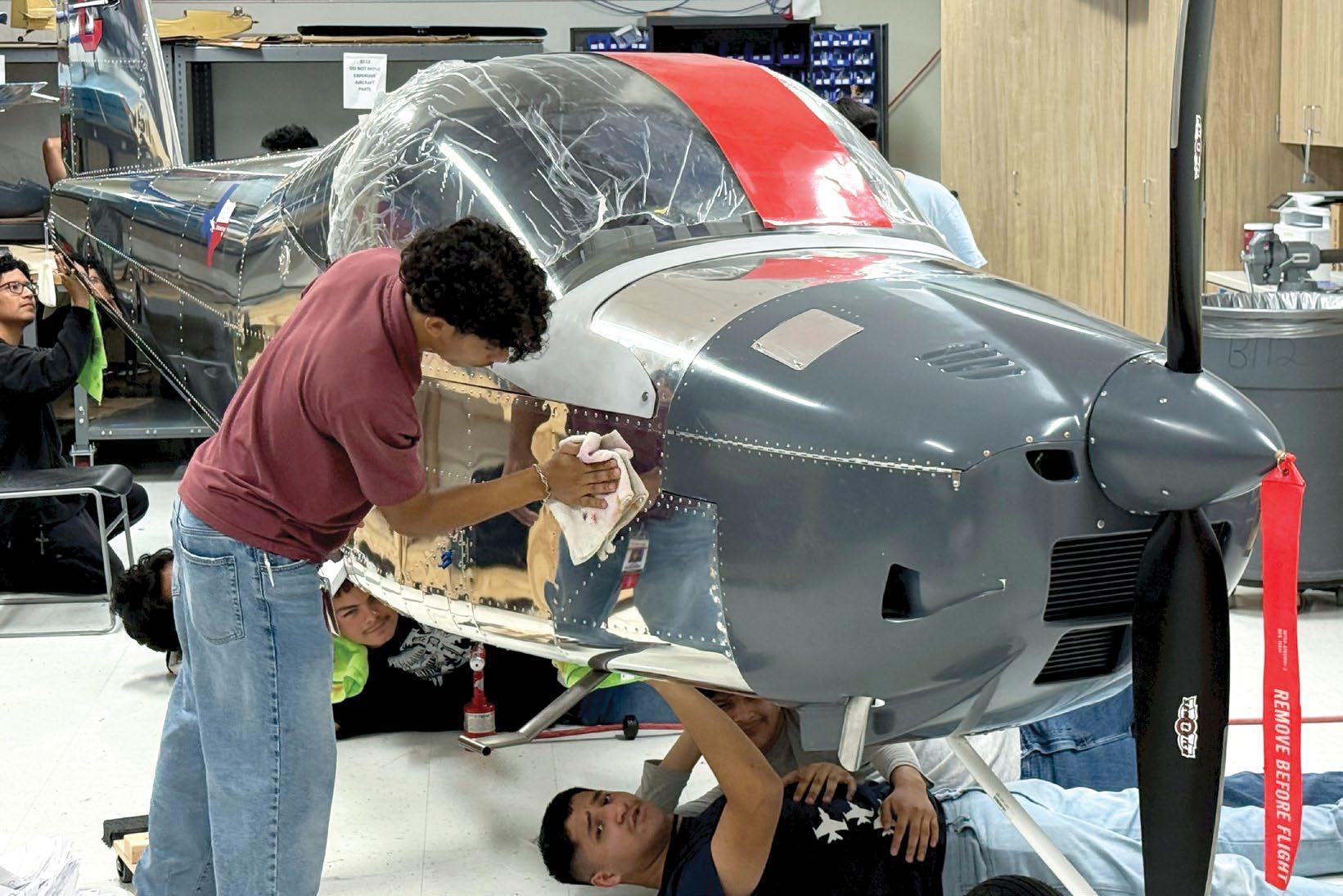
Cleveland ISD is located about 50 miles northeast of Houston and has about 12,711 students enrolled. The program’s students have the chance to earn a commercial drone license, a private pilot certificate, credit toward the general test required to earn an airframe and powerplant license, and possibly most impressive — to build not one, but two airplanes. They take the math and science learned in the classroom and apply it to real-world situations.
Cleveland ISD’s CTE Aviation and Engineering students shared their experience in March at TASB’s Governance Camp in Galveston.
As freshmen, students learn the basics of aviation, and they are exposed to the different career pathways available to them, Garcia said. As sophomores, they work toward their Part 107 Civil License — a commercial drone license that allows students to use their skills through drone work, which means they can earn money and be exposed to career opportunities.
Students learn about the different types of drones and see the complexities, so they better understand the field, she said. They also learn about drone mechanics, safety, and regulations.
Learning by doing
To be a better drone pilot, students need to understand all aspects of flying drones, said senior Kevin Velasquez, the program manager. “Yes, you can go buy one, and that’s fine,” he said. “But when you build your own drone it gives you a sort of connection, you give more passion to it, because it’s like, ‘I did that.’”
Once students have passed the test and have their drone license, they can move on to the private pilot ground school, Garcia said.
“We actually have an FAA-approved curriculum that our mentor teaches us, which allows us to get so many great aspects and get the first big step into what being a pilot is,” she said. “We learn aerodynamics; we learn instruments — what actually is there in a cockpit. And obviously when we teach our students, we also want to be able to tie it back to their core classes. Our study materials actually
tie back a lot to science and math.”
The students have a chief flight instructor who comes to the school to mentor students, Velasquez said. The flight instructor, who teaches the students to fly for free, must sign off so that they can be issued a student license, which helps them with their flying.
“This gives our students a huge advantage in their pilot careers,” Garcia said. “After students get their pilot license, they are allowed to use our flight simulators — our FAA certified flight simulators — that actually allows our students to fly and log hours toward their private pilot license.”
Using simulators takes away some of the real risks, while offering students access to a variety of scenarios that might be encountered in the air, Velasquez said.
“You know when you are up there anything can happen,” he said. “So, having a sim is a good way for kids [to learn], so

certified 500 commercial drone pilots,” Velasquez said. “Three years, 500 kids; the next generation of aviation.”
Brian Stafford, the aviation and engineering instructor at Cleveland ISD, said that for some students who might not normally come to school, the program inspires them to show up every day.
“I used to coach football,” he said. “But for me, this has been probably the most rewarding program I’ve taught in my 15 years in education. And it’s nice to be able to teach something with a realworld application that you can see them applying as they graduate and leave. To be able to get them the different licenses and then watch them go out and make money, that’s pretty cool.”
The engineering, pilot, and mechanics programs converge at the end, coming together in a practicum course taken by juniors and seniors, Velasquez said. The practicum is a two-block class that students can take for two years.
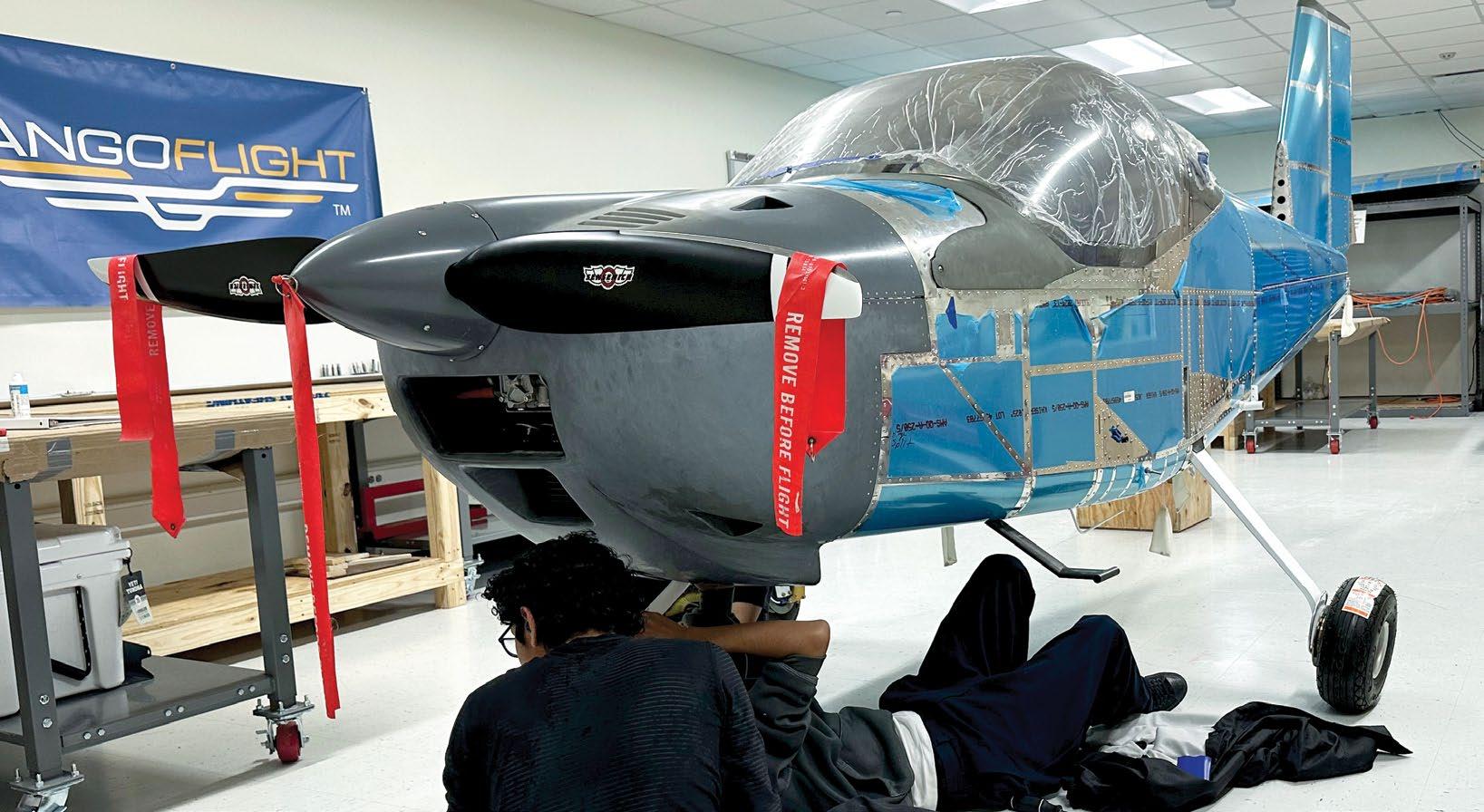
“In our class, through our [district’s] partnership with Tango Flight, we are given the resources and the curriculum needed to build a plane,” Velasquez said. “That’s what we do. We build a plane.”
Tango Flight is a two-year aviation/ aerospace-based program created to inspire the next generation of engineers, pilots, aviation mechanics and technicians, and flight crews.
“This is an opportunity that only about 60-something schools in the entire nation are able to do,” Velasquez said. “And I think there are around 10 [schools] in the entire state of Texas. So, it’s something that we were very proud of that we were able to do.”
once they actually go and get into the cockpit, they already have that knowledge of trying it in the sim.”
Velasquez is working toward his private pilot certificate and is expected to earn it in the summer.
“Most of us don’t come from a lot of resources,” Garcia said. “And to be able to have this at school, it really allows us to get the support and help we need. And having this allows us to get an advantage.”
Senior Josue Cardenas, assistant manager for the program, said that while the classes in general are fun, and flying drones and using a simulator are also
exciting, at the end of the day, students have to do the work if they intend to pass and earn their private pilot certificate.
“In our classes, the tests we take are FAA exams, which are government-issued exams," Cardenas said. “Now, these aren’t just simple ABC or 1+1=2 questions. These are real-world scenarios they put you in. And some of these questions are pretty hard to answer.”
Despite the challenges, the students in the program achieve higher pass rates than the national average, with students earning a 98% pass rate for their pilot certificate, as one example.
“In the last three years since we’ve started our aviation program, we have
Velasquez said the first plane the students built took about two years to finish, which was a big milestone because no other schools have been able to finish that quickly.
"No school has been able to do that apart from a school that was taught by the owner and founder of Tango Flight,” he said. “And then, with our current plane, we are going to finish it in one year. That has not been seen before and it’s something that we are really proud of.” H
Mary Ann Lopez is a staff writer for Texas Lone Star.
by Beth Griesmer
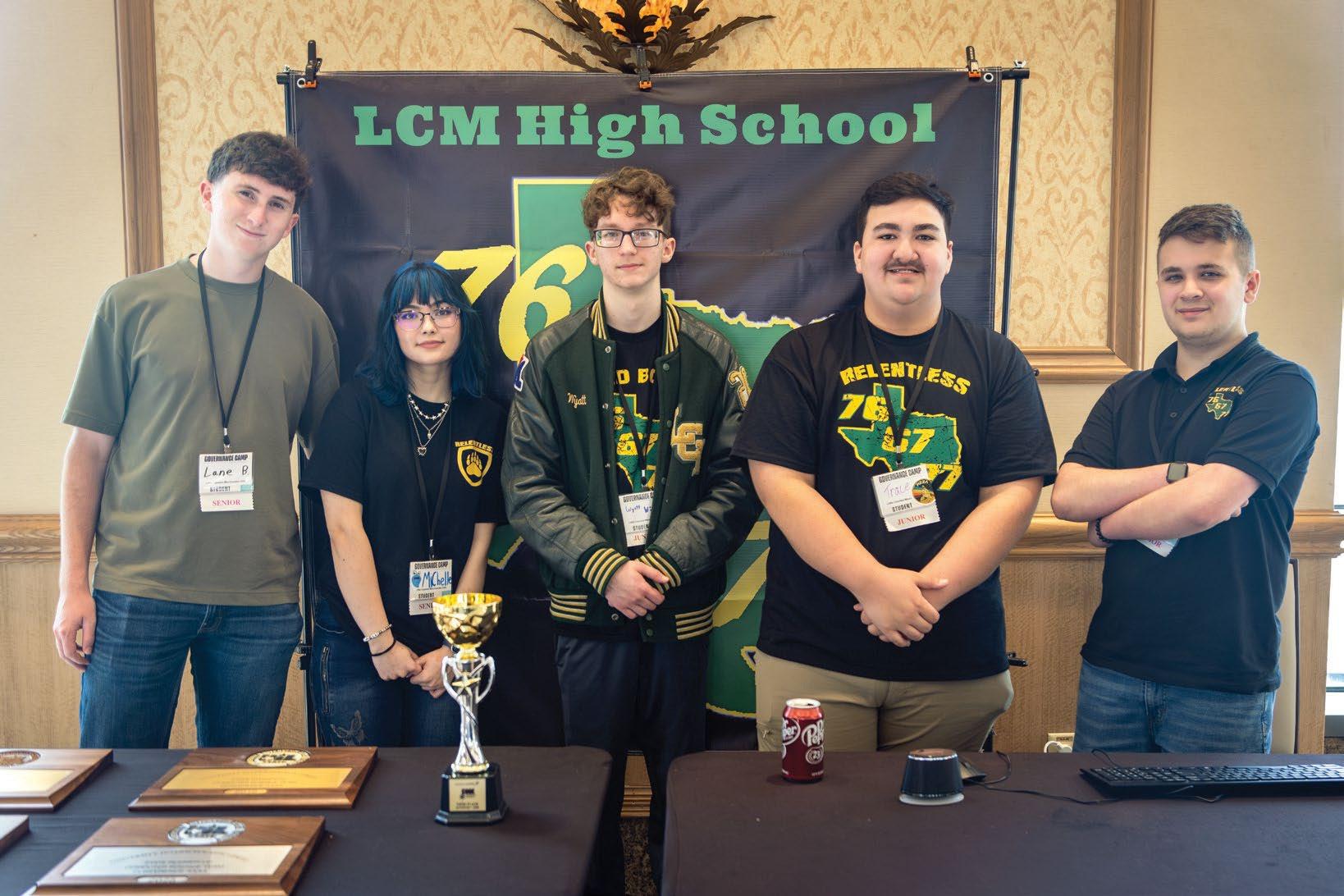
Ask Jarvis the chatbot anything about Little Cypress-Mauriceville CISD and it will impress you with its knowledge about the 3,000-student district east of Beaumont. Students from Little Cypress-Mauriceville High School developed and trained the chatbot using skills they attained in programming and software development courses, a career and technical education pathway in the district.
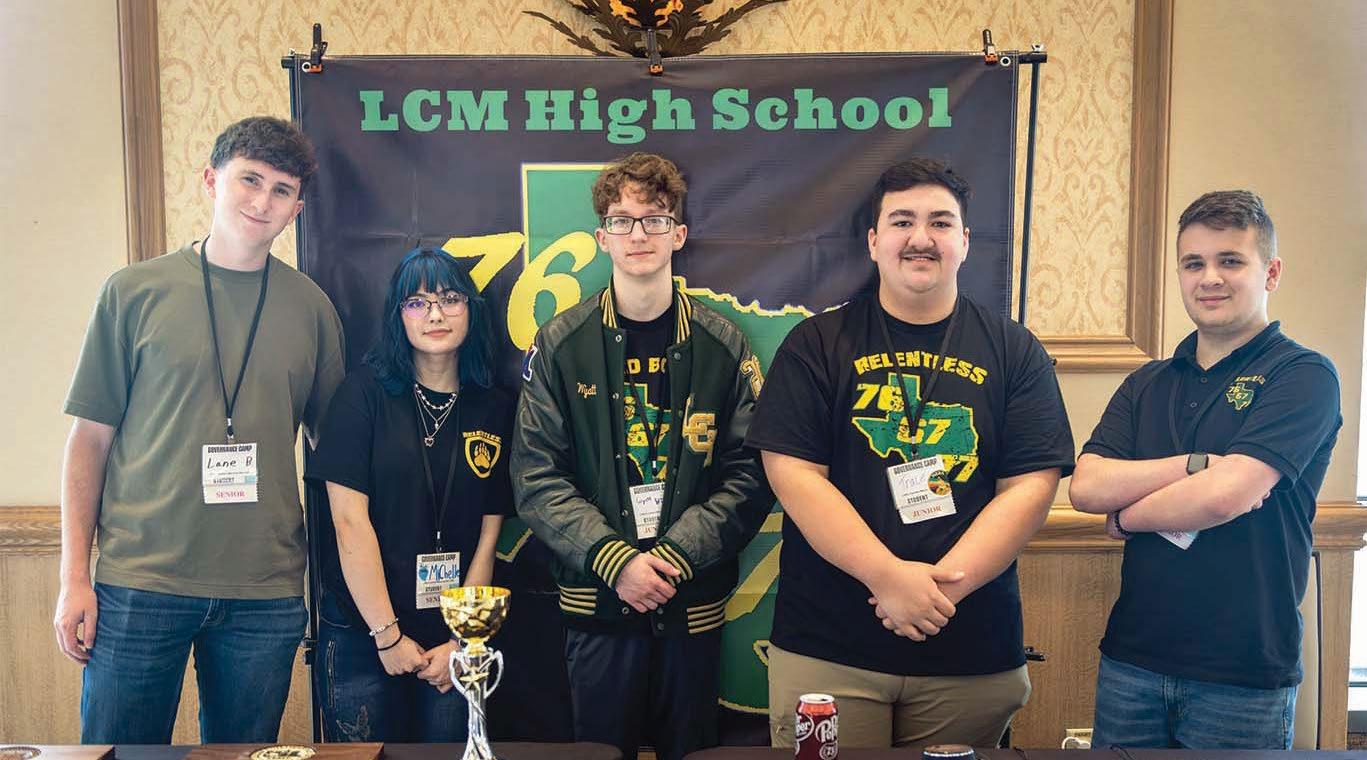
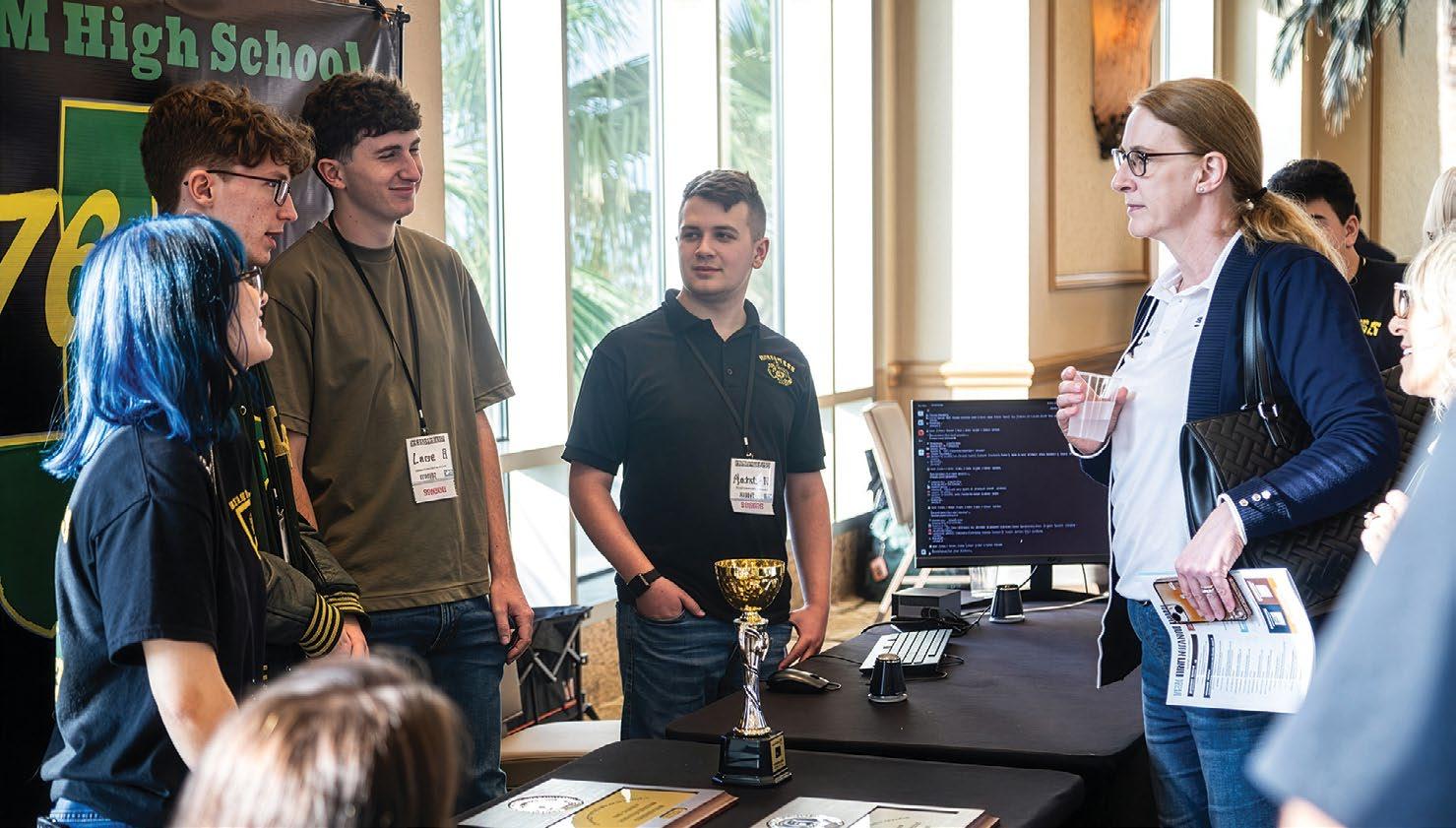
The Little Cypress-Mauriceville High School computer science students presented their work at TASB’s Governance Camp in March, sharing how projects tied to University Interscholastic League competitions are helping them build skills in algorithms, debugging, and computational thinking.
“I am so proud of their accomplishments,” said Terry Morris, Little Cypress-Mauriceville High School computer science teacher. “Whether they pursue computer science or other career paths, they are learning valuable skills they can apply to many aspects of their lives.”
Overall, the students demonstrated how classroom coding can translate into real-world problem-solving. Through the UIL coding projects, students practiced breaking down challenges into smaller steps, testing solutions, and learning from mistakes, which are habits that mirror the work of software developers and engineers.
District leaders say opportunities like TASB Governance Camp help students connect their learning to a broader audience. During the presentations, Little Cypress-Mauriceville High School students demonstrated technical ability as well as confidence and professionalism, explaining complex concepts to school board members and education leaders from across Texas.
“Experiences like this remind us
that when students are given meaningful opportunities to create, present, and lead, they rise to the occasion,” the district shared. With hands-on projects that blend competition, creativity, and practical applications, the computer science students are not only learning to code, but they are also learning to think, collaborate, and communicate in ways that will serve them well in college and future careers. H
Beth Griesmer is a staff writer for Texas Lone Star.
B At TASB Governance Camp in March, Little Cypress-Mauriceville CISD students talked to trustees about their coding skills project.
Longview High School
senior Brynn Woods, an accomplished member of her local FFA chapter, earned Grand Champion honors last fall in the State Fair of Texas Job Interview Contest, standing out among top competitors from across the state.
The contest challenged students to demonstrate real-world career readiness through a rigorous application and interview process. Participants submitted a job description, cover letter, and résumé before advancing to in-person interviews with industry professionals in Dallas. The top 31 students competed in multiple rounds, including a written follow-up letter and final interview with a branch manager from a local recruiting firm.
Woods earned the Grand Champion title, receiving a college scholarship, a championship buckle, and a banner. Her achievement also earned her recognition as a Big Tex Scholar, honoring leadership, professionalism, and academic achievement.
“I was shocked because I went into that contest expecting nothing to come from it, and then to win the whole thing was surreal,” Woods said. “My advice for anyone wanting to try something new is do not count yourself out — because you never know what can happen.”
Woods has been a member of Longview FFA for five years and serves as both a chapter officer and area officer, representing more than 100 schools across Northeast Texas. She attended Longview ISD for six years and was also active in the National Honor Society, Texas Bank and Trust Student Board, and Longview ISD Student Advisory Board.
“Brynn represents the best of Longview ISD — a student who leads with confidence, humility, and purpose,” said Marla Sheppard, Longview ISD superintendent. “Her success is a
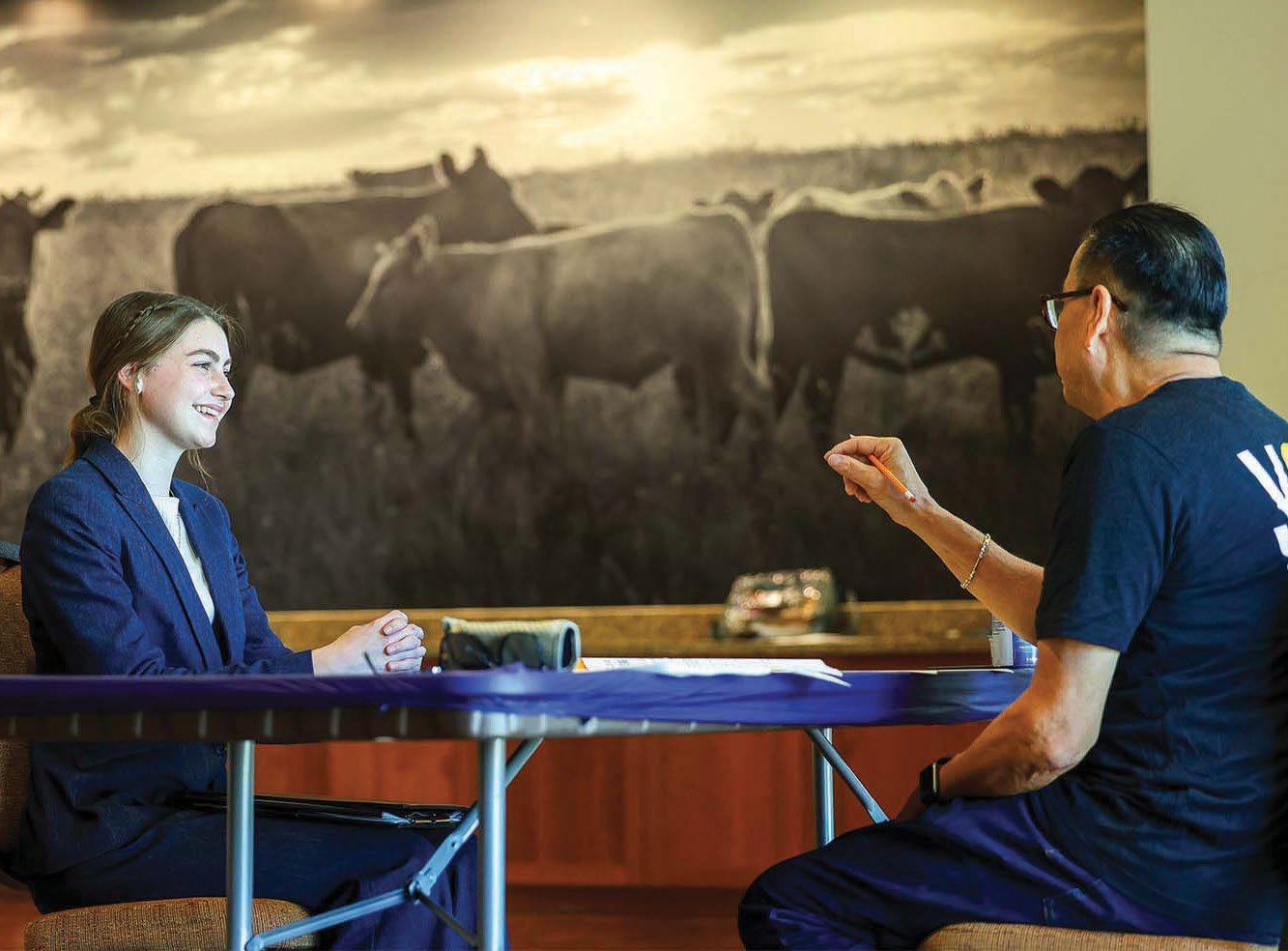
reflection of her hard work and of the strong opportunities provided through our award-winning agricultural science and FFA programs.”
The Longview FFA Chapter is one of the most recognized programs in the nation, with more than 1,300 active members, making it the largest FFA chapter in the U.S. Students gain hands-on leadership and career training through agriculture, business, and technical education, preparing them for college and future careers. Longview ISD serves about 8,100 students.
“The strength of Longview FFA comes from students like Brynn, who are willing to challenge themselves,” said Cyler Frost, Longview FFA chapter advisor. “Her accomplishment at the State Fair shows how our students take classroom learning and apply it at the highest levels.” H
This story is courtesy of Longview ISD.
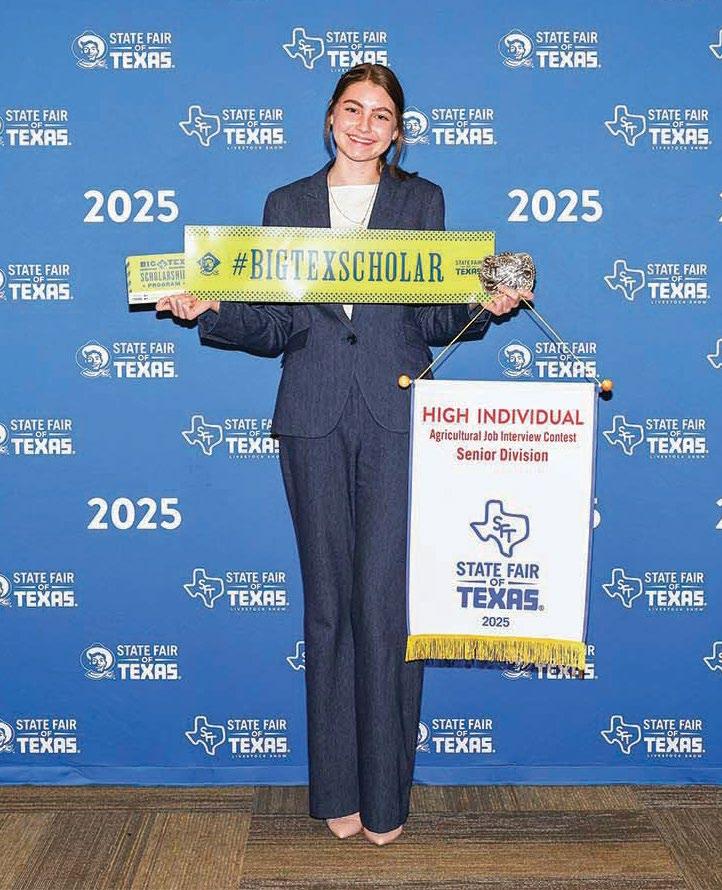
Congratulations to Longview High School senior Brynn Woods for earning Grand Champion honors in the State Fair of Texas Job Interview Contest! Students were challenged to demonstrate realworld career readiness through a rigorous application and interview process. The Grand Champion title comes with a college scholarship, a championship buckle, and a banner.
courtesy of Longview ISD
Sometimes, the best stories are not told; they are lived. This year, Texarkana ISD’s Texas High School Student Council has written a story that reflects a strong commitment to student leadership and service.
Returning this spring from the Texas Association of Student Councils Annual Conference, these student leaders brought home more than recognition; they brought home excellence. The council earned the prestigious Sweepstakes Blue Ribbon for Outstanding Student Council, along with Outstanding Awards in several major categories: Pride and Patriotism, Energy and Environment, DASH (Drug, Alcohol, Safety, and Health Awareness), and Community Service.
To be recognized as outstanding in each category, students completed a minimum of 20 impactful projects per area while also meeting 55 rigorous standards of excellence. Beyond their project work, council members and advisers actively participated in and led leadership training sessions and workshops at the conference, further demonstrating their commitment to growth and service.
Adding to the celebration, Texas High School earned a Top Ten Video Award for a student-produced project. The winning video, created by Sanders Wiggins, highlighted the council’s efforts to reimagine and revitalize Tiger Camp, an initiative that continues to strengthen school culture and student connection in the district, which serves about 7,200 students.
The district’s Texas High School Student Council was also selected to host the 2028 TASC Annual Conference, reinforcing the program’s reputation for excellence across the state.
Achieving meaningful goals
While at the conference, the celebrations continued with exciting
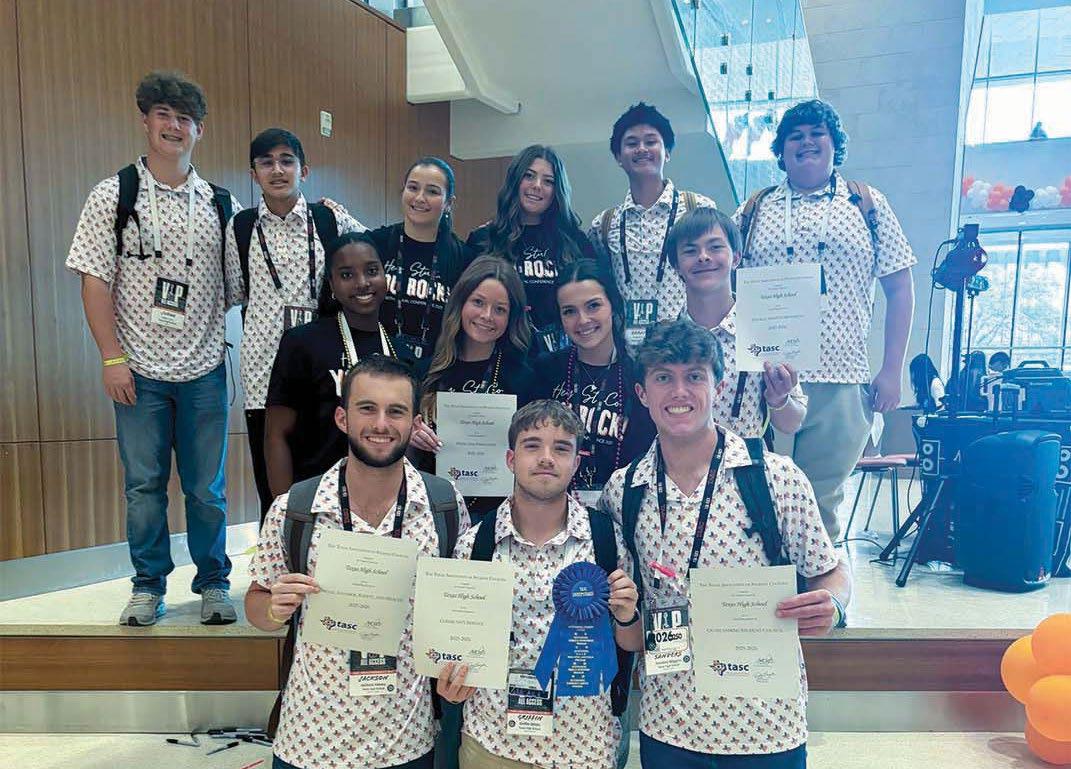
news: Texas High School was once again named a 2026 National Gold Council of Excellence by the National Association of Student Councils. This marks the 18th time the council has earned this distinguished recognition, reflecting its continued success in meeting 72 national standards of excellence while achieving meaningful goals across multiple service and leadership areas.
“This prestigious award is a testament to the highest standards of quality, leadership, innovation, and community engagement that your council consistently demonstrates,” NASC shared in its official recognition.
Every project, every initiative, and every success is student driven. While advisers provide guidance and support, it is the students who plan, implement, and bring each idea to life. Their dedication, creativity, and commitment to service continue to elevate not only their school but the entire Texarkana community.
“This group of students continues to raise the bar for what student leadership can look like,” said Student Council Advisor Susan Waldrep. “Their willingness to serve, lead, and support one another is what sets them apart. I am so proud of the work they have done and the impact they continue to make.”
Superintendent Doug Brubaker added, “We are very proud of our students who serve on the Texas High School Student Council. Their achievements also reflect Texarkana ISD’s commitment to developing strong student leaders. Across our district, we intentionally create opportunities for students to lead, serve, and grow. These students represent what is possible when we invest in leadership development and support them in becoming active contributors to their schools and communities.” H
This story is courtesy of Texarkana ISD.


by Mary Ann Lopez
When Friendswood High School seniors and FFA members Jaxtin McCollum and Ava Stone discovered that younger students in their district didn’t know what agriculture is and its importance, they knew they had to do something to help educate them about it.
The pair have spent the last several years doing outreach for elementary school students at Friendswood ISD, a district with about 6,142 students enrolled. With support from their Agriculture Science teacher and FFA advisor, Rachel Sawyer, and their Brazoria-Galveston County Farm Bureau representative, Deana Fuchs, the AgVocates outreach program reached more than 600 students in spring 2026, Fuchs said.
Through the AgVocates Ag Literacy program, McCollum and Stone have given presentations at Cline, Windsong, and Westwood elementary schools. The presentations take place on special occasions that celebrate STEAM learning, such as Go Texan Day. While the idea was Fuchs’, McCollum and Stone put in the hard work to make the program a success at the schools. The pair even won the FFA state title for the Texas FFA ServiceLearning Award.
“Each school year, we gather a group or committee of Friendswood FFA students together for this project,” Fuchs said. “In the fall, I present them with several agriculture-accurate books along with a supporting activity for each book. The students then decide which book/ activity they will present for that school year and help me get supplies ready for the activity if needed.”
Texas Lone Star caught up with McCollum and Stone to learn more about their work with the outreach program. Their answers, which they collaborated on, have been condensed and lightly edited.
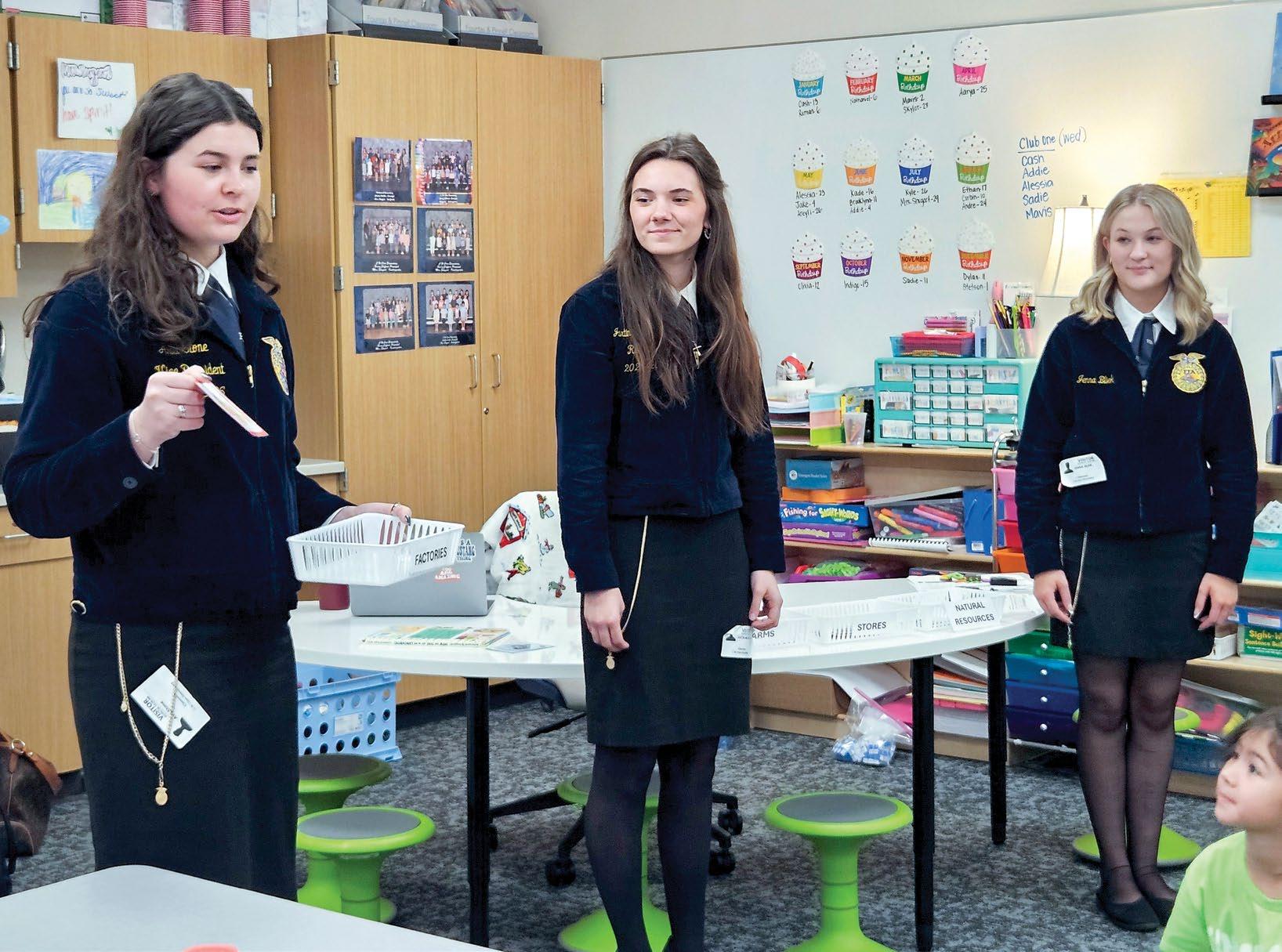
Q: How long have you been in FFA?
We have both been involved in FFA for the past four years of high school.
Q: How long have you been participating in the literacy program?
We have been involved with this (AgVocates) committee since 2022 and became the co-chairs of the committee in 2024. Our roles shifted from listening and participating in the monthly meetings and supporting classroom presentations to leading monthly meetings and the activities during the classroom presentations.
Q: Why did you decide to participate in the agricultural literacy program? Why was it important to you?
Being an FFA member, it is easy to have a very strong understanding of what
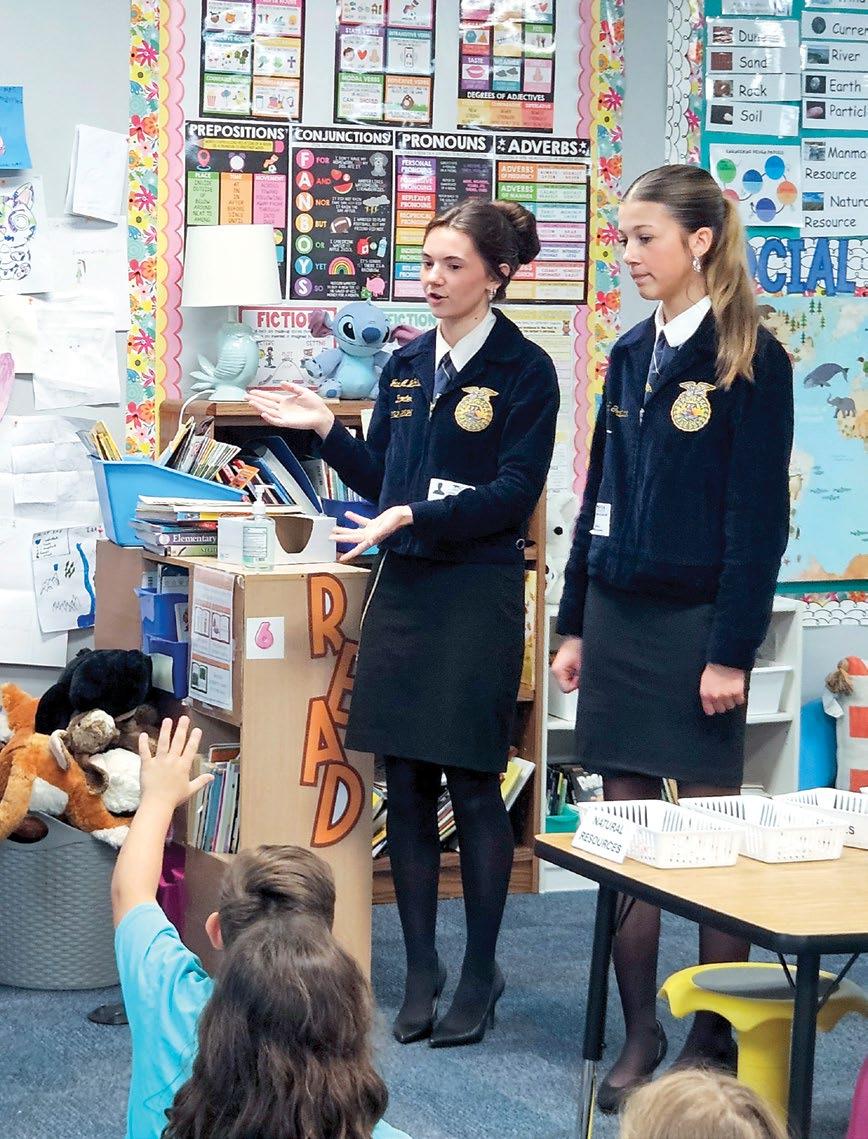
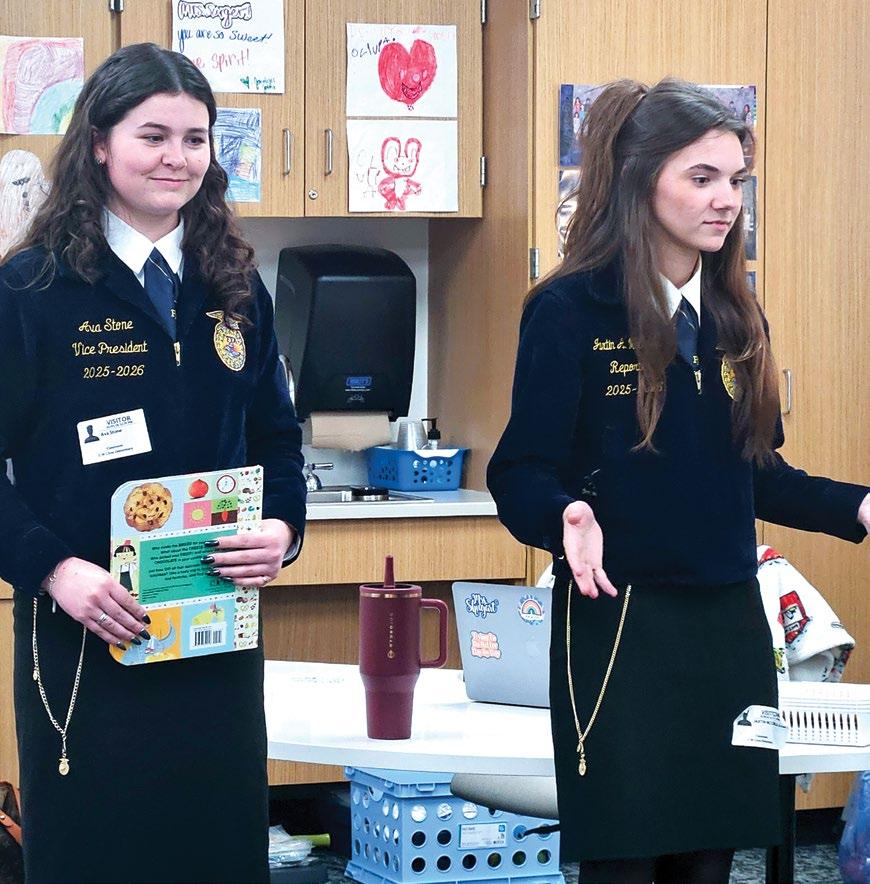
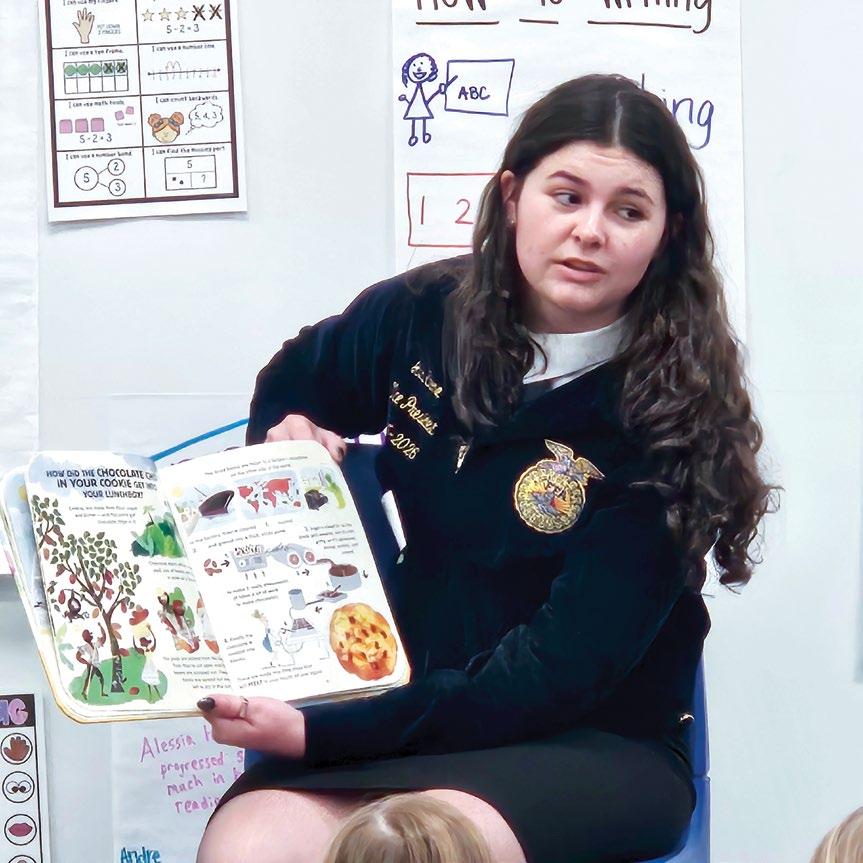
awareness and help younger generations provide their own meaning of it.
Q: How did the County Farm Bureau help you plan and prepare for your program?
The Brazoria-Galveston County Farm Bureau provides all the materials needed for our classroom presentations. They provide the agricultural literacy books, the activities, all materials needed for the activity, teacher evaluation sheets, and an informational paper packet for each member in the committee that explains a detailed plan of our presentations. The County Farm Bureau is a vital organ in the body of this program.
Q: What kind of research and work were involved in creating your literacy program?
The research done for this project primarily consisted of taking advantage of our resources. A key resource we had was the expertise of Ms. Fuchs. She has been a huge help in finding agricultural topics for our students based on age, location, and education level.
Q: What are the goals for the program?
The primary goal is to make sure every elementary student, in our hometown of Friendswood, understands basic agricultural concepts such as natural resources, dairy education, agricultural inventions, pollination, and common farming practices.
Our secondary goal is to spark an interest or passion in these students, and for them to be a part of the Agriculture, Food, and Natural Resources classes offered at our high school.
Q: Has the program been successful?
elementary schools, six different grade levels, and 42 classrooms. By the end of our presentation, according to the feedback forms, we actually saw a high level of comprehension for the concepts we presented. This is a very successful result of the heart and passion poured into the committee.
Q: How did your teacher support you and help you with this project?
Mrs. Sawyer is the agriculture teacher who oversees our committee. She communicates with the elementary schools in our city and presides over the activities and lessons. Mrs. Sawyer is a key factor in maintaining the success and longevity of this project.
Q: Since you are seniors, what are your hopes for the program after high school?
As the year ends and we go off to college, our hopes are that the program continues to grow and reach all elementary classes at Friendswood. We want students to be able to confidently answer the question, ‘What is agriculture?’
Another hope we share for this committee is to increase agricultural participation among youth through the high school level. Through participating at the college level in the collegiate Texas Farm Bureau, we are dedicated to helping others find their passion for agriculture, advocating, and education.
Q: What has made you most proud?
agriculture is and its personal meaning and significance. The need we discovered is that today’s young children do not know what agriculture is; therefore, it does not mean anything to them.
Obviously, this is a huge issue because it threatens the future of agriculture. This was identified by us at our very first presentation when we asked the question, ‘Can someone tell me what agriculture means?’ In a classroom of 25 secondgrade students, not a single hand in the room was raised. Since then, we have been determined to increase agricultural
There are two types of success experienced in this project. The first is our measurable success, which is the number of students and classrooms we have presented to, and the second type of success is the learning outcomes for the students.
The learning outcome is based on an evaluation sheet that includes feedback to show us how well our project is received and its impact on students. After each presentation, it is collected to evaluate the program’s effectiveness and identify areas for improvement to talk about at our next meeting.
Just this year, we reached three
What has made us the most proud is seeing local elementary students who are excited and eager to learn about agriculture. A big joy we have experienced is when students remember who we are from the year prior. It makes us so proud to be a part of this impact, no matter how big or small.
Q: Anything else you’d like to share with readers?
Our work and dedication to this committee and the agricultural industry is done with a servant’s heart and a genuine love of teaching students about agriculture. We are so beyond grateful to share our passion with today’s youth through this committee. H
Mary Ann Lopez is a staff writer for Texas Lone Star.
At La Porte ISD, the Superintendent’s Legacy Leaders Student Advisory Council is a distinctive leadership initiative designed to amplify student voice and cultivate the next generation of leaders within the district.
Comprised of students from La Porte High School and the Academy of Viola DeWalt High School, the council brings together individuals identified by their principals and counselors as exemplary representatives of their campuses.
Throughout the school year, Legacy Leaders meet about six times with Superintendent Walter Jackson, engaging in meaningful dialogue about their educational experiences. These sessions provide students with a unique platform to offer honest feedback, reflect on campus culture, and help shape decisions that impact their schools and district, which serves about 7,000 students.
The result is a collaborative environment where student perspectives directly inform district leadership. The council is more than a discussion group; it serves as a real-world, master class in civics, where students actively practice the principles of representation, dialogue, and participatory leadership.
Developing young leaders
Beyond discussion, the council emphasizes leadership development. Jackson, who holds a doctorate in educational leadership from Baylor University and executive leadership certifications from Rice University and Harvard University, guides students through exercises and conversations designed to strengthen their communication, critical thinking, and decision-making skills. These interactions not only prepare students to lead within their schools but also equip them for future academic and professional pursuits.
A highlight of the Legacy Leaders
experience is the annual capstone event held in the spring. In years when the Texas Legislature is in session, students travel to the Capitol to observe the legislative process firsthand, watching live sessions from the gallery and gaining insight into how public policy is shaped. In alternating years, the group participates in enriching educational excursions, where they explore history, leadership, and public service through an immersive lens. This impactful program comes at no cost to either the district or participating students. Through the generous support of La Porte ISD’s Partners in Education, these opportunities — from leadership sessions to capstone experiences — are
fully funded, ensuring that every selected student can participate without a financial barrier.
The Superintendent’s Legacy Leaders Student Advisory Council stands as a powerful example of student engagement in action. By combining authentic input with intentional leadership development and real-world experiences, the program ensures that student voices are not only heard but valued, and that tomorrow’s civic leaders are prepared today. H
This story is courtesy of La Porte ISD.
Photo courtesy of La Porte ISD
by Mary Ann Lopez
For Earth Club members at Alief ISD’s Early College High School, giving back to their community is a key reason they get involved. However, it’s the club’s projects, their role in environmental sustainability, and global impact that drive the work.
“Instead of only learning about environmental issues in a classroom, we actively work on solutions,” Angelina Nguyen, a junior and the club’s treasurer, said. “I liked the idea of being able to see the direct results of my work, whether that’s a garden growing over time or knowing that our efforts contributed to a cleaner, healthier environment. It made the experience feel more meaningful and impactful.”
Three of the club’s leaders – Angelina Nguyen, senior Anthony Nguyen, the club’s president, and senior Minh-Minh Nguyen, club vice president – all agree that the Earth Club is popular with students because of the wide variety of volunteer projects offered, from tree planting to recycling to garden projects. While the three share the same last name, they are not related.
“This flexibility allows students with different interests and schedules to participate in ways that suit them best,” Angelina Nguyen said.
Strong student participation
Misty Chen-Goodspeed, the club’s sponsor, said the group was founded in 2017 by three students who saw an opportunity to work with the Alief Super Neighborhood Council. Alief ISD serves about 36,441 students, with Alief Early College High School enrolling about 400. The Earth Club has strong student participation and though it started small, today the club has about 60 members.
“That is how Earth Club started, with the purpose of offering opportunities to the students to give back to the local
communities by participating in and taking care of the community garden and other projects,” she said.
Over the years, the club expanded its partnership network, working with CITGO, the Alief Super Neighborhood Council, Rice University, SEWA International, and the IDEAStudio at West Houston Institute, part of Houston Community College. Through these partnerships, the club gets support for field trips, volunteer events, and garden projects.
One project, the Enchanted Grove, is now a thriving permaculture garden at West Houston Institute. Once a garden in need of care, the club was tasked with generating ideas for the garden, compiling their findings, creating a sketch of the future garden, and pitching the idea through a presentation, said Anthony Nguyen.
For junior Samad Bisuga, the club’s assistant president, the Enchanted Grove is the project he is most proud of, and the other students seem to agree.
“I’m proud of the amount of time and dedication we put into this project,” Bisuga said. “I’m proud to see the garden when I’m walking toward WHI. It constantly reminds me that ‘we did this,’ and I remember what the old pond used to look like and the process of deconstructing it. Even to this day, when our members are maintaining the garden, it reminds me how far we have come.”
This school year, the club worked on two projects, including a sensory garden on the school campus and a Texas native plants garden that members hope to have certified by the National Wildlife Federation, Anthony Nguyen said. To gain certification, the project must meet specific criteria, such as having a place for insects, a certain number of plants, and a resting area for birds and other small animals.
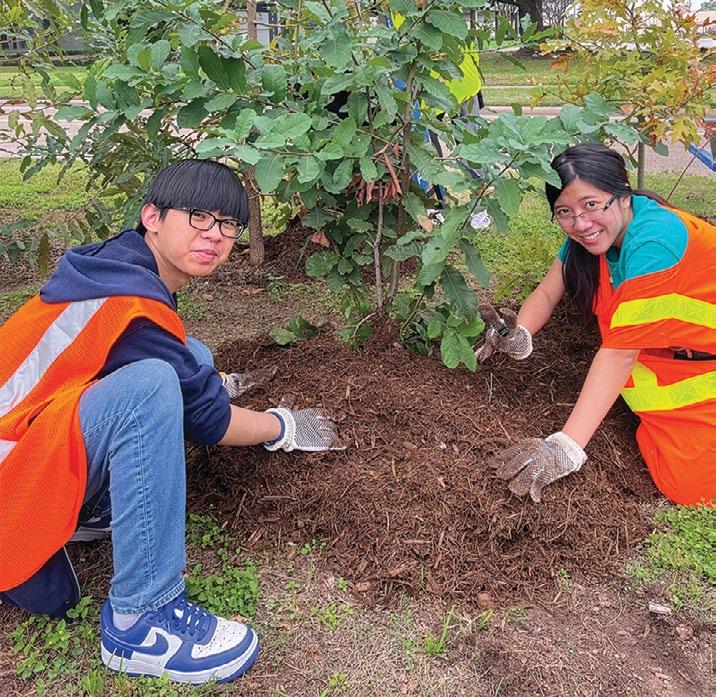
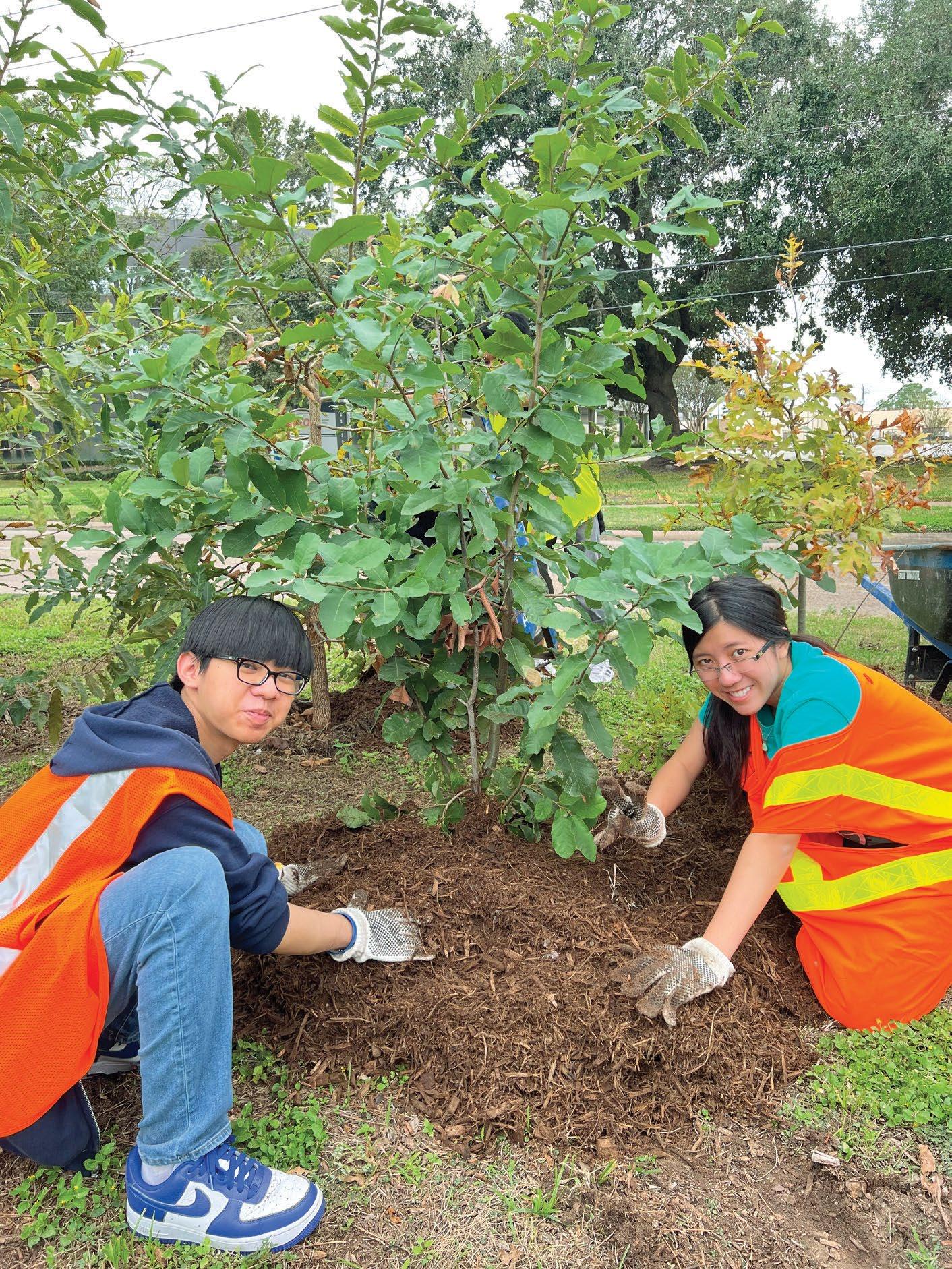
The Earth Club at Alief Early College High School has a lot of participation thanks to the variety of volunteer activities available to students, such as tree planting, recycling, and garden projects. Members say the club is also a great way for students to take a break from their studies and recharge. One project, the Enchanted Grove, is now a thriving permaculture garden at West Houston Institute.
The sensory garden will offer students an interactive experience when they walk through. “We hope to accomplish this by adding interactive features and fragrant plants that have a soothing/relaxing effect,” he said. “We also hope to add a waterspout to stimulate the auditory senses.”
Minh-Minh Nguyen said the impact of Earth Club spans far beyond campus.
“Although we do much of our work on our school’s campus, the impact on our community is everlasting,” she said. “We hope to continue our efforts to make Alief greener for all and teach incoming students the value of the environment and why it’s so important to maintain. With this, Earth Club is more than just a school organization, but rather a learning experience to grow as an individual.” H
Mary Ann Lopez is a staff writer for Texas Lone Star.
Santa Fe ISD believes in creating a vibrant and inclusive learning environment that goes beyond academics. The district’s innovative House Systems at Barnett, Kubacak, and R.J. Wollam elementary schools reflect its commitment to fostering a positive school climate and building meaningful, lasting connections among students. The program promotes unity, character development, and a strong sense of belonging for all.
Each elementary campus has its own unique set of core values that are all centered around one common theme: being good humans. Values such as honesty, courage, and kindness serve as the foundation of the House System. Each House is built around a specific core value and represented by a House color.
Students are assigned to a House in kindergarten. House leadership varies by campus. Some schools select Student House Leaders, while others choose to have Teacher House Leaders or a combination of both.
Student House Leaders are typically upper-grade students, often fifth graders, selected by a committee of teachers. House Leaders help plan rally activities, support younger House members, assist with character lessons, and serve as positive role models.
Throughout the school year, House meetings are held where teachers and student leaders collaborate to create chants, activities, and lessons focused on the core value they represent.
House Rallies occur four times a year and are where the magic truly happens. Students dress in their House colors, practice their chants, and participate in games planned by teachers to earn House points. Each rally builds excitement and strengthens school spirit as Houses work
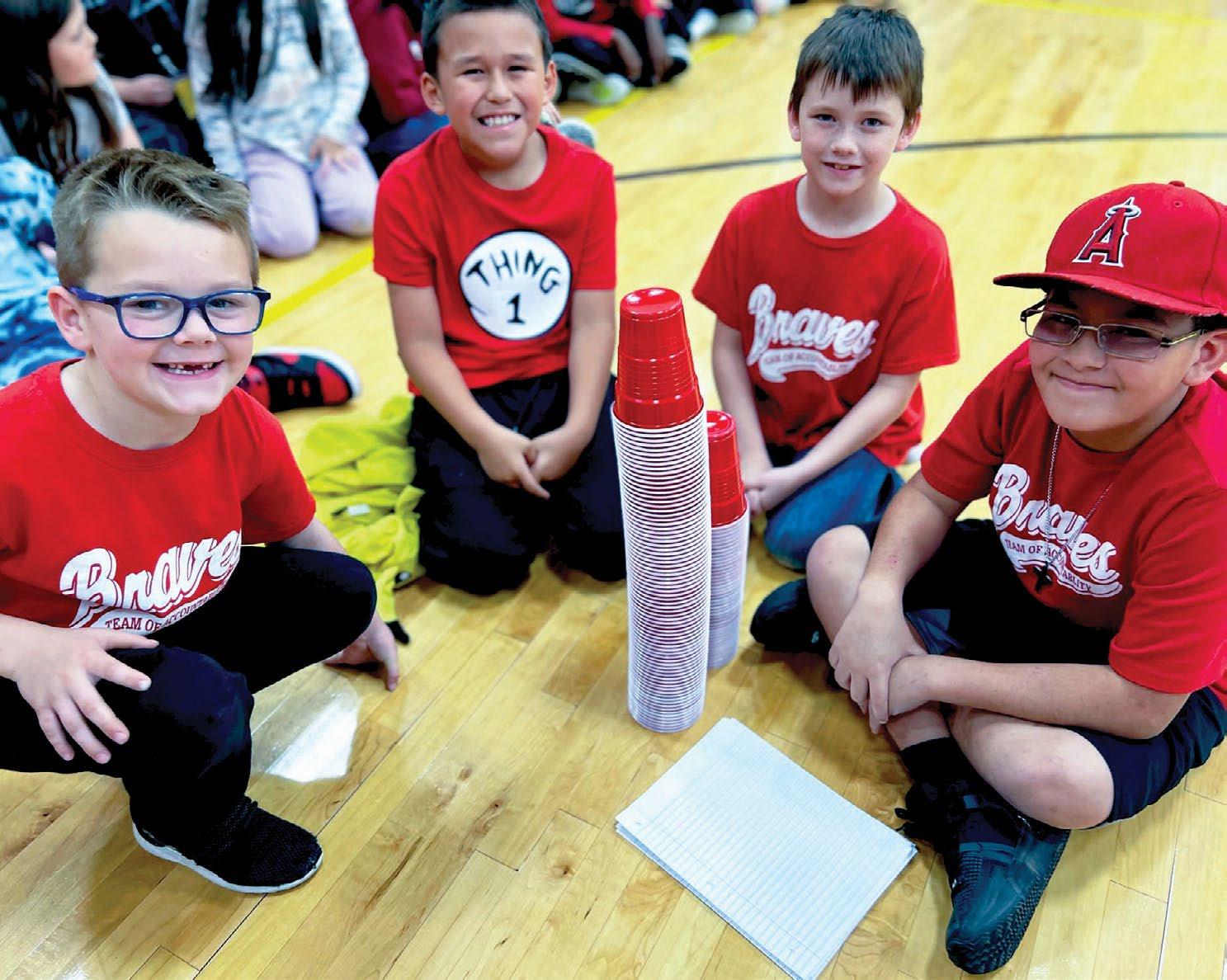
Santa Fe ISD’s House Systems at its three elementary schools promote unity, character development, and a strong sense of belonging for students. House Rallies are a special part of the program. Students dress in their House colors, practice their chants, and participate in games planned by teachers to earn House points.
together toward the goal of earning the most points.
Students earn House points through positive behaviors that reflect their core values. Teachers award points for actions such as demonstrating kindness, showing leadership, helping others, working hard, and making responsible choices. The House with the most points was announced at the end of the school year.
Across all elementary campuses, staff have noticed a powerful sense of belonging created by the House System.
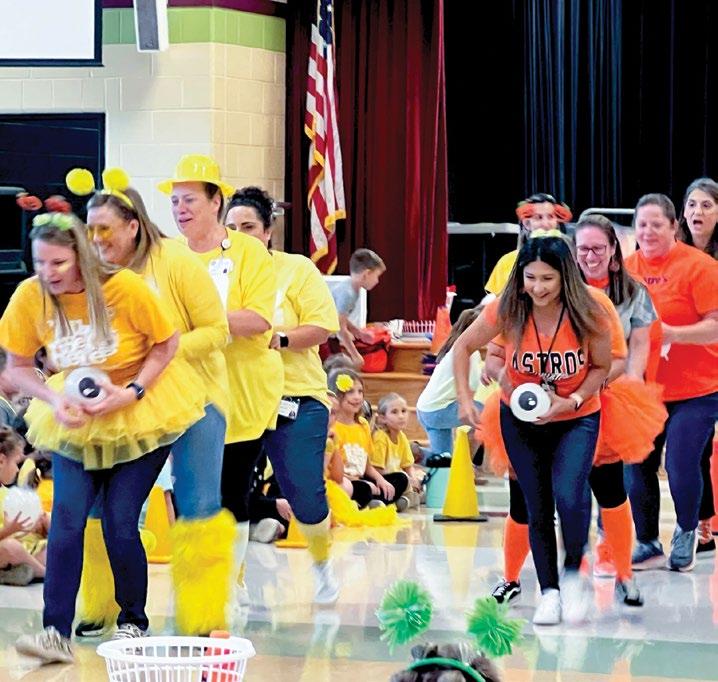
Teachers report increased engagement, improved behavior, and higher motivation in and out of the classroom.
As students move through the grade levels, they carry the lessons, values, and friendships formed within their Houses. Together, they grow into responsible and empathetic leaders with shared values and a common goal: to be good humans.
Santa Fe ISD serves 4,273 students. H
This story is courtesy of Santa Fe ISD.
by Mary Ann Lopez
Editor’s note: Leadership TASB is a unique board development program designed to take experienced board members to a new level of service and leadership.
As part of the Leadership TASB experience, each class visits districts across the state to learn more about best practices in board governance, better understand educational challenges, and experience innovative programming.
Texas Lone Star asked some members of the Class of 2026 to share their personal perspectives and experiences from these visits to offer insight into the LTASB experience and how it impacts cohort members, their board service, and their knowledge of governance and leadership.
In April, the class made its fourth and final trip prior to graduation. The cohort traveled to Texarkana, making visits to Pleasant Grove and Texarkana ISDs. Kristi Littleton, Port Aransas ISD board president and a TASB Director, shared her insights and perspective from the trip
with TLS. Littleton has been on her board since January 2021. Her responses have been condensed and lightly edited.
Q: Why did you apply to participate in LTASB and how has the experience been?
I believe that the more I learn, the better I can be in my role as a school board trustee. This Leadership TASB experience has given me an opportunity to learn and grow alongside my classmates as we share ideas and experiences from our individual districts. Being able to visit several diverse districts across Texas has allowed me to see firsthand the amazing things that are coming out of public education.
Q: With this being your fourth and final LTASB trip — with only the final session at Summer Leadership Institute remaining — and having some experience with the program and the visits, what were you anticipating and excited about for this trip to Texarkana?
I anticipate each trip with LTASB more and more as the bonds within our group continue to strengthen. I always look forward to what I will see and hear that I can bring back to my district. Each place that we visit has its own unique culture, and it’s interesting to see how that shapes the district’s atmosphere, energy, and the way they support their students
and the overall environment of their campuses. I was particularly anxious to see how a district so close to the northern border of Texas would compare to my own, and to the districts we visited in the Rio Grande Valley, on the southernmost border.
Q: What were some highlights and insightful moments for you during the school visits in Texarkana?
One of the biggest highlights for me during the Texarkana visits was seeing the strong relationship between the board and superintendent at Pleasant Grove ISD and how that support helps drive the district to excel. Another standout moment was seeing how intentionally Texarkana ISD was developing student leadership, starting as early as 3 and 4 years old. It was impressive to see the level of trust placed in students and how they are guided to grow into confident, capable individuals ready for the future. The commonality at both districts was a clear and consistent goal of preparing their students for success.
Q: With this being the last trip before the final session in Fort Worth, and your completion of the program, how has your experience in the program changed how you understand and act in your school board role?
This experience has given me a broader understanding of my role as a board member and seeing the bigger picture beyond my own district. I have been able to learn how both large and small districts operate and been given insight into how they navigate challenges that we all face, like state mandates and
financial pressures, while still focusing on student success. That perspective has helped me be more thoughtful and intentional in my approach to decisions at my own district. It has also given me ideas on how we can improve, operate more efficiently, and be more deliberate in our planning for the future.
Q: If you look back at your first trip versus this last trip, how has it changed your depth of understanding of board governance, leadership, and advocacy?
I feel like I came into the program with a solid foundation in these areas, but this experience has deepened that understanding and how I apply it. Being able to talk through ideas and hear from 31 other trustees who share the same goal has strengthened my approach. It has helped bring more alignment and direction to my advocacy efforts and confidence knowing that I am not alone in the journey.
Q: Are there any key takeaways from this visit to Texarkana that you will share with your board? Overall, have the visits helped you open up to new ideas or programs that could benefit your own district?
Yes! Through this LTASB experience I have seen several ways districts used bonds to improve their campuses and creatively maximize their facilities to make every dollar count. Coming from a highrecapture district, bonds are essential for us to maintain our campuses, extend their useful life, and support continued growth. Financial responsibility has always been a top priority of the PAISD board, and it has been valuable to see new ways we can stretch each dollar. I have also seen innovative ways that schools are engaging students far beyond just teaching to a test, and I am excited to bring those ideas back to PAISD to help us continue focusing on real-life student success.
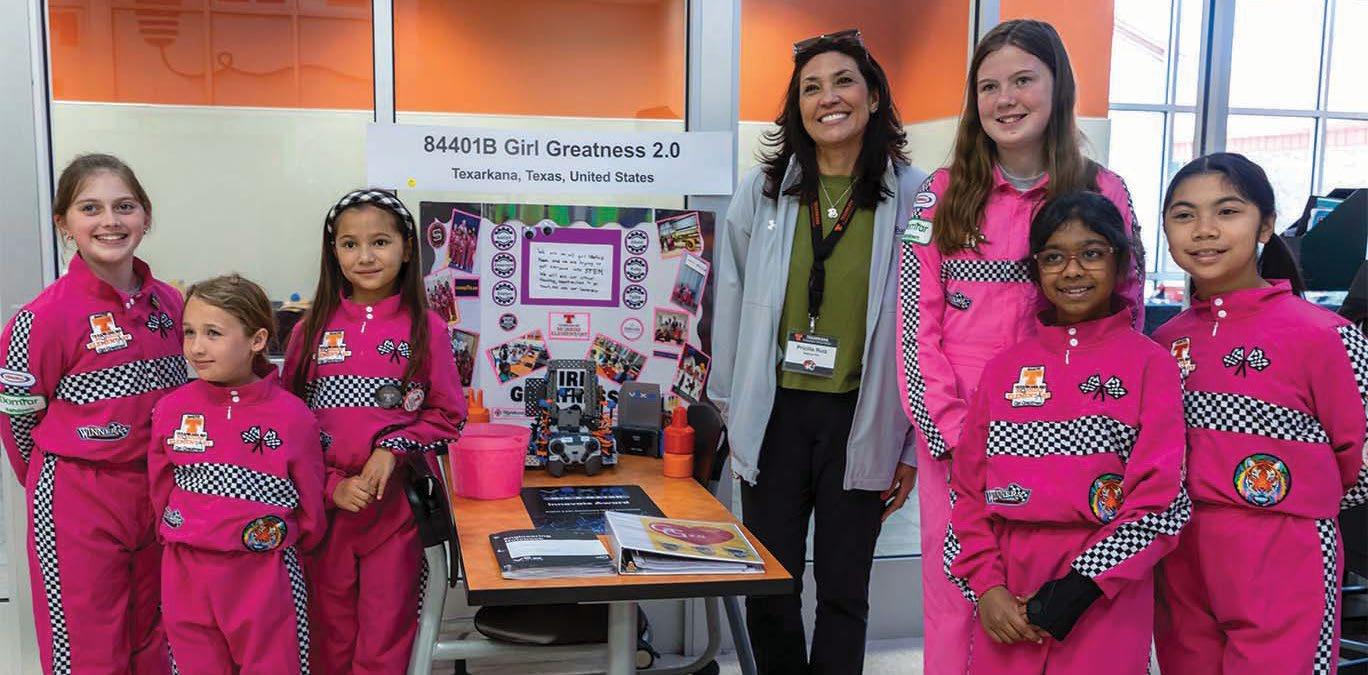
A The Leadership TASB Class of 2026 visited students at Texarkana ISD’s Martha and Josh Morriss Mathematics and Engineering Elementary School, learning more about their projects.
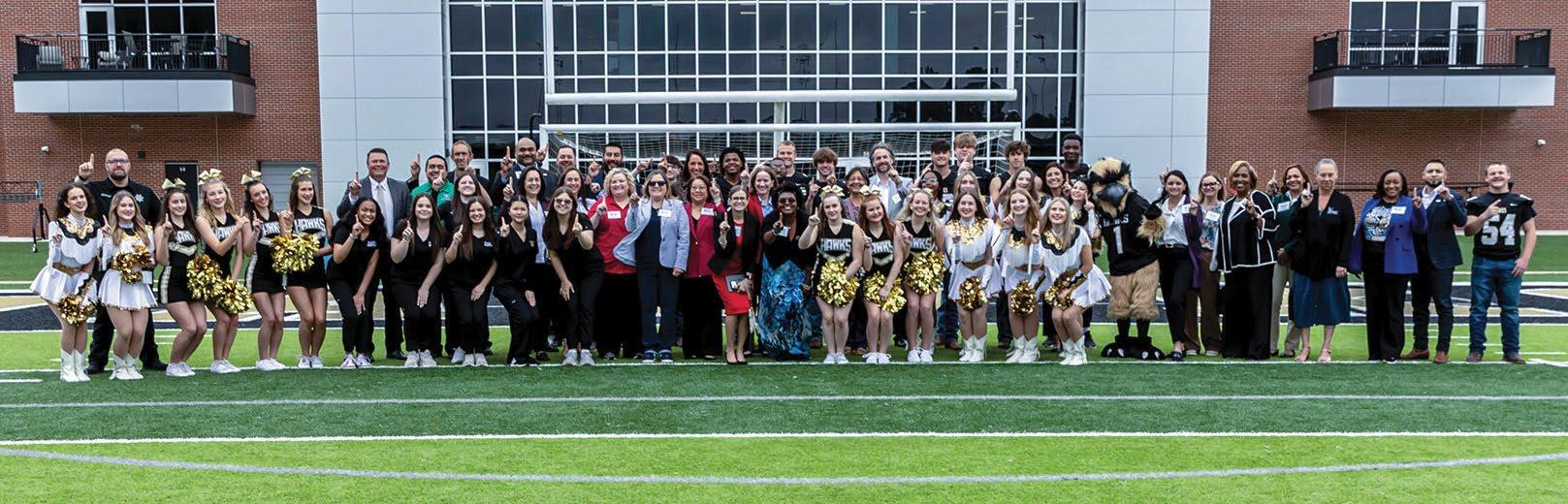
B The members of the LTASB Class of 2026 pose with students and staff from Pleasant Grove ISD during the April visit to the district.
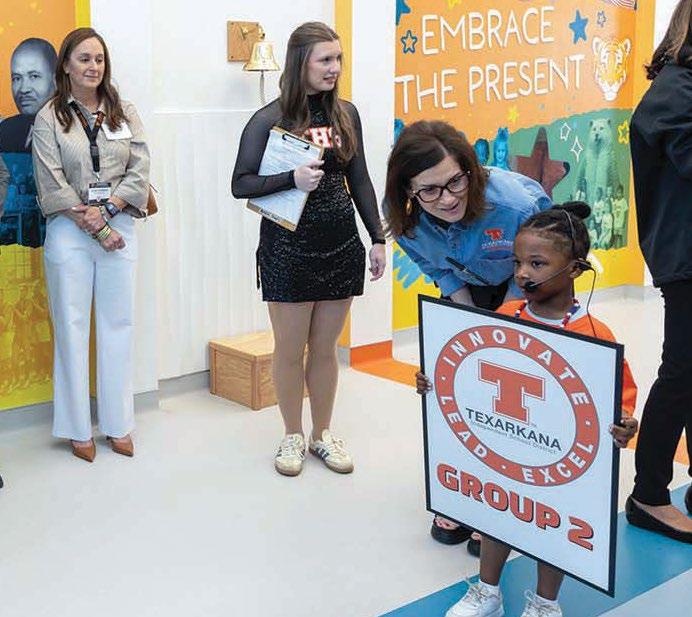
C Students from Texarkana ISD’s Paul Laurence Dunbar Early Education Center led class members on tours of their school.
Q: As you approach your graduation ceremony and your final capstone project, what will you take away from the LTASB experience?
This LTASB experience has reinforced that leadership and governance go beyond our own district. We have been given an incredible opportunity to collaborate, share ideas, and learn from one another. I am leaving with new friends, lasting connections, and a network of individuals with the common goal of doing what’s best for the 5.5 million public school kids across Texas. I am coming home with practical ideas and a goal of intentionality when making decisions for the future of our district.
Q: If you could sum up your trip to Texarkana in one sentence, what would it be?
This trip highlighted the Texarkana public school’s passion about excellence, intentionality in building strong students, and inspiring academic success through purposeful instruction and meaningful student voices.
Q: What would you tell a trustee who is considering applying for the LTASB Class of 2027?
I would tell them the same thing a fellow trustee and LTASB alum told me: ‘If you have even thought about doing it, do it! You won’t be sorry.’ I have learned so much, grown in my own role as a trustee, and built confidence and validation.
Q: Is there anything else you would like to add or think readers should know about your experience?
There’s a real sense you feel when you are in a room with a group of people who all care so deeply about the same thing: students. Through LTASB, I have felt that shared pride and passion for doing what’s best for students, even with the challenges we face as board members. It creates a sense of strength and purpose centered around doing the very best job we can do for the students we serve. H
Mary Ann Lopez is a staff writer for Texas Lone Star.
by Beth Griesmer
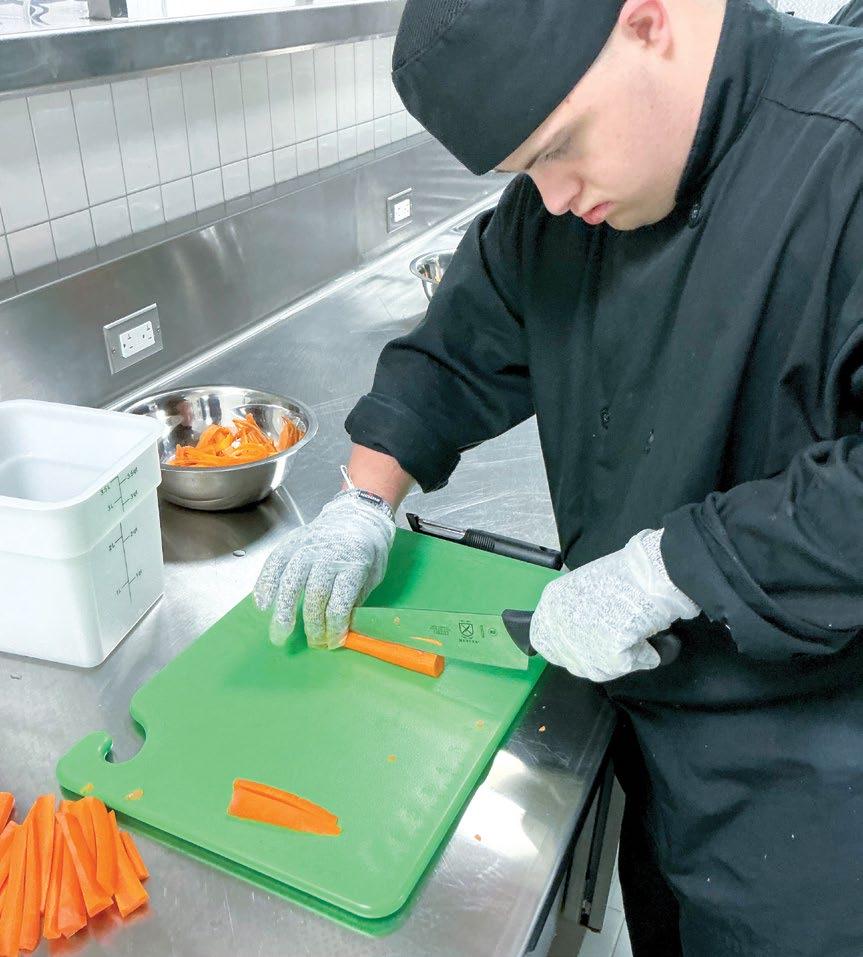
Lucas Baldwin loves to make omelets. But he is also skilled at preparing vegetables and can sauté carrots like a pro. Baldwin is part of an 18+ program at Georgetown ISD that focuses on preparing special education young adults for life beyond high school through skill development in the areas that matter most after graduation.
“An 18+ program shifts away from the academic component and instead makes sure students are ready for whatever their next step may be,” said Eden Guthrie, Bridges 18+ coordinator for Georgetown ISD. “Our goal is to ensure students have the skills they need to be as independent as possible.”
The Bridges program began in 2005 and has steadily expanded as the need for meaningful postsecondary transition services has grown. This year, the program serves 42 students, with
53 enrolled for the 2026-27 school year, reflecting both its success and the trust families place in the program. Overall, Georgetown ISD serves about 13,000 students.
Bridges emphasizes individual daily living skills, focusing on preparing students for employment and skill training that will give them the tools and confidence to someday pursue independent living.
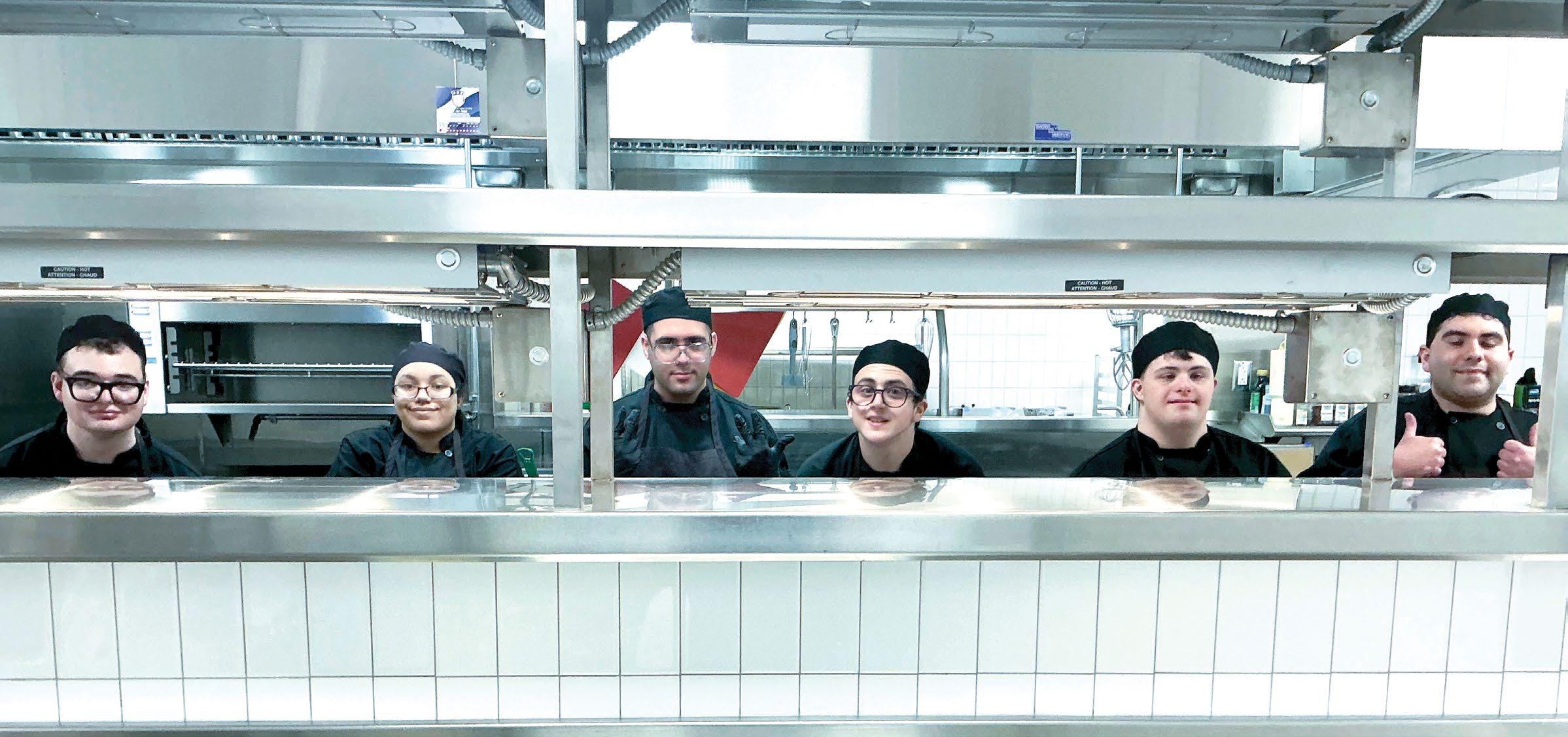
One of the standout components of the Bridges program is its culinary skills pathway, which had 10 students this year. The program recently achieved a significant milestone with approval by the American Culinary Federation. ACF is the nation’s largest professional organization for chefs and culinary professionals and sets national standards for culinary education, food safety, technical skills, and professionalism.
Receiving ACF approval required a comprehensive review of curriculum, lesson plans, structural practices, and overall program design.
“This certification shifts the narrative from focusing on limitations to focusing on qualifications,” said Courtney Marak, culinary skills trainer for the program. “It provides tangible proof of our students’ skills, readiness, and professionalism. This recognition represents opportunity, dignity, and access to meaningful employment.”
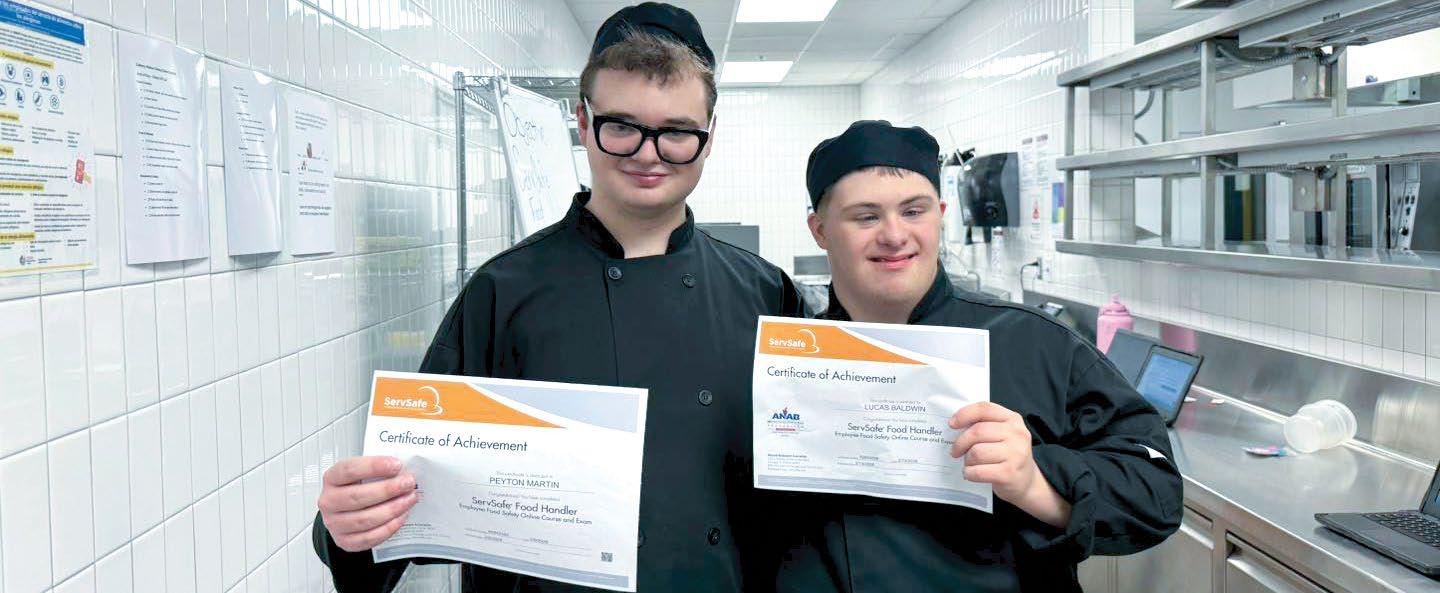
Bridges culinary students this year also participated in a 10-week food preparation certification program through the Central Texas Food Bank. The fast-paced, hands-on training is offered at no cost and culminates with students receiving a professional knife set, chef’s jacket, and pants.
For students like Tyanna Eiland, the
impact of Bridges is life changing. Eiland has worked at Gold Burger Diner in Georgetown for more than a year.
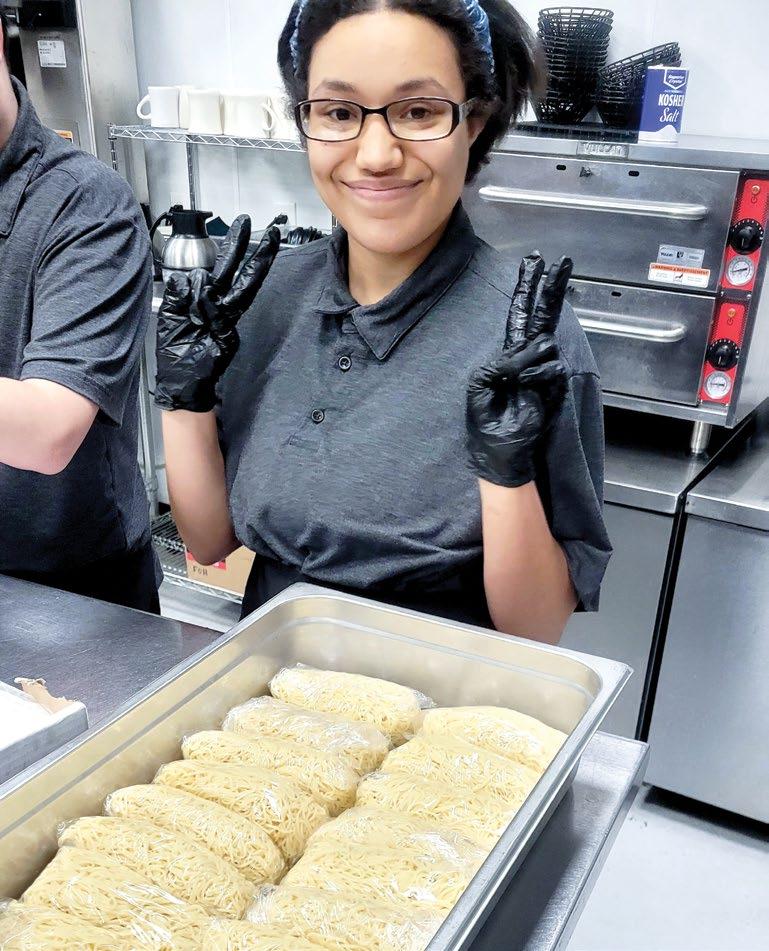
“Because I have a job, I can help buy groceries, pay my phone bill, and buy things I need,” Eiland said. With her American Culinary Federation certification, she is also able to earn higher wages and expand her career opportunities.
Strong community support Texas 18+ transition programs are designed to help students continue receiving special education services up to age 21 or 22 while working toward measurable postsecondary goals in employment and independent living. Georgetown ISD’s program aligns
closely with state guidance by providing instruction in real-world environments and supporting students as they move from school-based services to adult supports and employment.
What sets Bridges apart is its strong network of community partnerships and its emphasis on hands-on learning in real work settings. Georgetown’s supportive local community plays a critical role in the program’s success.
“We have about 21 community partners, including volunteer and internship sites,” Guthrie said. “Georgetown is a fantastic community that truly supports students and adults with disabilities.”
These partnerships allow students to practice workplace skills, develop routines, interact with co-workers, and
gain confidence in professional settings. Students participate in work-based learning across four different industries of grocery, retail, custodial, and restaurant and food service.
Support from local organizations has helped Bridges students access resources that directly impact their success. Through a partnership with Uplift Wilco, Georgetown ISD received a $10,000 grant that helped students prepare for employment by providing interview outfits, haircuts, and even laptops.
Ultimately, the Bridges program lives up to its name by connecting education to employment and training to independence.
“It’s a bridge from doubt to belief in our students’ potential,” Marak said. “And most importantly, it’s a bridge to a confident, meaningful adult life.” H
Beth Griesmer is a staff writer for Texas Lone Star.
A Students work on the line in the Bridges culinary facilities.
B Lucas Baldwin slices carrots as part of his culinary skills training.
C Tyanna Eiland uses her training from the Bridges program at her job at a restaurant in Georgetown.
D Students in the Bridges culinary program work toward their food handler certifications.
Photos courtesy of Georgetown ISD
by Mary Ann Lopez
Showing school pride is always in season in Texas. But for students at Thrall ISD, finding spirit gear was once nearly impossible in the small town of about 900 located 45 miles northeast of Austin in Williamson County.
In 2021, teacher Monica Barton, who was new to the district, worked with her four business practicum students to create Practically Purple, a business in which students design, fabricate, market, and sell spirit gear to Thrall ISD school staff and students and the larger Thrall community. Thrall ISD has about 923 students enrolled who live in Thrall and the neighboring small communities of Beaukiss, Shiloh, Noack, Hare, Structure, and Sandoval.
“As their adviser, I assist them with product ideas and purchases and teach them how to market and sell their products,” Barton said.
The practicum is only open to thirdyear business students, Barton said. This year, six students took the course.
“Mrs. Barton is the perfect person to sponsor a practicum like this,” said senior Brynn Leschber. “She is always helping us come up with ideas for new products and makes sure we have all the materials we need.”
The name came directly from the districts' school colors, which are purple and white. The six students in the class learned different skills to create products sold in the brick-and-mortar shop at Thrall High School.
“There are different main jobs, including laser engraver, embroiderer, and vinyl worker,” Leschber said. “At the beginning of the year, we assign one or two people to a specific job, and we are taught the special skills to do that job.”
Leschber is a vinyl worker, but she has learned to multitask to support the business, which can get quite busy,
especially during football season.
“The entire business is run by only six girls,” she said. “On Friday mornings during football season, we make anywhere from $500 to $900 selling spirit items at our elementary school.”
Everything the students make is customizable, she said. Some of the items sold at the store include door signs, koozies, embroidered napkins and blankets, and cutting boards. They also sell smaller spirit items, such as small megaphones, tumblers, hair bows, bells, handheld fans, dog tags, and tiger stuffed animals (the district mascot).
The students look for ideas for new products on Pinterest and Facebook; then they make samples to see if people like them, she said. They also send surveys to faculty and staff.
“The most common way people place orders is by emailing our Practically Purple email,” she said. “People see our items on our Facebook page, and we have pop-up booths at our high school football games.”
The money they earn from selling their products goes back into the business and materials needed to create their designs, she said.
The business helps students get real-world experience and learn valuable skills such as customer service, problemsolving, budgeting, design, and advertising.
“It has been helpful by teaching me about teamwork and running a business, and it has introduced me to machines I would like to have for my own personal use,” Leschber said. She likes being part of a successful program and is proud that the school and community supports it.
Leschber said that she is grateful to have a teacher like Barton, who not only supports students in the class but also supports their extracurricular activities
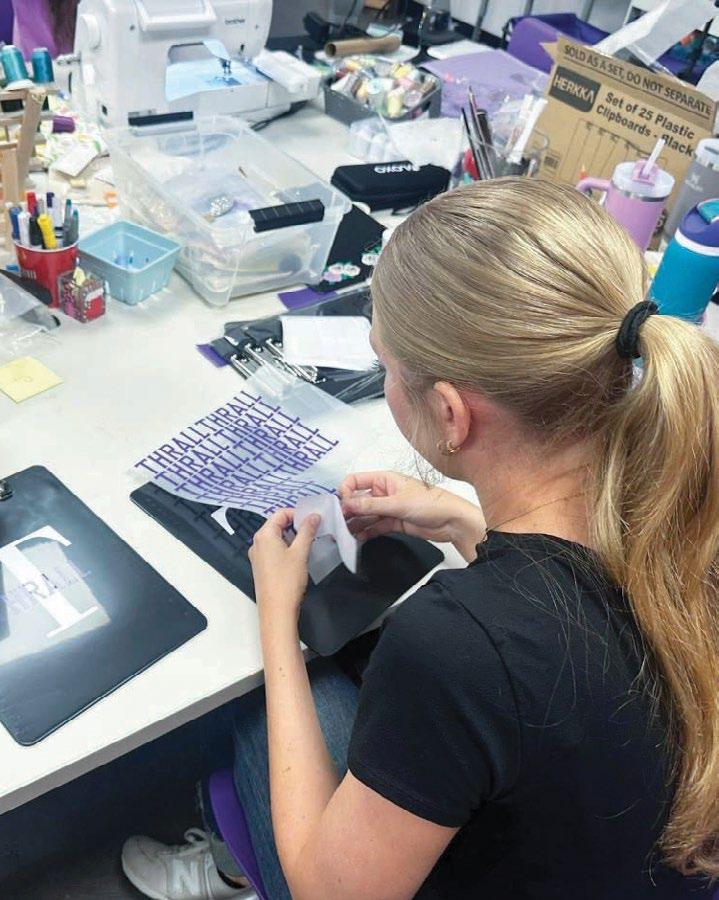
At Thrall High School, Practically Purple is a thriving business that allows juniors enrolled in the school’s business practicum course to design, market, and sell a variety of customizable products.
The business started as a way for locals to purchase spirit gear, but it evolved from there. The practicum students gain real-world business experience and learn valuable skills.
and has helped seniors apply for college and scholarships.
“She has shown us love and taught us life skills that I know we will all take with us when we leave Thrall High School,” she said.
Aside from the business skills, Leschber said that as part of Practically Purple, she's also gained some life lessons.
“I have learned that in order to be successful at something, you are going to have to put in extra work and sacrifice some of your time to get things done,” she said. H
Mary Ann Lopez is a staff writer for Texas Lone Star.
Texas
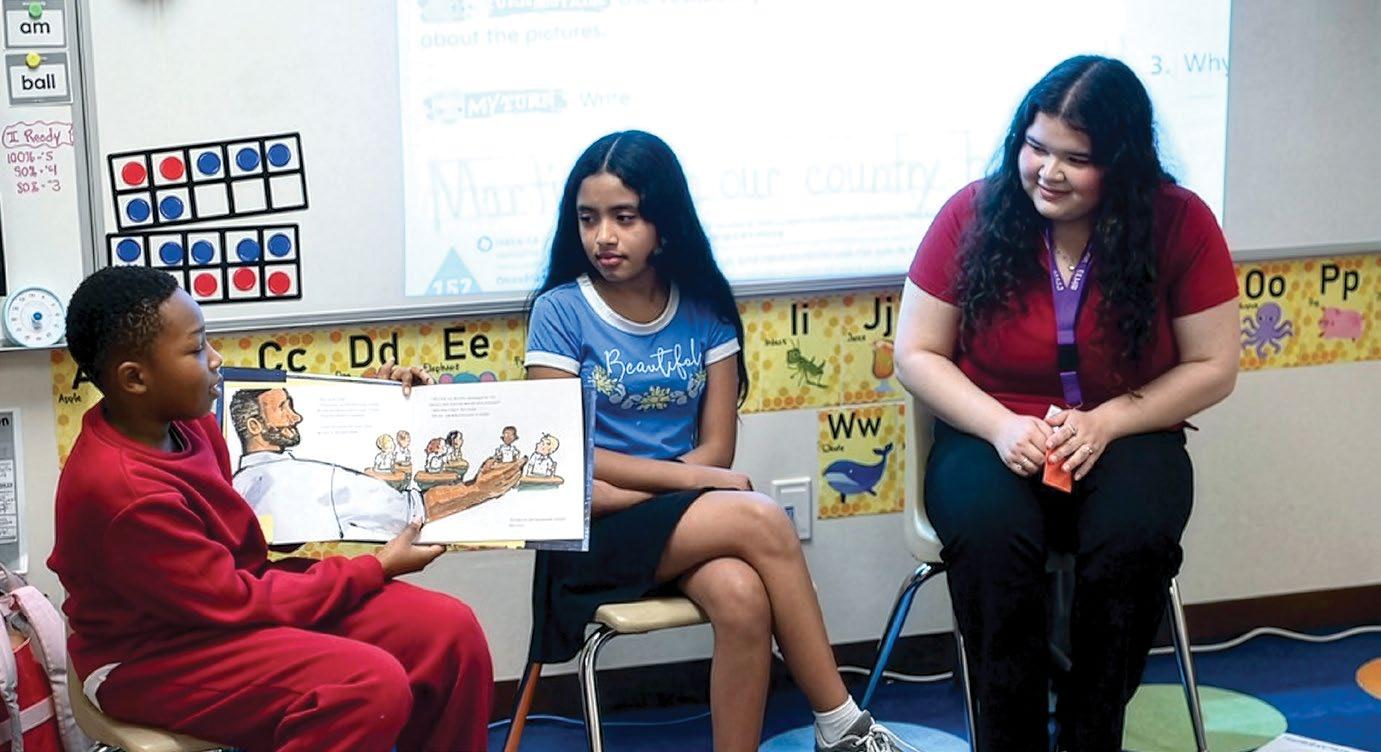
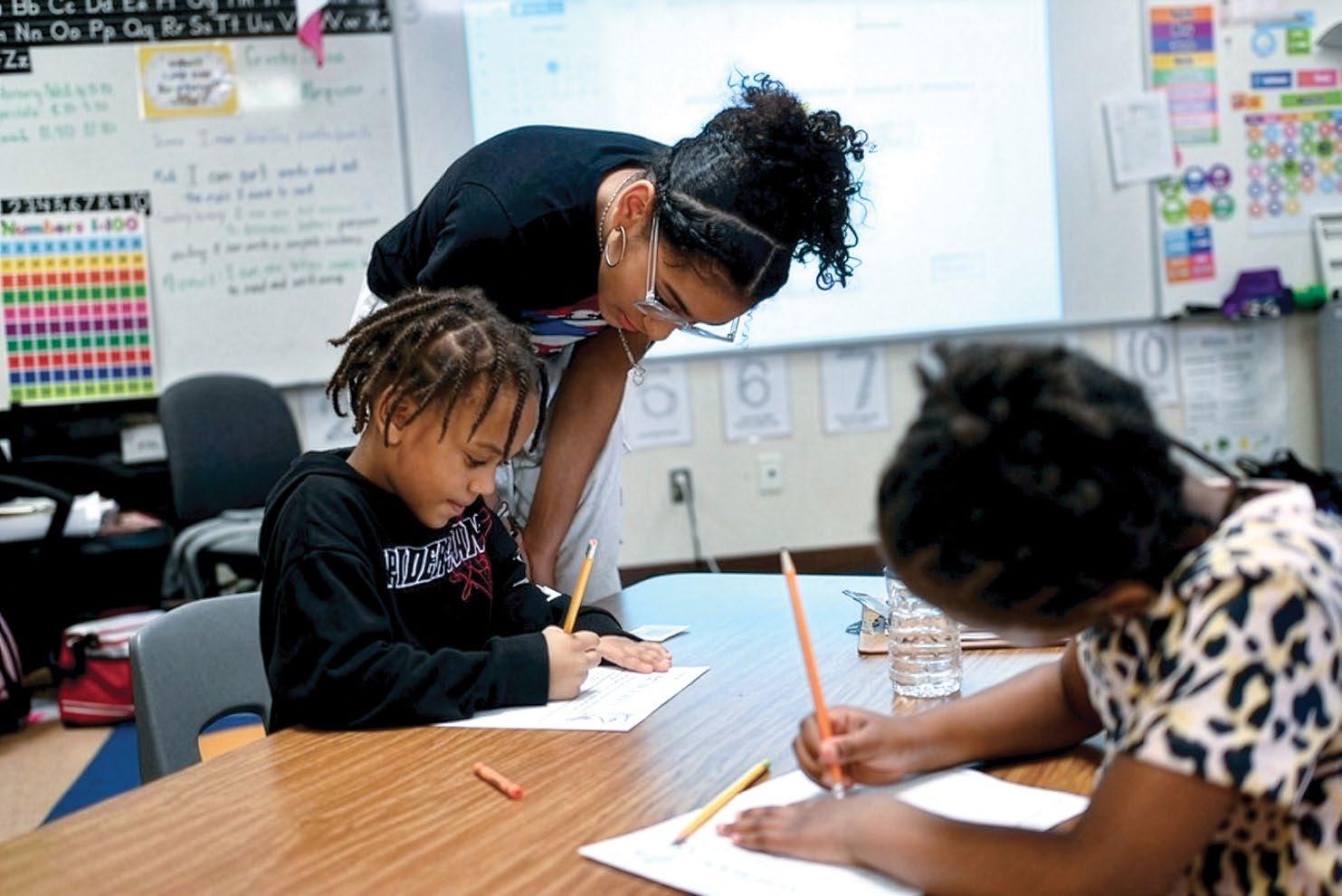
As school districts across Texas look for ways to strengthen the future teacher pipeline, Killeen ISD is introducing students to the profession earlier than ever while building confidence, leadership skills, and a sense of purpose.
This year, Reeces Creek Elementary launched a Future Teachers Club for fifth graders, connecting students with high school juniors and seniors enrolled in the district’s Career Center education program. The initiative gives students an early look at teaching while helping them grow as leaders and communicators.
At the campus, 10 high school education interns were paired with fifth-grade students who had expressed interest in becoming teachers. The groups met throughout the year, building relationships and learning from one another before leading a hands-on literacy event for younger students.
A spring reading
During the spring semester, the fifth graders and their high school mentors hosted a “read along” for kindergarten and first-grade classes. Students took turns reading aloud, leading discussions, and guiding activities. Fifth graders led interactive lessons, asking younger students to identify how characters were feeling and act out emotions, turning reading into an engaging, student-led experience.
The program is designed to give students an early understanding of what it means to be an educator while reinforcing key skills such as communication, leadership, and empathy.
“This experience has been special to witness our students grow in confidence as they step into leadership roles,” said Reeces Creek counselor Shana Munoz. “They’re not just learning; they’re beginning to see themselves as future educators.”
High school students also benefit from the experience, gaining real-world practice as they prepare for careers in education. Both schools are part of Killeen ISD, which serves about 41,000 students.
“We want to get kids excited about reading,” said Alannah Bush, a junior and education intern. “It’s meaningful to work with students who are already thinking about becoming teachers.”
For the young students, the experience offers both inspiration and a clearer sense of what lies ahead.
“My teachers always show respect and kindness to me,” said student Edith Cruz. “I want to do the same thing and make kids feel happy and comfortable.” H
This story is courtesy of Killeen ISD.
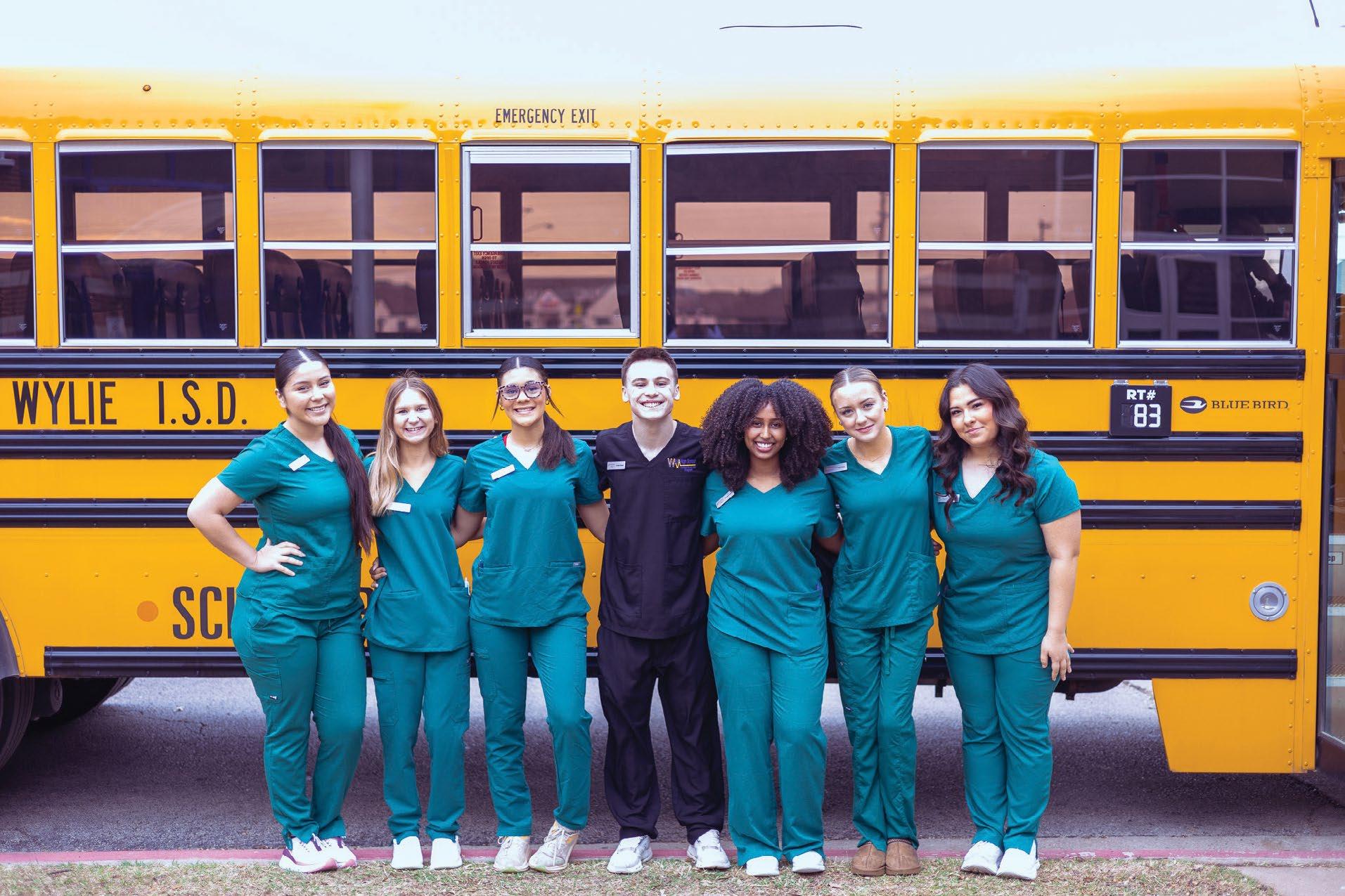
The bus doors fold open and out steps a line of Wylie ISD-Taylor County students who look a little like they’re headed to a big game. But they’re in their scrub uniforms. They’re in those white, waterproof shoes that say, “I’m ready for whatever today brings.” And as they gather on the sidewalk outside Wesley Court Senior Living in Abilene, they don’t just stroll in like it’s another Wednesday morning.
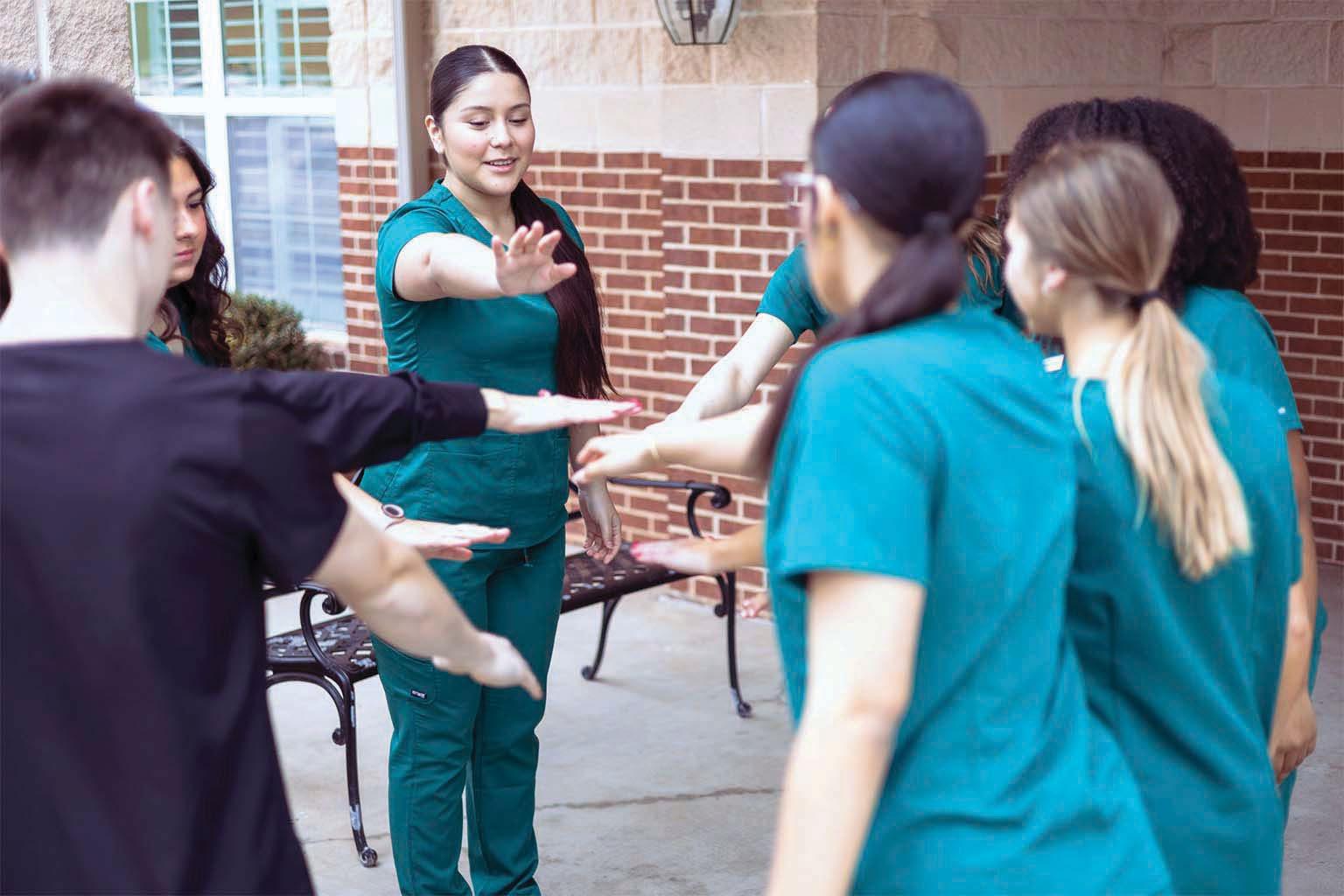
They circle up. Hands stacked. Bringing it in close. One last breath together.
“CNA, make their day!”
“CNA, let’s go slay!”
Then they break the huddle and walk through the entrance tunnel for what they half-jokingly call their two-hour “clinical gameday” — real residents, real routines, real learning that can’t be captured in a textbook.
This is Wylie ISD’s Certified Nursing Assistant program in motion: a pathway built on skill, compassion, and the quiet understanding that caring for people is both sacred work and serious work.
It’s changing lives in the district, which serves 5,500 students. It’s changing residents. And, in a small but steady way, it’s strengthening the fabric of the community.
If you ask senior Shalom Haile what a CNA is, she answers with an image to ponder.
“There’s this expression that every job in the healthcare field is a step up the ladder,” she said. “And CNA is the one holding the ladder.”
It’s the kind of line that lands because it’s true. In healthcare, the CNA role lives close to the ground level of human need. It’s not flashy. It’s not always easy. It is deeply personal. It is the work of noticing, assisting, and protecting dignity in the small moments — helping someone eat,
helping someone stand, helping someone feel like themselves.
It’s also, as Wylie CNA instructor Lex Hood explains, one of the most practical doors a student can walk through if they’re serious about the medical field.
Students can graduate already certified, able to step into real work locally while also building a strong foundation for nursing school, medical programs, and other healthcare paths. It’s preparation with a credential at the end — and confidence that gets built along the way.
Before students ever set foot in a clinical hallway, they earn their way in. Hood explains that students build toward CNA through health science coursework. They apply. They’re recommended. They commit. And because class size is limited, students learn early that this opportunity is something you pursue with intention, not something you stumble into.
Once they’re in, the pace is steady and demanding. The state requires CNA students to learn 46 skills, many of them tied to what healthcare professionals call activities of daily living. Students practice everything from making an occupied bed to taking vital signs, from safe transfers to safe feeding, from personal care routines to communication skills that protect a resident’s comfort and dignity.
There’s a written portion of the state exam, including a small set from the 46 skills that must be performed correctly, in order, with safety at the center. That pressure is real.
But in Hood’s room, pressure is never the point. Purpose is. Because students aren’t just memorizing steps. They’re learning why the steps matter — and why “doing it right” is a form of respect.
For Wylie ISD’s CNA students, Wesley Court Senior Living isn’t just a clinical site on a calendar. It’s where classroom lessons
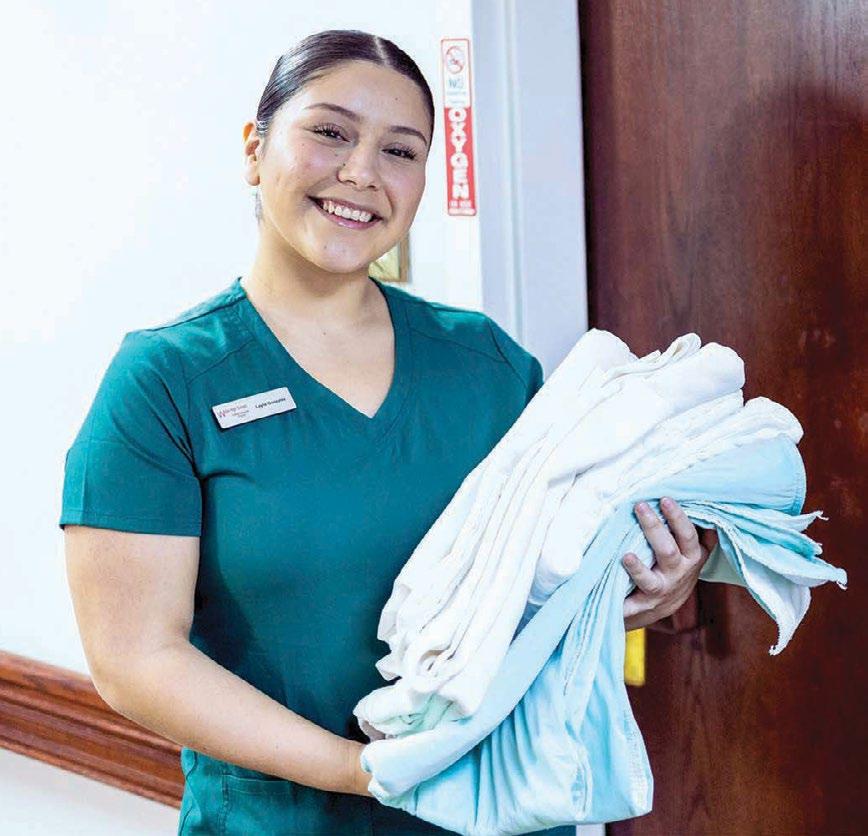
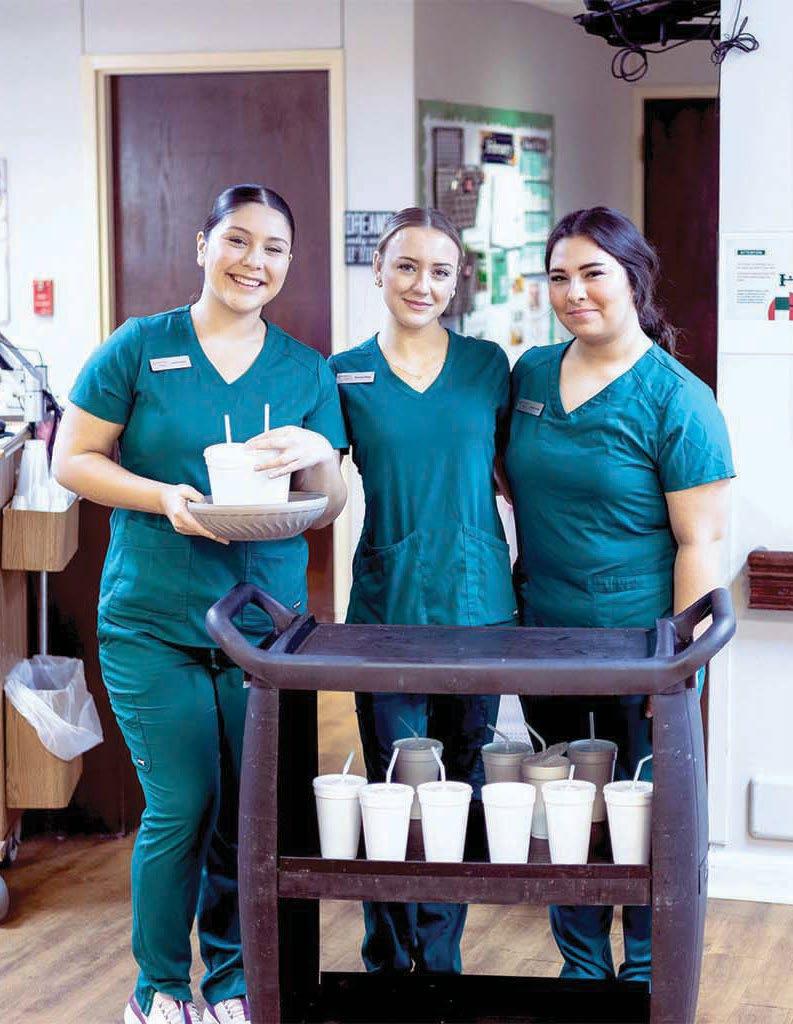
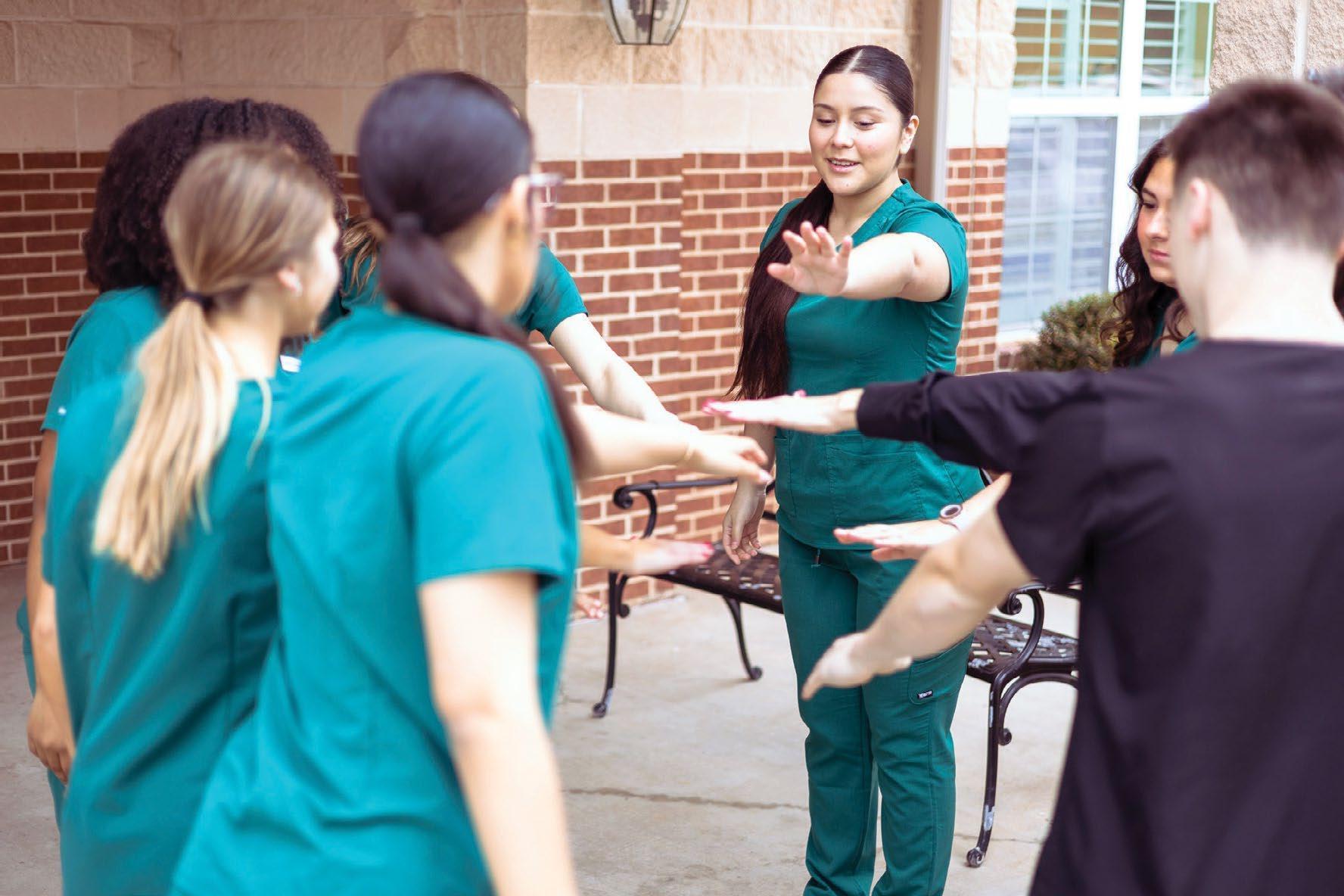
Wylie ISD’s Certified Nursing Assistant program is built on skill, compassion, and the understanding that caring for people is both sacred and serious work. Dressed proudly in their scrub uniforms, students visit with residents, change bed linens, and perform other duties at Wesley Court Senior Living in Abilene. They even like to do their own pregame huddle outside Wesley Court before their duties begin.
Photos courtesy of Wylie ISD
start to breathe.
Even the language in the program is intentional. Students are taught to say residents, not patients, because it’s their home.
Hood reminds students that when you enter a room, you’re entering someone’s space. Their routines. Their preferences. Their life. The work isn’t to take over. The work is to help. A “patient” can feel like a task. A “resident” is a person who lives here — with a favorite chair, a preferred blanket, and a story that existed long before today’s schedule.
Clinical days come with a rhythm. Students arrive, straighten uniforms, and check nerves at the door. They wash
hands. They pull gloves. They meet the CNAs they’re assigned to shadow. And then they ask the question that quickly turns into a full morning of work: “What do you need help with?”
The state requires 40 hours of clinical experience, and Wylie ISD students complete those hours at Wesley Court. That means real routines and real assistance — supporting residents with daily care, safe transfers, vital signs, feeding assistance, mobility, and the countless small tasks that keep a day steady and dignified.
Ask students what surprised them, and you might expect them to mention the technical side — the steps, the checklists,

the seriousness of clinical work. They do, especially when they talk about how many details each skill includes. But the biggest surprise? How meaningful it feels.
“It’s really rewarding,” Kenzee Petty said. “I always leave … in a really good mood.”
Layla Gonzalez said the program changes the way students think about people, about aging, and about dignity. It also corrects some of the misconceptions teenagers sometimes carry about longterm care.
“A lot of people assume this work is only about the hard parts,” she said. “But there’s so much more to it — you’re helping someone feel comfortable, respected, and cared for.”
That’s what the program does so well. It doesn’t gloss over reality, but it also doesn’t reduce residents to tasks. It teaches students to show up with skill and respect — and to leave with a fuller heart than they expected.
Petty remembers one moment that shifted her mindset in seconds. She was talking with a resident and made a casual comment about how nice it must be to rest so much. The resident’s response stopped her. “I wish I could get up every day,” he told her.
Gonzalez spoke with a resident about her dance competitions and admitted she was nervous. The resident gave her what Gonzalez calls a “never give up” speech, a steady reminder that persistence matters. “It’s been forever stuck and replaying in my mind,” she said.
Hood will tell you the program is built on compassion before it’s built on checklists. When asked what qualities students need, she doesn’t hesitate: “Number one, they need to be compassionate.”
Not because the work is dramatic — but because it’s personal. After weeks of showing up at Wesley Court, students learn residents’ routines, favorite stories, and the little things that make someone feel comfortable. So, when clinicals wrap up, Hood said many students feel a real tug in their chest.
"They'll say, 'I'm going to miss them,' and you can tell they really mean it." H
This story is courtesy of Wylie ISD.
Two students from San Angelo ISD’s Central High School this year earned the distinguished Texas Music Educators Association’s All-State honors in band and choir.
Ian Caraballo-Pagan, a junior this year, was awarded the TMEA 6A All-State Symphonic Band, clarinet, for a second time. Dylan Ochoa, a freshman this year, was awarded the TMEA All-State Large School State Mixed Choir, tenor.
To be selected for the All-State honors, the San Angelo ISD students joined more than 70,000 high school musicians from across the state to audition before a panel of judges in 33 TMEA Regions. Students who ranked the highest then advanced to compete against student musicians from other TMEA Regions at the TMEA Area level, with the highest ranking then qualifying for AllState status.
“We are incredibly proud of Dylan’s accomplishment of making first chair and placing into the TMEA All-State Large School Mixed Choir his freshman year,” said Landon Gilmore, Central High School director of choirs. “This [is] the most prestigious of the All-State choirs with only two students in each voice part being taken from Area A to this ensemble.”
“For [the] contest, Area A … is a huge area, geographically. To be number one for that entire part of the state, and as a freshman, is really quite incredible and a testament to Dylan’s talent and hard work. In addition to being a leader in the CHS Choir, Dylan is also a member of the CHS Mighty Bobcat Band. I love that Dylan is able to participate in band and choir while maintaining strong academics,” Gilmore said.
Daniel Villanueva, Central High School director of bands, said CaraballoPagan “is a junior clarinetist and drum major for the Central High School Bobcat Band, and has impressively achieved back-to-back TMEA All State recognitions,
This story is courtesy of San Angelo ISD. West Texas
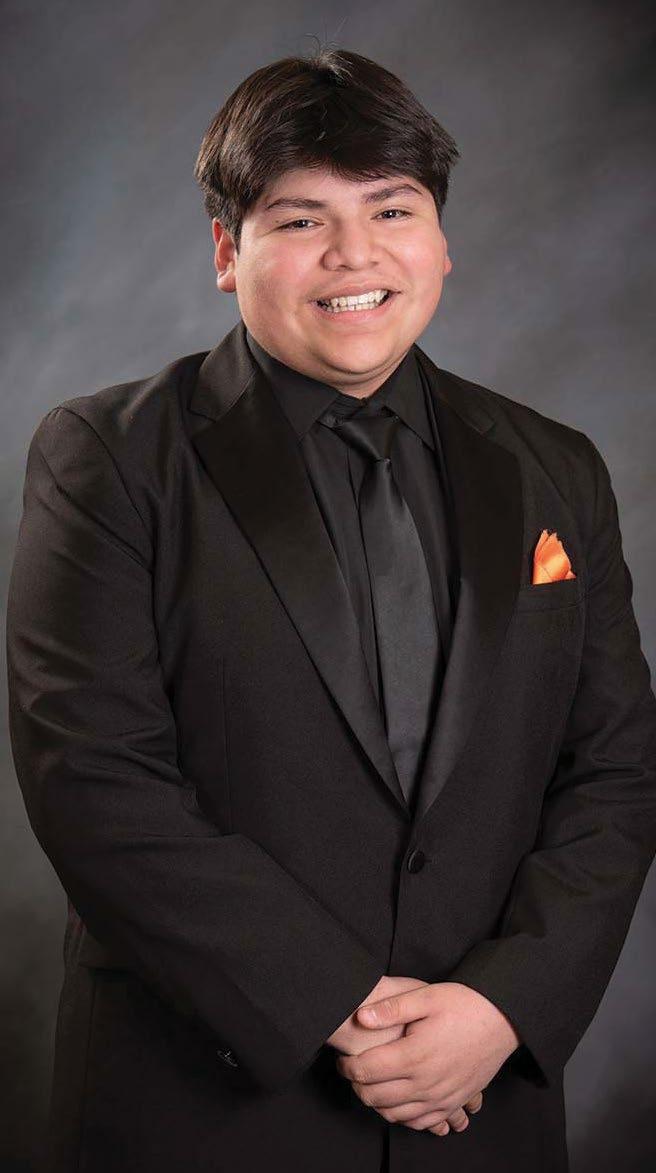
A Dylan Ochoa, a freshman this year at San Angelo ISD’s Central High School, earned a Texas Music Educators Association’s All-State Large School State Mixed Choir honor. Ochoa is a tenor.
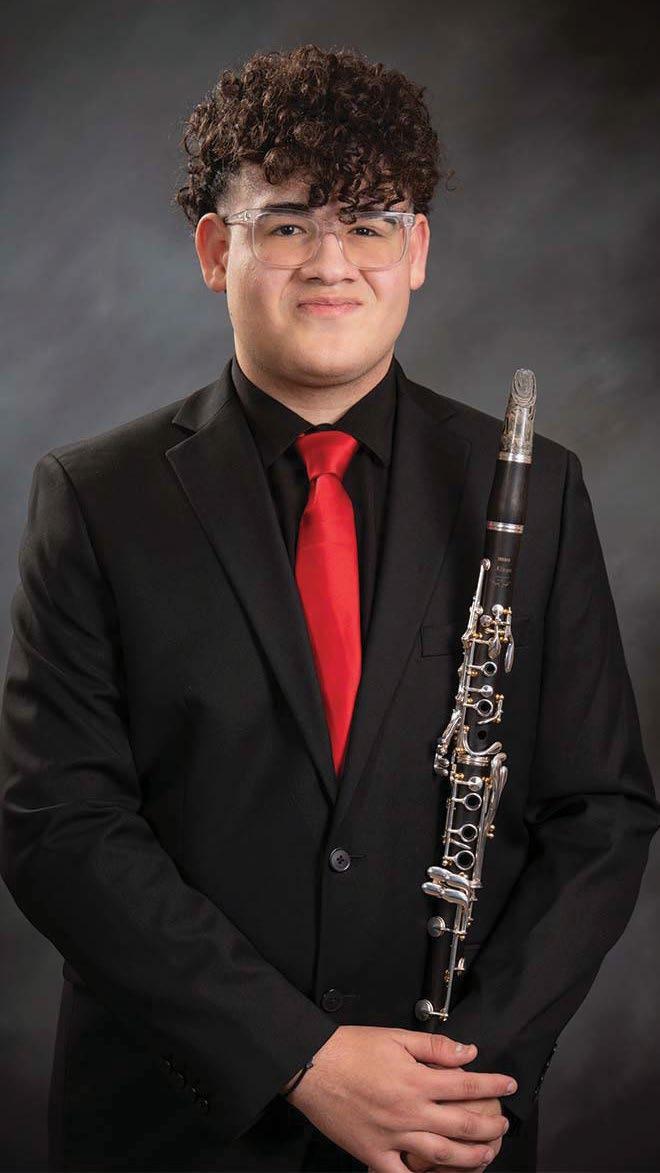
B Ian Caraballo-Pagan, a junior at San Angelo ISD’s Central High School, earned a Texas Music Educators 6A All-State Symphonic Band honor this year. Caraballo-Pagan plays the clarinet.
Photos courtesy of San Angelo ISD
putting him in an elite class of musicians in the state of Texas.
“Each year, nearly 70,000 students audition for TMEA All-State, and only 3% advance through all rounds of auditions to claim the title of ‘Texas All-Stater.’ Ian leads by example and helps to raise up his peers with his tenacious and diligent clarinet playing, and also creates a positive learning environment with his electric personality,” Villanueva said. “We are incredibly proud of Ian’s achievements
and representation of the Central Bobcat Band at the state level.”
The All-State student musicians performed with their respective AllState ensembles Feb. 14 in San Antonio. Nationally recognized conductors directed the ensembles.
San Angelo ISD serves about 12,300 students. H
Texas education leaders unite to connect, collaborate, and advance student success.
Houston
The annual event where Active Members shape TASB’s direction, elect TASB officers and directors, and approve the Advocacy Agenda.
Houston
The conference that inspires collaboration and amplifies student voice in leadership.
Galveston
TASB’s signature conference builds trustee skills and connections for effective governance. Especially valuable for new board members.
San Antonio
Grapevine (new location)

The sound of clucking chickens replaces the usual hum of a typical school day at El Paso ISD’s Center for Career and Technology Education.
It may not look like a traditional classroom, but for dozens of El Paso ISD students, it’s the first step toward a future in veterinary medicine.
CCTE’s Veterinary Assistant Program offers a unique, two-year pathway where students move beyond textbooks and into hands-on learning. From practicing clinical skills in the classroom to working alongside professionals in veterinary clinics across the city, students are gaining real-world experience before they even graduate from high school.
Students apply during their sophomore year and enter the program as juniors, where they begin building foundational knowledge in animal anatomy, terminology, and handling techniques. By their senior year, those skills are put to the test through hands-on experiences at veterinary clinics across El Paso.
“They have to apply to be here, so there’s already a strong desire to learn,” said instructor James West. “Students feel this is a real step toward veterinary school or becoming a veterinary technician.”
Inside the classroom, learning is anything but ordinary. On any given day, students may be practicing proper restraint techniques, learning how to safely use medical tools, or even caring for live animals, including the program’s resident chickens. Guest speakers also bring in a variety of animals, from household pets to exotic species, giving students exposure to the wide range of cases they may encounter in the field.
For students like Jacob Resendez of Franklin High School, the experience is already paying off.
“This is a big opportunity,” Resendez said. “We’re not even in college yet, but
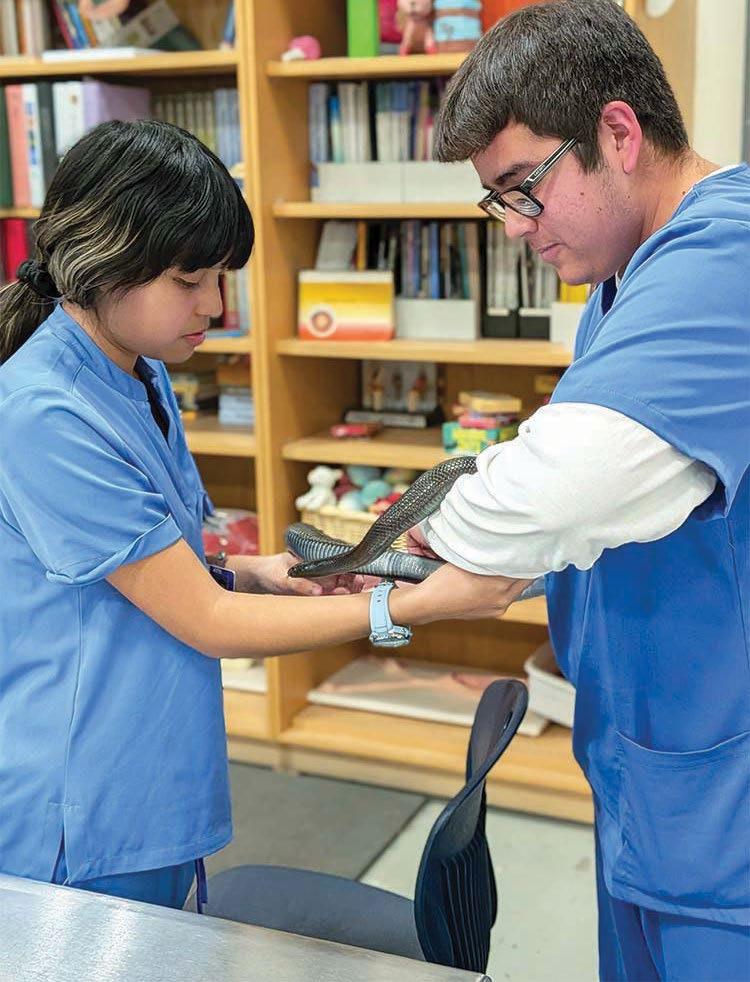
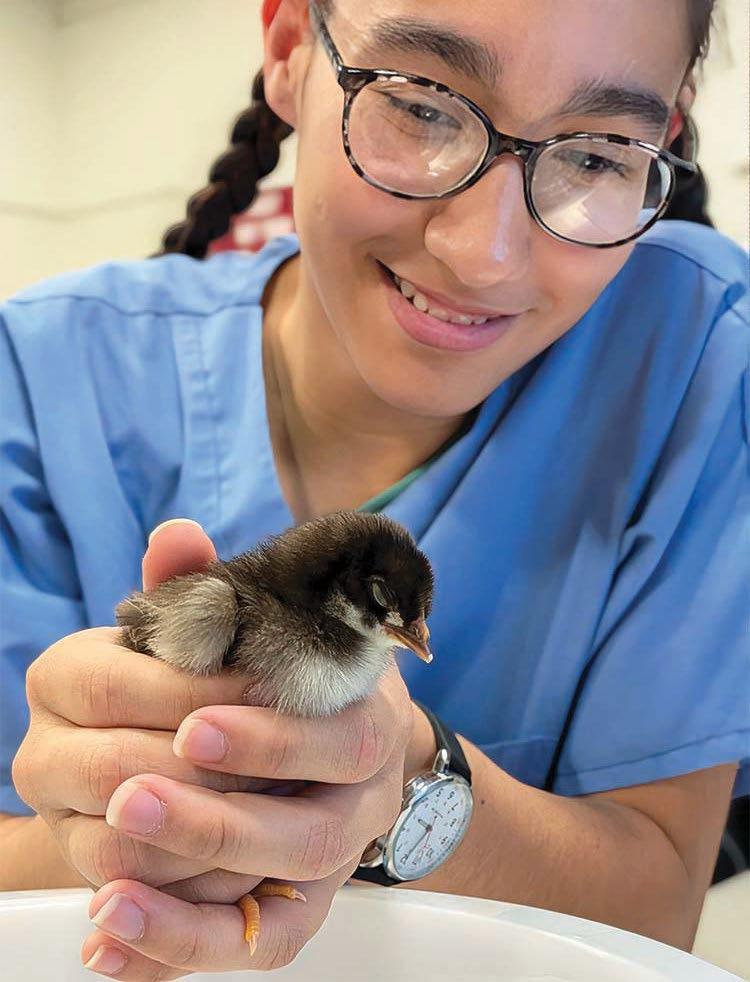
El Paso ISD’s veterinary assistant program, part of the district’s Center for Career and Technology Education, is a two-year pathway that provides students with the first step toward a future in veterinary medicine. Students get to practice clinical skills in the classroom as well as work alongside professionals in veterinary clinics across the city.
we’re working toward certification and getting real experience with animals. We’re learning hands-on and also building people skills.”
Austin High School junior Sharon Maynez said the program helped her discover a new passion.
“I originally wanted to go into engineering, but I realized it wasn’t for me,” the student said. “I’ve always loved animals, and this class helped me see that this could be my future.”
Beyond technical skills, the program emphasizes communication, confidence, and professionalism, which are qualities essential in a field where working with both animals and their owners is part of the job.
“One of the benefits is that students leave with skills that make them immediately marketable,” said Hevila Ramos-Rickner, an instructor. “They’re gaining experience that many people don’t get until much later.”
The program, which has been part of CCTE for more than a decade, continues to grow, now serving dozens of juniors and seniors each year. It also plays an important role in addressing a nationwide shortage of veterinary professionals by preparing students early and connecting them to local opportunities. The overall district serves about 46,000 students.
For West, who once planned to become a veterinarian himself before discovering a passion for teaching, the impact is clear.
“Our goal is to prepare students for the real world,” he said. “Whether they pursue this career or not, they leave here more confident, more skilled, and ready for what’s next.”
And sometimes, that journey starts with something as simple, and unexpected, as caring for a chicken in the classroom. H
This story is courtesy of El Paso ISD.
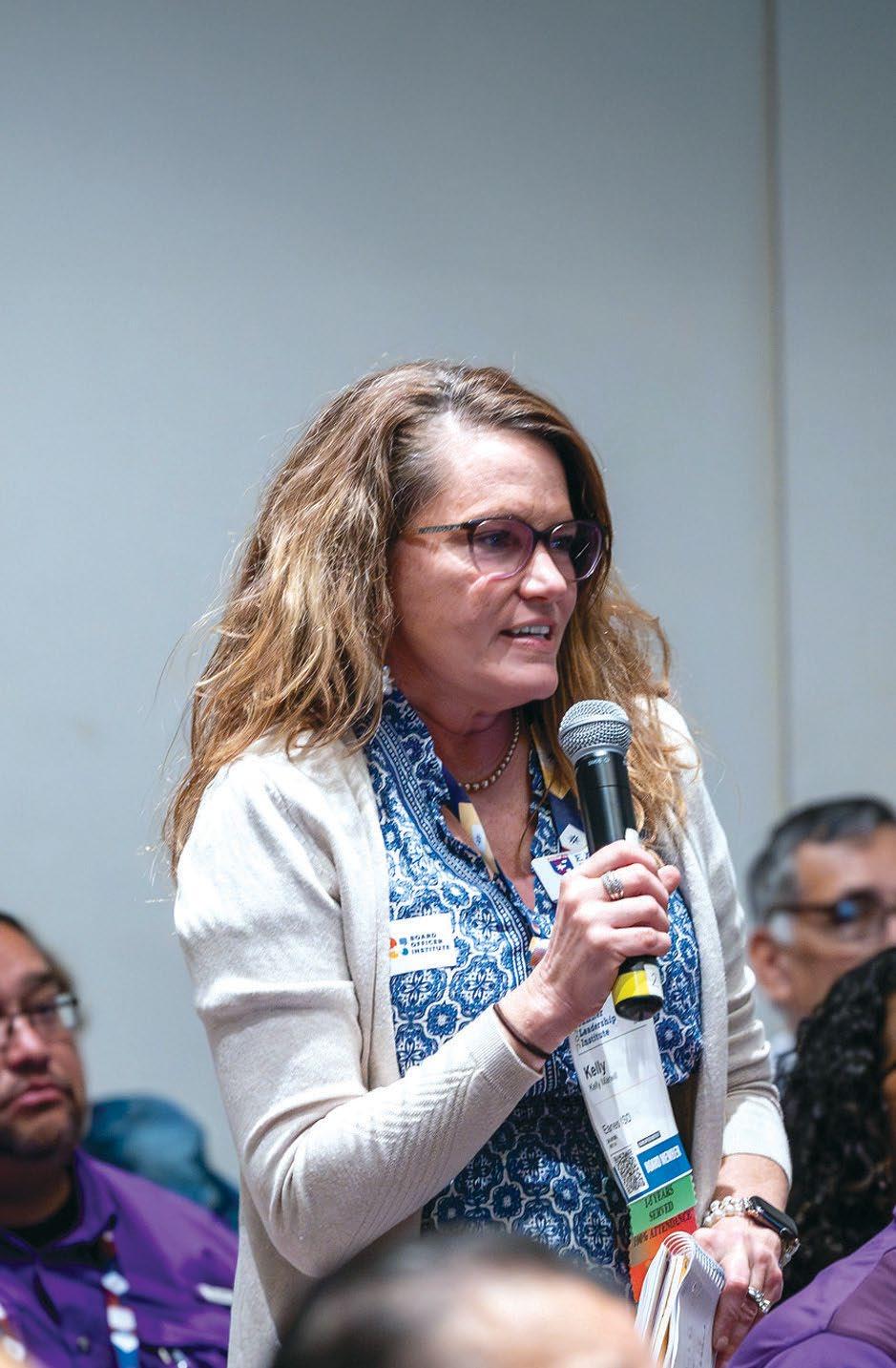

Every Thursday during lunch this school year, the courtyard at San Antonio ISD’s CAST Tech High School was transformed.
Students eagerly stopped by the racks of clothes, the table holding numerous pairs of pants, and another table stocked with free hygiene items. Sometimes there was screen printing available for shirts and other apparel. Sometimes there was even music. And always, there was a special sense of community.
Holding a sign reminding students they can take up to three items for free was senior Daniel Muñoz, beaming.
Second Chance Thrift, the school’s in-house thrift store, is the brainchild of Muñoz and senior Logan Botello. The Project Based Learning legacy project touched the lives of the school’s 422 students this school year. CAST Tech is part of San Antonio ISD, a district that serves about 42,000 students.
“I knew we had to do a project for our senior PBL Legacy, and I tried to think of things that resonated,” Muñoz said. “I thought a thrift store on campus could be beneficial to so many people.”
Muñoz checked in with teachers and administration and got approval for the project. In thinking ahead of the longevity of the project, Muñoz decided to launch the project first as a club that would then fuel the store.
After asking teacher Julia Palmer to be their sponsor, Muñoz, Botello, and about 15-20 other students started meeting after school, bringing in their own no-longer-used school clothes as seed donations and planning what the store could look like.
“It was a relief to feel the support of teachers and administrators,” Muñoz said. “We have had so much support from them. I feel like overall here at CAST Tech, we have the freedom to just ask, and they’ll tell us what we can do.”
The club quickly received two
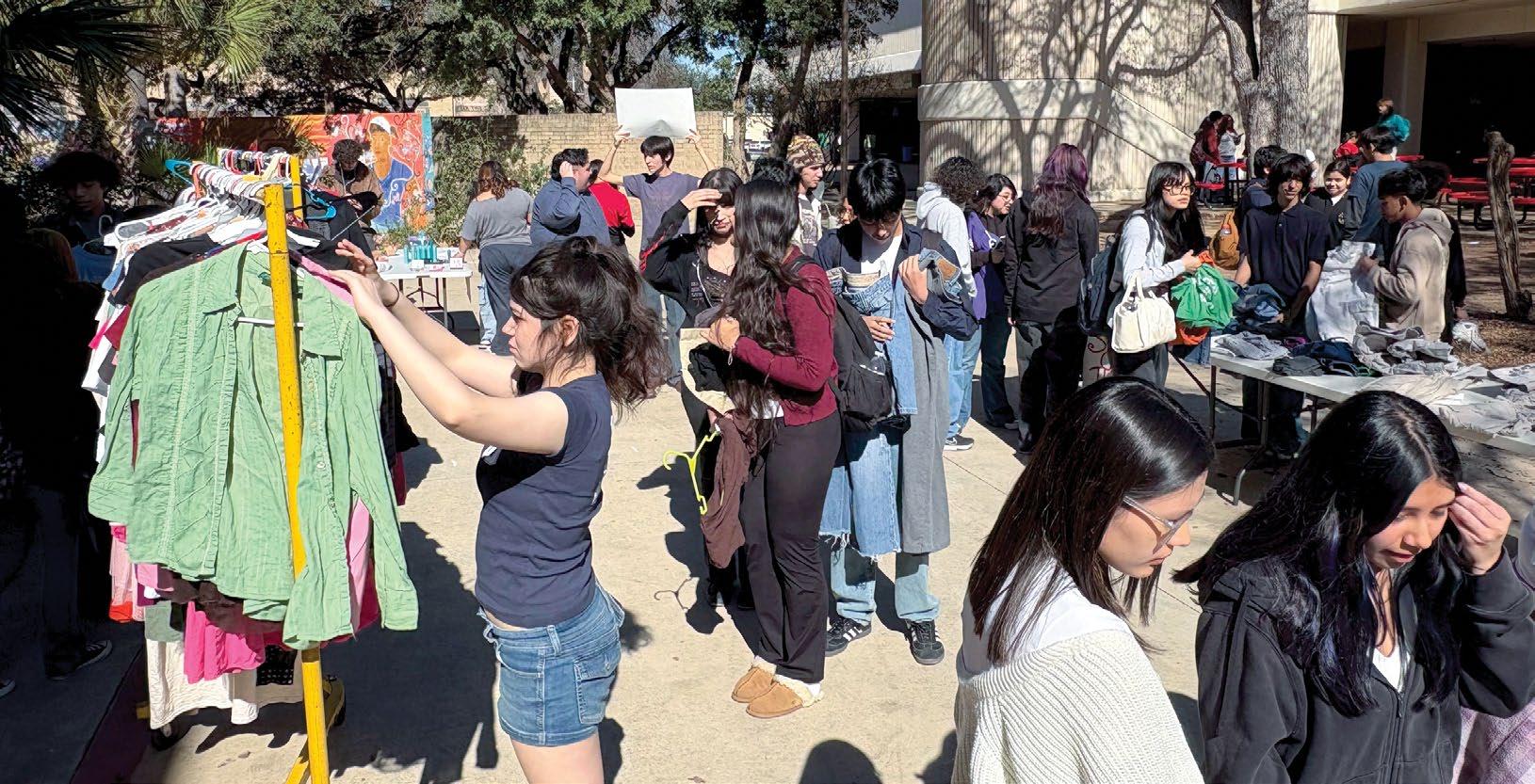
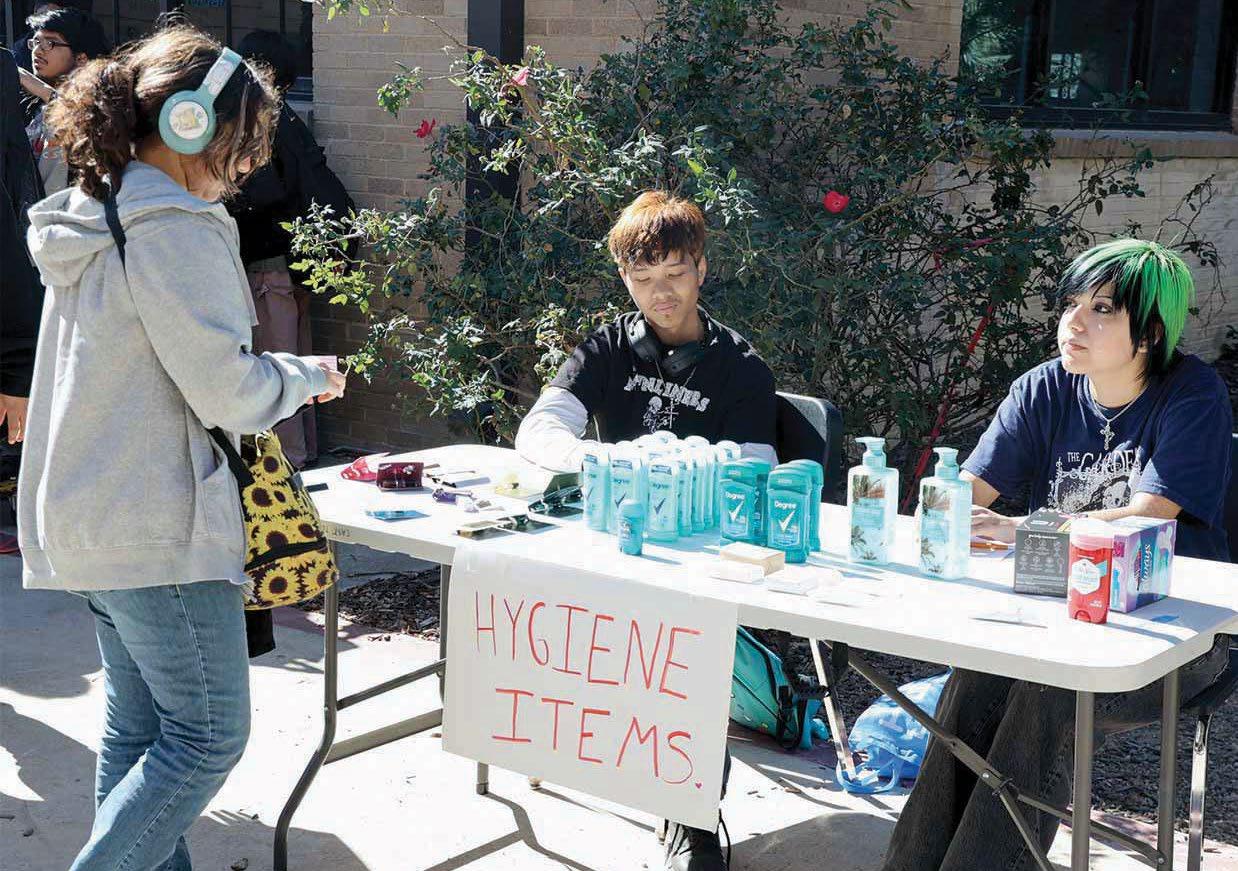
donated racks and staged the items they donated themselves.
By Thanksgiving break, they were ready for a soft opening, and club members like senior Estevan Garcia invited their friends after school to see the merchandise available in Palmer’s room.
Giving and receiving
The unexpected benefit: Everything is free.
“I wanted to engage everyone in CAST Tech around the love of clothes and bring people together,” Garcia said. “I can really feel it when it’s in here and the music is playing and everyone is having a good time.”
Since that first opening, they’ve received more donations, including some new hygiene products, which they also make available free of charge. The project was rolled downstairs into the school’s

courtyard, and when lunch started on Thursdays, students swarmed the racks. They could each take up to three clothing items and one hygiene item, free of charge. The project reached nearly 200 students, and about 350 clothing and hygiene items were distributed. Students loved their finds.
“I think this is good to have at school because not a lot of people can go out and get their own clothes, so just knowing that I can go somewhere that is safe and protected to get my clothing is a really good thing,” junior Daniel Ruiz said.
Garcia said it felt great when he saw students change clothes after visiting Second Chance Thrift during lunch. It’s exactly what Muñoz was hoping for.
“I want them to feel happy and look forward to wearing the clothes at school,” Muñoz said. “I definitely know that feeling of finding something cool to wear. It just feels nice. Even if nobody compliments me, I know that I like it so much and it just

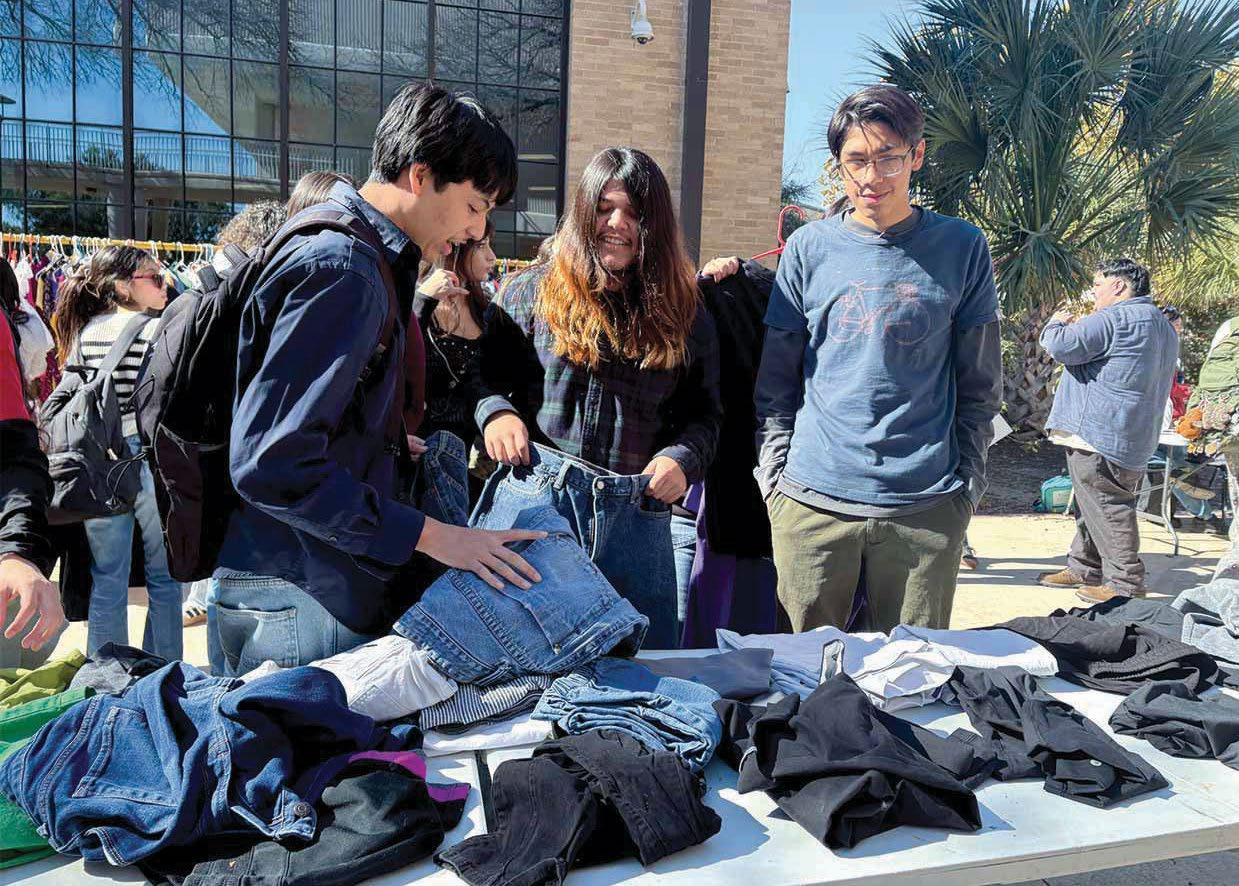
helps me in my day-to-day.”
Students plan to continue the thrift store next school year. The club is also looking to expand into accessories, trinkets, and art supplies.
“These items might be simple to some people, but they have a big impact on students’ self-esteem and confidence and their overall participation academically and socially,” Muñoz said. “We hope that this can impact so many kids.” H
This story is courtesy of San Antonio ISD.
A The thrift-store project moved from a classroom to the outdoor patio at San Antonio ISD’s CAST Tech High School, where students swarmed the racks at lunchtime on Thursdays.
B The thrift store program offers students some new hygiene products, which also are free.
C Senior Daniel Muñoz holds a sign reminding students they can take up to three items for free at the in-house thrift store.
D Students check out racks of free clothes at Second Chance Thrift at San Antonio ISD’s CAST Tech High School.
E Jeans are a popular clothes item at Second Chance Thrift.
Photos courtesy of San Antonio ISD
Corpus Christi
ISD’s Fashion Design program at King High School produces remarkable results, with students frequently earning state placements under the guidance of veteran teacher Valerie Elizondo.
At the regional Family, Career and Community Leaders of America conference this year, multiple students placed in their competition categories. In Fashion Construction Level 2, Anell RiveraSoto took first place, followed by Kyley McLerran in third and Katherine Angeles in fourth. Level 3 saw Kylie Mondragon earn second place, with Loewel Reyes placing fourth and Shelby Park fifth. Notably, Rivera-Soto went on to claim third place at the state conference, an extraordinary achievement for a student in her first year of sewing.
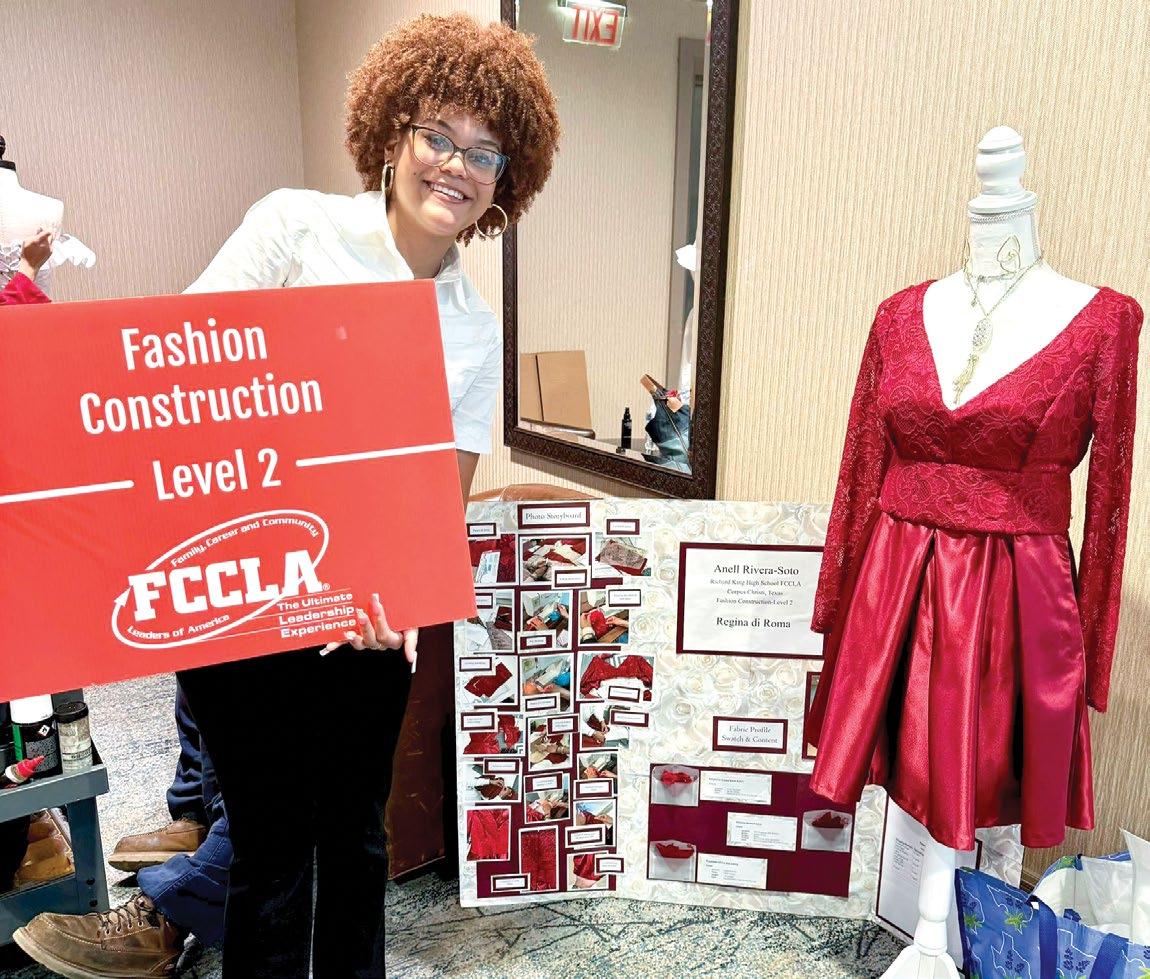
A At the regional Family, Career and Community Leaders of America conference this year, several students in Corpus Christi Corpus ISD’s Fashion Design program at King High School placed in their competition categories, including Anell Rivera-Soto, who earned first place. She went on to claim third place at the state conference — a great achievement for a student in her first year of sewing.
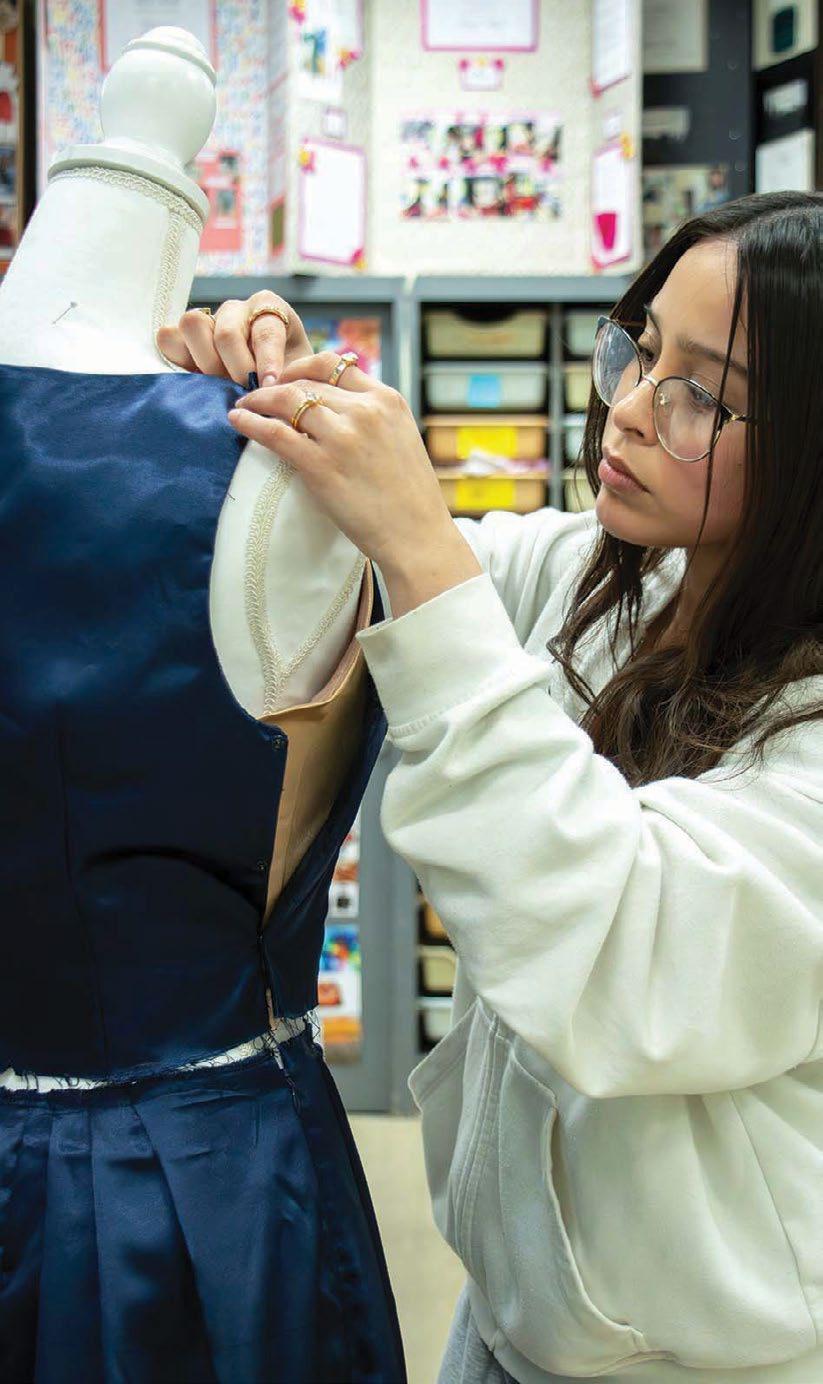
Success does not stop at traditional competitions. Senior Jiselle Castillo was among four King students vying for a spot in Goodwill’s Work the Runway, a multiphase competition challenging designers to create looks from upcycled materials around the theme “Cultura Meets Couture: What Does Culture Mean to You?”
Drawing inspiration from her father’s memorable, always-starched blue jeans, Castillo designed a denim gown with belt loops forming vertical lines along the dress. Her vision earned the highest score in the first round.
Students are also gaining experience beyond the classroom. Thanks to a partnership with designer Julian Gold, fashion design students worked behind the scenes at the Charity League’s Annual Style Show this February, learning
B Senior Jiselle Castillo works on an original design in the King High School sewing classroom, which is stocked with industrial sewing machines, design stations, mannequins, and fabric. Students make pillowcases the first year. By the end of the second year, they model their own garments at a runway show held on campus.
firsthand what it takes to produce a professional fashion event.
In Elizondo’s classroom, students use industrial sewing machines, design stations, mannequins, and a closet bursting at the seams with fabric to build garments entirely of their own choosing. Beginning with pillowcases in their first year, by the end of the second year, students model their own garments at an end-of-the-year runway show held on campus each May.
A $2,500 grant recently awarded
from the Corpus Christi Education Foundation will further strengthen the program, funding the addition of serger machines to help students achieve professional-quality finishing on their garments.
The program, the only one of its kind in the district that serves about 32,000 students, is open to incoming freshmen from any campus through Corpus Christi ISD’s Programs of Choice transfer program. H
This story is courtesy of Corpus Christi ISD.
The McAllen High School JROTC program has earned a special recognition, known as Honor Unit with Distinction (HUD), following a recent review of the entire program.
Inspectors from Fort Sam Houston in San Antonio evaluated the McAllen ISD school’s Junior Reserve Officers’ Training Corps program on March 25.
“I am humbled and honored to report that your Bulldog Battalion has passed its triennial inspection (known as the JROTC Program for Accreditation or JPA) with a 99% (score),” said McAllen High School Senior Army JROTC Instructor and retired Lt. Col. Leonard Cianciotto.
“I’m grateful for the support we enjoy here, especially to our wonderful counselors and administration who help sustain our efforts in helping young people achieve their potential, our fellow faculty with whom we work together towards the same goal, and to our parents for their faith in us as we help mentor their children,” Cianciotto said.
A HUD is the highest rating an Army JROTC program can receive, representing the top 10-15% of units nationwide. It signifies exceptional performance in leadership, training, and unit maintenance, usually requiring a score of 95% or higher on the triennial JROTC Program of Accreditation (JPA) inspection.
Cianciotto also thanked his assistant, retired Sgt. 1st Class Benito Contreras, for his efforts in guiding the program. The distinction is good for the next three years.
Multiple student leaders participated in helping the program earn the award. These included Battalion Commander Derek Toscano, Battalion Executive Officer Ronaldo Lara, Command Sergeant Major Kayla Bujanos, Personnel Officer Edwin Flores, Operations Officer Austin Wong, Logistics Officer Daniel Cuesta, Public Affairs Officer Xiamara Mendez, Drill Team Commander Delila Nerri, and Service-Learning Presenter Aaralyn
Bazan. Other students interviewed by inspectors included Anjelica Maya, Romeo Bernal, Francisco Castillo, Caleb Williams, Salvador Coronado, Jacqueline Jaime, Juan Chavez, Luis Prichard, Ronaldo Lara, and Miquel Hinojosa. H
This story is courtesy of McAllen ISD.
• The Gold Star: Cadets in these units wear a gold star on their uniform, which sets them apart from other units.
Members of the McAllen High JROTC program stand at attention while undergoing inspection this spring for the program’s JROTC Program for Accreditation. Officials from Fort Sam Houston in San Antonio named the program an Honor Unit with Distinction. The designation is good for the next three years.
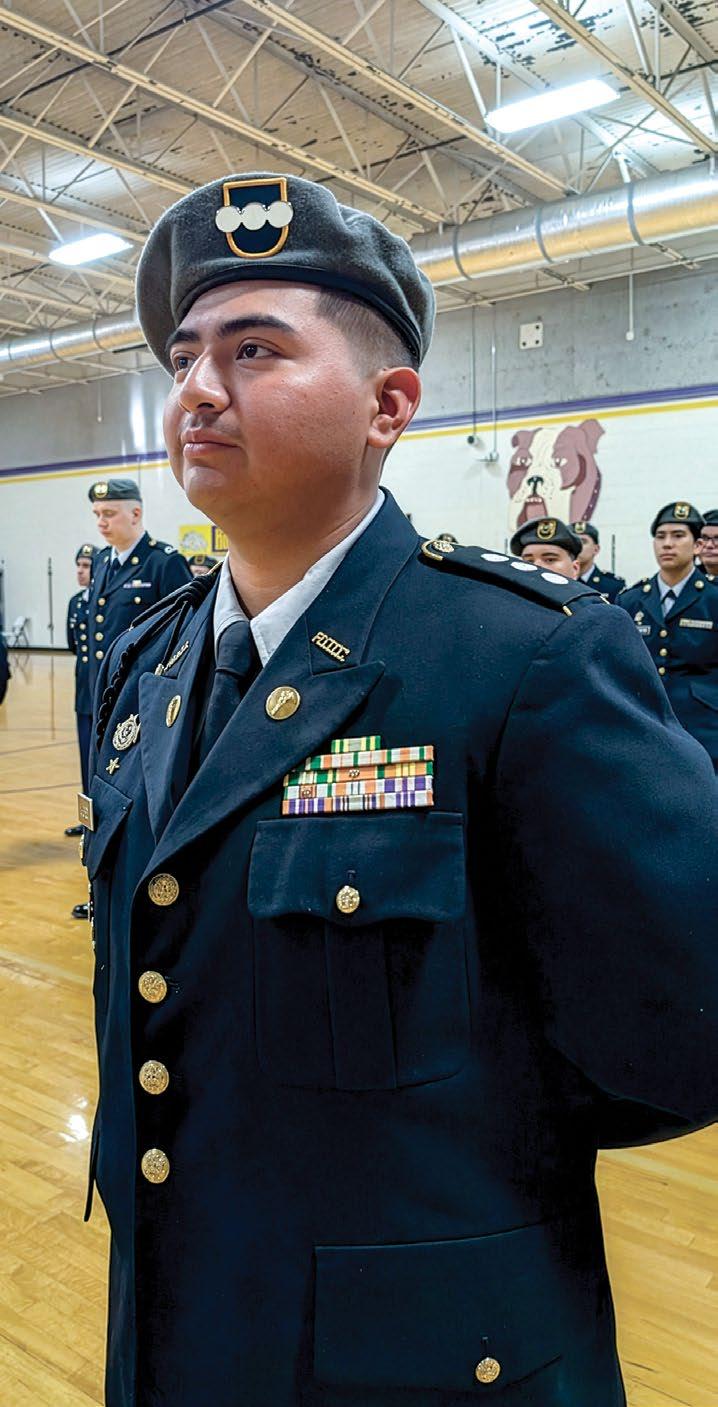
• Academy Nominations: Senior Army Instructors (SAI) at these units can nominate qualified cadets for appointments to military service academies (e.g., West Point, Annapolis, and Air Force Academy), an advantage reserved for top-tier units.
• Rigorous Evaluation: Units are evaluated every three years on cadet-led briefings, portfolios, drill, uniform appearance, cadet knowledge, and instructor compliance.
• This distinction demonstrates a unit’s high standards and dedication to producing skilled student leaders.
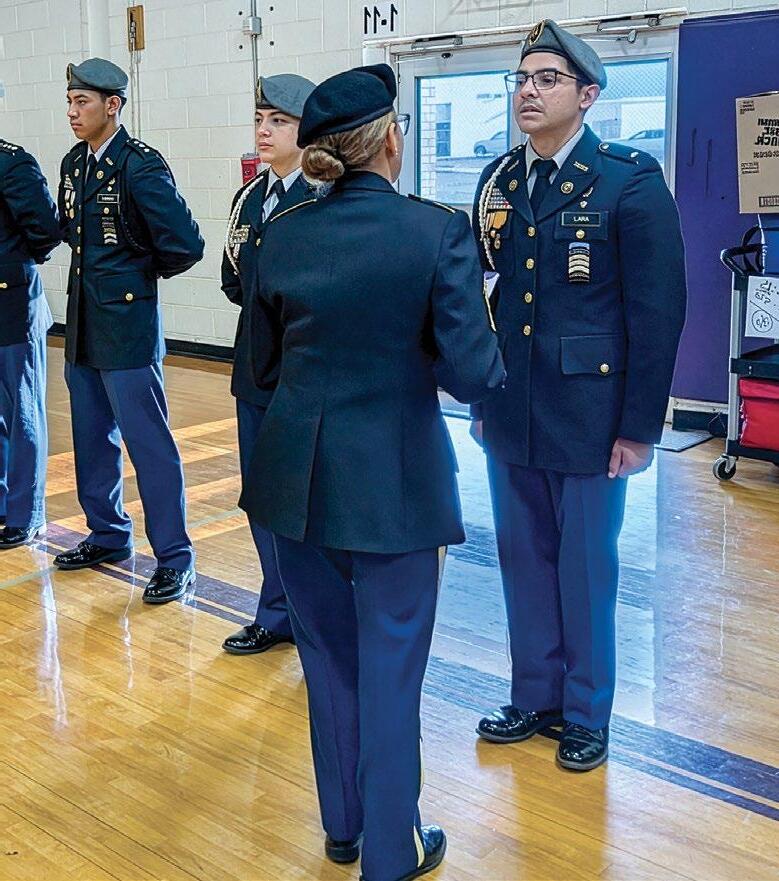
This school year, the Arlington ISD Dan Dipert Career + Technical Center turned into a big market for two days, and all the vendors were students.
Entrepreneurship students from the CTC put their business ideas to the test during the district’s annual Market Expo.
The expo is a “pop-up event where our entrepreneurship students participate in a preliminary competitive pitch, and the teams who present the most viable business ideas are provided a safe and supportive space to create and sell products,” said Debbie Blackner, Arlington ISD CTE specialist. She is one of the pioneers of entrepreneurship in the district, which serves more than 50,000 students.
The event was the culmination of months of preparation for students in Arlington ISD’s entrepreneurship program. Working in teams of three to five, they developed business plans, created products, designed marketing materials, and took on leadership roles.
But long before anything was sold, the student teams first pitched their business ideas to the Greater Arlington Chamber of Commerce in a competition to secure microloans to fund their start-ups.
Nineteen teams received funding from the Chamber and went on to more than double their microloans in total revenue during the Expo. After repaying their loans and covering expenses, each team earned profits that the students got to keep.
The budding entrepreneurs sold a wide variety of products during the event, including barbecue beef tips, pork sliders, mac-and-cheese chicken bowls, street tacos, cheesecakes, cookies, brownies, flowers, hand-sewn bags, and more.
Team effort equals success
But not every student was running a booth. Some students formed specialized teams responsible for marketing, logistics,
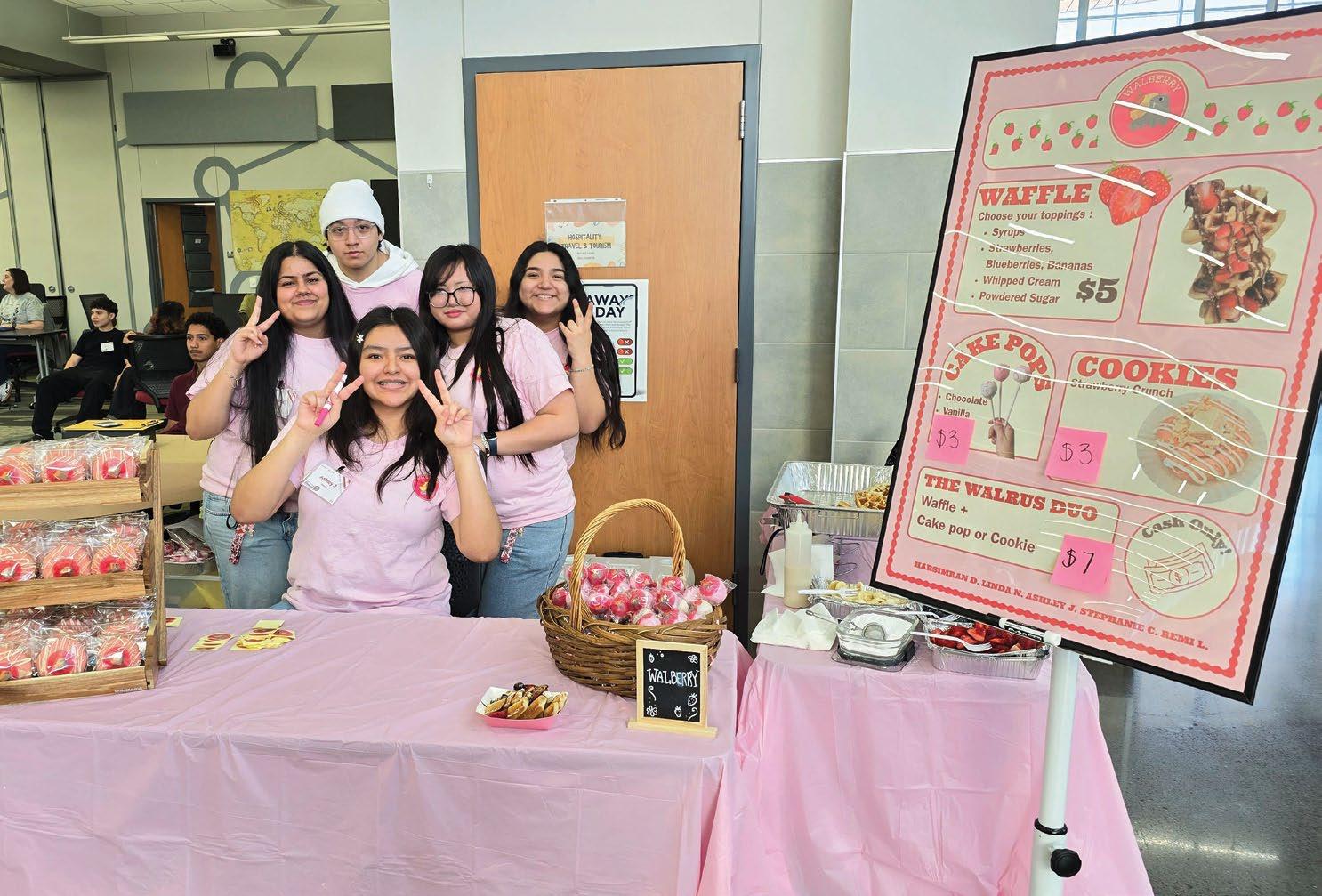
Students’ business ideas were on display for two days this school year at Arlington ISD’s Market Expo. The annual expo is the culmination of months of preparation by students in Arlington ISD’s entrepreneurship program.
Bcustomer experience, and data analysis to ensure the event ran smoothly. An eight-person student leadership team also helped coordinate the day.
The experience mirrors the real world of business. Students tracked key performance metrics throughout the event, including the cost of goods sold, completed sales, and both gross and net profits.
“Our Entrepreneurship I students truly hit it out of the park at this year’s Market Expo,” said Angela Montgomery, one of the entrepreneurship teachers who leads the event. “Their creativity, resilience, and new entrepreneurial mindset resulted in our most successful and profitable Expo to date.”
Montgomery and fellow CTC entrepreneurship teacher Izehi Agboaye were thrilled to see their students put so
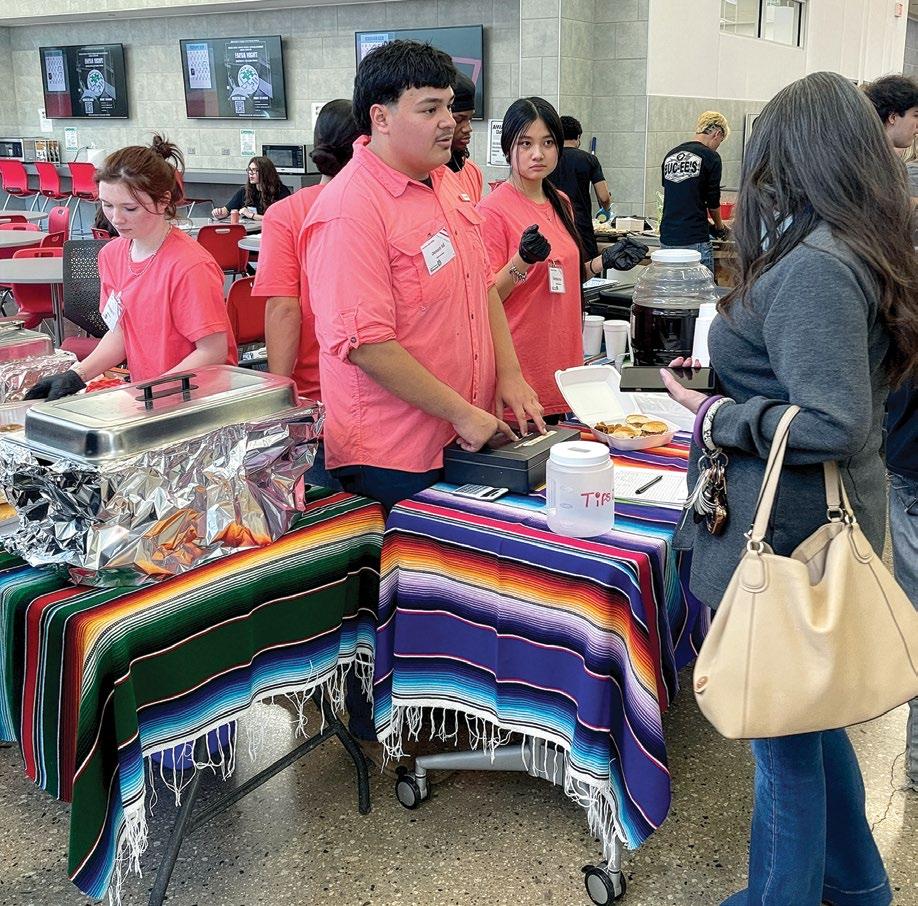
much into their businesses.
“What makes this achievement even more meaningful is the pride students expressed in their work and the confidence they gained along the way, many now seeing opportunities in the business world they hadn’t imagined before,” Montgomery said. “Market Expo gives students a safe space to test ideas, take risks, experience failure, recover, learn, and ultimately succeed — exactly what entrepreneurship is all about.”
Through partnerships with the Chamber and hands-on experiences like Market Expo, Arlington ISD students are learning far more than theory. They’re gaining the confidence and real-world skills to turn their ideas into a profitable reality. H
This story is courtesy of Arlington ISD.

Don’t settle for meeting software price hikes, confusing tiers, and limited functionality. BoardBook® is a dependable and affordable all-in-one meeting platform. Join
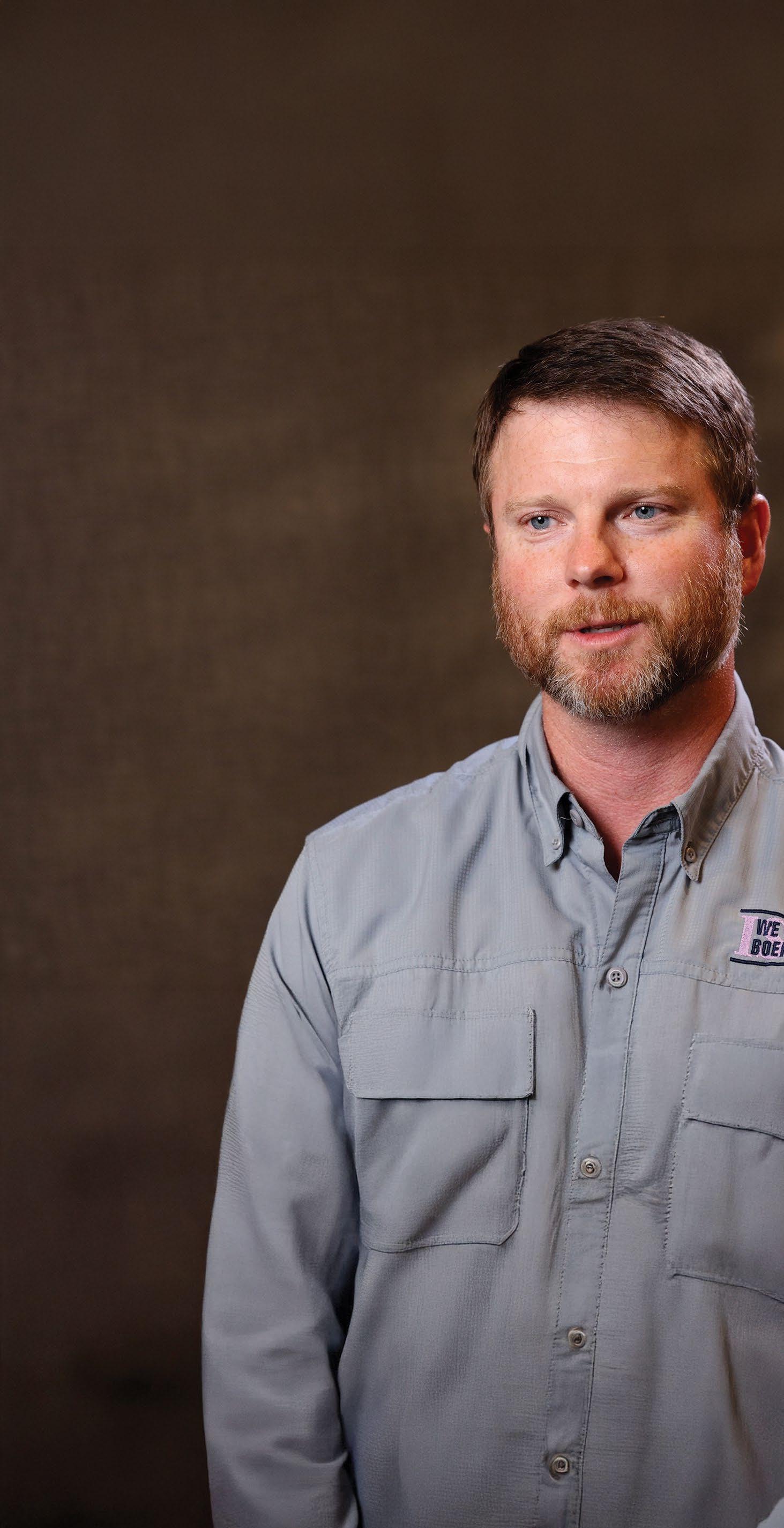
It was important that we get the right person right from the jump. I can’t say that would have happened without ESS and TASB. I think that you guys really played a big part in helping us do that so perfectly. And now we’ve got the perfect superintendent.
In its more than 30-year history, ESS has conducted over 800 searches on behalf of districts across Texas.
With a team of search consultants who know Texas and its diverse school districts, ESS has proven itself to be the go-to search firm for leadership recruiting.
ESS brings experience to the table and a guarantee, so trustees can feel confident they’ve found the best leader for the job.
The Coppell High School Eco Club has been selected as the 2026 Texas Environmental Excellence Award Youth winner, a statewide honor recognizing the studentled organization’s measurable and lasting impact on environmental stewardship.
Presented by the Texas Commission on Environmental Quality, the award celebrates the club’s innovative, yearround work to reduce waste, restore ecosystems and inspire sustainable action on campus and throughout the Coppell community. Students were formally recognized during the annual awards banquet June 9 at the Bullock Texas State History Museum in Austin.
With more than 100 active members, the Eco Club has built a culture of student leadership and service through a structured model of eight student officers who oversee teams, coordinate events, and manage logistics. The high school is part of Coppell ISD, which serves about 13,559 students.
Under the guidance of adviser Jodie Deinhammer, students lead initiatives that create visible environmental improvements while giving peers meaningful opportunities to serve.
“This recognition reflects the passion and dedication our students bring to making a real difference,” Deinhammer said. “They understand that small, consistent actions can create lasting change, and they’ve shown what student leadership can accomplish when it is rooted in purpose.”
Since 2021, the CHS Eco Club has diverted more than 5,400 pounds of hard-to-recycle materials from landfills through targeted recycling drives. Those efforts include collecting 1,091 pounds of batteries, 401 pounds of electronics, 2,572 pounds of plastics, and nearly 100 pounds of makeup products.
In addition, the club’s monthly
campus and community cleanups have removed more than 2,050 pounds of litter, reinforcing a student commitment to environmental responsibility beyond the school day.
The club’s impact also extends into sustainable agriculture and habitat restoration. Through the Coppell High School garden and orchard, students have harvested and donated more than 1,560 pounds of fresh produce to the community, helping reduce food transportation emissions while supporting local families. Eco Club members also maintain a pocket prairie and monarch butterfly garden filled with native grasses,
milkweed, and wildflowers that improve water infiltration, reduce erosion and support pollinator populations.
This statewide award highlights how Coppell ISD students are pairing innovation with service to create solutions that benefit both their campus and the wider community. From waste diversion to food production and native habitat restoration, the CHS Eco Club continues to model how student leadership can drive meaningful environmental change across Texas. H
This story is courtesy of Coppell ISD.
At the Coppell Farmer’s Market, Coppell High School Eco Club members sell seeds to the public.
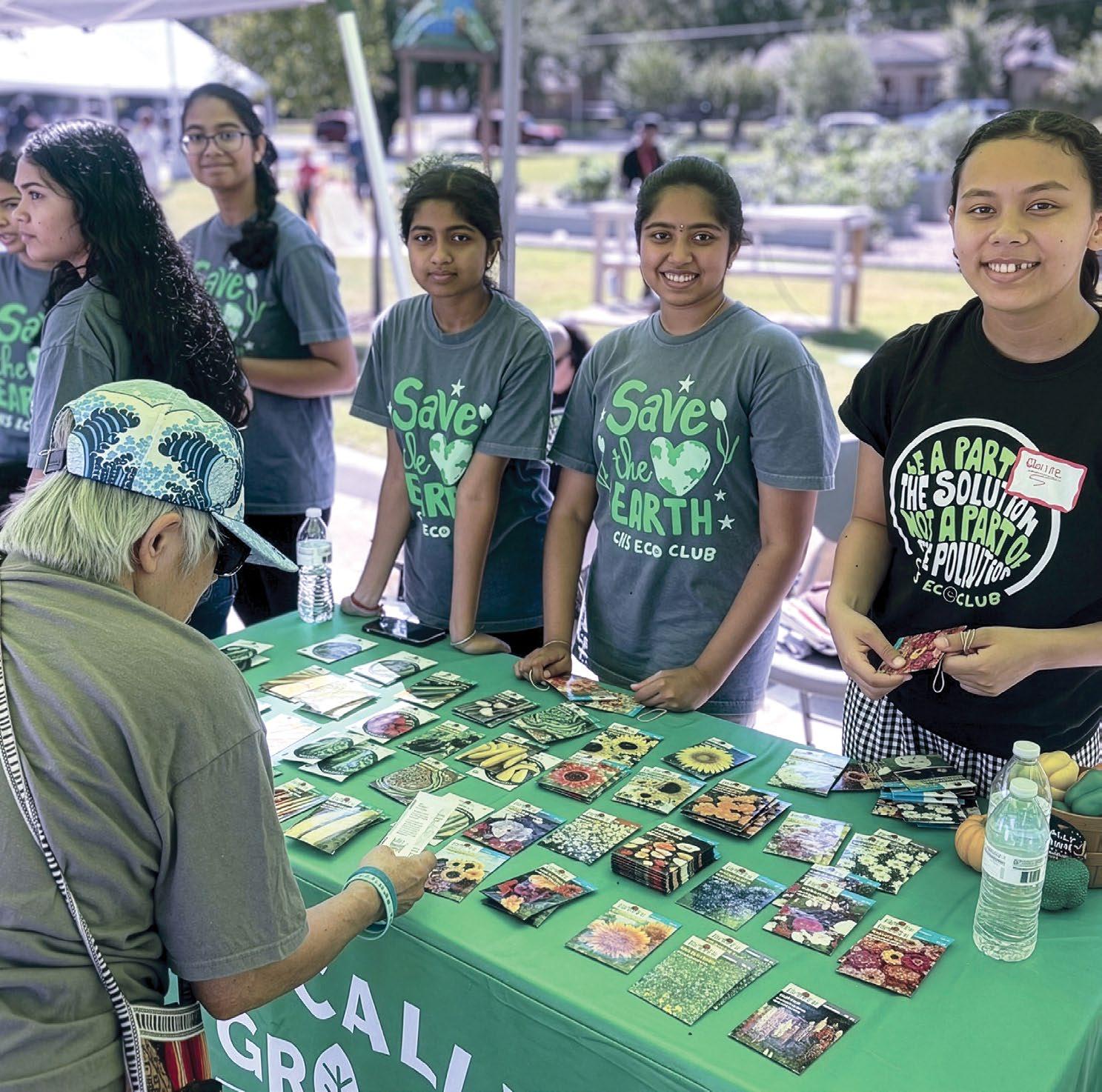
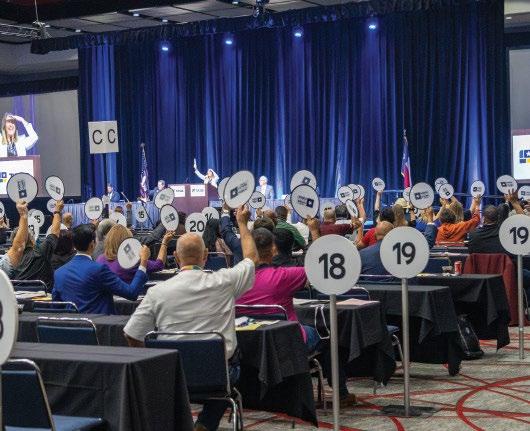












by Beth Griesmer
Many districts have embraced student voice on their school boards, even having a student or two serve in a nonofficial capacity. Crowley ISD has taken it a step further with a student trustee program that gives more than a dozen students a place on the dais and a direct line to district leadership in an advisory role.
“It’s been a game changer for us here in Crowley ISD,” said Anthony Kirchner, the district’s chief communications officer.
Located southwest of Fort Worth, Crowley ISD serves more than 17,000 students across 27 campuses. In its third year, the student trustee program included 16 juniors and seniors, representing all three district high schools. During the school year, student trustees attended board meetings and shared updates during a standing board agenda item designed to elevate student voice.
The program centers on the “three C’s”: celebrations, campus events, and considerations. Kirchner said the district intentionally shifted the final “C” from concerns to considerations to reinforce that students should bring not only what needs attention, but also possible solutions. “That’s really equipped them to be problem solvers,” he said.
At TASB’s Governance Camp in March, the group participated in a mock board meeting led by Kirchner. Student trustees modeled how the three C’s work in real time by sharing highlights from across the district and practicing the professional expectations that come with addressing elected officials.
Celebrations ranged from athletics and academics to campus culture. When it came to considerations, student trustees focused on supporting mental health across the district and helping students juggle the demands of college-
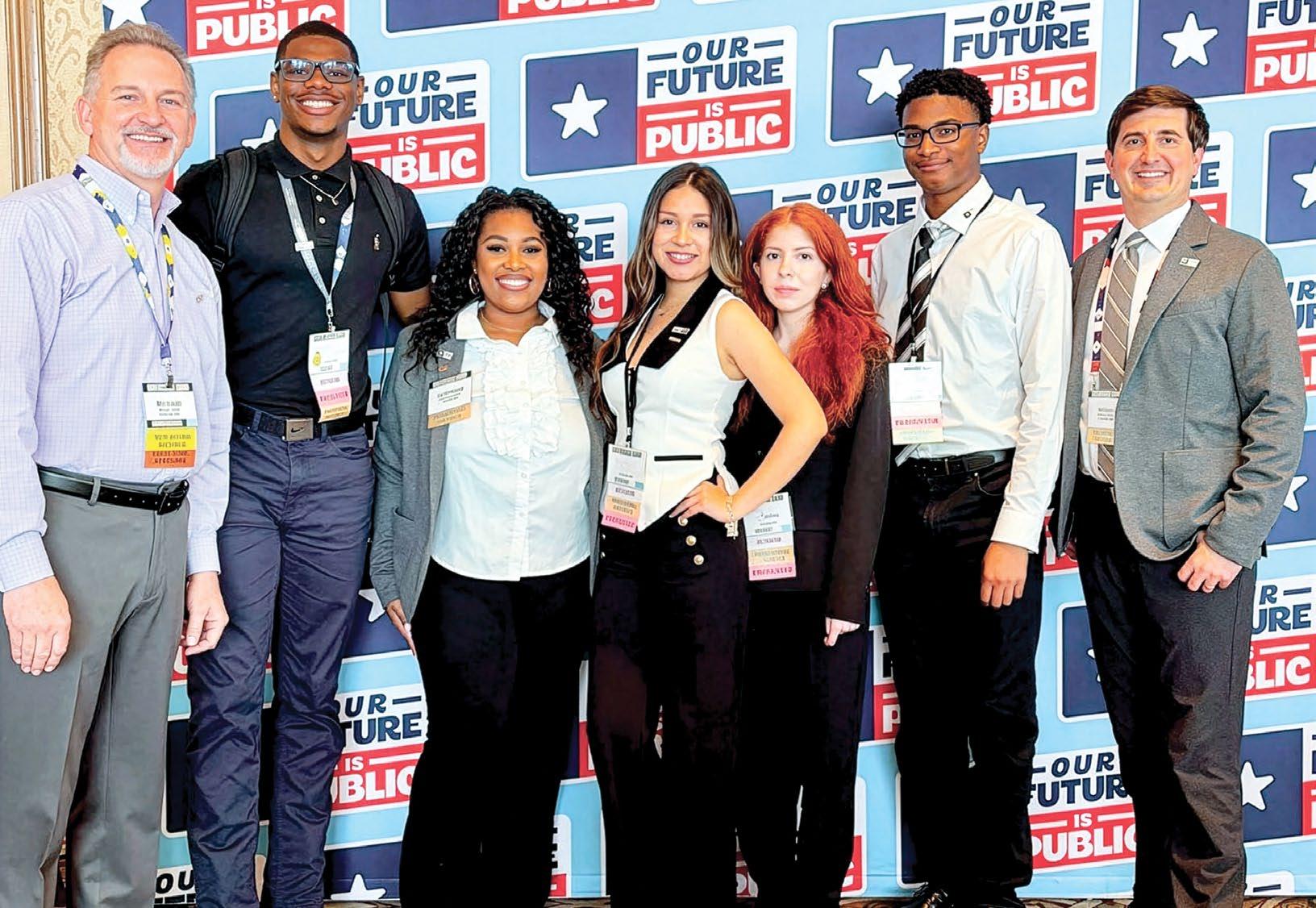
A Crowley ISD students pose with trustee Micheal Laszek (left) and Anthony Kirchner (right), Crowley ISD’s chief communications officer, at TASB Governance Camp in March.
B Crowley ISD student trustees regularly attend and participate in board meetings.
C Crowley ISD students John Whitfield and Vincent James presented at TASB Governance Camp in March on their experiences being student trustees.
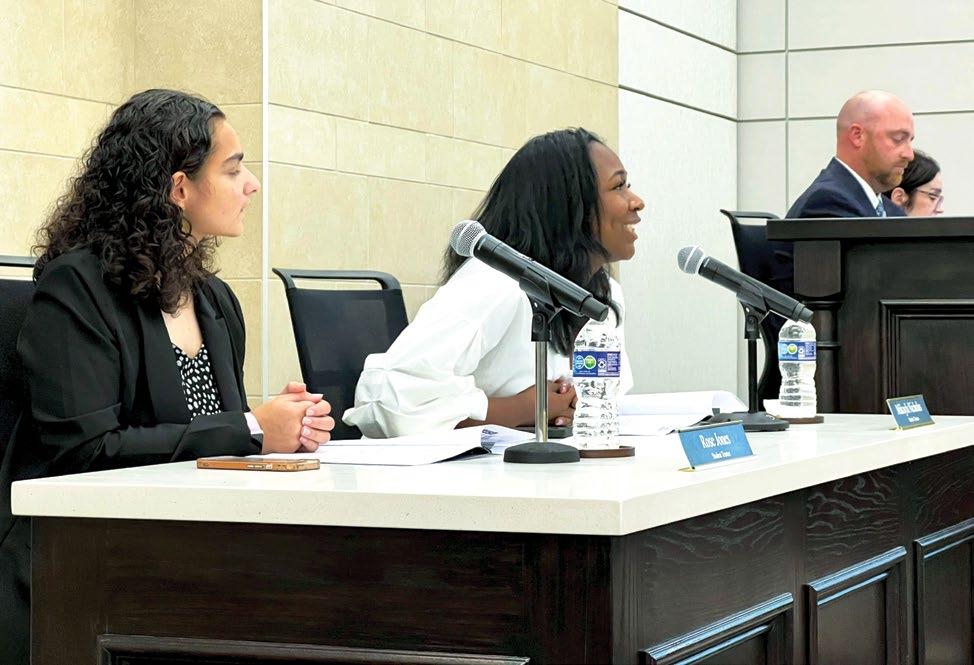
level coursework and activities. Students proposed building regular, structured support time into the schedule.
This year, the students saw one of their considerations become a concrete change. The student trustees raised concerns about the logistics of traveling between home campuses and classes at Tarrant County College. The students proposed a tracker that could help families
navigate late buses and the ripple effect on class time and family schedules. Kirchner said student advocacy helped the board understand the scale of the challenge and accelerated a solution. Crowley ISD is partnering with Durham Transportation to pilot a bus tracker app with Crowley Collegiate Academy, allowing students and parents to see bus locations and estimated arrival times.
“My favorite thing about being a student trustee is having the leadership
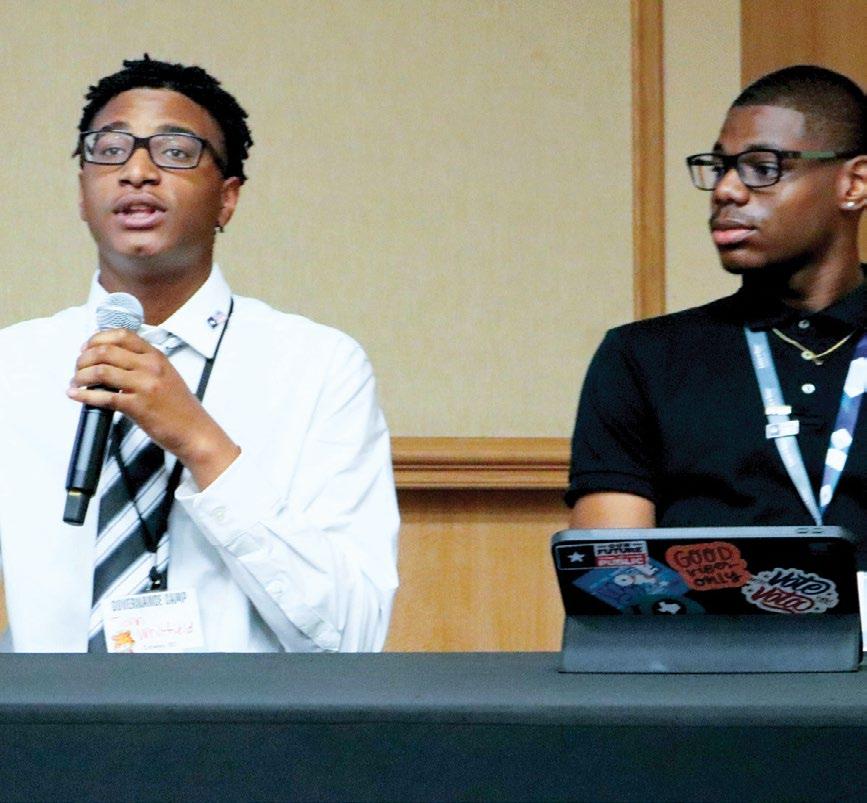
role and being able to have a voice for other students,” said Crowley Collegiate Academy senior Xzanthy Rodriguez. “I could bring it up at the board meetings and see what we can do to find a solution.”
The student trustee selection process is designed to be both competitive and developmental. Campus leaders nominate students, and then applicants submit an essay. District staff review submissions and finalists complete formal interviews. Once selected, students attend training in the summer.
“I would say my favorite thing about being a student trustee is being able to use my voice at a higher level within the district,” said Crowley High School senior Vincent James.
Students are candid about the learning curve. When asked during the Gov Camp presentation what’s hardest about serving as a trustee, James joked, “It is definitely sitting in the board meetings,” drawing laughs and agreement from school board members in the audience.
Junior Destiny Castillo said the program has taught her that change requires preparation. “Actually finding a solution is usually the hardest part.”
For Crowley ISD, this program helps students become informed, communityminded leaders who can celebrate successes, surface needs, and help move ideas from campus hallways to boardroom action.
“You can’t just come and complain,” Castillo said. “You have to be the one to step up and make the change.” H
Join the more than 1,000 Leadership TASB members who have been at the forefront of board service in Texas.
Take the bold step to improve your leadership and advocacy skills, while expanding your board governance knowledge.
Be the next trustee to say: I Am LTASB!
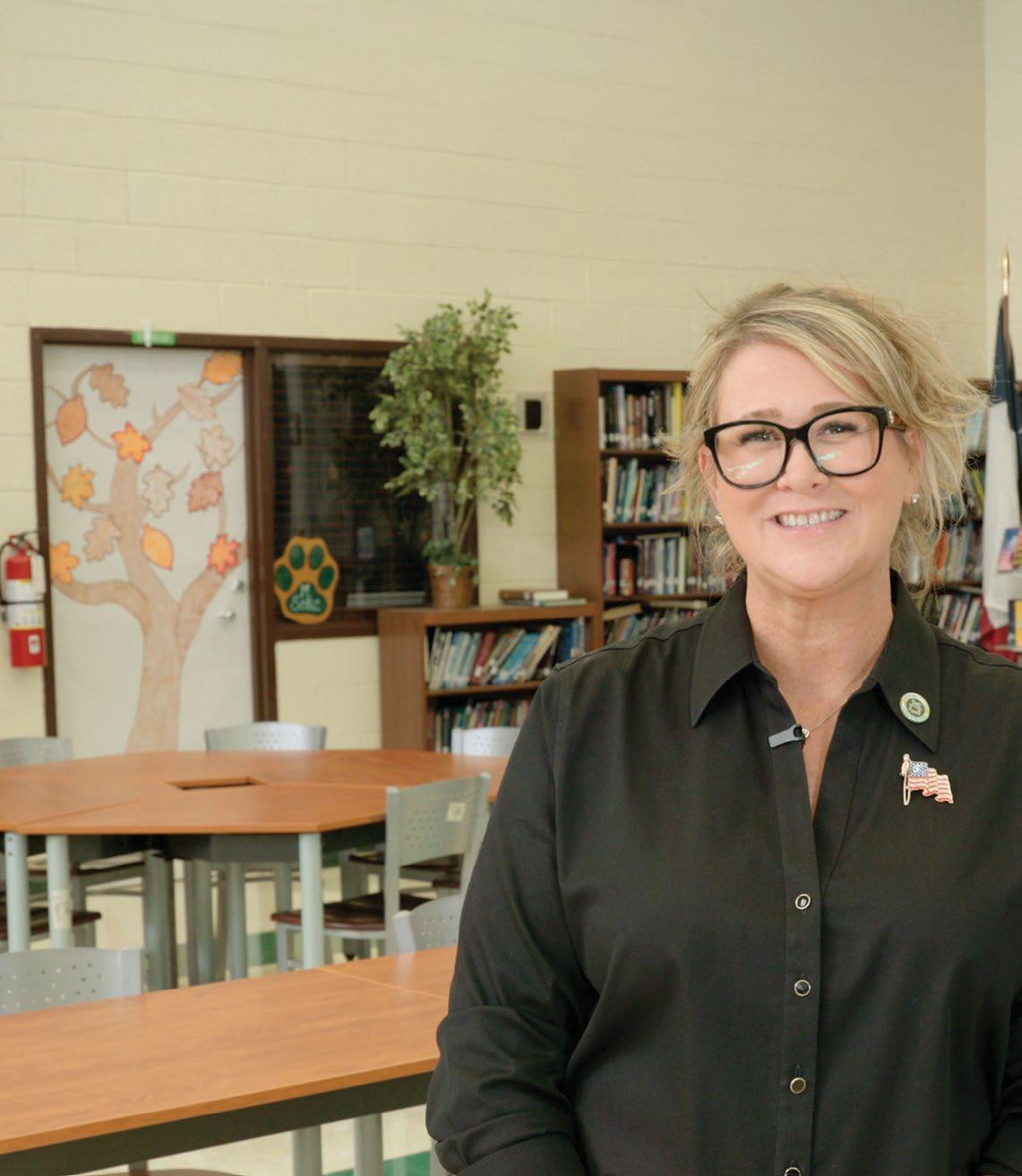
Texas needs our public schools and needs advocates for public schools. We are able to do that and be that.
Alison Savage Lyford CISD trustee, TASB Director
When you step into Dallas ISD’s Lincoln High School and Humanities/ Communications Magnet’s news studio, it doesn’t look like a typical classroom, but a professional broadcast station.
Cameras are set. The studio is illuminated by bright lights and the signature Lincoln logo.
For Derrick Knighten, audio/video production and theatre arts director, the newly renovated space is a full circle moment. A proud 1998 Lincoln graduate, Knighten once sat in the same program when it was known as Radio/TV. Now called Digital Media Arts, the program has transformed alongside the industry itself.
“At one time, we were cutting everything on quarter-inch tape, and then I was able to witness the bridge from analog to digital,” Knighten said.
Principal Lance Williams sees the program as part of a much larger legacy for the school, which is part of Dallas ISD –a district that serves 138,000 students.
“This program is one of the signature legacies of the legendary Lincoln High School. For generations, this powerhouse program has shaped storytellers and trained future professionals who’ve gone on to make an impact in media and beyond,” Williams said. “Today, that legacy is stronger than ever.”
The reimagined program features a news broadcasting studio, a professional sound recording studio, and a nonlinear editing lab that mirrors real-world production environments.
For students like senior Antoine E., the transformation is exciting to witness.
“My favorite part is seeing how much has changed over the past four years,” Antoine said. “It’s fun learning how to use all the new equipment.”
Although Antoine plans to major in sports medicine at Texas College this fall,
he said mastering professional camera and production skills is a valuable asset he’ll carry into any field.
For student Jarrett P., the program opened the door to a new career pathway in communications.
“Before, I casually dismissed the news,” he said. “Now I see the importance of why we need it — to keep everyone informed, involved, and aware of what’s going on in the world.”
Following graduation this past spring, Jarrett plans to join the armed forces, where he intends to pursue a degree in communications.
Beyond technical training, Knighten emphasizes media literacy in the classroom by teaching students to critically analyze content and understand its broader impact.
“Media literacy — whether in news or film — teaches you to truly understand what you see, how it relates to government, how it affects you here as a Dallasite, a South Dallas native, as an African American, Latino — how does it affect you personally?” Knighten said.
Students don’t just sit behind cameras. They write scripts, edit film, build confident on-camera presence, produce podcasts, record music, and manage lighting and sound for theatre performances. Graduates leave with Adobe Premiere certification and handson experience that reflects professional industry standards.
The long-term goal is to one day operate as a live, closed-circuit television station broadcasting directly from Lincoln’s studio. For now, students are already gaining the skills and experience to tell meaningful stories and continue Lincoln’s legacy. H
This story is courtesy of Dallas ISD.
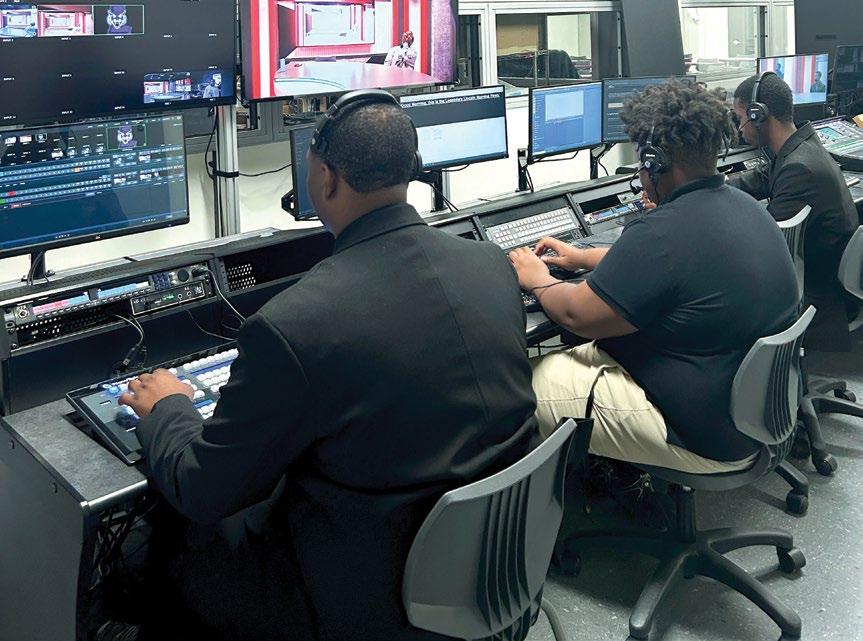

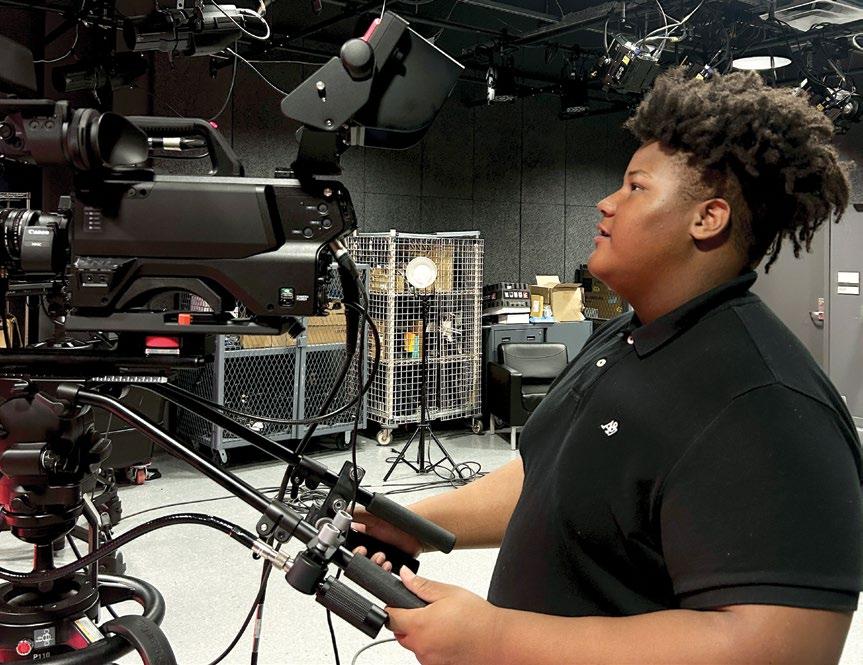
Dallas ISD’s Lincoln High School and Humanities/Communications Magnet’s news studio includes a professional sound recording studio and editing lab. Students learn about operating cameras, writing scripts, editing film, managing lighting, and more. The long-term goal? Operating a live, closed-circuit television station broadcasting directly from Lincoln’s studio!
Photos courtesy of Dallas ISD
Inside the Arlington Museum of Art, beneath gallery lights and among professional installations, artwork created by Eagle Mountain-Saginaw ISD students now lines the walls, not as a classroom assignment, but as part of a fully realized exhibition.
The second annual NAMNAL Exhibition – Human Intelligence vs. Artificial Intelligence: The Art of Survival–opened in April, expanding significantly from its inaugural year. For the first time, student artists from all four Eagle Mountain-Saginaw ISD high schools — Boswell, Chisholm Trail, Eagle Mountain, and Saginaw — are represented. This demonstrates both the program’s growth and the depth of talent across the district, which serves 24,021 students.
Centered on the evolving relationship between human creativity and AI, the exhibition challenges students to think critically about technology’s role in the artistic process. The result is a collection
of work that is as thoughtful as it is visually compelling.
For these students, the experience is rare. While still in high school, the students are exhibiting in a professional museum setting, an opportunity typically reserved for collegiate or emerging artists. It’s a moment that transforms how they see their work, and how others see them.
That blend of rigorous instruction and real-world exposure is what sets NAMNAL apart.
“In an era where meritocracy is greatly undervalued and education is beset by budget cuts and shifting priorities,” said Boswell High School art teacher DJ Perera, who organized the experience, “the NAMNAL Exhibition showcases what true academic success looks like when school districts invest in innovative programs that foster a culture of excellence.”
The exhibition is the result of a collaborative effort connecting the district with leading institutions, including Texas Christian University, The University of Texas at Dallas, and regional arts organizations. Through these partnerships, students engaged in highlevel workshops led by working artists and educators, pushing their work beyond traditional classroom expectations.
For Eagle Mountain-Saginaw ISD, the expansion of NAMNAL reflects an ongoing commitment to providing meaningful, real-world opportunities in the arts. For the students, it marks something more personal, a defining moment when their creativity moves beyond the classroom and into a space where it belongs. H
This story is courtesy of Eagle MountainSaginaw ISD.
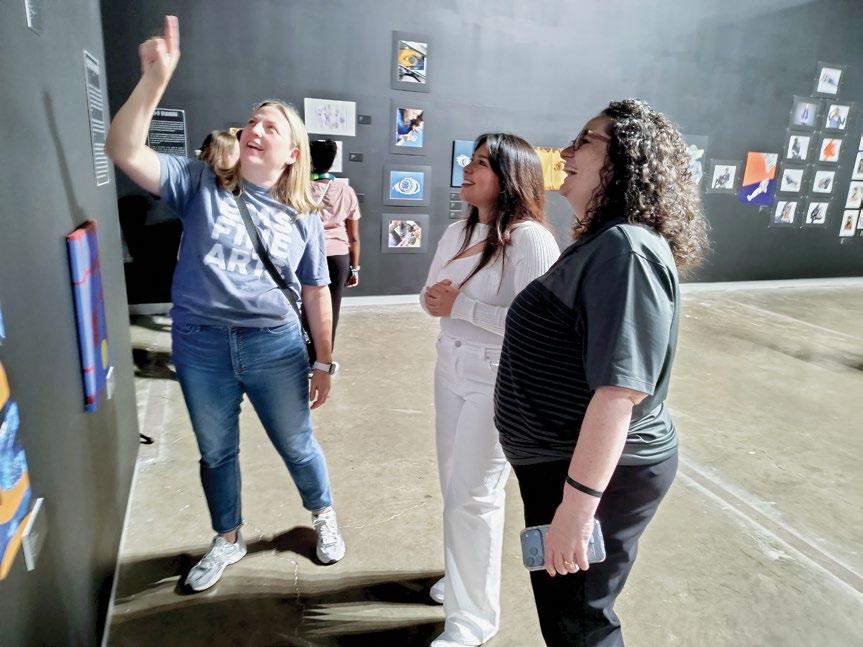
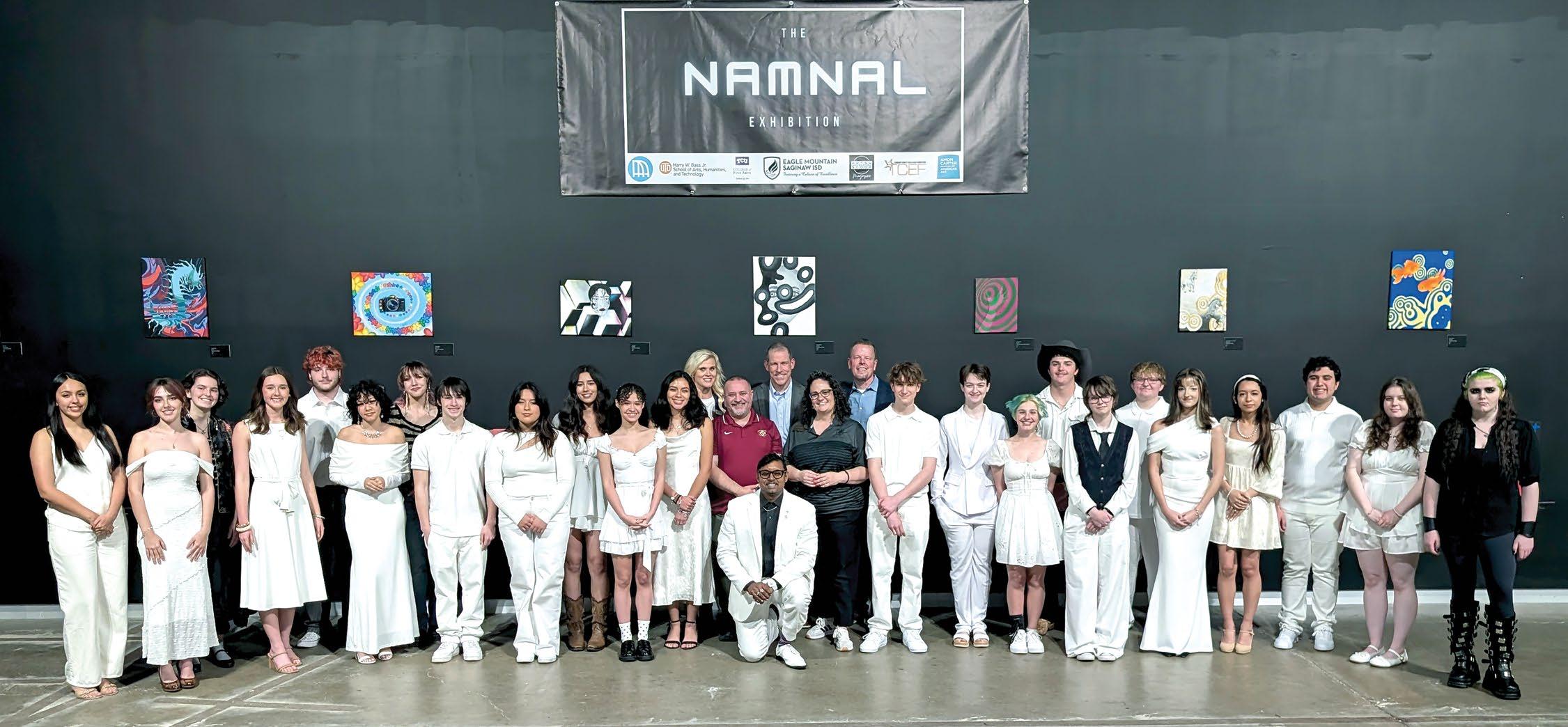
Grapevine-Colleyville ISD’s Career and Technical Education program launched a new Emergency Medical Technician course at the start of the school year that is taught by firefighters from the Grapevine Fire Department.
Designed for high school seniors in the health science pathway, the class offers students the opportunity to earn their EMT certification before graduation, preparing them for immediate entry into a fire academy or career. The idea for the class came in response to student needs, said Stephanie Speaks, the CTE director for the district, which serves 13,263 students.
“We had students who were interested in EMT certification, and we had a partnership with a local college for the students to enroll concurrently in their spring semester. The interest there was not very high because classes were during the spring semester of their senior year and at night after they had been at school all day,” Speaks said.
That’s where the Grapevine Fire Department came in.
“This opportunity might open doors for students to be a firefighter, a physician, a nurse, or they might want to get their Ph.D. in the medical field,” Fire Chief Darrell Brown said. “This could be the pathway that helps them grow and see what’s possible. This makes them marketable.”
After conversations with the fire department, there was agreement “this was an area of need and would also potentially help fill their pipeline,” Speaks said.
Led by Captain Tyson Doucet and a rotating team of five firefighters, all who have their instructor certificate, the course gives students direct access to professionals who live the EMT life every day.
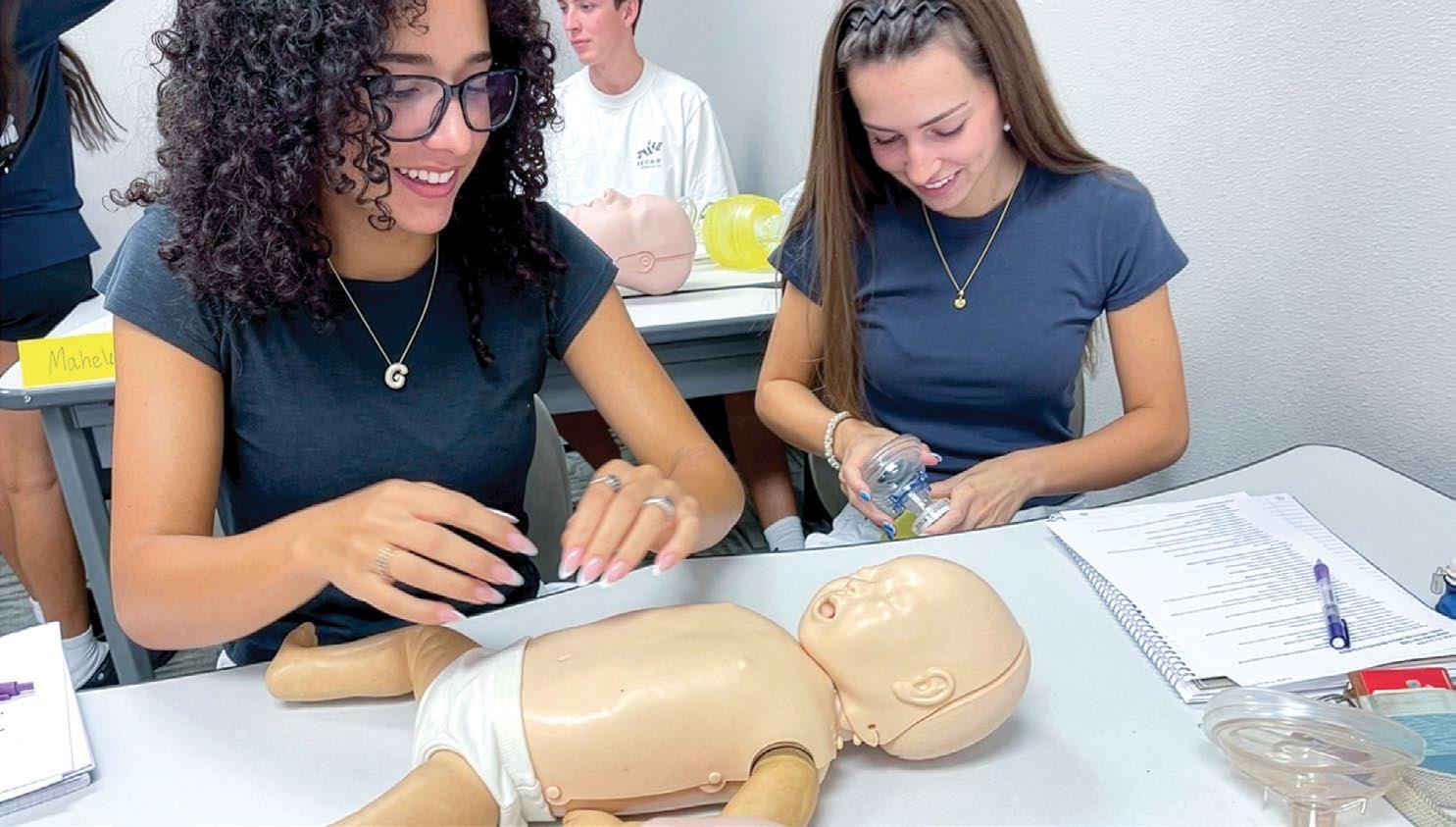
When students voiced an interest in an Emergency Medical Technician course, Grapevine-Colleyville ISD’s Career and Technical Education program responded. This school year, the CTE program launched a new EMT course that is taught by firefighters from the Grapevine Fire Department.
“I think it’s a great opportunity not only for the students, but also for the fire department,” Doucet said. “It could be the beginning of a ‘grow-your-own’ program. We get to help shape future EMTs, and maybe even future Grapevine firefighters.”
Students will also have the opportunity to participate in clinicals, ride-alongs with EMTs, and emergency room rotations.
“Once they learn the skills in the classroom, they can see real-life experience so they can see the field they might enter,” Doucet said.
Students also have to maintain an average of 75% or higher throughout the entirety of the course and pass tests and a final before they can take the National Registry of Emergency Medical Technicians exam. If they pass the national exam, they can take the state test, which allows them to work in Texas.
“After the state test, they are hirable
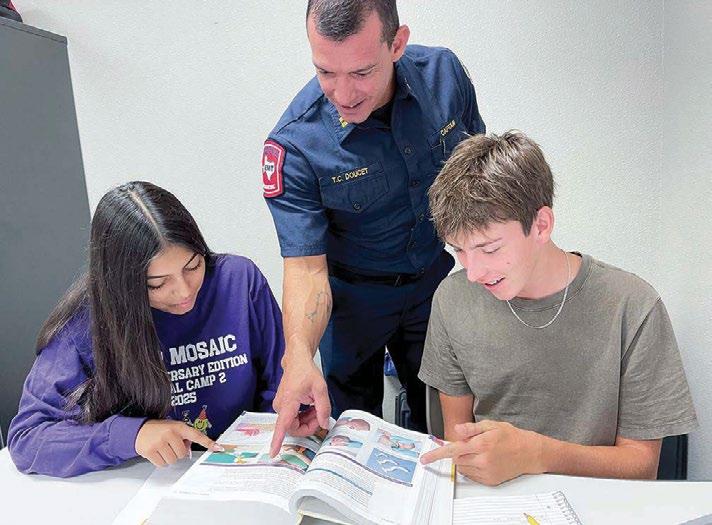
right out of high school,” Doucet said, adding that he looks forward to later this summer when he will possibly be looking at several more potential EMTs.
For students like Mahek Khawaja, a senior at Colleyville Heritage High School, the course is more than just a class; it’s a steppingstone. “I want to be an EMT during college, then go on to become a physician assistant in an emergency room,” she said. “This class is giving me real-world experience.”
Speaks agreed. “This is about giving students career opportunities. Whether they go straight to work or use this as a launching pad for medical school, they’re leaving us with real hands-on preparation.” H
This story is courtesy of GrapevineColleyville ISD.
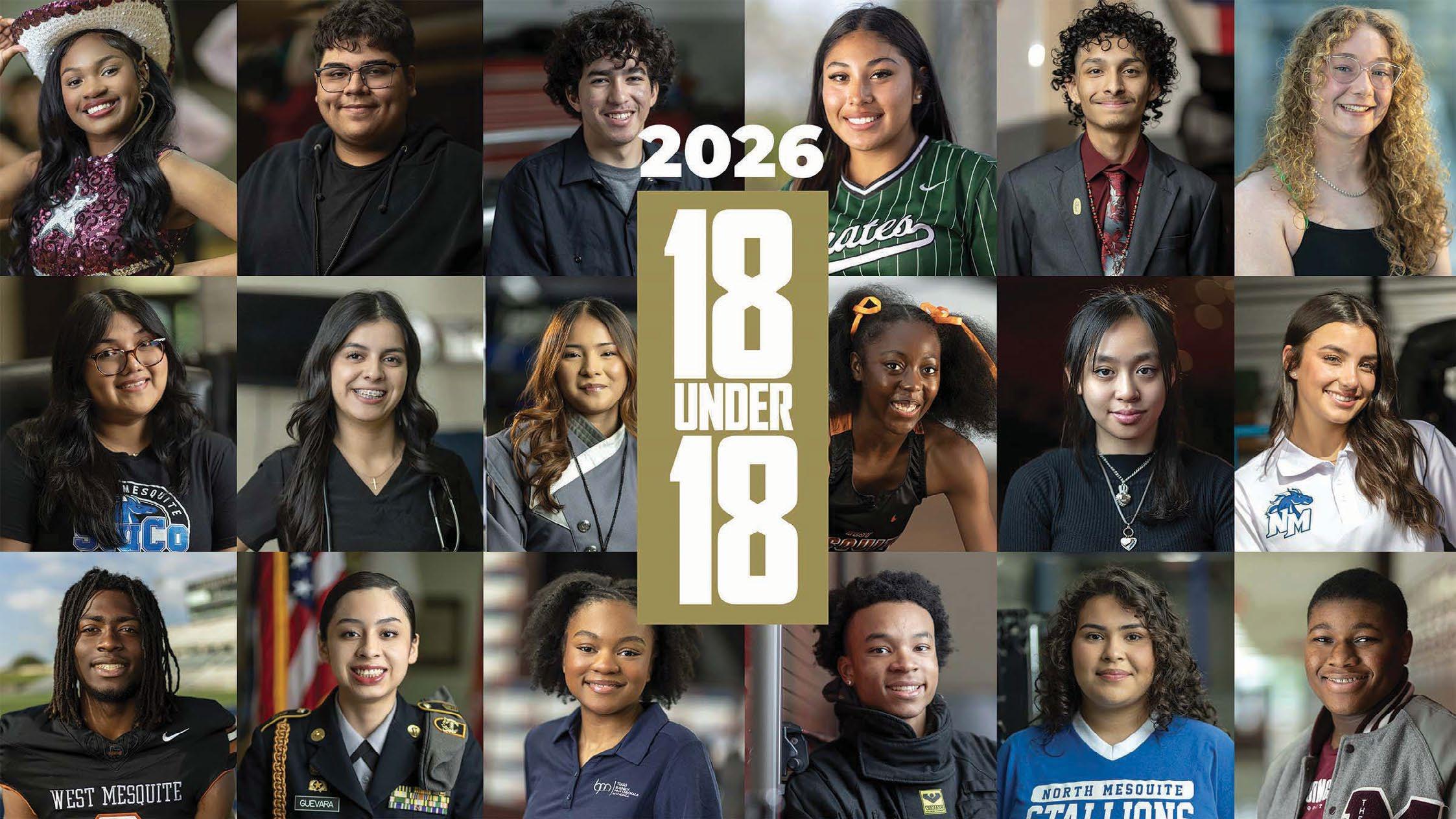
AT Mesquite ISD, student success goes beyond grades. It is reflected in a commitment to developing the whole student through meaningful opportunities, strong relationships, and experiences that empower learners to lead with purpose and impact. The district’s 18 Under 18 program celebrates exceptional students who represent the very best of Mesquite ISD.
The initiative, launched in spring 2025, recognizes 18 students under 18 years old from across the district who are making the most of the experiences and pathways available to them. Whether through academics, fine arts, athletics, leadership, or career-focused programs, each student represents a unique path shaped by curiosity, commitment, and the choices they make along the way.
Selected through a nomination process led by teachers and campus
leaders, these students stand out not only for their accomplishments but for how they contribute to their school communities. They are leaders in classrooms, performers on stage, competitors in athletics, and contributors to programs that challenge them to grow.
What sets the honorees apart is not a single achievement, but the way they embrace a range of opportunities and challenges. Their stories reflect a district culture grounded in the Mesquite Promise, which encourages students to seek new experiences, set ambitious goals, and pursue their passions with confidence. As Superintendent Ángel Rivera said, “When students are supported in being their authentic selves, they are empowered to explore their passions and pursue excellence.” This belief is reflected in the ways students across Mesquite ISD are
supported in discovering who they are and what they aspire to become.
Across disciplines and interests, Mesquite ISD creates meaningful ways for students to connect their learning beyond the classroom. The 18 Under 18 program brings those experiences into focus by highlighting students who are actively shaping their own journeys.
As these students look ahead, they carry with them the experiences and support systems that will guide them along their chosen paths. Their success reflects not only individual effort, but a community deeply committed to its students. Mesquite ISD serves 36,600 students.
“Of all the things we are proud of in Mesquite ISD, our students remain our greatest source of pride,” Rivera said. H
This story is courtesy of Mesquite ISD.
Several Prosper ISD High School students had the opportunity to run video for Grammy-winning band Kool and the Gang at a charity fundraiser this year.
They were asked to work the event because of the skills and experience they gained in their high school broadcast/ film pathway in the career and technical education department and from working at the district’s Children’s Health Stadium as the football audio and visual crew.
It marked the fifth year that Prosper ISD students have run video at the fundraiser. In previous years, Prosper ISD students have run video for Gladys Knight, America, The Four Tops, The Beach Boys, and others.
“I worked in corporate AV before I started teaching,” said Michael Logan, the school’s audio and video production teacher. “We have become well-known in our area for our professional display on our jumbotron and ribbon boards.”
Logan said that several years ago, a former client who was at the stadium and saw the students’ work asked if the students were available to work as camera operators for a fundraiser.
“I said absolutely. We started in 2020 and have been running video for the annual Catholic Charities Dallas Bishop’s Gala every January,” he said. This year’s event raised over $1 million for the charity.
Four students from Prosper High and one from Walnut Grove High School were hired to operate cameras and manage video for the event, broadcasting to five screens throughout the venue. They got real-world experience building the screens, setting up projectors, and running cameras. The evening concluded with a live concert by Kool and the Gang, the Rock and Roll Hall of Fame band.
“During the performance, Prosper High students took 100% control of the production and delivered a truly professional show,” Logan said. “This amazing opportunity is made possible
by the steadfast support of our district and high school leaders who consistently champion our program and help us create life-changing experiences for our students.”
Prosper ISD serves more than 29,000 students. H
In January, several Prosper ISD High School students ran video for Grammywinning band Kool and the Gang at a charity fundraiser. They got the cool assignment because of the skills and experience they gained in their high school broadcast/film pathway in the career and technical education department and from working at the district’s Children’s Health Stadium as the football audio and visual crew.