
Featured Event
txEDCON
HOUSTON
SEPT. 11-14

TASB Officers 2024-25
Rolinda Schmidt, President, Kerrville ISD
Tony Hopkins, President-Elect, Friendswood ISD
Mary Jane Hetrick, First Vice President, Dripping Springs ISD, Region 13B
Dan Micciche, Second Vice President, Dallas ISD, Region 10C
Sylvia Sánchez Garza, Secretary-Treasurer, South Texas ISD, Region 1B
Armando Rodriguez, Immediate Past President, Canutillo ISD
TASB Board of Directors 2024-25
Moises Alfaro, Mathis ISD, Region 2
Rose Avalos, Aldine ISD, Region 4A
Carlos Bentancourt, Slaton ISD, Region 17
Lynn Boswell, Austin ISD, Region 13A
Darlene Breaux, Alief ISD, Region 4B
Steve Brown, Ector County ISD, Region 18
Marlene Bullard, Tornillo ISD, Region 19
Kevin A. Carbó, Mesquite ISD, Region 10D
Crystal Carbone, Pearland ISD, Region 4C
Justin Chapa, Arlington ISD, Region 11C
Julie Cole, Hurst-Euless-Bedford ISD, Region 11A
Thomas Darden, Cooper ISD, Region 8
Dynette Davis, Frisco ISD, Region 10E
Angela Lemond Flowers, Houston ISD, 4D
Rebecca Fox, Katy ISD, Region 4E
Ginger Friesenhahn, East Central ISD, Region 20A
Linda Gooch, Sunnyvale ISD, Region 10B
Angie Hanan, Fort Bend ISD, Region 4G
Carol Harle, Northside ISD-Bexar County, Region 20B
Bryan Holubec, Thrall ISD, Region 13C
Todd LeCompte, Cypress-Fairbanks ISD, Region 4F
Mark Lukert, Wichita Falls ISD, Region 9
Raymond P. Meza, San Felipe Del Rio CISD, Region 15
Steven Newcom, Eagle Mountain-Saginaw ISD, Region 11D
Nicholas Phillips, Nederland ISD, Region 5
Quinton “Q” Phillips, Fort Worth ISD, Region 11B
Margaret Pruett, Victoria ISD, Region 3
Tony Raymond, Sabine ISD, Region 7
Keri Roberts, Goldthwaite CISD, Region 12
Alison Busse Savage, Lyford CISD, Region 1A
Rich Sena, Boerne ISD, Region 20D
Cindy Spanel, Highland Park ISD-Potter County, Region 16
David Sublasky, ESC 19, ESC Representative
Greg Welch, Clyde CISD, Region 14
Beth Whittington, New Caney ISD, Region 6A
SEPTEMBER
11-14 • txEDCON — Houston
16 • TASB HR Services: Managing Workplace Accommodations — Virtual Event
24-25 • TASB HR Services: Understanding Compensation in Schools — Virtual Event
30-Oct. 1 • TASB Facility Services: M&O Foundations — Austin
OCTOBER
13-14 • TASB HR Services: HR Academy — Austin
22-23 • TASB HR Services: Understanding Wage and Hour Law — Virtual Event
22-24 • TASB Conference for Administrative Professionals and BoardBook® Training — Austin
NOVEMBER
6-7 • TASB HR Services: Advanced HR Seminar — Austin
12-13 • TASB HR Services: Understanding Compensation in Colleges — Virtual Event
19-20 • TASB HR Services: Administering Pay Plans — Virtual Event
DECEMBER
3-4 • TASB HR Services: Navigating Educator Certification — Virtual Event
17 • TASB HR Services: Administering State, Military, and Local Leave Benefits — Virtual Event
2026
JANUARY
14-15 • TASB HR Services: Wage and Hour Law for Community Colleges — Virtual Event
FEBRUARY
2-3 • TASB Governmental Relations: 2026 Texas Federal Advocacy Conference — Washington, D.C.
3 • TASB HR Services: Administering Assault Leave — Virtual Event 18-19 • TASB HR Services: Service Record Management — Virtual Event
MARCH
TASB HR Services: Workers' Compensation for HR Staff — Virtual Event 4-7 • TASB Governance Camp: Powered by Student Voice — Galveston
• TASB HR Services: Managing Personnel Records — Virtual Event
For more information about these events or deadlines, visit the TASB website at tasb.org or call TASB at 512-467-0222 or 800-580-8272 toll-free.


Education leaders unite for learning in Houston
14 The Legislature and Public Ed
Stakeholders assess session’s impact on districts 18 Q&A: Service and More
Academy ISD’s culinary arts program adds café
Texas Lone Star • Volume 43, Number 4
Texas Association of School Boards
P.O. Box 400 • Austin, Texas • 78767-0400
512-467-0222 • 800-580-8272
Laura Tolley • Managing Editor
Shu-in Powell • Graphic Designer
Lalo Garcia • Photographer
Prisma • Printer
Contributors: Sara Butler, Theresa Gage-Dieringer, Brianna Garcia, Beth Griesmer, Dax González, Karlyn Keller, Mary Ann Lopez, Sylvia Wood, Matt Mitchell
Cover design: John Pyle
Texas Lone Star (ISSN 0749-9310) is published six times a year by the Texas Association of School Boards. Copyright© 2025 by the Texas Association of School Boards (TASB). All rights reserved. Reproduction, adaptation, distribution, and exhibition in whole or in part are prohibited under penalty of law without the written license or permission of TASB. Copies of Texas Lone Star are mailed to trustees of TASB member school boards and their superintendents as part of their membership. Subscriptions are available to nonmembers for $36 (1 year), $69 (2 years), and $99 (3 years). Single copies are $5.
Address changes should be sent to Michael Pennant, TASB, P.O. Box 400, Austin, Texas 78767-0400.
Articles in Texas Lone Star are expressions of the author or interviewee and do not represent the views or policies of TASB. Permission to reprint should be emailed to communications@tasb.org or addressed to the Managing Editor, P.O. Box 400, Austin, Texas 78767-0400.
Texas Lone Star does not guarantee publication of unsolicited manuscripts.
Postmaster: Send address changes to TASB, P.O. Box 400, Austin, Texas 78767-0400.


Dedicated to Students
A
new year reminds us of our purpose
by Rolinda Schmidt
Iremember as a child feeling restless, nervous, and unable to sleep the night before the first day of school. Those emotions faded as the hours crept by and were replaced with feelings of anticipation and excitement as I boarded that big yellow bus the next morning.
I feel that same sense of anticipation from our students on the first day of class each year at Kerrville ISD. As board members, we are always there to open car doors and greet them with “good morning” and high fives to make sure they know how happy we are to have them back.
This year was different. This year, we welcomed students back to class with deep feelings of gratitude for what we still have and profound feelings of grief for what we have lost.
As you all know, Kerr County and surrounding areas sustained catastrophic flooding over the July 4th holiday weekend. The losses were staggering. Precious children attending camp, trusted counselors looking after them, and Texans spending the holiday in the beautiful Hill Country lost their lives in the flooding.
On that horrific weekend, Kerrville ISD personnel sprang into action to help. Campuses were opened to those in need, our hero bus drivers evacuated campers and reunited them with their families, and everyone pitched in to offer a meal, a chain saw, a shoulder to cry on.
I want to extend my deep, sincere thanks to all of you who sent messages of concern and offers of help. Your support has helped sustain me through this tragic time.
Texas school board members are known for coming together to help our students and supporting each other in
times of great need. There is nothing more important to us than the safety of our kids, and we all grieve deeply when a child is lost.
Serving as TASB President
We will never forget the young children who perished in the flooding, and our hearts ache for their parents and families. But starting the new school year marked a milestone for our community as we try to move forward. Thank you again.
The new year also brings closure to another chapter for me as my term as your TASB President comes to a close. My year has included a whirlwind of events — both exhilarating and challenging.
Trips across this great state to gain knowledge and network with other trustees at conferences were enlightening and impactful. Another important experience for me was the opportunity to visit school board members on their home turf. With the assistance of fellow TASB officers and directors, presentations were shared at area school board association meetings and at TASB Spring Workshops and regional trainings.
We showcased the many services TASB offers its members, services that have evolved over 75 years to fill gaps and offer solutions to school districts to improve efficiency and effectiveness and keep resources in the classroom.
See you at Delegate Assembly
In addition to TASB’s many services, each Active Member can select a delegate and an alternate to represent them at Delegate Assembly, TASB’s official membership meeting, where every member has a vote in the organization’s direction. Our voice is more important now

than at any other time I can remember in my 30 years as a trustee. The challenging 89th legislative session was testament to this fact. School trustees from all corners of the state — Orange to El Paso, Amarillo to Mission — made their voices heard in support of the resources needed to best serve our more than 5.5 million schoolchildren and ensure their access to a high-quality public education.
Meaningful legislation was passed during the regular session, but there is much more to be done.
Trustees are encouraged to meet with their legislators leading up to the 2027 legislative session. Share your district’s successes and challenges, and build relationships and goodwill. Helpful tips and activities can be found in the Toolkit for Community Advocacy at tasb.org/resources/ community-advocacy-toolkit.
An honor to serve
I want to thank each of you for allowing me to serve as your President. I appreciate the TASB officers, directors, and staff, all of whom provided expertise, support, and guidance. I can assure you that TASB will be in capable hands when I pass the gavel to your next president, Tony Hopkins, Friendswood ISD’s board president.
I will sum up this year with a line from the song What I Like About Texas by Texas singer-songwriter Gary P. Nunn: “lt’s the spirit of the people who share this land.”
Texas trustees have an abundance of spirit. Let us all continue to carry that spirit forward for our kids and the future of Texas public education.H
Rolinda Schmidt, a Kerrville ISD trustee, is the 2024-25 president of TASB.
Rolinda Schmidt

School Is Back!
Trustees take on learning opportunities
by Laura Tolley
Welcome to the 2025-26 school year! Classes have started, and the exciting whirl of activity is underway in schools across Texas. I wish you all a productive and safe year.
We hope to help you get the new school year off to a good start in this issue, which includes stories on several important topics to our members. Dax González, division director of TASB Governmental Relations, looks back at the regular legislative session and breaks down what it means for school board members and their districts. The story begins on page 14.
Looking ahead, Mary Ann Lopez, a senior communications specialist at TASB, writes about the upcoming txEDCON in Houston, where thousands of school board members and other school leaders will gather in September for four days of learning, engagement, and connection. Read more about the range of educational activities offered at the event in a story that begins on page 8.
We also have a Q&A article about a popular career and technical education course at Academy ISD, a small district located about halfway between Waco and Austin. The story, which begins on page 18, is part of a larger effort here at TASB to highlight the exciting and innovative work ongoing in many districts in the CTE arena.
I invite you to take a few moments to read TASB President Rolinda Schmidt’s final column on page 5. It’s been an honor to have Schmidt write for the magazine this past year about her work with TASB and public education in Texas!
Working hard over the summer
I hope each of you had some down time with family and friends over the
summer. I know it can be a busy time as you work on budgets, preparations for the new school year, sorting out what legislative actions mean, and attending training events like Summer Leadership Institute in San Antonio and Fort Worth.
Some trustees got up early and travelled far to attend SLI. Others, like newly elected San Antonio ISD trustee Mike Villarreal, were located a bit closer. Villarreal was just recently sworn in as a trustee, so it still was impressive to see him at SLI.
“I've attended TASB conferences before as a state representative, but this is my first year as a school board trustee for San Antonio ISD,” Villarreal said. “Even though I have legislative experience, serving on a school board involves different responsibilities and legal frameworks. I wanted to understand these distinctions from day one rather than learn through trial and error. I'm here with my colleague and new trustee, Jacob Ramos. We both believe in being prepared to serve our students effectively.”
Villarreal said events like SLI “are invaluable, especially for new trustees without prior governance experience. They provide crucial foundation knowledge about school law, finance, and legal responsibilities.”
Making the extra effort
And to say I was impressed by Snyder ISD Board President Brad Hinton’s effort to attend SLI in San Antonio is an understatement.
Hinton usually travels to SLI in Fort Worth because it’s closer to his West Texas community. But this year, Snyder ISD hosted two breakout sessions at both locations, and Hinton was excited about his district’s participation in SLI.

Yet on the day of their San Antonio presentation, the Snyder ISD board had met until 1:30 a.m. Still, Hinton got up at 5 a.m. and drove 300 miles to downtown San Antonio to participate in the sessions.
One was called Strategic Leadership in Action: Building an Effective District Framework. The other, which immediately followed the first one, was called Transformation Board Engagement Through Instructional Rounds. (You can read more about Snyder ISD’s efforts in the October/ November issue.)
“It’s a privilege to stand up here today,” Hinton said after the first session. His district has faced some serious challenges, but he believes it is now headed in the right direction, and he was honored to talk to fellow trustees about how they are making progress. He hopes the lessons learned in his district can help fellow trustees.
While he always “gets a lot out of SLI” and enjoys learning about new ideas and programs in public education, Hinton was not able to take advantage of all the SLI opportunities in San Antonio because he had to immediately get back on the road home to Snyder.
“I’m a cotton farmer,” Hinton explained. “It’s planting season.”
That is standout dedication — to his school board, the district’s approximately 2,500 students, his family, and the community. It is the kind of commitment we see from school boards all across Texas, and we are grateful to all of you.
I hope you enjoy the issue.H

Laura Tolley is managing editor of Texas Lone Star.
Laura Tolley
2025 Education leaders unite for learning in Houston
by Mary Ann Lopez
Heading back to the Bayou City for the first time in nearly a decade, txEDCON will welcome thousands of school board trustees and administrators from big and small districts across Texas as they come together Sept. 11-14 for four days of learning, engagement, and connection at the George R. Brown Convention Center.
“As the largest gathering of public school leaders in the state of Texas, txEDCON is a wonderful opportunity to network while also receiving high-quality training to serve school communities and students,” said Dan Troxell, TASB executive director. “And this year, we are so excited to welcome everyone to Houston.”
The premier annual conference, hosted by the Texas Association of School Administrators and TASB, offers school board trustees, superintendents, and district administrators access to timely and thoughtful programming on a wide range of topics. Each session is designed to support the important work they do for their districts.
Tim Fletcher, Slidell ISD’s board president, said he first attended the convention, now known as txEDCON, in the 1970s when he was a few years into his board service. Fletcher is celebrating 52 years of board service in September.
Even though he’s been to txEDCON consistently over the decades, he still finds it a worthwhile experience, and he encourages others to attend.
“If you’re energetic and you want to stay abreast of all the new things going on, you need to go, especially with the legislative updates they give,” Fletcher said.
Slidell ISD is located northwest of the Dallas-Fort Worth metroplex, and it serves about 482 students. Fletcher
said that the roundtable discussions during sessions are great opportunities to talk with trustees from districts of all sizes. “You can see what happens in other districts that way,” he said.
“Talking to other school districts, there are unique things they do that maybe we don’t do that might be a good idea to try,” he said. “You will hear things you will think that will never happen in your school district, and it does happen. It is always kind of nice to know what somebody else has done.”
This year, registrants can choose from more than 100 sessions that will be offered at txEDCON. All the trainings are designed to support education leaders so they can lead and govern effectively to support the advancement of Texas public schools, while also strengthening support for public education and public education students.

Attendees participate in roundtable discussions during sessions at txEDCON 2024.
Houston


Special workshops
For new board members and experienced trustees filling board officer roles, txEDCON provides two training programs with topics, tools, and best practices to meet their needs and continuing education requirements.
Texas Trustee Institute is a curated two-day program designed for new trustees just starting their board service journey, while Board Officer Institute is a program for new board officers or those interested in a board officer role.
TTI provides an overview of some of the most critical topics and information a new board member needs to know to effectively navigate their service. Topics to be discussed include:
• Texas Open Meetings Act
• Board Policy
• School Law
• Board Operating Procedures
• Advocacy
txEDCON Sneak Peek

BOI is a one-day training offering board officers tools to help them be more effective at managing and facilitating board meetings. The session will dive into Board Officer Roles and Responsibilities, Robert’s Rules of Order, and Managing Effective Meetings, among other topics.
Preregistration is required to attend TTI or BOI.
Key programming
While Texas may have more than 1,000 school districts, most are small, which is why the Small School District Seminar continues to be a source of great interest for many trustees and administrators. The program, being held Sept. 12, is designed for districts with 999 or fewer students. It will include featured speaker Darryl Henson, superintendent of Marlin ISD, and will spotlight three small districts: Hearne, Henrietta, and Runge ISDs. There will also be a Legislative Update for Small Schools.
“Small districts have such very specific needs and concerns that we really try to provide them with the information and tools to help them be prepared to successfully navigate any challenges they may face,” said Jackie Clark Spencer, division director, events for TASB Communications, Marketing, and Events. This year, the seminar will be held at the Hilton Americas-Houston.
In addition, a number of pre-conference sessions will be held on Sept. 11, and preregistration is required.
The pre-conference session by the Council of School Attorneys will feature two panels of experienced school attorneys. The panels will offer a full three hours of continuing education credit, with the unique opportunity to hear from school law practitioners from multiple law firms and school district in-house counsel at the same time.
Photos by TASB Media Services
Trustees show their support for students during the general session performances at txEDCON 2024.
One panel will cover required content for the mandatory continuing education on Preventing Child Abuse and Neglect. Panelists will discuss new legislation on reporting educator misconduct. The second panel will focus on school district grievances and what legislative changes mean to that process.
Other special required trainings will be offered, including:
• Post-Legislative Update, which fulfills trustees’ biennial training requirement
• Child Abuse Prevention
• Evaluating and Improving Student Outcomes: The Board’s Role in Continuous Improvement
General Sessions
Not only does txEDCON offer a myriad of training sessions for trustees and administrators, it also includes heartwarming student entertainment that leaves convention goers feeling inspired and motivated. This year, students from Kerrville ISD perform Sept. 12 and students from San Angelo ISD perform Sept. 13. Also, txEDCON wouldn’t be complete without engaging speakers who share stories of personal growth, leadership, and transformation. This year’s keynote speakers are:
• Kevin Brown is a motivational speaker and author who is passionate about helping people and organizations embrace a simple philosophy that separates worldclass organizations and high-performance people from everybody else. He calls it The Hero Effect.
• Justine Froelker, a licensed professional counselor who has authored 12 books, shares a transformative program to help people and teams live and lead with self-awareness, authenticity, and resilience to build courage-centered leaders and cultures.

Attendees enjoy a breakout session at txEDCON24. This year, there will be more than 100 sessions.
• Anthony Trucks is a former foster child, NFL football player, competitor on American Ninja Warrior, author, identity shift coach, and the founder of Dark Work and the creator of the Dark Work Experience. He teaches people how to access the power of their identity through Dark Work, tap into their full potential, and “Make Shift Happen!”
Also, the Superintendent of the Year will be announced on Friday, and the Outstanding School Board Award and Key Communicator Award will be presented on Saturday.
Delegate Assembly
One event held in conjunction with txEDCON that relies on member participation is Delegate Assembly.


Students from Canutillo, El Paso, Fabens, Socorro, and Ysleta ISDs performed during the second general session at txEDCON24.
At txEDCON24, Tomball ISD had a space-themed performance that highlighted the district's innovative programs.

Delegate Assembly is TASB’s official membership meeting, which is held every year in conjunction with txEDCON. As active members, each local school board and regional education service center board has the exclusive right to appoint a delegate and an alternative to represent their board and community. Delegates discuss and vote on a number of action items. The 2025 Assembly is Saturday, Sept. 13, at the George R. Brown Convention Center.
Trish Bode, a member of the Leander ISD board, president of the Central Texas School Board Association, and a member of the Leadership TASB Class of 2017, said she always attends and wouldn't miss participating in Delegate Assembly.
“I am so thankful to get to be a part of that,” she said. “To get to talk to others about how policies and legislation are impacting them, and to be able, in a group to advocate for our kiddos and for our areas, and the things that we see we want to focus on as a group. I’m thankful for the discussions, the honesty, the vulnerability of that group.”

How to register
Registration is open and ongoing for txEDCON 2025. Those who want to attend and who have not registered yet should do so at tasa.tasb.org. For those who are unable to pre-register, there will be onsite registration available, but rates increase after Sept. 10.
As in previous years, there is a special rate for full boardsuperintendent teams. The system has been updated to automatically assign eligible members to the discounted registration option of “Leadership Team” at a discounted rate, which is $100 off the regular rate per registrant.
Full registration is required for the following:
• Public official of a school district
• Administrator or employee of a school district
• Member of the Council of School Attorneys
• Administrator or employee of an education service center
• Vendors who are not exhibiting
Note for school districts
School board members and administrators should coordinate registration through their district’s central office. TASA and TASB do not require session selection with registration; however, there are pre-conference options on Thursday and the Small School District Seminar, Texas Trustee Institute, and Board Officer Institute on Friday that do require registration. A $50 nonrefundable registration fee is required for the pre-conference sessions.

Learn more and register today!
Have questions? Please contact us at 800-580-8272, extension 2451, or registrar@tasb.org
Board members make their voices heard while voting at Delegate Assembly, which is held every year in conjunction with txEDCON.
Student performances are a convention highlight. Last year, Tomball ISD wowed the crowd during the first general session.
Photos by TASB Media Services
Registration, Exhibit Hall, and more
Registration for txEDCON 2025 is ongoing and leadership teams are encouraged to attend. The process has been simplified to automatically assign eligible members to the discounted registration option of “Leadership Team” at a discounted rate.
Attendees also will have the chance to visit TASB staff at txEDCON at the TASB booth, where Association representatives can answer members' questions about the TASB Advantage.
With so many concurrent session options available, attendees at past events may have found they had little time to visit the Exhibit Hall. But this year, time has been built in so they can scope it out, Spencer said. The opening reception on Sept. 11 has been extended and will be held from 3:30 to 6:30 p.m.
“The opening reception is a great opportunity to connect and network with other education leaders,” Spencer said.
Find a convention ‘buddy’
When she first began attending txEDCON, Bode said it was a little overwhelming to realize how many sessions and options were available. But she learned to choose the sessions that made the most sense for her and which ones she could share with her fellow board members.

For first timers attending txEDCON, Bode offers a suggestion: “I think finding a buddy just makes the learning richer,” she said. “It’s neat to debrief with someone after [a session].”
Bode said she hasn’t missed a year since she began her board service in 2015.
“I think the networking and the learning are valued and critical,” she said. “I love getting to talk to the other trustees. It gives you a space and a time to be able to see what other trustees in Texas are doing and how they’re doing it different, what works for them, and to be able to share best practices.”H
Mary Ann Lopez is a staff writer for Texas Lone Star
Bellville ISD Superintendent Nicole Poenitzsch celebrates being named the Superintendent of the Year during the 2024 SOTY award ceremony.











THE LEGISLATURE AND PUBLIC ED
Stakeholders assess session’s impact on districts
by Dax González
Editor’s Note: This story was written before the 2025 special legislative session concluded. We will provide public ed-related updates from the special session online at tasb.org.
Texas legislators delivered historic investments in public education and also passed several new education policy changes during the regular legislative session this year. From sweeping school funding increases to the debut of a billion-dollar education savings account voucher program, lawmakers significantly reshaped the educational landscape.
The new laws are still being studied by public school leaders across Texas and other stakeholders to determine exactly how they impact the more than 5.5 million students served by public schools.
Public school funding
House Bill 2 is easily the 2025 regular session’s most impactful bill for public education. The bill earmarks $8.5 billion in new state funding — a landmark infusion for a system that has seen record inflation and no significant funding increase since 2019.
As the session started, legislators identified about $4.8 billion in revenue available to support increased school funding. The Texas Senate directed the bulk of that to go toward teacher salaries, while the House prioritized an increase to the basic allotment. The two chambers also identified special education programs and school safety
enhancements as priorities and moved forward with similar plans to address both.
In the end, negotiators arrived at the final version of HB 2, which dedicates $3.7 billion to establish a teacher retention allotment that will increase salaries for teachers with three or more years of experience by between $2,500 and $8,000. To help address salaries for other staff and other costs identified by trustees and administrators that might normally be paid out of the basic allotment, legislators included $500 million for other nonadministrator school staff salaries and $1.3 billion for a new Allotment for Basic Costs to help schools address fixed costs such as utilities, payroll taxes, and insurance. HB 2 also includes an increase to the basic allotment of $55 per student.
Help for smaller districts
Small and midsized districts will also see a $300 million increase to their overall allotment. While the allotment is generally reserved for districts below 1,600 (small) and 5,000 (midsize) students, legislators may soon need to address larger charter schools that receive the allotment. All charter schools are entitled to the average small and midsize per-student allotment that eligible public schools receive, and there are currently 15 charter schools with more than 5,000 students each that are receiving a total of more than $245 million from the allotment.
HB 2, signed into law by Gov. Greg Abbott on June 4, will help address issues raised by school leaders for years, though work still lies ahead to ensure all school districts have the resources to meet the varied needs of their unique communities.
Teacher incentives, certification
Embedded within HB 2 are broad changes to teacher certification requirements and incentive programs to help in the recruitment and retention of teachers — a critical need across the state.
The bill requires schools to have only certified teachers in foundation courses by 2030 and includes $135 million to help districts assist their teachers in getting certified to comply. The bill also increases Teacher Incentive Allotment stipends, and the high needs/rural factor amounts by thousands of dollars, raising the potential for educators to earn more competitive salaries. Further, the bill sets aside funding for grow-your-own programs, apprenticeships, additional support for certification of teachers in high-needs areas, mentorship programs, and support for rehiring retired teachers.
These provisions aim to address chronic staffing shortages and elevate teacher quality. But rules are still forthcoming for some of these program enhancements, and district leaders will need to navigate the varying program and funding requirements associated with them.
Special education
HB 2 and Senate Bill 568, which restates provisions outlined in HB 2, institute a paradigm shift in special education funding: moving away from a system of funding based on where students are educated to an inten-
sity-based model to acknowledge the varying services that different students may need.
The education commissioner is now tasked with developing eight tiers of funding for students requiring special education services to assist districts with providing the services to help students thrive. The bills allocate $850 million for special education purposes, of which a large share will go toward the shift to intensity-based funding. But there are other provisions that also seek to enhance these services.
In an effort to address district backlogs with evaluating students who may need special education services, legislators included an allotment of $1,000 per child for whom a district conducts a full, initial evaluation. Additionally, they boosted support for special education transportation and specialized training for staff.
(House Bill 2) requires schools to have only certified teachers in
foundation courses by 2030 and includes $135 million to help districts assist their teachers in getting certified to comply.
Student discipline
During the legislative interim, lawmakers heard from many school leaders about how student discipline and districts’ ability to address serious disciplinary issues were both impacting teacher retention and impeding student learning in some cases. Legislators responded by passing House Bill 6, which provides districts with more flexibility to address student discipline.
The new law expands district authority to suspend, and in severe cases expel, students; provides options for first-time offenders caught with vape pens; clarifies that inschool suspension is not subject to a time limit (but requires an evaluation at least every 10 school days); and provides districts with funding for virtual alternative education placements.
Safety funding
HB 2 and Senate Bill 260, another “belts and suspenders” bill containing the same provisions as HB 2, increase school safety funding by using $430 million to boost the per-student safety allotment from $10 to $20, and the per-campus allotment from $15,000 to $33,540.
Education savings accounts
In one of the more controversial legislative actions during the regular session, legislators passed Senate Bill 2, which established a $1 billion education savings account voucher program. The program will be administered by the Texas Comptroller with the assistance of new Certified Education Assistance Organizations. After a year of organization, ESAs will be available for the 2026-27 school year and will allow families to apply for state funding to pay for approved educational expenses such as private school tuition, instructional materials, academic assessments, public school classes that do not generate average daily attendance funding, transportation, tutoring, computer hardware/ software (not to exceed 10% of the account), and educational therapies.
ESAs will be granted at three levels:
1. 85% of the average state and local per-student funding (currently about $10,500)
2. Up to $30,000 for students requiring special education services (Exact amount will be determined by a public school evaluation and the resulting individualized education program.)
3. $2,000 per child who is being homeschooled
The CEAOs, which can collectively be paid up to 5% of the program funding to run the program, will be required to prioritize applicants based on the following four categories:
1. Students with disabilities from families below 500% of the federal poverty level
2. Families at or below 200% of the poverty level
3. Families between 200% and 500% of the poverty level
4. Families at or above 500% of the poverty level (Only 20% of program funds may be used for students in this category.)
There are some protections built into the program, including requirements that funds be used on approved educational expenses and vendors, that private schools be accredited and in operation for at least two years prior to accepting ESA funds, and that students using ESAs for private schools must take a nationally norm-referenced test to help determine student performance.
For those students who use an ESA to attend a private school and return to public school midyear, the state will provide additional funding equal to the remaining basic allotment plus an additional 10% to assist with remediation and that student will not count toward the district’s accountability rating for that year.
While the $1 billion appropriated for the program is fixed for the first biennium, the cost of the program is expected to grow rapidly, reaching almost $4 billion per year in 2030.
Property tax reform
As the legislative session started, then-Texas Comptroller Glenn Hegar announced that legislators would have a $24 billion surplus to work with as they crafted the state budget. Lawmakers used the extra funding to pass a few bills to build upon property tax relief legislation passed in the past few sessions. Voters will have the chance to approve the tax relief proposals in the November election.
The three proposals increase the homestead exemption from $100,000 to $140,000, raise the homestead exemption for disabled homeowners and those over the
Lawmakers used the extra funding to pass a few bills to build upon property tax relief legislation passed in the past few sessions. Voters will have the chance to approve the tax relief proposals in the November election.
age of 65 from $10,000 to $65,000, and increase business personal property exemptions from $2,500 to $125,000.
Testing reform
Parents, school leaders, educators, and others have been calling for reform to the state’s accountability and assessment systems for years, but legislators were unable to develop a plan that is acceptable to both House and Senate leaders. House Committee on Public Education Chair Brad Buckley (R-Salado) attempted to address the issue in House Bill 4, which eliminated the STAAR exam and called for through-year testing. The measure did not survive the session, and legislators will need to spend time over the interim considering changes to the system that both chambers can agree upon before trying again in the 90th legislative session.
Looking ahead
The regular 2025 Texas legislative session is an inflection point: a significant investment in public education comes hand-in-hand with a new ESA program and many changes to student discipline, special education, and teacher incentives and certification. School leaders should spend the next year gathering data and evaluating how new laws are impacting their schools and students. This information will help legislators next session as they look to improve upon or legislation enacted this session. As always, one of the best ways that school leaders can stay up to date on legislative issues facing public schools is to join the School Board Advocacy Network, which comes with a free subscription to the TASB Legislative Report, by signing up at tasb.org/advocacy/capitol-watch.H
Dax González is division director of TASB Governmental Relations.


Scan to listen to legislative news on our podcast.
HOW ROCKWALL ISD COMMUNICATES LEGISLATIVE CHANGES TO STAKEHOLDERS
by Matt Mitchell
The 89th Texas Legislature proved to be one of the most impactful sessions yet for public education. Many changes are on the horizon, including an increase in new public school funding through the passage of House Bill 2. School funding can be complex, so it’s important for districts to communicate any changes — and challenges — to mitigate the misinformation surrounding this subject.
At TASB’s Summer Leadership Institute, Rockwall ISD hosted a breakout session on how it communicates school funding changes to stakeholders. Its plan is designed to give the community a better understanding of this complicated topic. The district offered these tips for creating an effective communications plan:
1. Identify “misleads”: Rockwall ISD has identified common myths or what the district calls “misleads” surrounding school finance. Debunking misleads has become a central focus of the district’s communications efforts. To help keep community members better informed, the district has created online resources, including its Rockwall ISD Connections newsletter.
2. Be transparent: Rockwall ISD stresses the importance of being open with community members not only about its finances, but also its priorities and challenges its schools face. This includes communicating the impacts of the Legislature (such as the basic allotment increase), inflationary costs, future budget reductions, salary changes, and other tangible impacts on teachers, students, and families that could result from changes to school funding.
3. Community outreach: Rockwall ISD conducts outreach to its taxpayers — community clubs and organizations, parents, and retirees — by meeting with them directly, either in large or small groups and even in one-on-one settings. The district also communicates with its stakeholders through its social media channels and its e-newsletter. “School finances should be fair to taxpayers, and they should understand exactly how their tax dollars are being used for their local schools,” said Rockwall ISD Superintendent John Villarreal.
Matt Mitchell is a staff writer for Texas Lone Star

Q&A: Service and More
Academy ISD’s culinary arts program adds café
by Laura Tolley
It’s more than service with a smile at Academy ISD High School’s Beestro, a new café that offers an inviting space for students and some community events. Named after the district’s mascot, the Bumblebees, the café is part of the school’s culinary arts initiative, a popular career and technology education program.
Academy ISD, a district of about 1,800 between Waco and Austin, tapped into regional expertise to shape the robust CTE program, which provides students with the skills and knowledge they need to pursue careers in culinary arts and hospitality.
In districts across Texas, school leaders are working hard to offer interesting and innovative CTE programs that ignite student passions and help prepare them to successfully enter a range of important industries in their communities and beyond.
Academy ISD’s culinary arts program, one of several CTE courses offered, not only trains students; it involves the community in creative ways. Catered events, including senior citizen luncheons, are held in the Beestro to give students the chance to demonstrate their culinary talents. And local professionals and industry experts serve on the district’s CTE Advisory Council to ensure that the curriculum for all CTE courses remains relevant.
“The culinary program is a very high-quality program and fun environment that I have been a part of for the last three years,” said Reid White, a senior this year. “Our new commercial kitchen is an amazing add to our program and has benefited us in so many ways this past year. The Beestro has done just as much. It provides us with a room to serve people when we put on events such as senior citizen luncheon, superintendent luncheon, and school board dinners.”
“I strongly believe our culinary program is unlike any other,” White added. “I have been lucky enough to be a part of this amazing program for the past three years. It has helped me
Academy
learn overall communication because that is vital in the kitchen. It has also helped me learn to be comfortable outside of my comfort zone.”
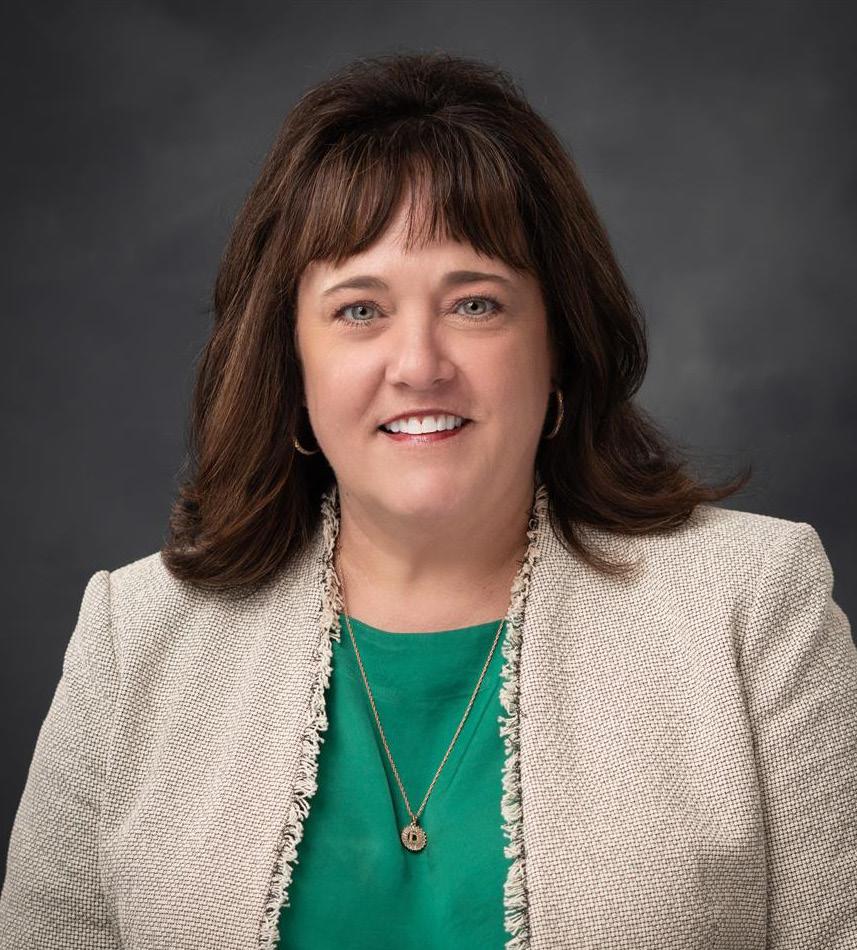
Texas Lone Star talked to Academy ISD Superintendent Darla Nolen about the inspiring culinary arts program and the importance of CTE education. Her comments have been lightly edited.
Question: Tell us about Academy ISD’s CTE culinary arts program, which includes the high school’s Beestro café operation. What are the different components? How long did it take to design and implement this CTE program?
A: The four-year program includes the following courses: Introduction to Culinary, Culinary Arts, Advanced Culinary Arts, and Practicum. The key components of our culinary program are classroom instruction for our introductory classes, then students move into more hands-on kitchen experience and front-of-house training. Students receive industry-based certifications, such as the Servsafe Manager and Food Handlers. Students also gain knowledge of the different career paths within the culinary and hospitality industries.
Academy ISD Superintendent Darla Nolen
Photo courtesy of Academy ISD


As with all of our CTE programs, the goal is for our students to be equipped with the practical skills and knowledge needed for career readiness. With what they accomplish in the culinary program in high school and the certifications they receive,
students can gain immediate entry into culinary and hospitality professions upon graduation.
Academy ISD’s culinary program at the Beestro also works to develop essential power skills such as teamwork, communication, problem-solving, professionalism, and customer service.
Overseeing the Beestro and culinary classes are three dynamic instructors. Elise Jacko, a former restaurant owner, Chuck Mann, who owns a food truck and has catering experience, and Anyely Sierra Rivera, an instructional assistant who is a product of the culinary arts program at Academy ISD, and a recent culinary graduate from Texas State Technical College.
Question: How has the culinary arts program grown and improved?
A: Approximately one out of every five Academy High School students participate in this pathway, making it a popular choice for learners even before we had the Beestro and an
amazing new kitchen. A bond passed in 2021 by the community allowed Academy ISD to build a new high school, and with it came a revamped and improved culinary space. This program has always dished out incredible food, even in their original space, which had a single stove and small prep area. We moved from the cramped quarters to a spacious six-station setup for students, an instructor demonstration area complete with video, and ample space for an entire class to move about safely and efficiently. The kitchen, also equipped with a smoker, pizza oven, and industrial walk-in refrigerator and freezer, connects directly to the culinary classroom, making it convenient for students to apply what they have learned.
As Mann, one of the program’s instructors, said, “It’s hard to believe what was accomplished in our previous kitchen. We have the fortunate opportunity to elevate all aspects of our culinary program because of the beautiful space we have now.”
Question: What role does the Beestro operation play in the CTE program?
The kitchen also connects to the Beestro, a café centrally located in the school. Within the Beestro is a coffee lover’s dream setup, where specialty drinks are made for staff and

Academy High School’s Beestro serves as a gathering spot for students and a venue for special luncheons.
Academy ISD Superintendent Darla Nolen watches a student work in the culinary arts kitchen.
Photos by TASB


guests. Students even enjoy the flexible seating space just outside the Beestro’s doors, which gives it all the café vibes.
Instructor Jacko noted that eventually, high school students may have the opportunity to order a latte. “However, in our first year of opening the Beestro, we wanted the focus to be on learning the new equipment and keeping the same quality standards we are used to. We have big ideas on what is to come, from having more student-focused events, to a curbside lunch delivery for our staff,” Jacko said.
Our state-of-the art culinary kitchen and Beestro provide real-time, (evolving) practical hands-on experiences for students to gain skills using modern equipment, preparing them for real-world culinary environments. Exposure to professionalgrade tools helps students adapt quickly to industry expectations after graduation. Our advanced technology creates an engaging, efficient learning atmosphere, improving comprehension and retention.
Our kitchen and Beestro incorporate the latest safety features, reducing the risk of accidents while teaching proper safety protocols. The access to diverse equipment fosters experimentation, encouraging students to explore new cooking techniques and recipes.
Students build confidence and competence, better positioning them for culinary schools, internships, or immediate job opportunities. Overall, a state-of-the-art kitchen bridges the gap between education and professional culinary careers, enhancing both skill development and student motivation.”
Question: How has the Academy ISD community gotten involved in the CTE culinary arts program and the Beestro? What is the community’s reaction to the program?
A: Our community is involved in the culinary program in several ways. The CTE Advisory Council for Academy ISD invites local professionals and industry experts to ensure the curriculum remains relevant and meets workforce needs. Catered events for the school district, outside entities, and the community showcase our students’ talents and provide them with real-world experience in preparation and presentation.
Some favorite events are the senior citizen luncheons where community members (we don’t check IDs ��) enjoy a meal that is prepared by our students in the culinary kitchens and served to our guests. It is a full circle event where students set the tables with linens and utensils, prepare and serve the meal, interact and engage with the guests, and wash the dishes

Academy High School student baristas create specialty drinks for a senior citizens luncheon this spring in the Beestro café.
A culinary arts student serves senior citizens at a special community luncheon held this spring in the high school’s Beestro café.
Photos courtesy of Academy ISD
at the end. Community members, grandparents, staff members’ parents, city officials, religious leaders, all are welcome. It provides in-the-moment learning opportunities that are beyond knife cut tutorials and recipes. Events such as this allow a connection to form between the student and the alumni, neighbor, or grandparent. It is both powerful and priceless to understand how a meal can bring people together.
Question: What role do CTE programs play in providing Texas public ed students with a great education?
A: Several graduates of Academy ISD use their knowledge and skill from the Beestro program to obtain part-time jobs during college, or to pursue culinary careers. Everyone has to eat, so to equip our students with strong culinary acumen is something that they can always use, even if they do not pursue this particular career path.
CTE courses provide students with the opportunity to explore and learn through their interests and talents. These programs produce a skilled workforce that greatly impacts our state’s economic growth. These programs aren’t just helpful and enjoyable ways to fill a student’s schedule. They are essential.H
Laura Tolley is managing editor of Texas Lone Star.


CTE Content on tasb.org
As support and funding for college, career, and military readiness programs increases, districts can look to TASB to highlight school district CTE programs, dual credit opportunities, Texas workforce initiatives, grant funding, and teacher certification requirements. TASB members can find information about opportunities and strategies for implementing CTE programs in their districts and showcase the benefits of public education. Check out the CTE-focused articles and resources on tasb.org for reliable information and inspiration.


Culinary arts students participated in a cooking competition where Academy High School instructors served as judges.
Finding interesting ways to work with basic ingredients was essential to the “chopped” competition.
Enrolling in School
Review eligibility rules for students
by TASB Legal Services
The start of a new school year is a good time to review who is eligible to enroll in public schools, what documents are required for enrollment, and other relevant information. District administrators and trustees often face questions about when and how students can enroll in the district. Below are answers to some of the most frequently asked questions regarding student enrollment.
Who can enroll in the district?
A person who is at least 5 and under 21 years old on Sept. 1 of the school year in which they are seeking to attend can be enrolled in a Texas school district if the person satisfies at least one of the conditions for enrollment in Texas Education Code section 25.001. Many of the conditions for enrollment are discussed in this column, but a school district should review the law in TASB Policy FD(LEGAL) for a full list.
What documents are required for enrollment?
The Texas Education Code requires that documents establishing a child’s identity be provided within 30 days of enrollment. Tex. Educ. Code § 25.002(a-1). If the child is under age 11, the person enrolling the child must provide a certified copy of the child’s birth certificate or other reliable proof of the child’s identity and age and a signed statement explaining the person’s inability to produce a copy of the birth certificate. If the person fails to provide this information by the applicable deadline, the school must notify appropriate law enforcement before the 31st day after the person fails to comply. Tex. Code Crim. Proc. art. 63.019.
What if a parent or legal guardian can’t provide proof of the child’s identity?
While the law specifies the required proof of identity for enrollment, the Texas Education Agency clarifies in its Student Attendance Accounting Handbook that a district should not deny enrollment solely because of a failure to provide documentation verifying a student’s identity or prior school records. However, if a parent or legal guardian does not submit the required information within 30 days of enrollment, the district must notify local law enforcement and request a determination as to whether the child has been reported missing. Tex. Educ. Code § 25.002(c).
If a parent or legal guardian does not submit the required information within 30 days of enrollment, the district must notify local law enforcement and request a determination as to whether the child has been reported missing.

Exceptions to this general rule apply for special populations, such as homeless students and students in foster care. Additionally, a parent may provide a physician’s affidavit of medical risk, or an affidavit signed by the parent declining a vaccination for reasons of conscience in lieu of vaccination. Tex. Educ. Code § 38.001(c).
Can the district ask for proof of residency?
Yes. According to Texas Education Code section 25.001(c), the school board or its designee may require evidence that a person is eligible to attend school within the district at the time of application for admission, and the board may establish the minimum proof of residency acceptable to the district and allow reasonable inquiries to verify eligibility for admission.
What should the district do if a nonparent tries to enroll a child?
Are immunization records required for enrollment?
Yes. A district can deny admission to an applicant who is not fully immunized and has not begun the required immunizations. Tex. Educ. Code § 38.001(a).
The district must record the name, address, and date of birth of the person enrolling the child. Tex. Educ. Code § 25.002(f). While a court order granting legal control is preferred, it is not required for a nonparent to enroll a child. A child cannot be denied enrollment solely

because the enrolling adult lacks a court order. Ideally, a nonparent should provide a notarized power of attorney from the parent, allowing the district to communicate with them about school matters. This document grants specific parental rights without limiting the parent’s authority and can be revoked at any time. TASB Policy Service provides a sample power of attorney form in the TASB Regulations Resource Manual at FD(EXHIBIT).
Where should the child of divorced parents enroll?
A district must enroll if the child and either parent resides in the district or, even if the child does not reside in the district, a parent who is a joint managing conservator, sole managing conservator, or possessory conservator of the student resides in the district. Tex. Educ. Code § 25.001(b)(1), (2). Keep in mind that the right to admission might be altered by provisions in the divorce decree, which may specifically state which parent has the right to enroll the child or make educational decisions. District administrators should insist that the parent provide the district with copies of all relevant orders issued by the court related to custody of the child.

Accidents happen. Are your students covered?
Why choose student accident and athletic insurance from TASB Benefits Cooperative’s awarded provider, Texas Kids First?
• Coverage on or off campus designed to insure students participating in University Interscholastic League (UIL) activities
• Trusted by trainers endorsed by Texas State Athletic Trainers’ Association and Southwest Athletic Trainers’ Association
• Connected statewide insuring more than 275 school districts and a network of over 3,000 medical providers in Texas
• Top rated by A.M. Best Company, a leading insurance rating authority*
Administered by
What should a district do when a minor who lives separate and apart from their parent enrolls?
State law requires school districts to admit a minor who has established a residence separate and apart from their parents or legal guardian, with exceptions for applicants with certain disciplinary histories. Tex. Educ. Code § 25.001(b)(4), (d). TASB Policy Service provides form documents in the TASB Regulations Resource Manual to assist districts enrolling minors living separate and apart from their parents. TASB Regulations Resource Manual at FD(EXHIBIT) contains an Affidavit of Student Admission Information (For Student Living Separate and Apart from Parent or Guardian) requiring the person enrolling the minor to attest to the child’s age, current residence, names and addresses of the child’s legal guardians, and information allowing the district to determine whether the disciplinary history disqualifies the minor from admission.
Can the district enroll a person whose grandparent lives in the district and provides after-school care?
Yes. A district must admit a person
State law requires school districts to admit a minor who has established a residence separate and apart from their parents or legal guardian, with exceptions for applicants with certain disciplinary histories.
who does not reside in the district if the person’s grandparent lives in the district and provides a substantial amount of after-school care, as determined by the board. Tex. Educ. Code § 25.001(b)(9). The amount of care required for admission purposes varies from district to district and should be defined in writing. TASB Policy Service offers a sample resolution districts can use when determining what constitutes substantial care by a grand-
parent in the TASB Regulations Resource Manual at FD(EXHIBIT).
Where should homeless students be enrolled?
A homeless student is entitled to admission in any school district. Tex. Educ. Code § 25.001(b)(5). Under the federal McKinney-Vento Act, the term homeless children or youth means individuals who lack a fixed, regular, and adequate nighttime residence. 42 U.S.C. § 11434a(2). Whether a student meets the definition of homelessness is a case-specific inquiry depending on the individual’s living situation and circumstances. Each district must designate a liaison for students who are homeless. 42 U.S.C. § 11432(g)(1)(J)(ii), (g)(6)(A). The contact information for each district’s liaison is located at TASB Policy FFC(EXHIBIT).
Where should students in foster care or Texas Department of Family and Protective Services conservatorship be enrolled?
A child in foster care may attend schools in the district in which the foster parents reside free of charge regardless of the amount of time the child has lived in the district. Tex. Educ. Code § 25.001(f).
New training for maintenance directors
Build a strong foundation for your operations program. Get the tools and knowledge needed to lead with confidence and set your department for long-term success. Sept. 30 & Oct. 1 8:30

tasb.org/training-events/mo-foundations-2025
Federal law requires the district to presume that it is in the best interest of the student to remain in the student’s school of origin, which here means the school in which the student was enrolled at the time the student was placed in foster care. 20 U.S.C. § 6311(g)(1)(E).
Can a peace officer or service member choose to transfer their child to a different campus or school district other than the campus or district where the child would be eligible to enroll?
Yes. Upon request of a parent or guardian who is a peace officer or service member, a school district must transfer a student to another campus in the district. Tex. Educ. Code § 25.0344.
The statute also states that upon request, a district must transfer the student to another school district “under an agreement under Section 25.035” of the Texas Education Code. This reference to Section 25.035, which permits adjoining districts or districts in adjoining counties to enter into transfer agreements subject to certain conditions, has raised legal questions since the law went into effect. In the Student Attendance Accounting
Handbook, TEA states that districts “must accept the transfer application of students whose parent or guardian is an active military servicemember or peace officer and requests a transfer to another campus in the currently enrolled district or to another adjoining school district.” A district questioning whether to accept a transfer application of a child of a peace officer or servicemember should consult with the district’s school attorney.
If you have questions about these issues, consult your district’s attorney or call TASB Legal Services at 800-580-5345 H
This article is provided for educational purposes and contains information to facilitate a general understanding of the law. References to judicial or other official proceedings are intended to be a fair and impartial account of public records, which may contain allegations that are not true. This article is not an exhaustive treatment of the law, nor is it intended to substitute for the advice of an attorney. Consult your own attorney to apply these legal principles to specific fact situations.
The work-site posters offered by HR Services are designed to meet the needs of Texas public schools. The posters make it easy for districts to post federal and state notices pertaining to government employees and entities. Discounts are available for bulk orders.
visit
Attend Delegate Assembly
Help shape TASB advocacy efforts at annual meeting
by Dax González
The 2025 TASB Delegate Assembly is just around the corner, and every Active Member has the opportunity to make their voice heard.
Delegates will not only be voting on changes to the 2024-26 TASB Advocacy Agenda, but they will also have the opportunity to vote on a new structure for the Agenda moving forward. You can read more about proposed changes to the Agenda structure in TASB Deputy Director Tiffany Dunne-Oldfield’s column on page
42. I will focus on possible changes to the current Advocacy Agenda in this column.
Amplified voice
For decades, trustees have amplified their voices by working together on key priorities for Texas public education at Delegate Assembly — TASB’s official membership meeting, where every Active Member has a vote in the direction of the organization. The Advocacy Agenda changes adopted by delegates at the Assembly will dictate TASB’s advocacy
efforts during the interim leading up to the 90th legislative session.
And while the 89th Texas Legislature ended the regular session June 2, we’ve seen several special sessions over the past few years, including one this summer. Updating the current Advocacy Agenda is crucial to ensuring that TASB Governmental Relations staff knows where our membership stands on the issues that may be addressed during a special session.
In fact, the Legislative Advisory Council, which helped develop the current Advocacy Priorities, met June 14 to suggest updates to the priorities to reflect recently passed legislation. Delegate Assembly is your chance to review, amend, and act upon those changes.
New resolutions
In addition to the priorities, school boards submitted a few new resolutions to add to the current Advocacy Resolutions that highlight local concerns not already contained in the Advocacy Agenda. These resolutions will help TASB GR staff respond to issues that may arise during any special session or other occasions during the interim.

Trustees from around Texas attended the 2024 Delegate Assembly in San Antonio.
Photo by TASB Media Services
The 2025 Delegate Assembly will be held Sept. 13 during txEDCON in Houston. As Active Members, each local school board has the exclusive right to appoint a delegate who will speak and vote for their board. During the Assembly, delegates discuss and vote on a variety of action items — from electing TASB directors and officers to approving the education issues included in the Advocacy Agenda.
Naming a delegate
For local boards, the process to name a delegate begins at a regular board meeting with an agenda item to appoint a delegate and alternate to attend Delegate Assembly. Then, the board should discuss who would be the best fit for these roles.
Once the board takes action to name its representatives, the superintendent or administrative assistant can proceed with registering the chosen delegate and alternate. Directions are posted at delegate.tasb.org.
What to expect as a delegate
The Delegate Handbook and Nominations Committee Report are posted a few weeks before the Assembly. Registered delegates and alternates will receive an email with a link to the resources, including the action items under consideration.
On the day of the Assembly, delegates and alternates will first attend their regional caucus meetings. This is a working lunch where colleagues from the same region get together and discuss action items, including any concerns and proposed amendments. It’s also a chance to ask questions of TASB Directors, staff, and other trustees.
At 1:45 p.m., all delegates and alternates head to the assembly hall.
Assembly kicks off at 2 p.m. Only one representative from each school board is allowed on the floor. However, guest seating is provided at the back of the room so delegates and alternates can trade off time on the floor if desired.
For more information on Delegate Assembly, visit delegate.tasb.org.H
Dax González is division director of TASB Governmental Relations.
Invested in Texas Public Schools
Since 1991, Lone Star Investment Pool™ has provided flexible investment solutions tailored to Texas school districts — with personal service from people who know you by name.
Make us part of your diverse bond investment strategy and discover how the Pool can help your district meet its financial goals. Large

SHARS in the Spotlight
Navigating actions taken during the legislative session
by Karlyn Keller
It started with a phone call from a small district. A SHARS coordinator, clearly overwhelmed, said, “I just need someone to tell me what all of this really means and whether we’re going to lose funding.”
If you’ve worked with School Health and Related Services for any length of time, you’ve likely felt the same way. Between policy shifts, funding uncertainties, and ever-changing requirements, the program can feel like a moving target. That’s why we’re breaking down the key takeaways from the 89th Texas Legislature and proposed policy changes from the state’s Health and Human Services Commission. Here’s what it all could mean for your district as well as the Texas Education Agency.
Legislative details and SHARS impacts
1. Senate Bill 1952 — centralizing oversight
SB 1952 requires a new Memorandum of Understanding between TEA and HHSC. It clearly designates HHSC as the lead agency for SHARS going forward.
Why this matters: Over the last five to six years, TEA has played a supporting role in helping districts navigate the educational context of Medicaid billing. The intent, as expressed by some lawmakers, was that more money would flow into special education services broadly, which could help districts support students with
Legislative/Legal Highlights at a Glance
Bill/Change What It Does
Senate Bill 1952 Designates HHSC as sole administrator of SHARS
House Bill 500 Proposed SHARS funding of $934 million was removed before passage; however, special education was increased in House Bill 2.
Senate Bill 1266 HHSC will provide a support team to help with enrollment, revalidation, and credentialling to reduce the administrative burden of the process.
HHSC Provider Competency Update May allow nonlicensed healthcare providers to verify Personal Care Services competency as of October 2025.

disabilities even if not directly tied to SHARS reimbursements.
What to watch: How HHSC structures guidance and technical assistance moving forward, and how the regional education service centers will provide SHARS support.
Implications for Districts
An effort to streamline oversight that may reduce TEA involvement
No SHARS fix this session, but updated special education funding could ease impact.
Additional support available for districts navigating the online system
An effort to create flexibility but requires training, oversight, and policy clarity
The intent, as expressed by some lawmakers, was that more money would flow into special education services broadly, which could help districts support students with disabilities even if not directly tied to SHARS reimbursements.

2. House Bill 500 — SHARS funding … almost
One of the more closely watched items this session, especially for those familiar with SHARS, was HB 500, which originally included a $934 million supplemental appropriation to help offset disallowed SHARS reimbursements from FY2022 and FY2023. However, SHARS-specific funding was not included in the final bill.
So, what happened instead? While SHARS funding did not survive the final version of the bill, the Legislature increased overall special education funding and revised the funding methodology. The intent, as expressed by some lawmakers, was that more money would flow into special education services broadly, which could help districts support students with disabilities even if not directly tied to SHARS reimbursements.
The takeaway: While the SHARSspecific remedy didn’t pass, the revised special education formulas may provide some indirect relief by strengthening overall funding for the same student population.

Why do school boards choose TASB Executive Search Services?

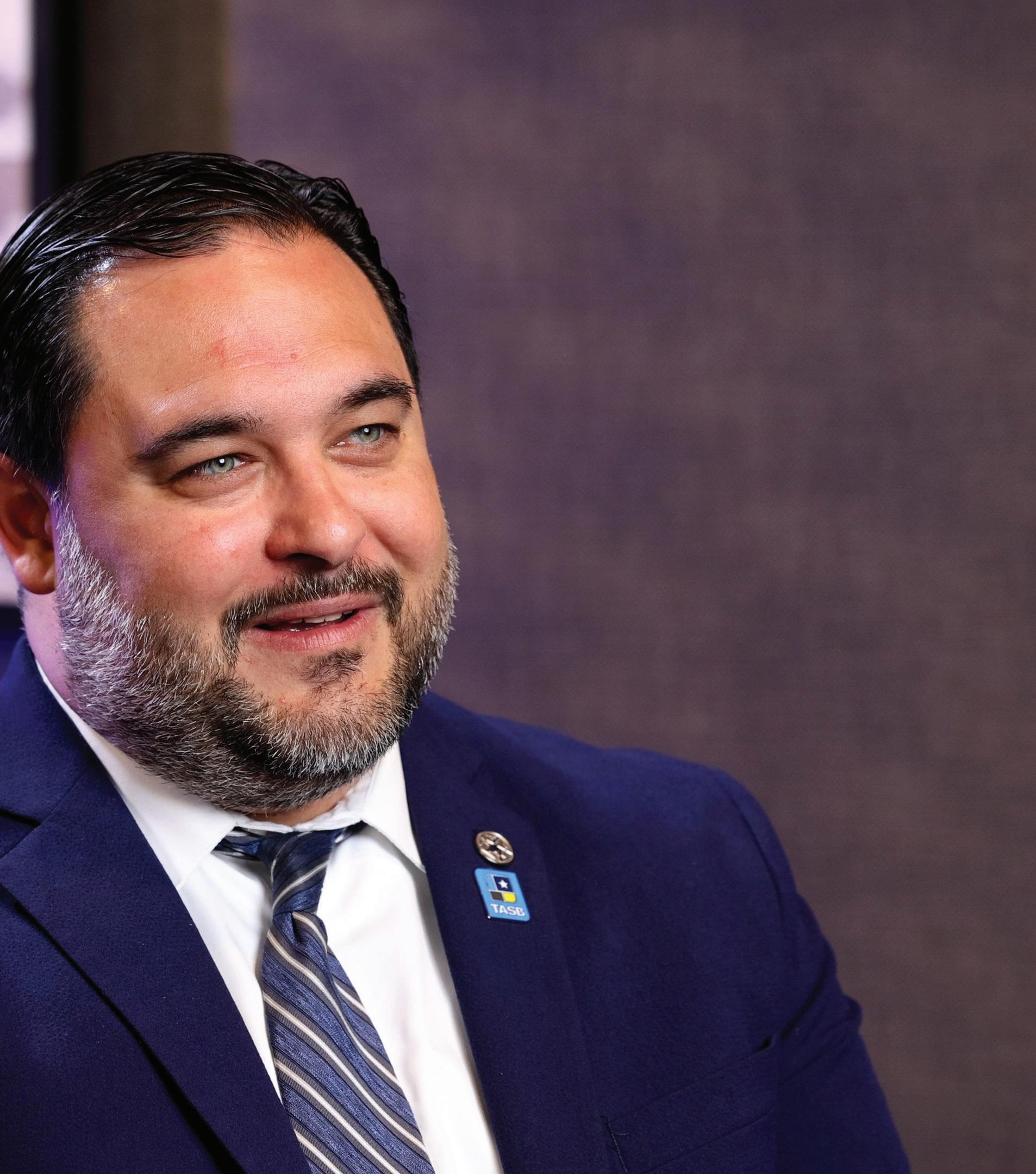
If you’re looking for a group that’s got a lot of experience with diverse communities, that’s cost effective, that’s willing to listen and to work with trustees, TASB ESS is a good choice for you.
– Justin Chapa, president of the Arlington ISD board of trustees
In its more than 30-year history, ESS has conducted over 800 searches on behalf of districts across Texas.
With a team of search consultants who know Texas and its diverse school districts, ESS has proven itself to be the go-to search firm for leadership recruiting.
ESS brings experience to the table and a guarantee, so trustees can feel confident they’ve found the best leader for the job.
tasb.org/ess
executive.search@tasb.org
800-580-8272
What it means for SHARS: Districts still face outstanding disallowances and appeals from previous years, but the increased special education funding could help in the broader service delivery landscape.
On the horizon: Federal actions may also bring additional developments in the months ahead. We continue to monitor the changing landscape of Medicaid federally.
• Responsibility to ensure proper internal training, supervision, and documentation
• Anticipate: Informally, we have been told that HHSC plans to publish updated guidance in August 2025 with implementation starting Oct. 1, 2025.
If finalized, this change will shift how districts manage this internal process. Now is the time to begin planning for
Districts can expect to have subject matter experts from the state available to assist them, which is important given that all providers will need to have their application revalidated in the near future.
3. Senate Bill 1266 — support for enrollment and revalidation
SB 1266 demonstrates the Legislature’s understanding that enrollment and revalidation can be complicated, and providers such as school districts may need additional guidance to navigate the application process. Districts can expect to have subject matter experts from the state available to assist them, which is important given that all providers will need to have their application revalidated in the near future.
4. Provider Competency Verification — What could change?
HHSC is reviewing a major change to PCS under SHARS: allowing “qualified school employees” (rather than only licensed health care providers) to verify competency of PCS staff.
What’s changing?
Current rule: Only an LHCP can assess and sign off on provider competency.
Proposed change (Oct. 1, 2025): A qualified school employee could assess and verify competency if they meet criteria defined by HHSC.
What this could mean:
• Flexibility for districts managing PCS providers, especially in understaffed settings
staff training and internal oversight.
SHARS timeline: What’s ahead?
Summer 2025: SB 1952 was effective on June 20, 2025; HHSC and TEA will begin working on an MOU once any necessary waivers from the federal government are secured.
Fall 2025: Final policy language published in Texas Medicaid Provider Procedures Manual
Oct. 1, 2025: Proposed implementation of provider competency change
What should districts do now?
✔ Stay informed
TASB continues to monitor both state and federal activity around SHARS and will share updates regularly.
✔ Review documentation practices
Ensure your team’s internal procedures are strong and adaptable. Be prepared by staying in the know.
✔ Prepare for transitions
Begin assessing how changes in policy could affect your staffing, training, and compliance processes.
✔ Share Impact
Communicate with lawmakers and agency staff about how SHARS policies
affect your students, staff, and district. Your perspective helps inform decisionmaking.
Moving forward
The 2025 legislative session didn’t bring a direct funding fix for SHARS, but it did reshape some of the support structures around it. With broader special education funding increases and a potential shift in how PCS competency is handled, districts may see opportunities to strengthen their programs in new ways.
And as always, federal Medicaid activity could influence Texas implementation in the months ahead. Your ongoing engagement is essential to making sure districts have a seat at the table.
So, to the SHARS coordinator who asked what it all really means: It means things are shifting, but support and guidance remain strong.
We’re in this together. We’re here to support you through the changes — every step of the way.H
Karlyn Keller is division director of TASB’s Student Solutions.
Stay Connected with SHARS Matters
SHARS policy is always evolving and staying informed is the best way to stay ahead.
If you’re not already receiving our updates, we invite you to sign up for SHARS Matters, including both our newsletter and webinar series. You’ll get timely insights, training opportunities, and updates on legislative and policy developments, all focused on helping districts navigate SHARS with confidence.
Subscribe by emailing us at shars@tasb.org and ask to be added to the SHARS Matters mailing list.
TASA names five finalists for 2025 award Honor Boards
Five Texas school boards have been selected as Honor School Boards as part of the 2025 Texas Association of School Administrators School Board Awards.
Each year, the program recognizes outstanding Texas school boards for commitment and service that has had a positive impact on Texas public school students.
The five Honor Boards were selected by a committee of Texas school superintendents. The selection committee’s decisions were based on criteria that include support for educational performance, support for educational improvement projects, commitment to a code of ethics, and maintenance of harmonious and supportive relationships among board members.
The five school boards selected as 2025 Texas Honor School Boards are Colorado ISD (ESC 14), Galena Park ISD (ESC 4), Memphis ISD (ESC 16), Plano ISD (ESC 10), and Temple ISD (ESC 12).
Winner announced at txEDCON
The five boards are now finalists for the program’s highest honor: 2025 Outstanding School Board. They will be interviewed Sept. 12 at txEDCON in Houston, where one board will be named Outstanding School Board the next day. The other Honor Boards, as well as the regional winners, will also be recognized at that time.
The 10 boards to be recognized as 2025 Regional Honor Boards are:
Region 1: Roma ISD
Region 2: Port Aransas ISD
Region 5: Orangefield ISD
Region 7: (Large district) Grand Saline ISD
Region 7: (Small district) Overton ISD
Region 11: Northwest ISD
Region 13: Round Rock ISD
Region 19: (Small district) Anthony ISD
Region 19: (Large district) Clint ISD
Region 20: New Braunfels ISD H

“Education is the movement from darkness to light.”
—Allan Bloom
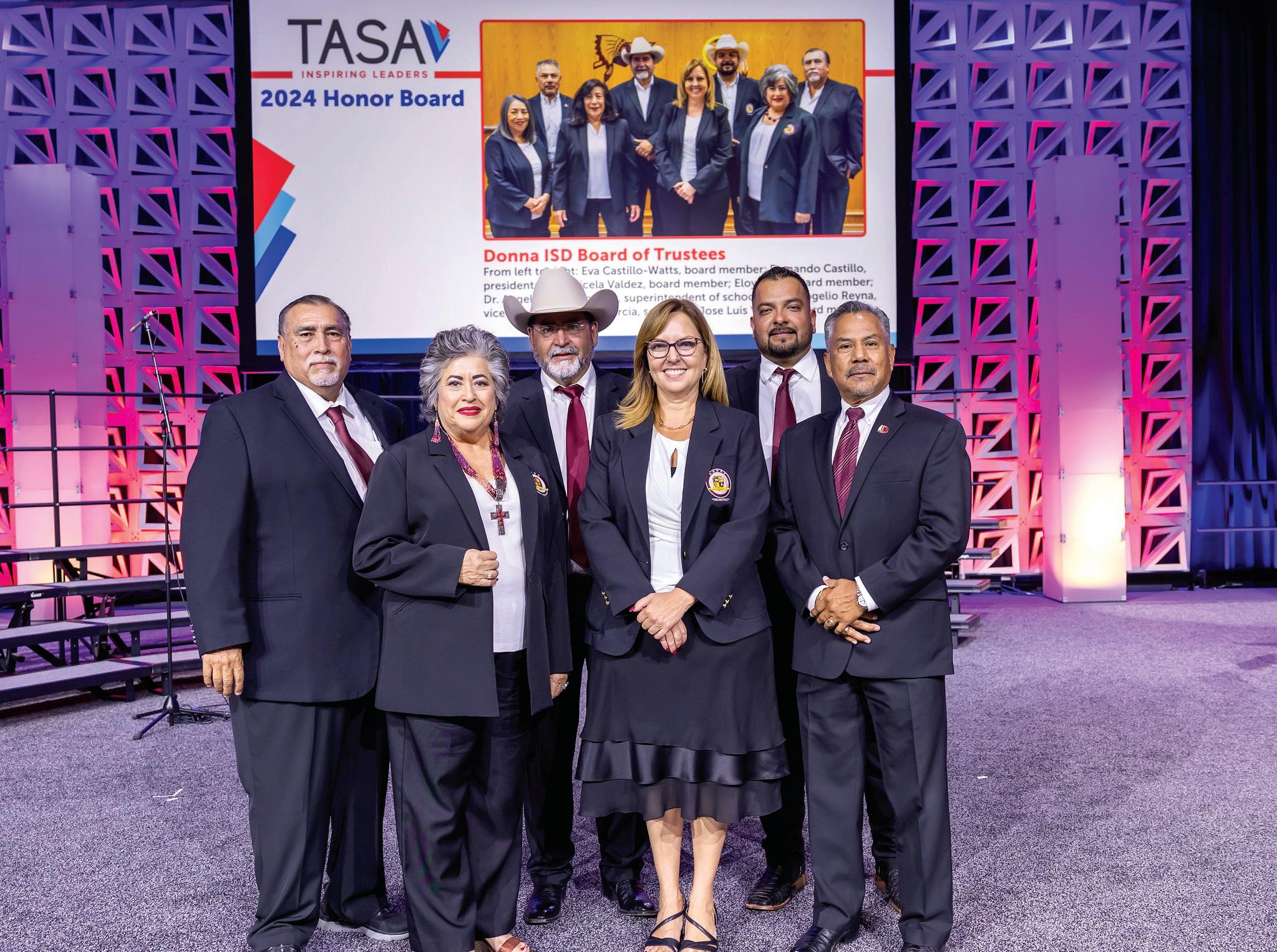
At txEDCON24 in San Antonio, Donna ISD was named the 2024 Outstanding Honor Board by TASA.
Photo by TASB Media Services
Diplomacy and Conviction
Learning to walk a delicate line with advocacy
by Quintin Shepherd
Editor’s notes: The District Voices column features opinion articles written by education leaders around Texas. Send submissions to managing editor Laura Tolley at laura.tolley@tasb.org
In today’s educational and political landscape, governance is no longer about choosing between diplomacy and conviction. It is about learning to lead at the intersection of both. Although progress often requires a long-game mindset, ideals can be protected through pragmatic action.
Many educational leaders find themselves walking a delicate line. On one hand, they are committed to systems-level
change rooted in fairness, opportunity, and innovation. On the other, they must navigate evolving political climates, imperfect legislation, and shifting public expectations. Leading in this moment calls for a reframing of what it means to be both diplomatic and resolute.
Balancing idealism and pragmatism
Governing in education often involves supporting legislation that, while not perfect, reflects a step in the right direction. Current state legislative efforts in Texas may fall short in some areas of funding or implementation, yet they represent incremental progress. For education leaders, choosing to support these efforts is not an
abandonment of higher aspirations, but rather a recognition that change, more often than not, is evolutionary rather than revolutionary.
This is not about settling. It is about strategic statesmanship, which is a governing philosophy that blends idealism with pragmatism. In this approach, advocacy becomes a process of engagement over time by laying the groundwork, building alliances, and shaping future amendments. It requires enduring participation in policymaking processes, even when outcomes are partial, delayed, or politically charged.
A measured approach
If you’ve ever heard me speak or read nearly anything I’ve ever written, you know I believe that in public service, the loudest voice is not always the most effective one. Measured leadership does not mean a lack of urgency or concern. Instead, it often means carrying the burden of urgency with deliberate care. When educators and students are under constant pressure, additional strain from reactive leadership can create more harm than good.
Superintendents and board members who advocate with intention often do so from a place of deep responsibility. Their aim is to protect students and staff from

Pflugerville ISD Superintendent Quintin Shepherd chats with students at lunchtime.
Photo courtesy of
Pflugerville ISD
harmful policy, while not inadvertently increasing the operational burdens on those charged with implementing it. Thoughtful advocacy means making every move count — strategically, compassionately, and with eyes on the long term.
Creating boundaries in diplomacy
Diplomacy should not be confused with passivity. Drawing clear boundaries is not a retreat from engagement. It is often the foundation that enables productive dialogue. In governance, as in life, when boundaries are absent, erosion of trust, values, and, eventually, outcomes follows.
Knowing when to negotiate and when to hold the line is a skill set essential for today’s education leaders. It is possible to:
• Engage in diplomacy without being manipulated.
• Negotiate when it serves progress without compromising core convictions.
• Support incremental movement without accepting injustice as inevitable.
These principles require clarity of vision, patience, and the ability to communicate firm expectations even in the face of ambiguity.
Leading
for the long game
Superintendents often carry the weight of advocacy with a sense of urgency, but also with caution. Every decision has the potential to ripple through communities, influence staff morale, and shape students’ experiences. The work is as emotional as it is operational.
Leading for the long game means understanding that progress in public education rarely arrives through sweeping reform. Instead, it comes through consistent engagement through activities such as testifying in hearings, collaborating across lines of difference, showing up for the difficult conversations, and cultivating the trust necessary to revisit decisions again and again as conditions evolve.
A new model of leadership
The public education landscape is changing. It demands a model of leader-
ship that neither retreats to the middle nor rushes to the extremes. What is emerging is a new form, one that honors conviction but respects the necessary constraints of diplomacy. It asks leaders to draw boundaries that protect, not divide, and to build coalitions that can carry policy across the finish line, even if it takes more than one session to get there.
This leadership model is not about being the loudest voice or the quickest critic. It is about being persistent, strategic, and committed to transformation over time. In an era of polarization, the call to education leaders is not to choose between being idealists or realists, but to be both. To speak out not just with passion, but with purpose. Not just with urgency, but with endurance.
And most importantly, never confuse quiet leadership with passive leadership. Sometimes, the most transformative change begins not with a bang, but with a boundary.H
Quintin Shepherd is the superintendent of Pflugerville ISD, located north of Austin and serving more than 23,000 students.


Learning Together
SLI events offer trustees deep training experience
by TASB staff
Trustees from across Texas gathered at TASB’s Summer Leadership Institute in San Antonio and Fort Worth for several days of training and networking. The Association’s flagship training conference offered a range of keynote speakers, breakout sessions, and other educational activities designed to support board service.
Both locations offered more than 80 breakout sessions that were divided into five learning tracks: vision and goals, systems and processes, progress and accountability, advocacy and engagement, and synergy and teamwork. The tracks are from the Framework of School Board Development, adopted by the State Board of Education.
A total of 2,004 people representing 365 districts attended the June 11-14 San Antonio event, while 1,081 people representing 244 districts went to SLI in Fort Worth June 18-21. San Antonio attendees earned 16,174 in continuing education credit hours, and Fort Worth attendees had 8,440 CEC hours.
Learning, networking
TASB Director Kevin Carbó, a Mesquite ISD trustee, said SLI “is where we get most of our CEC credits. But of course, SLI is a lot more than that. It’s good education. But it’s also good networking.
“Education is about sharing knowledge, helping people understand what has to happen, what they have to do to succeed,” Carbó added.
Kathryn Knotts, a North Zulch ISD trustee, said she has attended previous SLI events, but she thought that this year’s gathering in San Antonio was probably the best one yet because of the range of educational programs offered.
“It’s been fantastic,” Knotts said. “At every session I’ve attended, I come away with one or two nuggets [of information] to take back to my district.”
The sessions “really homed in on what I needed,” added Knotts, whose district serves about 358 students in the North Zulch community, which is about 24 miles northeast of Bryan.
Knotts said she and her fellow board members took a “divide and conquer” approach to the event so that they could attend more sessions. They planned to meet later to discuss what they learned.
Informative breakout sessions
Many sessions were hosted by TASB experts, including several required training offerings such as the post-legislative update held on the final day at both locations. “I appreciate the clear and straightforward guidance we received from the Legal and GR teams,” said Mary Jane Hetrick, TASB first vice president and vice president of the Dripping Springs ISD board. “They laid out the information we need to go back to our districts and tackle a large number of new laws.”
Other sessions were hosted by trustees who wanted to share their experiences and successes with fellow board members.
“I learn the best stuff from other board members,” noted Misty Koerkenmeier, a Ferris ISD trustee.
Koerkenmeier had attended one pervious SLI before the San Antonio event. But this time, it also was her chance to share experiences with other trustees. Ferris ISD hosted its first SLI presentation about how the North Texas district’s systems, culture, and accountability strategies helped their students succeed.

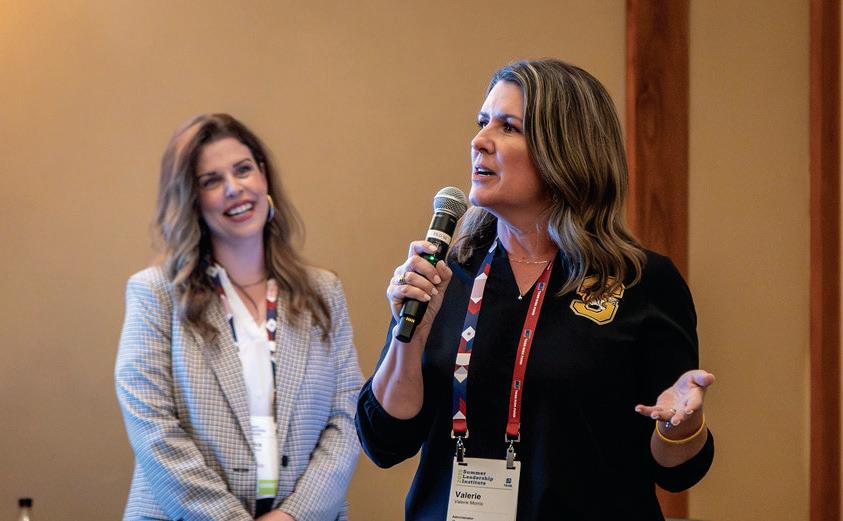

Last year, Ferris ISD was recognized for exceptional student growth and selected to present in June at the Model Schools Conference in Washington, D.C.
After the Ferris ISD session, several in the audience lingered to ask presenters additional questions. “I think it went really well,” she said. “It was a team effort.”
Other SLI highlights
General session speakers gave inspiring talks, including Seb Terry, an expert in helping leaders unlock their potential by building connections with the people around them. Another keynote speaker, Kristen Ziman, recounted her own leadership challenges when she became the first woman to lead the police department in Aurora, Illinois.
She encouraged trustees to seek out all viewpoints on issues, and to not let apathy take hold. She also noted that preparation and resilience can help open


the door to success. “It takes courage to step into the ring, and don’t you dare forget that,” she said.
Finally, to close out the events, Mickey Smith Jr., a seven-time teacher of the year and recipient of the 2020 GRAMMY Music Educator Award, used a mixture of music and message to inspire the crowd. He told school board members to figure out their own “sound” and to use it to encourage and empower others. At the end of the day, Smith said it’s not about being a subject matter expert but rather showing people that they matter by hearing and seeing them.
SLI also offered two pre-conference sessions. One was a research-informed session highlighting the practices and tools to help boards understand the current state of student learning and create meaningful and accountable goals. One held only in San Antonio was geared for board member spouses and partners. It offered them coping and support strategies.
At the Fort Worth event, the Leadership TASB Class of 2025 held its


graduation ceremony. Read more about that LTASB event on page 36.
In addition, there were several in-depth learning opportunities — Board Officer Institute, Texas Trustee Institute, and Governing With Purpose: The Mindset and Mission of Effective School Boards.
Corey Hardin, a Gainesville ISD trustee, said SLI offers attendees the opportunity to learn more about policies and procedures and how to ensure they are implementing those properly for students’ benefit.
“Education is power,” Hardin said. “We’re an important tool to make sure the kids get the resources they need to be the leaders of tomorrow.”H

Scan QR code to watch trustees at SLI.
A: Motivational speaker Mickey Smith Jr. plays the saxophone for attendees at the closing general session of SLI in Fort Worth.
B: Jessica Gore (left), assistant superintendent at Snyder ISD, and Valerie Morris, Snyder ISD’s director of communications, speak at a breakout session at SLI in Fort Worth.
C: George McShan, a former Harlingen CISD school board member and lifelong educator, was presented with TASB’s James B. Crow Innovation in Governance Award at SLI in San Antonio.
D: Attendees enjoy a general session at SLI in Fort Worth.
E: Greenville ISD trustees and superintendent pose in their red district shirts for a group photo.
F: SLI in San Antonio offered a pre-conference session for trustee spouses and partners on coping and support strategies.
G: TASB Director Kevin Carbó, a Mesquite ISD trustee, enjoys a session at SLI in San Antonio.
Photos by TASB Media Services
LTASB Trustees Graduate
Class of 2025 celebrates in Fort Worth
by Mary Ann Lopez
When Robert Anderson, a West Rusk County CISD trustee, arrived for the very first meeting of the Leadership TASB Class of 2025, he thought, “What have I gotten myself into?” The idea of interacting with so many new people seemed overwhelming. He was sure he’d made a mistake.
But a year later, with his time in the program coming to a close, Anderson said he built a strong network and lasting friendships. Touring school districts across Texas with members of the Class of 2025 completely changed his view of board service.
“Going through the program, it has allowed me to grow, and to grow as a person as well as a board member,” he said. “I’ve learned so much. Through the various schools we visited, and seeing their programs and talking with them about some of the issues they’ve had to deal with and overcome, really gave me some good ideas I was able to take back to my board and help our board grow as well.”
A graduation celebration
Anderson, along with his 32 fellow class members, celebrated their graduation
from LTASB during a special ceremony on June 20, held in conjunction with TASB’s Summer Leadership Institute in Fort Worth. Each member earned the designation of Master Trustee.
LTASB is the premier trustee leadership training program of its kind, connecting school board leaders to their purpose in serving Texas’ 5.5 million public school students. More than 1,000 trustees have completed the yearlong program since its founding in 1990.
In September 2024, the cohort kicked off its inaugural session in San Antonio with visits to Fort Sam Houston and Randolph Field ISDs. From there, they traveled to El Paso in November 2024, making visits to schools at San Elizario and El Paso ISDs.
In February, the cohort took part in the inaugural Leadership TASB Connect & Ignite conference, where the trustees networked with other LTASB alums and visited lawmakers at the Capitol. In addition, they also explored schools at Hutto ISD. And in April, the group traveled to Brazos and the Research Valley for on-site visits at Bryan and College Station ISDs.
Including the final event in Fort Worth, the group traveled more than 2,300 miles by land and air, visiting districts that in total serve about 120,000 students.

On the very first day of the program, Robert Long III, LTASB program manager and Board Development Services division director, asked the group a rhetorical question: Is public education worth saving?
For Melissa Gonzales, a board trustee at Gregory-Portland ISD, the answer was a resounding yes. And for her, the trip to El Paso highlighted the positive impact of public education.
“San Elizario ISD is a prime example of why public education is worth saving, where you have students who are eager and excited to learn and are proud and excited to share their knowledge and culture,” she said. “Students benefit from their teachers and leadership who seem vested in their community, who encourage learning and cultural pride, who are positive and optimistic and find ways to teach despite the lack of funding. Moreover, at SEISD, students see themselves in the leadership and learn from example that they can do and become whoever they want.”
Fulfilling the LTASB mission
Each site visit told a story about the remarkable complexity of public education in Texas, Carolyn Counce, TASB associate executive director for Member Services, said at the graduation ceremony.
“Leadership TASB is not just a program; it’s a call to action,” she said. “And this class answered that call with integrity, humility, and relentless curiosity. Thank you for saying yes, not just to TASB but to the 5.5 million public schoolchildren in Texas that count on you to lead well. You’ve proven through your journey and your commitment that governance matters and that student outcomes are your priority.”

Robert Long III, LTASB program manager and division director for TASB Board Development Services, shares the journey the LTASB Class of 2025 took during the yearlong program.
TASB Board members and staff pose with Aldine ISD's superintendent and school board, which received the Leadership TASB Legacy Award.
Photos by TASB Media Services
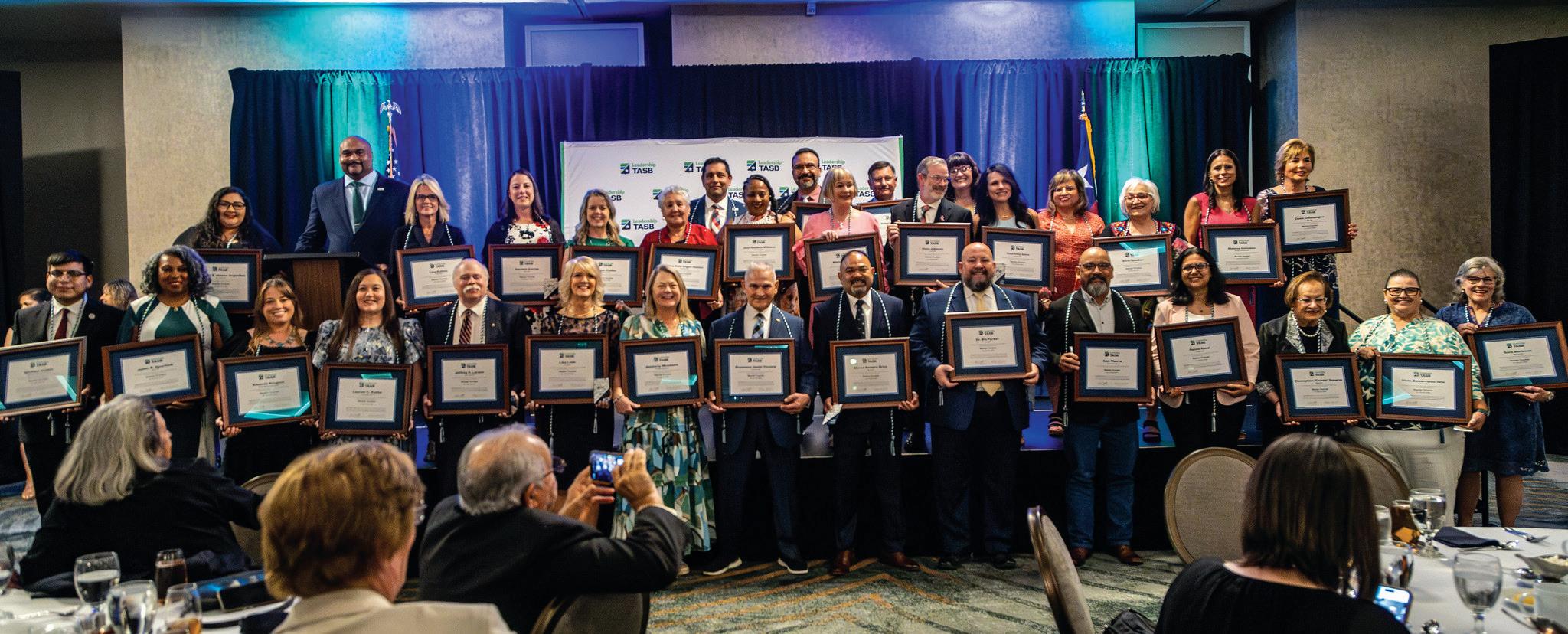
For Marco R. Ortiz, Taylor ISD’s board president, that commitment meant not being afraid to break out of his shell and make himself heard at the Capitol.
“That was something that just wasn’t my cup of tea,” Ortiz said. “I had to come out of my comfort zone for that. But when I did that, and I would have my classmates around me, it made me feel a little bit more comfortable. ... So, being an advocate and getting out of my comfort zone, that’s one of the biggest things that I think I’m taking away from this.”
During the ceremony, each member of the Class of 2025 was recognized for completing all of the requirements, including attending the five required sessions, Long told the crowd.
“From the border to the Capitol, these trustees have fulfilled the mission of Leadership TASB and now will be designated as Master Trustees, reflecting their leadership and commitment to public education and to the 5.5 million Texas public schoolchildren of this great state,” Long said.
At the evening’s festivities, which included each member of the Class of 2025 being recognized as they received a framed certificate, all TASB Officers were in attendance: TASB President Rolinda Schmidt, a Kerrville ISD trustee, Tony Hopkins, TASB President-Elect and Friendswood ISD’s board president, Mary Jane Hetrick, TASB First Vice President and Dripping Springs ISD’s board vice president, Dan Micciche, TASB Second Vice President and a Dallas ISD trustee, Sylvia Sánchez Garza, TASB SecretaryTreasurer and South Texas ISD’s board vice president, and Armando Rodriguez, TASB Immediate Past President and Canutillo ISD’s board president. All the TASB Officers are LTASB alums.
Honoring Aldine ISD’s trustees
In addition to the graduation ceremony, the members of the Aldine ISD Board of Trustees and Superintendent LaTonya M. Goffney were honored with the inaugural Leadership TASB Legacy Award. Upon Aldine ISD Trustee Conception “Connie” Esparza’s completion of LTASB, it marked a significant moment in the program’s more than 30-year history. Aldine ISD is the first board in which all seven sitting board members have completed the leadership program. Schmidt presented the district with the award.
“The milestone speaks to intentional leadership, a commitment to growth, and a strategic vision to board governance,” Schmidt said.
Those in attendance also heard from keynote speaker Missy Bender, LTASB Class of 2008, a former Plano ISD board member, and executive director of the Texas School Coalition.
“Leadership TASB is not just a program; it’s a mirror and a map,” she said. “A mirror that challenges you to look inward at your own values, your habits, your impact, and a map that lays out the complexity and the promise of public education in Texas.
“So tonight, as you celebrate this milestone, I challenge you to go forward not as spectators, but as lighthouses, not spotlights that blind, not floodlights that overwhelm, but lighthouses anchored, consistent, and guiding others through the fog of uncertainty,” Bender said. “You don’t need to have all the answers, but you do need to ask the right questions. You don’t need to do this work alone, but you do need to do it with conviction.”H
LTASB Class of 2025:
• Jennifer Alfaro, Rio Hondo ISD (former)
• Robert Anderson, West Rusk County CISD
• Sara Burleson, Midland ISD
• Emilio Carrasco, East Central ISD
• Dawn Champagne, Katy ISD
• Ginger Collier, Lake Dallas ISD
• Carmen Correa, Spring ISD
• Sylvia De La Garza, Plainview ISD
• Conception (Connie) Esparza, Aldine ISD
• Amber Feller Landrum, Round Rock ISD
• Melody Fowler, Arlington ISD
• Rick Garcia, Fort Bend ISD (former)
• Melissa Gonzales, GregoryPortland ISD
• Courtney Gore, Granbury ISD
• Elvia Guadian, Del Valle ISD
• Jean Hinchen-Williams, Henderson ISD
• Russ Johnson, Lorena ISD
• Lisa Kallies, Crosby ISD
• Amanda Kington, PecosBarstow-Toyah ISD
• Jeff Larson, Clear Creek ISD
• Lloyd Lietz, Three Way ISD
• Lisa Lobb, Irving ISD
• Kimberly McAdams, College Station ISD
• Francisco (Harvey) Oaxaca, McKinney ISD
• Marco R. Ortiz, Taylor ISD
• Bill Parker, Allen ISD
• Ranna Raval, Coppell ISD
• Lauren Rothe, Lumberton ISD
• Janet Spurlock, Alief ISD
• Mary Belle Unger-Robles, Southside ISD
• Michael Valdez, Edgewood ISD
• Viola Z. Vela, Lyford CISD
• Alex (Alejandro) Ybarra, Channelview ISD Scan QR code to see photo gallery of graduation.

Mary Ann Lopez is a staff writer for Texas Lone Star
Members of the Class of 2025 pose for their final group photo with their certificates denoting their Master Trustee designation.
Compliance and Audits
Why reporting purchase orders to BuyBoard® matters
by TASB staff
Managing procurement for a school district plays a critical role in ensuring that the district meets federal, state, and local purchasing requirements. And in the event of an audit, having the right documentation matters and makes a difference.
The Local Government Purchasing Cooperative (“Cooperative” d/b/a “BuyBoard®”) assists with simplifying purchasing while helping members comply with procurement requirements. A purchase through BuyBoard means a district is leveraging competitively solicited contracts that have already undertaken a competitive procurement process.
“Don’t miss out on a powerful tool for streamlined purchasing,” said Cesar Lopez,
division director of TASB Business Services Sales and Marketing. “BuyBoard helps lessen the burden of government for its members, saving valuable time and resources.”
Importance of purchase orders
However, a purchase isn’t considered a BuyBoard Cooperative purchase unless the purchase order is submitted to BuyBoard.
“That final step — reporting or submitting the PO — is what officially ties your purchase to the BuyBoard Purchasing Cooperative. Without it, your organization could be at risk if there is an audit or review,” said Arturo Salinas, division director of TASB Cooperative Purchasing.
Why POs matter:
Potential rebates: Each PO your district reports to BuyBoard adds to your potential rebate at the end of each fiscal year. There’s no limit to how much your district can earn back through the BuyBoard rebate program.
Transparency and accountability: Reporting POs creates a documented trail of a district’s purchases through BuyBoard, demonstrating how and where public funds are spent, fostering transparency and protecting against potential scrutiny.
Audit readiness: In the event of an audit, having complete and accurate PO records of your cooperative purchases is essential. Missing or incomplete records
With competitively procured contracts that meet state and local requirements, your district can buy with confidence. Make your procurement processes efficient, accountable, and audit-ready through BuyBoard.


can slow down the process and potentially raise red flags.
Contract compliance: Reporting POs helps everyone verify that purchases align with the terms and conditions of BuyBoard contracts.
Data accuracy and insights: PO reporting helps BuyBoard maintain accurate

purchasing data. This allows BuyBoard to improve vendor performance monitoring, contract management, and reporting — benefits that ultimately help members.
Auditing your POs
Regularly auditing POs ensures that your records are accurate and up to date,
making future audits less stressful. Here’s how BuyBoard members can audit their POs:
1. Log in at app.buyboard.com and navigate to Purchase > Purchase Orders.
2. Use the search function to find specific transactions by PO number, date, vendor, or status.
3. Verify that your reported POs match your internal records.
4. If a PO is missing, report it by selecting “Add Purchase Order” and entering the required details.
“Even if your organization has been using BuyBoard for years, regularly reviewing and submitting POs is key to keeping your records current and audit ready,” said Brian Bolinger, associate executive director for TASB Business Services. “It’s a simple task that reinforces your commitment to compliance.”
Gain more peace of mind and audit your POs today at app.buyboard.com. Call 800-695-2919 if you need assistance in auditing your BuyBoard POs.H
OPTIMIZE YOUR SPECIAL EDUCATION PROGRAM
Ready to optimize your special education program? TASB Student
Solutions’ comprehensive program reviews provide clear insights and data-driven recommendations tailored to your district — helping you make informed decisions and strengthen support for your students.
Plan ahead and build a stronger foundation for success.
It’s important for every BuyBoard® member to properly complete and submit purchase orders to potentially receive a BuyBoard rebate. Last year, TASB staff presented Amarillo ISD with its 2023-24 rebate check.
Photo courtesy of Amarillo ISD
Bulletin Board
Alice ISD Sees Landmark Growth in CCMR Readiness
AliceISD this summer announced a remarkable achievement in its commitment to preparing high school seniors for life beyond graduation. Over the past two years, the district has made significant strides in college, career, and military readiness, culminating in a record-breaking milestone for the Class of 2025.
In 2023, 48% of Alice ISD seniors earned at least one CCMR point, an indicator that a student is prepared for postsecondary success. By 2024, that number nearly doubled to 90%. And in 2025, the district continued its ambitious target, increasing to 91% of seniors achieving CCMR points.
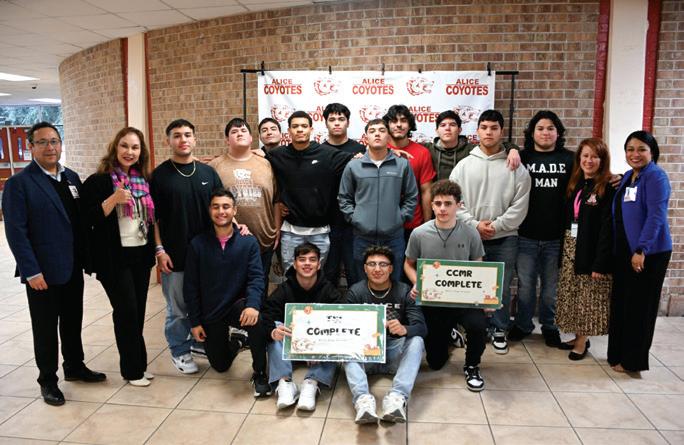
“This is more than just a number — this is a statement about who we are and what we believe in,” said Alice ISD Superintendent Anysia Trevino. “Our students are capable, our educators are dedicated, and our community is committed to ensuring that every child graduates prepared for college, a career, or service in the military.”
CCMR points are earned through a variety of rigorous accomplishments, such as scoring well on college entrance exams, earning industry-recognized certifications, completing dual credit courses, or enlisting in the military. The steady increase in these outcomes reflects Alice ISD’s strategic focus on student readiness and opportunity.
Behind this success is a combination of focused academic programming, career and technical education enhancements, dedicated staff support, and strong partnerships with families and the broader community.
“We are not just preparing students to graduate,” Trevino said. “We are preparing them to thrive for careers after graduation.”
Anenhanced website has been launched that offers a modern, user-friendly platform to strengthen Texas’ education-to-workforce pipeline through a collaboration between the Texas Education Agency, the Texas Higher Education Coordinating Board, and the Texas Workforce Commission.
“This education-to-workforce website will give Texas students the tools and training they need to succeed in the better job and bigger paycheck opportunities we provide in our great state,” Gov. Greg Abbott said in announcing the website this summer.
By focusing on aligned priorities from across partner agencies, the new website is designed to address the diverse needs of the Texas economy and workforce by ensuring all Texans have access to the education and workforce pathways needed to thrive.
The new website will help Texans to:
• Understand how public education, higher education, and workforce initiatives are being aligned
• Connect to grant opportunities to advance programming that support Texas’ education-to-workforce priorities
• Access advising tools that assist in education and career development
• Learn about apprenticeships and career pathways
Access the website at triagency.texas.gov
TASB’s Executive Search Services is currently accepting applications for these positions listed below:
▄ Clarendon ISD Superintendent
▄ Huffman ISD Superintendent
▄ Jim Hogg County ISD Superintendent
▄ Kermit ISD Superintendent
▄ Laredo ISD Superintendent
▄ Snook ISD Superintendent
For more information about vacancies, call 800-580-8272, email executive.search@tasb.org, or scan:

Website Launched to Strengthen Education-to-Workforce Pipeline
Alice ISD Superintendent Anysia Trevino (second from left) and other district leaders pose with high school seniors who have earned CCMR points.
Photo courtesy of Alice ISD
SOTY Award
Superintendent finalists named in TASB competition
by Sylvia Wood
Seventeen district leaders from across Texas have been selected as regional winners in the 2025 Superintendent of the Year competition held each year by TASB.
The regional winners are selected by committees at each participating education service center in the state. Those committees meet each spring to consider the nominees put forward by school boards in their respective regions.
“I want to thank all member school boards for their work in nominating superintendents to be considered for this prestigious award,” said TASB Executive Director Dan Troxell. “The process includes a lengthy application in addition to a board vote, so we know that the nominees have the full support of their trustees.”
Troxell also thanked all of the participating ESCs that screened and interviewed nominees to determine their regional winner. “These regional selection committees are essential to the success of the Superintendent of the Year program, which has been honoring excellence in Texas public education for more than three decades.”
To be eligible for the award, nominated candidates must have served in their
position with their current board for at least three years. Other criteria include accomplishments in the areas of public education leadership, management, school climate, board and community relations, fiscal management, school improvement, and instructional leadership.
This year’s regional SOTY winners will advance to the next phase of the competition in August, when a committee of the TASB Board of Directors holds interviews to select five state finalists. Those finalists then undergo another round of interviews before the Superintendent of the Year is announced at txEDCON, scheduled for Sept. 11-14 in Houston.
This year’s regional superintendents of the year, in order of ESC, are:
Region 1: Angela Dominguez, Donna ISD
Region 2: Eddie Hesseltine, Orange Grove ISD
Region 4: Roosevelt Nivens, Lamar CISD
Region 5: Shannon Allen, Beaumont ISD
Region 6: Adrian Johnson, Hearne ISD
Region 7: Lamond Dean, Chapel Hill ISD
Region 8: Jason Harris, Atlanta ISD
Region 9: Colin Howeth, Knox CityO’Brien CISD
A Solution Designed for Texas Boards
BoardBook® isn’t just another meeting management tool — it was purpose-built for Texas boards. That means you get the features, flexibility, and support you need for a simple price.
See BoardBook in action. Schedule a demo today!
Region 10: Mike Waldrip, Frisco ISD
Region 11: Lori Rapp, Lewisville ISD
Region 12: Andrew Miller, Moody ISD
Region 13: Mark Estrada, Lockhart ISD
Region 14: Larry Polk, Colorado ISD
Region 15: Amanda Traylor, Veribest ISD
Region 16: Kurt Ashmore, Wellington ISD
Region 19: Jose Franco, Fort Hancock ISD
Region 20: Gerardo Soto, Harlandale ISDH
Sylvia Wood is a staff writer for Texas Lone Star.

Determining Our Future
Important work awaits at Delegate Assembly
by Tiffany Dunne-Oldfield
As we count down the days until txEDCON, there’s a lot of excitement, but it isn’t just about the conference. The TASB Board of Directors has been hard at work on this year’s Delegate Assembly, which has the potential to be transformational for TASB and our members.
That’s because members will have the opportunity to weigh in on the future of TASB by voting on a revised Mission statement and reimagined Cornerstone Principles. And for the first time in TASB’s long history, delegates will be asked to consider a new process in which TASB will collect local legislative priorities developed by school boards across the state. These will be shared with our members, providing school leaders another way to connect on issues important to them, families, and other community stakeholders.
If this sounds like a lot to do in TASB’s annual business meeting, you’re right. But the timing in bringing these proposals forward to members couldn’t be better, especially as we work to position TASB for success in the decades to come.
There’s a lot at stake in today’s changing education environment, and we’ve been listening closely to members as we navigate the best path forward. In fact, the proposals being presented at Delegate Assembly are collectively the result of more than two years of intense work by the TASB Board, including several special committees and a nine-month strategic planning process.
For your TASB leaders, the process has been just as important as the outcome, namely because the goal was to develop a clear roadmap for the Association’s
work, including at the Capitol, that helps ensure alignment with member needs and further amplifies member voice. In fact, as a nonpartisan member association, connecting our work in Austin with what’s important to our members across the state must be a top priority.
Proposed changes to consider
This is most evident with the proposed new process for local legislative priorities. Currently, fewer than 30 boards submit resolutions to us each year in Austin, where they outline a legislative need in their district for consideration in the TASB Advocacy Agenda. If approved, the new process is intended to help connect the dots among our 1,023 member boards while also preserving the unique voice of each member district.
Why is this important? We know from looking at years of data that most boards aren’t engaging in our current resolutions process. This new model offers a formula for more grassroots involvement, expanded member voice, and the potential for increased collaboration on important public education advocacy issues.
That’s a win, because it’s clear that a one-size-fits-all approach doesn’t work in a state as big as Texas, where every school community is unique and every school board deserves the opportunity to speak up on issues important to their school communities.
Developing a strategic plan
The timing of this recommendation comes as TASB Directors have been developing a new strategic plan for the Association. Here, the challenge was figuring out how to build on TASB’s strong past while

also adapting to the challenges of today and tomorrow.
Based on research conducted through surveys, one-on-one interviews, group listening sessions, and leadership workshops, the Board is proposing to strengthen the way we articulate who we are and what we stand for as a member-led and member-driven association.
What does this look like? Specifically, they are proposing an update to the Mission statement, which hasn’t been changed since it was first adopted at the 1996 Delegate Assembly. They also are proposing a new set of reimagined Cornerstone Principles that helps explain what we believe as an association while also serving as the foundational building blocks for our advocacy. What you won’t see is the Statement of Beliefs.
The Board voted in July to recommend to Delegate Assembly that our core beliefs be woven into the Cornerstone Principles to simplify and clarify what TASB stands for in support of Texas schoolchildren and, therefore, how we advocate on behalf of our members.
Both the proposed Local Legislative Priority process and recommended strategic plan updates are big milestone moments for TASB. The proposals being brought to the 2025 Delegate Assembly reflect a true commitment to you, our members — because you are the driving force behind TASB’s success for more than 75 years and will be for the next 75 years.
Now is the time to be part of the future, just by taking part in Delegate Assembly on Sept. 13. Don’t miss this opportunity. See you in Houston!H
Tiffany Dunne-Oldfield is TASB’s deputy director.
Tiffany Dunne-Oldfield
Board Members: MAP YOUR JOURNEY TO SUCCESS
TASB supports trustees at every point along the board leadership journey, offering training and programs to excel at board governance.
New Trustees
Texas Trustee Institute
TTI offers a comprehensive program to build skills, dive into governance, and develop a leadership network.
Key offerings: Texas Open Meetings Act, Board Governance, Consensus Building.
Sessions coming to txEDCON 2025! Register now. tasa.tasb.org/registration
Master Trustees
Leadership TASB
For experienced trustees, meet with innovative districts and leaders, while learning what makes them successful. LTASB’s one-of-a-kind experience will expand your view of education leadership.
Learn more! leadershiptasb@tasb.org
Whole Board Training
Need support to improve communication and collaboration?
Board Development Services’ consultants are here to help! Get training tailored to your district’s needs.
board.dev@tasb.org
Foundational Training
Find on-demand courses for new trustees, including the Top 10 Things to Know bundle of essential courses, in the Online Learning Center.
onlinelearning.tasb.org
Experienced Trustees
Board Officer Institute
For veteran trustees and board officers, BOI imparts knowledge and tools for effective and efficient meetings.
Key offerings: Important Tools for Meeting Preparation, Effective Meetings, Focused and Productive Board Discussions.
Upcoming session at txEDCON 2025! Register now. tasa.tasb.org/registration
Continuing Education
With the Online Learning Center, you can find courses to support your board service, including: Preparing for Superintendent Evaluation, Board Officers Forum, and Advocacy 101 and 201.
onlinelearning.tasb.org
For additional information on any of these offerings: 800-580-8272, ext. 2453 • board.dev@tasb.org
onlinelearning.tasb.org
Texas Association of School Boards
P.O. Box 400
Austin, Texas 78767-0400

» Thursday, Nov. 6, 2025
Abilene - Region 14 ESC North Campus
» Thursday, Nov. 13, 2025
San Marcos - Embassy Suites
» Saturday, Nov. 15, 2025
South Padre Island - Hilton Garden Inn South Padre Island Beachfront
» Tuesday, Nov. 18, 2025
Tyler - Marriott Courtyard
» Wednesday, Nov. 19, 2025
Waco - Cambria Hotel Waco University Riverfront