y
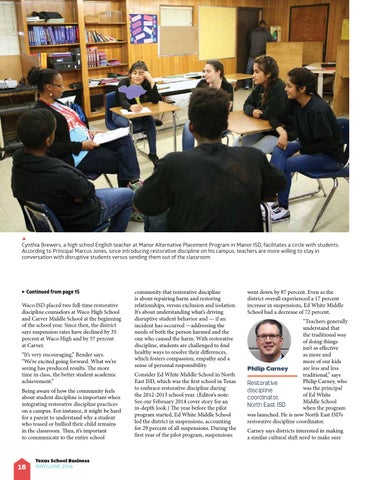
Cynthia Brewers, a high school English teacher at Manor Alternative Placement Program in Manor ISD, facilitates a circle with students. According to Principal Marcus Jones, since introducing restorative discipline on his campus, teachers are more willing to stay in conversation with disruptive students versus sending them out of the classroom.
> Continued from page 15
Waco ISD placed two full-time restorative discipline counselors at Waco High School and Carver Middle School at the beginning of the school year. Since then, the district says suspension rates have declined by 35 percent at Waco High and by 57 percent at Carver. “It’s very encouraging,” Bender says. “We’re excited going forward. What we’re seeing has produced results. The more time in class, the better student academic achievement.” Being aware of how the community feels about student discipline is important when integrating restorative discipline practices on a campus. For instance, it might be hard for a parent to understand why a student who teased or bullied their child remains in the classroom. Thus, it’s important to communicate to the entire school
16
Texas School Business MAY/JUNE 2016
community that restorative discipline is about repairing harm and restoring relationships, versus exclusion and isolation. It’s about understanding what’s driving disruptive student behavior and — if an incident has occurred —addressing the needs of both the person harmed and the one who caused the harm. With restorative discipline, students are challenged to find healthy ways to resolve their differences, which fosters compassion, empathy and a sense of personal responsibility. Consider Ed White Middle School in North East ISD, which was the first school in Texas to embrace restorative discipline during the 2012-2013 school year. (Editor’s note: See our February 2014 cover story for an in-depth look.) The year before the pilot program started, Ed White Middle School led the district in suspensions, accounting for 29 percent of all suspensions. During the first year of the pilot program, suspensions
went down by 87 percent. Even as the district overall experienced a 17 percent increase in suspensions, Ed White Middle School had a decrease of 72 percent. “Teachers generally understand that the traditional way of doing things isn’t as effective as more and more of our kids are less and less Philip Carney traditional,” says Philip Carney, who Restorative was the principal discipline of Ed White coordinator, Middle School North East ISD when the program was launched. He is now North East ISD’s restorative discipline coordinator. Carney says districts interested in making a similar cultural shift need to make sure