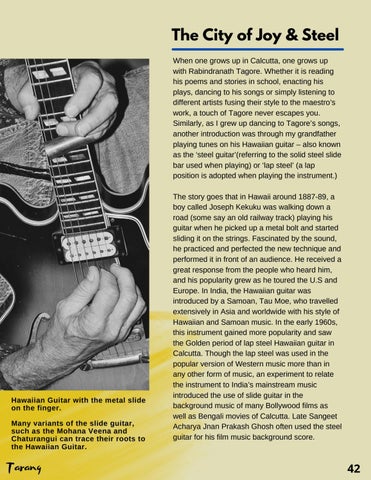
The City of Joy & Steel When one grows up in Calcutta, one grows up with Rabindranath Tagore. Whether it is reading his poems and stories in school, enacting his plays, dancing to his songs or simply listening to different artists fusing their style to the maestro’s work, a touch of Tagore never escapes you. Similarly, as I grew up dancing to Tagore’s songs, another introduction was through my grandfather playing tunes on his Hawaiian guitar – also known as the ‘steel guitar’(referring to the solid steel slide bar used when playing) or ‘lap steel’ (a lap position is adopted when playing the instrument.)
Hawaiian Guitar with the metal slide on the finger. Many variants of the slide guitar, such as the Mohana Veena and Chaturangui can trace their roots to the Hawaiian Guitar.
Tarang
The story goes that in Hawaii around 1887-89, a boy called Joseph Kekuku was walking down a road (some say an old railway track) playing his guitar when he picked up a metal bolt and started sliding it on the strings. Fascinated by the sound, he practiced and perfected the new technique and performed it in front of an audience. He received a great response from the people who heard him, and his popularity grew as he toured the U.S and Europe. In India, the Hawaiian guitar was introduced by a Samoan, Tau Moe, who travelled extensively in Asia and worldwide with his style of Hawaiian and Samoan music. In the early 1960s, this instrument gained more popularity and saw the Golden period of lap steel Hawaiian guitar in Calcutta. Though the lap steel was used in the popular version of Western music more than in any other form of music, an experiment to relate the instrument to India’s mainstream music introduced the use of slide guitar in the background music of many Bollywood films as well as Bengali movies of Calcutta. Late Sangeet Acharya Jnan Prakash Ghosh often used the steel guitar for his film music background score.
42