//SYS21///INTEGRA/BST/VOL2/REVISES 31-7-2001/BSTC10.3D ± 397 ± [381±426/46] 30.7.2001 3:46PM
Powering of ships: general principles 397 If the variation of helical chord length with radius is known, then the true blade area can be obtained analytically by integration. This is known as the expanded area and the expanded area ratio (EAR) is de®ned by EAR
4AE D2
In some earlier work, the concept of a disc area ratio (DAR) was employed in which the developed area was increased to allow for the boss. Froude proposed a boss allowance of 25 per cent of the developed area but Gawn used 12:5 per cent. A true helicoidal surface is generated by a line rotated about an axis normal to itself and advancing in the direction of this axis at constant speed. The distance the line advances in making one complete revolution is termed the pitch. For simple propellers, the pitch is the same at all points on the face of the blade. This is the face pitch of the propeller and the ratio of this to the propeller diameter is the face pitch ratio i:e: face pitch ratio
P D
The distance advanced by a propeller during one revolution when delivering no thrust is termed the analysis pitch. In practice, this is rather greater than the geometrical pitch of the propeller. When developing thrust, the propeller advance per revolution is less than the analysis pitch. The di erence is termed the slip. That is, slip analysis pitch
advance per revolution
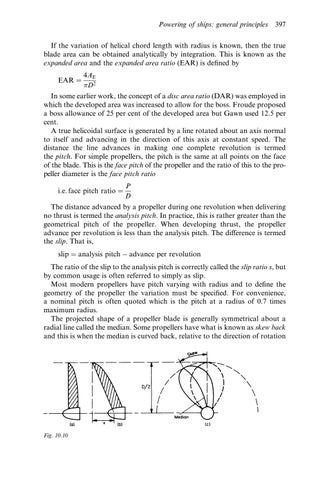
The ratio of the slip to the analysis pitch is correctly called the slip ratio s, but by common usage is often referred to simply as slip. Most modern propellers have pitch varying with radius and to de®ne the geometry of the propeller the variation must be speci®ed. For convenience, a nominal pitch is often quoted which is the pitch at a radius of 0.7 times maximum radius. The projected shape of a propeller blade is generally symmetrical about a radial line called the median. Some propellers have what is known as skew back and this is when the median is curved back, relative to the direction of rotation
Fig. 10.10