//SYS21///INTEGRA/BST/VOL2/REVISES 31-7-2001/BSTC10.3D ± 387 ± [381±426/46] 30.7.2001 3:46PM
Powering of ships: general principles 387 Each component can now be studied separately provided it is remembered that each will have some interaction with the others. W A V E - M AK I N G R E S I S T A N C E
It is common experience, that a body moving across an otherwise undisturbed water surface produces a wave system. This system arises from the pressure ®eld around the body and the energy possessed by it must be derived from the body. As far as the body is concerned the transfer of energy will manifest itself as a force opposing the forward motion. This force is termed the wave-making resistance. A submerged body also experiences a drag due to the formation of waves on the free surface, the magnitude of this drag reducing with increasing depth of submergence until it becomes negligible at deep submergence. This typically occurs at depths equal to approximately half the length of the body. An exception to this general rule can occur with submarines at sea if they are moving close to the interface between two layers of water of di erent density. In this case, a wave system is produced at the interface resulting in a drag on the submarine. A gravity wave, length , in deep water moves with a velocity C de®ned by C2
g 2
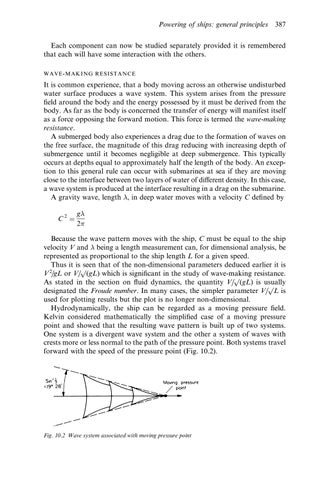
Because the wave pattern moves with the ship, C must be equal to the ship velocity V and being a length measurement can, for dimensional analysis, be represented as proportional to the ship length L for a given speed. Thus it ispseen that of the non-dimensional parameters deduced earlier it is V 2=gL or V= (gL) which is signi®cant in the study of wave-making resistance. p As stated in the section on ¯uid dynamics, the quantity V= (gL) is usually p designated the Froude number. In many cases, the simpler parameter V= L is used for plotting results but the plot is no longer non-dimensional. Hydrodynamically, the ship can be regarded as a moving pressure ®eld. Kelvin considered mathematically the simpli®ed case of a moving pressure point and showed that the resulting wave pattern is built up of two systems. One system is a divergent wave system and the other a system of waves with crests more or less normal to the path of the pressure point. Both systems travel forward with the speed of the pressure point (Fig. 10.2).
Fig. 10.2 Wave system associated with moving pressure point