//SYS21///INTEGRA/BST/VOL2/REVISES 31-7-2001/BSTC14.3D ± 622 ± [590±632/43] 30.7.2001 3:54PM
622 Basic ship theory
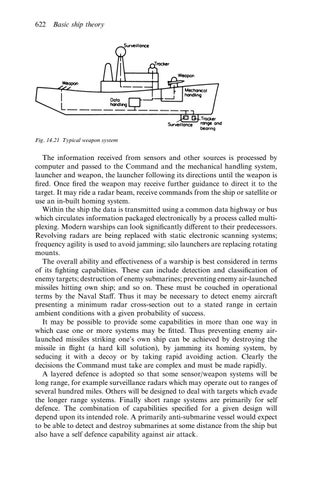
Fig. 14.21 Typical weapon system
The information received from sensors and other sources is processed by computer and passed to the Command and the mechanical handling system, launcher and weapon, the launcher following its directions until the weapon is ®red. Once ®red the weapon may receive further guidance to direct it to the target. It may ride a radar beam, receive commands from the ship or satellite or use an in-built homing system. Within the ship the data is transmitted using a common data highway or bus which circulates information packaged electronically by a process called multiplexing. Modern warships can look signi®cantly di erent to their predecessors. Revolving radars are being replaced with static electronic scanning systems; frequency agility is used to avoid jamming; silo launchers are replacing rotating mounts. The overall ability and e ectiveness of a warship is best considered in terms of its ®ghting capabilities. These can include detection and classi®cation of enemy targets; destruction of enemy submarines; preventing enemy air-launched missiles hitting own ship; and so on. These must be couched in operational terms by the Naval Sta . Thus it may be necessary to detect enemy aircraft presenting a minimum radar cross-section out to a stated range in certain ambient conditions with a given probability of success. It may be possible to provide some capabilities in more than one way in which case one or more systems may be ®tted. Thus preventing enemy airlaunched missiles striking one's own ship can be achieved by destroying the missile in ¯ight (a hard kill solution), by jamming its homing system, by seducing it with a decoy or by taking rapid avoiding action. Clearly the decisions the Command must take are complex and must be made rapidly. A layered defence is adopted so that some sensor/weapon systems will be long range, for example surveillance radars which may operate out to ranges of several hundred miles. Others will be designed to deal with targets which evade the longer range systems. Finally short range systems are primarily for self defence. The combination of capabilities speci®ed for a given design will depend upon its intended role. A primarily anti-submarine vessel would expect to be able to detect and destroy submarines at some distance from the ship but also have a self defence capability against air attack.