//SYS21///INTEGRA/BST/VOL2/REVISES 31-7-2001/BSTC12.3D ± 481 ± [473±538/66] 30.7.2001 3:50PM
Seakeeping 481 all the sub-surfaces interacting with the ship. Froude used this idea and further assumed that the `e ective wave slope' was that of the sub-surface passing through the centre of buoyancy of the ship. With this assumption it can be shown that, approximately, the equation of motion for undamped rolling motion in beam seas becomes 2 k 1 xx GMT g xx
0 0
where 0 sin !t; maximum slope of the surface wave; ! frequency of the surface wave. If 0 and !0 are the amplitude and frequency of unresisted rolling in still water, the solution to this equation takes the form 0 sin !0 t
!20 sin !t !20 !2
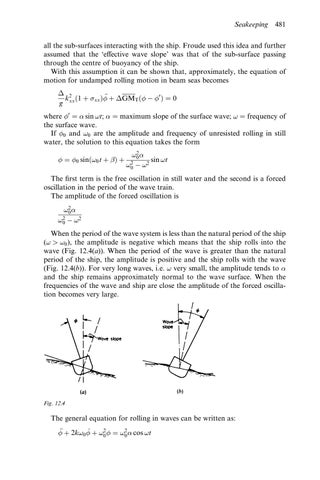
The ®rst term is the free oscillation in still water and the second is a forced oscillation in the period of the wave train. The amplitude of the forced oscillation is !20 !20 !2 When the period of the wave system is less than the natural period of the ship (! > !0 ), the amplitude is negative which means that the ship rolls into the wave (Fig. 12.4(a)). When the period of the wave is greater than the natural period of the ship, the amplitude is positive and the ship rolls with the wave (Fig. 12.4(b)). For very long waves, i.e. ! very small, the amplitude tends to and the ship remains approximately normal to the wave surface. When the frequencies of the wave and ship are close the amplitude of the forced oscillation becomes very large.
Fig. 12.4
The general equation for rolling in waves can be written as: 2k!0 _ !20 !20 cos !t