ALUMNI
SPOTLIGHT
Power Couples
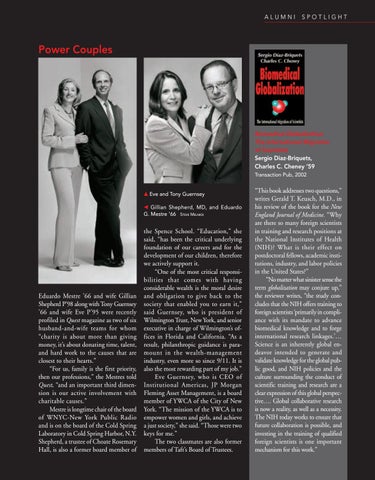
Biomedical Globalization: The International Migration of Scientists Sergio Diaz-Briquets, Charles C. Cheney ’59 Transaction Pub, 2002 Eve and Tony Guernsey Gillian Shepherd, MD, and Eduardo G. Mestre ’66 STEVE MELNICK
Eduardo Mestre ’66 and wife Gillian Shepherd P’98 along with Tony Guernsey ’66 and wife Eve P’95 were recently profiled in Quest magazine as two of six husband-and-wife teams for whom “charity is about more than giving money, it’s about donating time, talent, and hard work to the causes that are closest to their hearts.” “For us, family is the first priority, then our professions,” the Mestres told Quest, “and an important third dimension is our active involvement with charitable causes.” Mestre is longtime chair of the board of WNYC-New York Public Radio and is on the board of the Cold Spring Laboratory in Cold Spring Harbor, N.Y. Shepherd, a trustee of Choate Rosemary Hall, is also a former board member of
the Spence School. “Education,” she said, “has been the critical underlying foundation of our careers and for the development of our children, therefore we actively support it. “One of the most critical responsibilities that comes with having considerable wealth is the moral desire and obligation to give back to the society that enabled you to earn it,” said Guernsey, who is president of Wilmington Trust, New York, and senior executive in charge of Wilmington’s offices in Florida and California. “As a result, philanthropic guidance is paramount in the wealth-management industry, even more so since 9/11. It is also the most rewarding part of my job.” Eve Guernsey, who is CEO of Institutional Americas, JP Morgan Fleming Asset Management, is a board member of YWCA of the City of New York. “The mission of the YWCA is to empower women and girls, and achieve a just society,” she said. “Those were two keys for me.” The two classmates are also former members of Taft’s Board of Trustees.
“This book addresses two questions,” writes Gerald T. Keusch, M.D., in his review of the book for the New England Journal of Medicine. “Why are there so many foreign scientists in training and research positions at the National Institutes of Health (NIH)? What is their effect on postdoctoral fellows, academic institutions, industry, and labor policies in the United States?” “No matter what sinister sense the term globalization may conjure up,” the reviewer writes, “the study concludes that the NIH offers training to foreign scientists ‘primarily in compliance with its mandate to advance biomedical knowledge and to forge international research linkages.’… Science is an inherently global endeavor intended to generate and validate knowledge for the global public good, and NIH policies and the culture surrounding the conduct of scientific training and research are a clear expression of this global perspective…. Global collaborative research is now a reality, as well as a necessity. The NIH today works to ensure that future collaboration is possible, and investing in the training of qualified foreign scientists is one important mechanism for this work.”