Phelan-Pinto is in charge of Micato’s branding, from the carefully curated editorial and photo content of its website, micato.com, to its impressive brochures. Its Africa brochure is 171 pages long. “We look at it more as a coffee table type of book,” she says. “We don’t want it to be something that you roll up and swat flies with.” Micato treats its guests like family members, says Phelan-Pinto. They are invited to have dinner with Felix and Jane in Kenya or family friends in Cape Town or in Johannesburg, if their travels take them to South Africa. “Being a family company, we’re kind of barely a company in that sense,” she says. Phelan-Pinto began her career in the travel industry as a cruise director for small academically oriented cruises. One of the charters went to East Africa. It was there that she met her husband, Dennis Pinto, who was a ground operator for tour groups in Kenya. They had spoken on the phone for a year before they finally met. “I remember thinking, he has a nice voice,” Phelan-Pinto says of her husband, who is Micato’s managing director. The couple has two children, Sasha, who goes to Brown University (Phelan-Pinto’s alma mater), and Tristan, who
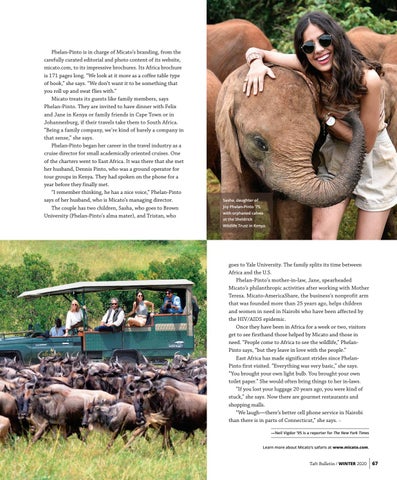
Sasha, daughter of Joy Phelan-Pinto ’75, with orphaned calves at the Sheldrick Wildlife Trust in Kenya.
goes to Yale University. The family splits its time between Africa and the U.S. Phelan-Pinto’s mother-in-law, Jane, spearheaded Micato’s philanthropic activities after working with Mother Teresa. Micato-AmericaShare, the business’s nonprofit arm that was founded more than 25 years ago, helps children and women in need in Nairobi who have been affected by the HIV/AIDS epidemic. Once they have been in Africa for a week or two, visitors get to see firsthand those helped by Micato and those in need. “People come to Africa to see the wildlife,” PhelanPinto says, “but they leave in love with the people.” East Africa has made significant strides since PhelanPinto first visited. “Everything was very basic,” she says. “You brought your own light bulb. You brought your own toilet paper.” She would often bring things to her in-laws. “If you lost your luggage 20 years ago, you were kind of stuck,” she says. Now there are gourmet restaurants and shopping malls. “We laugh—there’s better cell phone service in Nairobi than there is in parts of Connecticut,” she says. j —Neil Vigdor ’95 is a reporter for The New York Times Learn more about Micato’s safaris at www.micato.com.
Taft Bulletin / WINTER 2020
67