Alumni SPOTLIGHT
A Nose for the Business
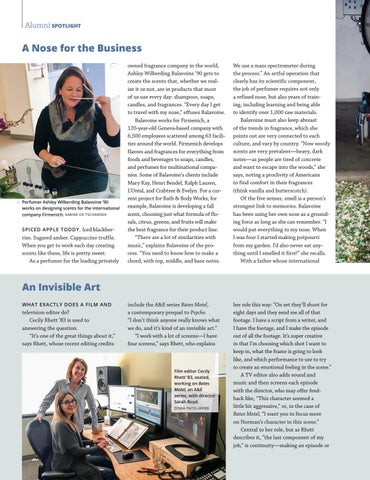
m Perfumer Ashley Wilberding Balavoine ’90 works on designing scents for the international company Firmenich. SABINE DE TSCHARNER
SPICED APPLE TODDY. Iced blackber-
ries. Sugared amber. Cappuccino truffle. When you get to work each day creating scents like these, life is pretty sweet. As a perfumer for the leading privately
owned fragrance company in the world, Ashley Wilberding Balavoine ’90 gets to create the scents that, whether we realize it or not, are in products that most of us use every day: shampoos, soaps, candles, and fragrances. “Every day I get to travel with my nose,” effuses Balavoine. Balavoine works for Firmenich, a 120-year-old Geneva-based company with 6,500 employees scattered among 63 facilities around the world. Firmenich develops flavors and fragrances for everything from foods and beverages to soaps, candles, and perfumes for multinational companies. Some of Balavoine’s clients include Mary Kay, Henri Bendel, Ralph Lauren, L’Oréal, and Crabtree & Evelyn. For a current project for Bath & Body Works, for example, Balavoine is developing a fall scent, choosing just what formula of florals, citrus, greens, and fruits will make the best fragrance for their product line. “There are a lot of similarities with music,” explains Balavoine of the process. “You need to know how to make a chord, with top, middle, and base notes.
We use a mass spectrometer during the process.” An artful operation that clearly has its scientific component, the job of perfumer requires not only a refined nose, but also years of training, including learning and being able to identify over 1,000 raw materials. Balavoine must also keep abreast of the trends in fragrance, which she points out are very connected to each culture, and vary by country. “Now woody scents are very prevalent—heavy, dark notes—as people are tired of concrete and want to escape into the woods,” she says, noting a proclivity of Americans to find comfort in their fragrances (think vanilla and butterscotch). Of the five senses, smell is a person’s strongest link to memories. Balavoine has been using her own nose as a grounding force as long as she can remember. “I would put everything to my nose. When I was four I started making potpourri from my garden. I’d also never eat anything until I smelled it first!” she recalls. With a father whose international
include the A&E series Bates Motel, a contemporary prequel to Psycho. “I don’t think anyone really knows what we do, and it’s kind of an invisible art.” “I work with a lot of screens—I have four screens,” says Rhett, who explains
her role this way: “On set they’ll shoot for eight days and they send me all of that footage. I have a script from a writer, and I have the footage, and I make the episode out of all the footage. It’s super creative in that I’m choosing which shot I want to keep in, what the frame is going to look like, and which performance to use to try to create an emotional feeling in the scene.” A TV editor also adds sound and music and then screens each episode with the director, who may offer feedback like, “This character seemed a little bit aggressive,” or, in the case of Bates Motel, “I want you to focus more on Norman’s character in this scene.” Central to her role, but as Rhett describes it, “the last component of my job,” is continuity—making an episode or
An Invisible Art WHAT EXACTLY DOES A FILM AND
television editor do? Cecily Rhett ’83 is used to answering the question. “It’s one of the great things about it,” says Rhett, whose recent editing credits
Film editor Cecily Rhett ’83, seated, working on Bates Motel, an A&E series, with director Sarah Boyd. DISHA PATEL-WEBB