tales of a TAFTIE
By Julie Reiff
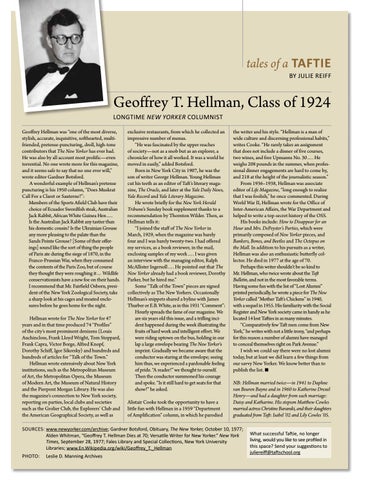
Geoffrey T. Hellman, Class of 1924 Longtime New Yorker Columnist
Geoffrey Hellman was “one of the most diverse, stylish, accurate, inquisitive, softhearted, multifriended, pretense-puncturing, droll, high-tone contributors that The New Yorker has ever had. He was also by all account most prolific—even torrential. No one wrote more for this magazine, and it seems safe to say that no one ever will,” wrote editor Gardner Botsford. A wonderful example of Hellman’s pretense puncturing is his 1950 column, “Does Muskrat Call For a Claret or Sauterne?”: Members of the Sports Afield Club have their choice of Ecuador Swordfish steak, Australian Jack Rabbit, African White Guinea Hen…. Is the Australian Jack Rabbit any tastier than his domestic cousin? Is the Ukrainian Grouse any more pleasing to the palate than the Sands Pointe Grouse? [Some of their offerings] sound like the sort of thing the people of Paris ate during the siege of 1870, in the Franco-Prussian War, when they consumed the contents of the Paris Zoo, but of course they thought they were roughing it… Wildlife conservationists have a new foe on their hands. I recommend that Mr. Fairfield Osborn, president of the New York Zoological Society, take a sharp look at his cages and moated enclosures before he goes home for the night. Hellman wrote for The New Yorker for 47 years and in that time produced 74 “Profiles” of the city’s most prominent denizens (Louis Auchincloss, Frank Lloyd Wright, Tom Stoppard, Frank Capra, Victor Borge, Alfred Knopf, Dorothy Schiff, Igor Sikorsky) and hundreds and hundreds of articles for “Talk of the Town.” Hellman wrote extensively about New York institutions, such as the Metropolitan Museum of Art, the Metropolitan Opera, the Museum of Modern Art, the Museum of Natural History and the Pierpont Morgan Library. He was also the magazine’s connection to New York society, reporting on parties, local clubs and societies such as the Grolier Club, the Explorers’ Club and the American Geographical Society, as well as
exclusive restaurants, from which he collected an impressive number of menus. “He was fascinated by the upper reaches of society—not as a snob but as an explorer, a chronicler of how it all worked. It was a world he moved in easily,” added Botsford. Born in New York City in 1907, he was the son of writer George Hellman. Young Hellman cut his teeth as an editor of Taft’s literary magazine, The Oracle, and later at the Yale Daily News, Yale Record and Yale Literary Magazine. He wrote briefly for the New York Herald Tribune’s Sunday book supplement thanks to a recommendation by Thornton Wilder. Then, as Hellman tells it: “I joined the staff of The New Yorker in March, 1929, when the magazine was barely four and I was barely twenty-two. I had offered my services, as a book reviewer, in the mail, enclosing samples of my work…. I was given an interview with the managing editor, Ralph McAllister Ingersoll…. He pointed out that The New Yorker already had a book reviewer, Dorothy Parker, but he hired me.” Some “Talk of the Town” pieces are signed collectively as The New Yorkers. Occasionally Hellman’s snippets shared a byline with James Thurber or E.B. White, as in this 1931 “Comment”: Hourly spreads the fame of our magazine. We are six years old this issue, and a trifling incident happened during the week illustrating the fruits of hard work and intelligent effort. We were riding uptown on the bus, holding in our lap a large envelope bearing The New Yorker’s imprint. Gradually we became aware that the conductor was staring at the envelope; seeing him thus, we experienced a pardonable feeling of pride. “A reader!” we thought to ourself. Then the conductor summoned his courage and spoke. “Is it still hard to get seats for that show?” he asked. Alistair Cooke took the opportunity to have a little fun with Hellman in a 1959 “Department of Amplification” column, in which he parodied
the writer and his style. “Hellman is a man of wide culture and discerning professional habits,” writes Cooke. “He rarely takes an assignment that does not include a dinner of five courses, two wines, and free Upmanns No. 30…. He weighs 208 pounds in the summer, when professional dinner engagements are hard to come by, and 218 at the height of the journalistic season.” From 1936–1938, Hellman was associate editor of Life Magazine, “long enough to realize that I was foolish,” he once commented. During World War II, Hellman wrote for the Office of Inter-American Affairs, the War Department and helped to write a top-secret history of the OSS. His books include: How to Disappear for an Hour and Mrs. DePeyster’s Parties, which were primarily composed of New Yorker pieces, and Bankers, Bones, and Beetles and The Octopus on the Mall. In addition to his pursuits as a writer, Hellman was also an enthusiastic butterfly collector. He died in 1977 at the age of 70. Perhaps this writer shouldn’t be so kind to Mr. Hellman, who twice wrote about the Taft Bulletin, and not in the most favorable terms. Having some fun with the list of “Lost Alumni” printed periodically, he wrote a piece for The New Yorker called “Mother Taft’s Chickens” in 1940, with a sequel in 1955. His familiarity with the Social Register and New York society came in handy as he located 14 lost Tafties in as many minutes. “Comparatively few Taft men come from New York,” he writes with not a little irony, “and perhaps for this reason a number of alumni have managed to conceal themselves right on Park Avenue.” I wish we could say there were no lost alumni today, but at least we did learn a few things from our savvy New Yorker. We know better than to publish the list. j NB: Hellman married twice—in 1941 to Daphne van Beuren Bayne and in 1960 to Katherine Drexel Henry—and had a daughter from each marriage: Daisy and Katharine. His stepson Matthew Cowles married actress Christine Baranski, and their daughters graduated from Taft: Isabel ’02 and Lily Cowles ’05.
Sources: www.newyorker.com/archive; Gardner Botsford, Obituary, The New Yorker, October 10, 1977; Alden Whitman, “Geoffrey T. Hellman Dies at 70; Versatile Writer for New Yorker.” New York Times, September 28, 1977; Fales Library and Special Collections, New York University Libraries; www.En.Wikipedia.org/wiki/Geoffrey_T._Hellman Photo: Leslie D. Manning Archives
What successful Taftie, no longer living, would you like to see profiled in this space? Send your suggestions to juliereiff@taftschool.org