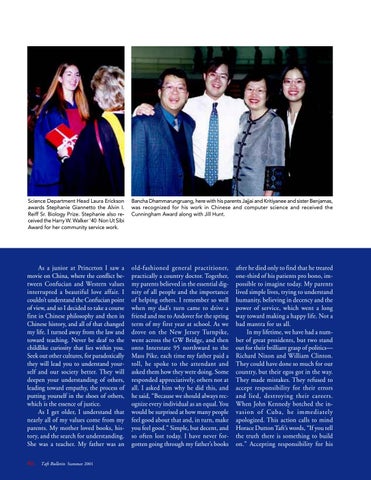
Science Department Head Laura Erickson awards Stephanie Giannetto the Alvin I. Reiff Sr. Biology Prize. Stephanie also received the Harry W. Walker ’40 Non Ut Sibi Award for her community service work.
Bancha Dhammarungruang, here with his parents Jajjai and Kritiyanee and sister Benjamas, was recognized for his work in Chinese and computer science and received the Cunningham Award along with Jill Hunt.
As a junior at Princeton I saw a movie on China, where the conflict between Confucian and Western values interrupted a beautiful love affair. I couldn’t understand the Confucian point of view, and so I decided to take a course first in Chinese philosophy and then in Chinese history, and all of that changed my life. I turned away from the law and toward teaching. Never be deaf to the childlike curiosity that lies within you. Seek out other cultures, for paradoxically they will lead you to understand yourself and our society better. They will deepen your understanding of others, leading toward empathy, the process of putting yourself in the shoes of others, which is the essence of justice. As I get older, I understand that nearly all of my values come from my parents. My mother loved books, history, and the search for understanding. She was a teacher. My father was an
old-fashioned general practitioner, practically a country doctor. Together, my parents believed in the essential dignity of all people and the importance of helping others. I remember so well when my dad’s turn came to drive a friend and me to Andover for the spring term of my first year at school. As we drove on the New Jersey Turnpike, went across the GW Bridge, and then onto Interstate 95 northward to the Mass Pike, each time my father paid a toll, he spoke to the attendant and asked them how they were doing. Some responded appreciatively, others not at all. I asked him why he did this, and he said, “Because we should always recognize every individual as an equal. You would be surprised at how many people feel good about that and, in turn, make you feel good.” Simple, but decent, and so often lost today. I have never forgotten going through my father’s books
40
Taft Bulletin Summer 2001
after he died only to find that he treated one-third of his patients pro bono, impossible to imagine today. My parents lived simple lives, trying to understand humanity, believing in decency and the power of service, which went a long way toward making a happy life. Not a bad mantra for us all. In my lifetime, we have had a number of great presidents, but two stand out for their brilliant grasp of politics— Richard Nixon and William Clinton. They could have done so much for our country, but their egos got in the way. They made mistakes. They refused to accept responsibility for their errors and lied, destroying their careers. When John Kennedy botched the invasion of Cuba, he immediately apologized. This action calls to mind Horace Dutton Taft’s words, “If you tell the truth there is something to build on.” Accepting responsibility for his