“I had a colonoscopy once and they let me watch it on TV. It was more entertaining than The Brown Bunny.” Got a classic Ebert style putdown in you? Come write for TFR! Get in touch with us at trinityfilmreview@gmail.com 2 2
EDITORIAL I’m scared about the future. I’m not talking about your garden variety future fears like unemployment, male pattern baldness and global warming. As someone drip fed on a steady diet of sci fi for the last two and a half decades my anxieties are more Terminator shaped. If the Danny Boyle’s and Rian Johnson’s of the world are to be belived I’m far more likely to freeze to death in a solar winter or be assassinated by my future self long before my first mortgage payment is due. Not all visions of the future are bleak though. Yes there may be dystopian dictatorships where children are forced to battle to the death whilst millions watch baying for their blood but there’s also a good chance there’ll be hoverboards too. In this issue of TFR we look at some of the most memorable depictions of the future on film , from the augmented reality of TRON to the augmented DNA of GATTACA. We also speculate on the future of the film industry that is currently seeing the rise of streaming services like Netflix and more and more premium content that does not originate on traditional TV networks. This kind of “progress” has consequences though and it pains me to say that we also spoke to Peter Dunne in what will be his last week as a Laser employee as the much loved movie Mecca closes down for good. TFR is still here though! As are our regular features like UNDERRATED/OVERRATED, THE NETFLIX GRAVEYARD and the usual bevy of REVIEWS. So sit back, relax, and enjoy. I’m off to tell past me to start production a week early because fifty odd hours of editing without sleep is no fun. Live long and prosper. Jack
3
CONTENTS
THE FUTURE
FEATURES
6.THE NETFLIX EFFECT
24. UNDERRATED - SUNSHINE
8. EYES WIDE SHUT / THE LAST DAYS OF LASER
25. OVERRATED - CALVARY
10. RISE OF THE SUPERMEN
26. CLOSE YOUR EYES
12. BRAVE NEW WORLD
28. NETFLIX GRAVEYARD UNDERCLASSMAN
14. RAGE AGAINST THE DYING OF THE HYPE
29. NETFLIX HIDDEN GEM KLOWN
REVIEWS
30. GRADUATE FOCUS HOWARD JONES
16. 2001: A SPACE ODYSSEY 18. FOXCATCHER
16
31. 5 WORD REVIEWS SCI FI EDITION
20. HORRIBLE BOSSES 2 22. HOCKNEY 23. PADDINGTON
18
08 4
22
25
16
THE STAFF EDITOR
Jack O’Kennedy
29
EDITORIAL TEAM Sean Nolan Eoin Moore Thomas Emmet Louie Carroll Luke O’Reilly
CONTRIBUTORS Lachlan Baynes Rachel Wakefield-Drohan Oliver Nolan Clare Martin Finbar Lynch Liam Farrell
PRINITNG Grehans
5 5
14
LACHLAN BAYNES EXAMINES THE changes in how we CONSUME OUR ENTERTAINMENT AND WHAT THEY MEAN TO THE SMALL AND BIG SCREEN We have been told that now is the golden age of television. That now is the age where it can stand side by side with the best of cinema; where the best in cinema have made the move to TV. This is the age of Breaking Bad, Game of Thrones, True Detective and House of Cards. Except that last one isn’t really television, is it? In 2013, House of Cards’ first season received nine nominations for the Primetime Emmy Awards, with director David Fincher taking home Best Director. This was the first major prize to be awarded for content produced by an online video distributor; in this case, Netflix. It also marked the first time that a Primetime Emmy has been awarded to, what is by definition, a webisode, and today House of Cards is not alone. This is not the golden age of television. This is the golden age of the online subscription. Streaming services like Netflix or Hulu Plus are now becoming the go-to place for premium content, attracting not just consumers but stars, directors and writers. We are in the burgeoning days of a paradigm shift across Hollywood, a shift that is impacting not just how media is consumed, but how it is produced as well. These services offer a freedom
that broadcast television and the cinema cannot: the freedom of the audience to dictate how they watch, when they watch, what they watch. The age of ‘binge TV,’ where seasons of television can be consumed with immediate ease and audiences can scroll through their Facebook newsfeed while The Walking Dead plays in another window. There is no doubt that the production and consumption of the media is changing. However, this evolution is not limited to the increased popularity of online content. Gaming platforms such as Sony’s PlayStation are redefining the kind of services they can provide while Hollywood studios are reevaluating the relationship between cinema and the Internet. This is what is happening now, but what happens next? Where do we go from here? Although I previously called today the age of the online subscription, this could be a misnomer. What today has truly become is the age of convergence; the rise of transmedia. Transmedia is the term used to describe a multiplatform experience of storytelling and is a concept that first rose to prominence around the early 2000’s, originally employed as a viral form of marketing. It has since extended to tie-in novels, games and websites, expanding the mythology and world of a narrative, allowing audiences to actively participate in the world without it ever being necessary to understand the core content. Fast-forward to today and transmedia is at the forefront of the current Hollywood fad, those three buzzwords: ‘shared film universe.’ Endeavors such as the incredibly successful Marvel Cinematic Universe have legitimized transmedia storytelling in such a way that industries previously distinct are
6
now entwined. Cinema, TV and online services have now converged such that properties can cross the boundaries between network television and streaming services and audiences will follow without blinking. Arrested Development, cancelled after three seasons by the Fox network, found new life on Netflix for a fourth season more than six years after it originally finished airing. There is still talk of a follow-up film. Marvel began their current slate of interconnected films with Iron Man in 2008, releasing ten films since and with another eleven set for release between now and 2019. In connection with the films there is also Marvel’s Agents of Shield, currently in its second season on the ABC and about to be joined by Agent Carter premiering in January next year. Yet the most ambitious phase of Marvel’s plan for global media domination is the deal struck with Netflix wherein five original series are to be released exclusively online beginning in 2015. Marvel Studios is now considered the poster child for transmedia storytelling, while Warner Bros. and Universal (amongst others) attempt to emulate this strategy with their own existing properties. But what the Marvel model truly represents is the successful convergence of industries, a state of co-existence and co-dependence wherein each service complements the other. This is not the norm and will not be the future unless our traditional notions of cinema and TV are re-defined. The recent announcement of the Crouching Tiger, Hidden Dragon sequels’ simultaneous release in Imax cinemas and on Netflix presents an adverse counterpoint to the Marvel ex-
ample. Backed by the Weinstein Co. the move marks a disruption in the traditional patterns of release and supplants the very notion of the physical cinema space. What would audiences prefer; going to the cinema and paying an increasingly exorbitant ticket price or staying in the comfort of their home and watching the film with a subscription that has already been paid for? Services like Netflix no longer just offer convenience; they offer innovation and originality that can be consumed in a context of the audience’s own choosing. Consequently, the move has led to a mass boycott from the largest cinema chains in the U.S. and other countries as they refuse to show the film if it maintains its same day theatres/online release mandate. Content like House of Cards or experiments like Crouching Tiger, Hidden Dragon challenges the relevance of our definitions of TV and cinema. Can material such as this fit within our pre-existing categories or is it time to classify them as something different? How do you classify something that is even beyond online streaming services and in a different medium entirely? In a further evolution of media convergence, your Xbox is no longer something you just use to play video games. From your PlayStation you can download music, stream films and TV and even check Facebook. In recent years they ceased being gaming platforms and became entertainment systems. Soon they are going to become entertainment channels. Debuting in December on the PlayStation Network is the comic book adaptation Powers, a series starring Sharlto Copley and Eddie Izzard. This will be the PSN’s first instance of
original programming, with more to follow, and will be available solely to PlayStation users and subscribers. PlayStation and Sony however are not alone. Xbox and Microsoft have just released, through the Xbox One, Halo: Nightfall, a live action mini series to tie-in with the next Halo installment and executive-produced by Ridley Scott’s production company, Scott Free Productions. This is not the first series Xbox has created to tie in with video games, with web series Halo: Forward Unto Dawn released in 2012 through the Xbox online service and YouTube. It will not be the last, with announcements made earlier in the year of a Halo television series co-created by gaming developer 343 Industries and Steven Spielberg himself, once again available to stream through the Xbox console. The question remains; how do we define this kind of content? Halo: Nightfall has been described as an ‘original cinematic series’ but what does that even mean? Is it capable of an Emmy nomination like House of Cards? Is it a webisode or is it TV? Or is it just something else entirely that we don’t have a name for yet. Somewhere between video game and film. The fact remains that the media as we know it has introduced new avenues for the production of original content outside of the traditional structures. As the years go on these avenues will become larger and the production of content more frequent and more commonplace. Programmes such as Powers or the proposed Halo TV show are only the first installments of a new model
for how media is distributed. Moving forward on this path, we can only expect greater convergence as a way for these previously distinct industries to survive and co-exist. Netflix, for all its success and popularity, is still limited in its global availability. Available in the U.S. and now expanded to most of Europe, nations like Australia and New Zealand must, however, still rely on the traditional distribution channels of network and cable television. Legal rights and issues may prohibit a worldwide expansion for the time being but there is no doubt that it will someday happen. And while we can predict that these services will continue to grow in popularity it is unclear exactly how that will affect the physical cinema industry. Films such as the latest Transformers entry, grossing US$1 billion internationally, proves that audiences still desire the unique cinematic experience for those big films. But what of smaller films with lesser-known casts and less obvious attractions, how will they fare? Ticket prices can only continue to go up meaning that audiences will only become more selective with how they spend their money. Online streaming offers a cheap and convenient alternative for entertainment and it is possible that streaming and home entertainment systems will cause these types of films to suffer, seen by studios as a financial risk and by audiences as a waste of time. Here we return to the concept of co-existence and convergence. Could the independent film industry find in streaming services a new avenue for distribution? One in which they gain greater relevance, exposure and followings? Studios will continue to spend money on big films because big films draw in audiences while streaming services, and even gaming platforms, can spend money on smaller projects because they already have guaranteed subscriptions; audiences that pay no matter the quantity of what they watch. Streaming services could become not just a location for original programming but also alternative content to the franchises and blockbusters that will continue to dominate the traditional cinema space. This may be the golden age of television or cinema, but where we stand now is in the midst of an expansion across mediums, forcing us to critically redefine what cinema and television can be. Platforms previously dismissed have now been legitimized and the content produced is only growing more innovative. It is clear the trajectory these industries are on but we can only wait and see where they take us.
7
EYES WIDE SHUT
WITH ONLY DAYS LEFT TO GO BEFORE IT SHUT ITS DOORS FOR GOOD, JACK O’KENNEDY PAID A VISIT TO LASER ON GEORGES ST. FOR A CHAT WITH LONG TERM STAFFER PETER DUNNE ABOUT THE STORES TWENTY THREE YEAR HISTORY AND THE CIRCUMSTANCES THAT LEAD TO ITS IMMINENT CLOSURE. There’s nothing left but a few obscure Jean Claude Van Damme flicks and a dusty copy of Rush Hour Three in the action section. The posters have been thoroughly pillaged, unless you enjoyed 300: Rise of an Empire in which case you’re in luck. A life size frozen in carbonite Han Solo and a model of R2D2 are tucked away in a basement corner, ready to be shipped off to an American collector. What does all this mean? It means that we’ve truly arrived at the last days of Laser, the beloved Dublin based video store chain which by the time you’ve read this article will have closed it’s doors for the final time. Any discerning film fan with a penchant for overspending on entertainment will be aware of Laser, “the specialist film and movie store” which has been trading in Dublin for over twenty five years. Whether you like films or not if you’re a local you’ll undoubtedly be familiar with the flagship George’s St. location with its black and white shopfront and the glaring eyes that make up it’s logo. Since they announced the closure of their stores (The Ranelagh and Andrews St. branches both bowed out in recent weeks) the Georges St. Laser has been a hive of activity as punters look to bag a bargain in the clearout sale. With the closing down of numerous Xtra-Vision locations, the very public struggles of HMV; shutting down and reopening stores in different locations with little success, the end of Laser can hardly have come as a big surprise.
Speaking to Peter Dunne, a soon to be graduated film student and ten year veteran of the store, we’re told that the first sign of a change in people’s buying habits was the post celtic tiger recession, “people just didn’t have the money to spend anymore”. Many would argue that streaming sites like Netflix, which launched in Ireland in January 2012, were the final nail in the retail film market’s coffin. When asked to comment on the boom in popularity of online streaming Mr. Dunne pointed towards the tradeoff one makes when one plugs for that kind of service. “If you have Netflix, they decide what you watch and they have a programme which tells you that if you like that then you’ll like this too. When you use that site you know exactly what you’re looking for, there are no surprises”. It’s a fair point. Scrolling endlessly on a click wheel doesn’t have quite the same appeal as spending a few uninterrupted hours perusing the shelves of a bustling store, coming across old favorites you hadn’t seen for a long time or something brand new that for one reason or another catches your eye. Netflix’s recommendation settings have been the source of much derision in the past and are currently being retooled (this writer was once suggested the Adam Sandler starring atrocity Grown Ups after giving The Shawshank Redemption a favorable review...no me neither). Ultimately an algorithm, no matter how well tested and frequently updated is never going to 8 8
match a passionate employee with a wealth of knowledge of films both old and new, someone who can tease out a film buyers likes and dislikes through casual conversation rather than twenty odd clicks on a taste survey. “I know that if we get a film student in here looking for a film by a particular director, we can say ‘yes we have that for you, and here’s a load of other films made by the same director which you might also enjoy”. The notion of someone logging on, picking and watching a film and leaving it at that, with no browsing around similar areas and filmmakers of interest is anathema to Peter who says that he “fears the next generation of film watchers are actively narrowing their film knowledge, shrinking it instead of allowing it to expand naturally”. It’s arguably been one of the worst years on record for physical film sellers, vinyl on the other hand, is having a bit of a moment right now, with sales this year set to reach their highest numbers in over a decade. How come the same cache and the desire to be a collector hasn’t crossed over to film fans and DVD’s or Blu Rays? “Well, speaking to younger people like my brother it’s becoming clear that there’s a generation of people being cultivated that just don’t understand the concept of paying for films. It’s alien to them and they’re just going to download or stream something without a moment’s hesitation. It’s a generational habit that people aren’t just going to snap out of when they’re in their twenties and say oh now I’ll start paying for films.” Peter goes on to say that the majority of their loyal customers would be older people and that the loss of the younger folk, teens and college students who in previous years would have been the lifeblood of film and video shops, has had a deeply detrimental effect on the health of their business.
Fundamentally, film’s success both at the box office and in the video shop depends on audiences and the nature of audiences is changing. The market for smaller, homegrown endeavours has shrunk dramatically and those films that do break through to the public arena often make little return because so few people pay for the product. Hence the filmmakers don’t make money, they can’t make more interesting films and we’re left with whatever Hollywood decides to shove down our throats at the cinema that week. As a current film student who used to make multiple trips to the DVD store a month but now settles for a couple of purchases a year and has a Netflix account, I can’t help but feel somewhat responsible for the closure of what for many people is the last genuine port of call for films, posters and props in the city. “The thing that I’m really disappointed about”, says Peter, “is that this store is one of Europe’s biggest film libraries. There’s films here that you can’t get on the internet because they’re just not up there, films that exist only on DVD that you’ll never come across again so what you end up with is this store of films that is culturally important and now it’s gone. It’s broken up and scattered around. On top of the wealth of the material you have the staff. Everyone who works here works here because they love film. We have employees here who are like walking film encyclopedias and now their knowledge will be gone too.” Despite the now inevitable shutting down of the store, there has been a massive swell of support from the Dublin film loving community, with tributes pouring out on social media, people packing out the store and even a march of support down George’s St. “The reaction from the community has been really overwhelming. Someone bought a book of condolences as a bit of a joke but after a few weeks it was full of kind messages. We even had a couple of TD’s
swing by and ask if there was anything they could do for us. It’s lovely and sad at the same time. I feel like I’ve said more than a hundred goodbyes in the last few days. People have come in shaking our hands thanking us for the service, others are phoning up with messages of gratitude. At the end of the day people are coming up and asking us, where am I going to go to rent films now? And the honest answer is nowhere, there’s nowhere else you can go for rentals in the city centre with a selection like ours.” “The thing that saddens me is that loss of community that you get with a place like this closing. We’ve had numerous cases of customers who don’t know each other but end up having a conversation over a film they both reach for in the shop. They’re not trying to pick each other up, they’re just having a chat about shared interests. That kind of discussion and sharing isn’t happening on Netflix.” When pressed on whether there’s any sort of resentment towards the sudden outpouring of support, perhaps thinking, if we’d had this level of loyalty all along we’d still be open, Peter says no. “You can’t blame a massive cultural shift like this on just a few people. What you’ve got here is the slow march of progress which I don’t think is necessarily a good thing but its seems to be the way everything is going”. The subject then turns to the idea of Kindles and how the way our books and film libraries which once occupied shelf after shelf and often entire rooms in our homes can now be contained within a drive the size of a fingernail. “You used to go to someones house at a party or after a date and you’d glance at their bookshelf and D.V.D.’s to see what they liked and if you were a good match. You used to be able to say, oh look this person likes Big Trouble in Little China, we’re going to get along just fine. You can’t do that anymore.”
9 9
People nowadays have ipods full of songs they haven’t listened to, Kindles full of books they have no intention of reading and now computers and hard drives packed with films that they will never get around to watching. “I just love the tangible nature of the physical medium, having something you can hold, it has more importance to you, it gives it more of an emotional weight. This lack of a physical product also affects the way we share things now.” Sure you can send someone a file. but it lacks the personal touch of sharing a favorite DVD or album with a friend, or a well thumbed book. When asked if he sees any future for the physical film market Dunne says “I’d love to say yes but being on the frontline and seeing it shrinking I don’t know how. It’s not just a problem with DVD, it’s a problem with retail in general. Really if there’s going to be any change at all people like film students need to lead the way and not have their blinkers on. I mean if you want to be a filmmaker and don’t pay to watch films then you’re shutting down your own industry. if you want there to be a place for you to work in after you graduate then you need to support it.’’ As we get up off our makeshift seats (rather appropriately they’re two large boxes of unsold DVD’s) I ask Peter if he has any outstanding memories of his time working at Laser. The answer is “Everything. I just love the whole thing. I was a customer here before I ever got a job. In fact I applied three times before they hired me. Working here really improved my film knowledge and made me hungry to see more and more. The ability to walk around and pick something up and go oh what’s this, I haven’t seen this before, and watch it. A whole world opens up every time...that’s my big memory.”
RISE OF THE
Eoin Moore takes a look at Marvel Studios, the history of comic-to-film adaptations, and the future of blockbuster releases. A few weeks ago, a film production company held a “special event” which was primarily focused on announcing the dates and names of their next nine films, to be released over the course of the next five years. Apart from a few casting announcements and some sparse plot details, no additional information was given. Effectively, Marvel Studios had released the equivalent of a general business strategy to the public, and the reaction was insane. Something very major has changed in blockbuster filmmaking. With the unprecedented rise and subsequent domination of the superhero genre, hollywood has gotten a serious taste for that particular flavour of broad appeal money, with startling results. It’s easy to forget, in the depths of the current superhero hysteria, that tinseltown had been trying and failing to make this formula work for decades. The road to the present day superhero greats is littered with hundreds of forgotten failures. There have been occasional masterpieces - Superman (1978), Batman (1989), and The Dark Knight (2008), to name a few - but in each case they were the exception. The right creative people had gotten together and were given just the right amount of freedom with the source material to make something the fans would like, the public would like, and therefore the producers would like. Big budget superhero movies are just starting to get it consistently right, and films like The Amazing Spider-Man 2 show that the people who should have worked out how to do this reliably by now still haven’t necessarily got a
5 BROKEN CAMERAS
clue. Marvel’s achievements in this field, which have changed the very landscape of blockbuster film releases, comes down largely to the way they approach translating the superhero story from page to screen. They were the first to attempt to use comic book publishing methods as a template for producing films. There was a logic to this; perhaps the reason that these films based on popular characters were failing so consistently was due to the fact that, in removing them from their comic book context, they had lost a key part of their appeal. Superhero characters, at least mainstream ones, inhabit shared universes: consistent (-ish), cohesive (at a stretch) worlds in which characters from individual series could interact each other. This was never planned. It began with lame crossover issues in which a couple of heroes would bump into each other, fight for a bit, resolve their differences, and then possibly beat up some Nazis together. Such events were good for sales (Captain America punching Spider-Man on the cover will never fail to move issues) so they happened again, and again, and again. Publishers pushing for these regular cash-grabs eventually found that they had stumbled into an entirely new form of storytelling. This unique format, in which countless characters coexist in a developing, shared universe, had become the default industry standard. It allowed for people thinking in terms of “the big picture” to have a lot of creative freedom in how to develop their characters’ stories, as well as setting the premise for the massive multi-crossover “event” comics which came to define the superhero comics genre. Of course, there were downsides to these excessively convoluted parallel narratives - namely how they made any given series completely inaccessible to new readers - but they were seriously popular, and worked fantastically as hype machines. The comics industry, in its decades-upon-decades long history of trial-and-error, had organically created a stunningly successful narrative structure in which to tell superhero stories. But while this structure had been perfected (and then relentlessly milked) for the comicbook medium, no one knew quite how to apply this to the big screen. Some spin-offs were created from successful superhero films in order to bring expanded universe characters into the cinema. Godawful examples of this include Supergirl (1984), a film so bad that it lost the filmmakers the rights to Superman, and more recently the truly abominable Catwoman
10
CONTROL ROOM
(2004). Less ambitious world-building strategies included cameos, visual references, and other tempting little hints of a greater universe, which became a commonplace feature of superhero cinema. Actually creating such an internal continuity still seemed far outside of the realms of possibility, however. One of the reasons that comics were able to be so experimental with their form and narrative structure was their dirt cheap production costs. The comic industry functions on the premise that the giant companies can afford to pay the relatively slim price to get a new series onto the shelves to test the waters. If after a couple of months the gamble hasn’t paid off, they can cut their losses and get on to funding some other new franchise attempts, while still relying on the steady intake from their established players to make up for the minor loss. Trying the same thing with a superhero movie can bankrupt entire studios. I suppose it’s natural enough that the first company to attempt this gauntlet was one of those comic giants. By the mid-2000s, many of Marvel Comics’ series had been adapted into films, but Marvel had not been in creative control of any of these. They had sold off the film rights to some of their most popular franchises - The X-Men, The Fantastic Four, Spider-Man - to other studios. In spite of this, they still held a massive, untapped well of characters. The president of Marvel Studios, Kevin Feige, constructed a plan to utilise the characters they still had control of, beginning
E SUPERMEN vel Cinematic Universe was met by complete astonishment. Naysayers were certain that the project would fail, that the comics-style serialisation would simply be another massively expensive bomb in the lengthy history of disappointing comic-to-film adaptations. However, The Avengers (2012) went on to nearly triple the box office of Iron Man, becoming one of the most lucrative films of all time.
THE SORROW AND with Iron Man and The Incredible Hulk in 2008. THE PITY While The Incredible Hulk had a tepid recep-
tion, Iron Man was an outstanding success. Whether it was due to the comedic tone, the contemporary political themes, or the absolute revelation of Robert Downey Jr. as the definitive Tony Stark, Iron Man was exactly the kind of breakout hit that Marvel needed to kickstart a shared universe. The post-credits scene suggests that plans were already in place to mingle these established characters together, but the scale of what followed could not have occurred without the Iron Man success story as a proof-of-concept. Marvel began producing a series of mostly unrelated films based on Marvel properties, eventually culminating in a massive feature in the style of classic “Team Up” issues. The initial announcement of the tentatively titled “First Wave” of the Mar-
This is an industry where money talks. Shared universes had been determined too much of a risk to ever be attempted until Marvel proved otherwise by doing it right. DC’s reaction was to announce Batman v. Superman: Dawn of Justice, a follow-up to Man of Steel and a planned prologue to a similar stream of shared universe releases; the long-term goal being to bring DC’s Justice League to the big screen. Meanwhile, Marvel was left to wonder what to do next. They had allowed a pipedream fanboy fantasy to play out and it had resulted in billions of dollars. Their response was to take a cue from the comics industry and go ahead with whatever else the nerds wanted to do, the more wild and ambitious the better. Aside from the expected sequels to their major properties, Marvel commissioned their zaniest adaptations yet: Guardians of the Galaxy (2014), Ant-Man (2015), and a number of tv series, bridging the Marvel Cinematic Universe with the smaller screen. Guardians of the Galaxy’s unexpected popularity, becoming Marvel’s most successful non-sequel release, only encouraged Marvel to aim for more ambitious heights. Throughout this all, Marvel has managed to keep the fans engrossed in whatever they’ll come up with next; the first teaser trailer for Avengers: Age of Ultron achieved a record-breaking 34.3 million views in its first 24 hours alone. This is how we find ourselves watching a 16 minute press conference in which a producer lists a film release calendar. While this event is crazy enough in itself, the films announced also indicate just how much further Marvel plan on pushing this wave. More diverse heroes, including Marvel’s first black lead, Black
11 11
Panther (2017), and Marvel’s first female lead, Captain Marvel (2018), have been announced. Fan favourites, and riskier bets, will also be arriving, like Doctor Strange (2016) and Inhumans (2018). Massive crossover events directly inspired by the comics will also be coming in the form of Captain America: Civil War (2016) and the long-awaited, insanely ambitious, two-part Avengers: Infinity War (2018/2019). DC and 20th Century Fox (who own all Marvel properties under the X-Men brand) have similarly announced films to cover the next half a decade or so, each to the exact date. The Marvel formula has proven too tempting to pass up. It’s an unsettling idea that day-specific release dates have been affixed to films that won’t be released until the end of the decade. The negatives of this rigidity have already begun to show; notoriously delay-prone director Edgar Wright was kicked off Ant-Man for falling behind schedule. As with their equivalent in the comics industry, these shared universes require a level of maintenance and precision. It’s difficult enough to maintain quality and deadlines on multiple comic series running in parallel; doing the same with multiple multi-million dollar films borders on the impossible. Marvel is commendable for its massive ambition, but eventually this bubble could burst. Regardless of how long this madness keeps working for Marvel, their embrace of the cinematic universe has changed the way superhero films are made. They have proven that not only is it possible to recreate the broad interconnectivity of the mainstream comic universe, but also that there’s plenty of money to be made in doing so. It will be interesting to see just how this change is adopted, how other studios will manage the transition to shared universe, and what creative possibilities await in the genre’s future. Whether superhero movies will encounter the same pitfalls as superhero comics, and become so densely intertwined as to become unapproachable, or whether they could even improve upon this borrowed structure, remains to be seen.
BRAVE NEW WORLD WALL-E
Thomas Emmet Pixar is a visionary studio, creating arguably the best animation for both children and adults, but it never mistakes itself for not pleasing the masses. Wall.E (close to being their best film) is their only film to come within the proximity of an indie vibe. In its near silent first twenty minutes the titular character tidies and cubes the waste element of earths wasteland entirely on his own. The predominant colour is sandy brown and the tone is post apocalyptic and smoggy. Desolation abounds. Aside from an insect and a seedling there is no obvious sign of life. There is something serene about the landscape, however isolated it may be, that sits in total contrast to the theory of a litter covered planet. The silence and emptiness is appealing for a while. And the debris from satellites having formed an ozone layer over the planet creates a night skyscape that is absolutely beautiful. Above the earth humanity resides in spacecrafts equipped with modern and colourful technology that caters caters to their every
The TFR staff look back on some of their favourite films that dared to look forward TRON
Eoin Moore
need, an assault on the senses. They are carried around by floating armchairs with a drink holder and a television screen, oblivious to everything else outside their own bubble. As a result they have become morbidly obese, lazy and self obsessed. Around them billboards in loud neon announce drinks, fashion and other capitalist propaganda from the behemoth corporation “Buy ‘n’ Large” that spirited them away from their home planet due to their own carelessness. The colours are as false as the lifestyle the citizens, formerly of earth, seem to be living. This is Pixar’s attempt to lampoon our current culture, but it is never heavy handed. It serves the story of a humanity rediscovering how to be human again, while letting Wall.E have his own stab at human feeling.
The 80s were a time for massive, incredibly inaccurate speculations. With the arrival of arcade machines, breathtaking cinematic special effects, and the first not-that-shit computers, it seemed like the future had finally arrived. How exactly this future worked was still a bit vague. People were enamoured with the idea of a “digital world”. It was understood that so many mechanical parts, flashing lights, and complex wires on one end led into something entirely different within the computer screen, and people’s imaginations were left to fill in the blanks. The world of Tron explained computers about as well as can be expected, for the era. Programs were sort of just people. Programming and playing video games were basically the same thing. The concept of using an “experimental laser” to “digitise” someone into a computer was totally within the bounds of poetic license. Disney turned the unknown world of computer software into The Land of Oz, and it was beautiful. As ludicrous as
The burgeoning romance between Wall E’s rusted 700 year old waste disposal bot and his love interest Eve, a sleek white droid, forms the crux of the film but it is the deserted dustbowl earth and its floating substitute that steal the film and leave one pondering long after leaving the cinema.
8 12 12
the neon-disco blue/red design combined with the uncanny human faces looks today, at the time it captured something about that magical, scary, digital world, bounding with potential. While the audience didn’t (necessarily) believe that inside of every computer system there was a despotic totalitarian society built on gladiatorial combat, Tron offered one of the first feasible allegories for the limitless computer world that was growing around them. A world of science fiction, even if it wasn’t necessarily populated by light cycles and Jeff Bridges, had finally arrived at society’s fingertips. What Tron captures, in its laughable inaccuracy, is the excitement of this growing revelation. Tron is an artifact; a cave-painting attempting to make sense of the unknowable. Its a perfectly crystallised vision of the future in the eyes of the past.
BACK TO THE GATTACA Luke O’Reilly FUTURE PT. II Louie Carroll
This vision of the future is unique by virtue of the fact that it’s actually only a year out from our present. For director Robert Zemeckis, way back in 1989, October 2015 must have seemed distant enough that anything was possible. In terms of the futuristic landscape on show, the town of Hill Valley is a far cry from the typically dystopic visions of the future in the likes of Blade Runner and Terminator. Back to the Future II’s…future is a more fun depiction then we are used to seeing. The most amusing element of this vision is various gadgets on show. The most iconic of these gadgets is the pink hover board on which Marty Mcfly escapes his pursuers. Zemeckis and co may have been optimistic about the arrival date of hover boards, however most of what the film predicts has pretty much come to fruition, giant tv’s, video calls and even shoes that lace themselves (exact replicas are available). The greatest shame is that we have yet to witness the majesty of Jaws 19 in “Holofilm” (At least we have 3D now) directed by Max Spielberg, son of Steven. Unsurprisingly, the “future” here has a distinctly 80s vibe. Apart from the fact that the clothes dry themselves, the style doesn’t appear to have progressed far past the decade in which the film was made. Most egregious of all the misjudgments about the future on show is the use of fax machines. Who knows, maybe these artifacts from the eighties will have a resurgence, we still have a year.
A.I.
Sean Nolan
Gattaca is a movie about perfection, and although it is far from perfect itself, like the best sci fi films it reflects the neuroses of its time. A film set in a near-distant ‘utopia’ Gattaca is about the long reaching effects of eugenics on society. The world is divided between two social classes; valids, those born after genetic tampering, and invalids, those born naturally. Although discrimination is illegal, the best jobs are given to the biologically superior valids, while the inferior invalids do menial tasks. With improvements in our understanding of genetics seemingly occurring on a near weekly basis the idea of eugenically improving humans to be better has had a resurgence in the popular consciousness. Gattaca is an attack on the fallacy of meritocracy, all men are not born equally, we are born with distinct differences in ability. Preferencing those who are the most intelligent and physically able over those who are less so still creates class divisions. But what is there to love about this depiction of the future, if a whole class of people are disadvantaged from birth? Indeed, with such a social set up how does it differ from our own? It is precisely because I believe Gattaca is both an allegory for the social divisions of our present as well as an indictment against our dream of a scientifically improved future that I like it so much. This is best captured in the swimming competition between two brothers Anton, a valid, and Vincent, an invalid. Every time they compete Anton wins. Yet one day a surge of determination comes over Vincent. Through sheer will he beats Anton, and nearly saves him from drowning. This invigorates Vincent to pursue his dream of becoming an astrophysicist against the norms of his society. As far as cinema goes, you don’t get a finer depiction of the indom9 itable human spirit than that.
Steven Spielberg’s A.I Artificial Intelligence is the Pinochio inspired story of David, a robotic young boy, and his search for the “blue fairy” whom he believes has the power to make him a “real boy.” The film’s production was led by Stanley Kubrick, before being passed on to Spielberg and the depiction of the 21st century we are offered is an odd mesh of the two directors’ distinct visions. This might account for the incredibly broad spread of concerns about the future the film expresses. On the one hand there are references to global warming and the flooding of coastlines, on the other is probably the more obvious of the film’s concerns, the question of what it means to be human as machines become more sentient.
13
A.I is considerably more restrained than much science fiction fare when it comes to visualizing the future. The film offers us very few establishing views of the cities, instead we tend to see only glimpses in the background, as the camera emphasizes the characters. When we are given a slightly deeper look at the society in which the story takes place the results seem to focus on its banal and familiar nature. The interiors of the buildings of the late 21st century look eerily similar to those of the late 20th century. The “flesh circus” a traveling sideshow in which old, unregistered robots are destroyed for the entertainment of a crowd, looks particularly shoddy and unimpressive just as one would expect the current equivalent to be. More often than not we are simply told, not shown how the world of the film is unlike our own. A.I depicts a future, which is familiar to us but something is slightly amiss, just as David has the appearance of a human boy but is not human.
RAGE AGAINST THE DYING OF THE HYPE Louie Carroll takes a look back at Christopher Nolan’s sci fi epic INTERSTELLAR and whether it lived up to the massive expectations. Few directors can rouse up excitement in the public consciousness like Christopher Nolan. No doubt over the last few weeks you’ll have been asked “have you seen Interstellar?” by someone you didn’t even think watched movies. Maybe having a track record of making some of the best and most intelligent blockbusters of the last decade has something to do with it. The Dark Knight Trilogy gained a position in pop culture that few others can attest to, save for the likes of Star Wars and The Lord of the Rings. Nolan’s success has allowed him to take progressively bigger risks in his filmmaking. With Inception in 2010 he proved that audiences wouldn’t be deterred by a blockbuster with a complex and intricate plot that required some brain power to understand. Having closed out his Bat trilogy two years ago with The Dark Knight Rises to mixed responses, Nolan pushes the boat out even further with Interstellar. A film based on theoretical quantum physics does not necessarily scream “mainstream appeal”. However, when Interstellar was announced, most repeated the now immortal chant “In Nolan we trust”. It seemed if anyone could make the theories of physicist Kip Thorne into a gripping cinematic experience, it was the man who led us down four levels of consciousness in Inception. The question, now that Interstellar has been out for nearly a month and many have seen it multiple times is...was our faith in Nolan justified? The short answer is “sort of”. Here’s the long answer: A glance at Interstellar’s synopsis will tell you that it’s a film of ideas. And in a year in which slinging a dead cat will probably result in hitting yet another transforming truck or a ninja turtle, ideas alone are refreshing in a big film such as this. In order to make these ideas palatable for a mainstream audience Nolan recruited Matthew McConaughey to anchor the film. One of Interstellar’s undisputed strengths is McConaughey’s charisma, which is utilised to full capacity here, giving the audience a rock to cling to in the surrounding sciency stuff. Often the film struggles under the weight of its own ideas and looks to its leading man to hold the audience’s hand through this tough terrain. Although
this is pulled off for the most part, McConaughey’s job is made more difficult by a script that’s bursting at the seams with exposition (A sphere is a 3D version of a circle…who knew?). On numerous occasions Nolan and his brother/co-writer Jonathan Nolan choose to tell rather than show. They just about get away with it, thanks in large part to their leading man. Away from the sciency stuff, it’s been much discussed how the film is a love letter to Nolan’s own daughter. This plays out on screen through the relationship between Cooper and his daughter Murph, initially played by Mackenzie Foy. The early scenes between the two are among the strongest in the film, surprising considering Nolan is a director that in the past has been accused as having a cold touch. This father-daughter relationship is terrifically performed by both actors and forms the emotional base for the entire film. If the human underpinning of Interstellar is solid, the device that sets the plot in motion is less so. A sequence of initially unexplained events leads to a very short turn around, ultimately sending McConaughey blasting off into space. This leaves the film on creaky ground throughout until the phenomenon at the beginning is explained. Leaving this revelation till the end puts pressure on the script to deliver a satisfying resolution; more on that later. When it comes to the supporting cast, the results vary widely, mostly through no fault of their own and largely because of the script. Anne Hathaway’s Dr. Brand is inconsistent in her motivations and characterisation. One minute she’s cold and calculated, the next she’s going all Huey Lewis about the power of love and how it transcends space and time. This particular speech is an unusual decision; while the sentiment is nice, the delivery is very heavy-handed. The other astronauts played by Wes Bentley and David Gyasi fare even worse. Both meet extremely ignominious ends and spend most of their screen time explaining things to Cooper like a senior infants teacher. The characters left on earth are given little to do. Michael Caine dodders around repeating the same Dylan Thomas poem which amounts to about eighty percent of his dialogue. With the exception of her first video transmission to her father, Jessica Chastain as the older Murph is dealt a difficult hand. Like Hathaway, her character has too many inconsistencies which undermine the emotional resolution of her character. Casey Affleck is unquestiona-
14 14
bly the most underserved of the talented cast as Cooper’s older son. The character is overlooked by both the script and Cooper, who seems to forget about him by the end of the film. Oh and Topher Grace, Topher Grace is in this film… While Interstellar will undoubtedly draw comparisons with Inception, the other Nolan film it most resembles is The Dark Knight Rises. In terms of ambition both films bite off more than they can chew. In Rises, Nolan managed to cram themes of terrorism and social disorder into a summer superhero film. While admirable, and successful on many levels, Rises is also the weakest film in the trilogy. In that instance Nolan was so concerned with the big picture that he neglected smaller areas like plot holes (where did his leg brace go?) and silly lines of dialogue (“cat got your tongue?”). The same can be said of Interstellar. Nolan deals with large concepts such as relativity and the transcendent power of love between a father and a daughter, while minor issues are once again overlooked. In terms of the science fiction spectacle on show, the film is in keeping with Nolan’s grounded aesthetic. The worlds explored feel like heightened versions of Earth. Much of the scenery was filmed in outdoor locations rather than a greenscreen. When it comes to the technology, the film also stays on the more believable end of the spectrum. The craft that transports the astronauts is barely removed from current technology. The robots TARS and CASE are the most innovative production design in the film, part R2D2, part iPod. Instead of giving us souped-up technology to gawk at, Nolan expects the audience to be in awe at the extent of human ambition and endeavour. A key fixture in any Nolan film is a bombastic Hans Zimmer score, Interstellar is no different. In their previous two outings, Zimmer’s score has been accused of being too intrusive. Thankfully on this occasion Zimmer reels himself in, in the sense that there are less fog horns than in Inception and Rises. The score bears some resemblance to the excellent Man of Steel score from last year, with more hopeful piano and a less ominous brass section, which makes sense given the optimistic nature of both Superman and Coopers mission. The introduction of Matt Damon as Dr Mann in the second half takes the film in an interesting, if unsteady direction. The once-good man gone mad from isolation
is a trope frequently used in sci-fi. The character comes off as a friendlier version of Mark Strong in Sunshine and having an All-American like Damon in the part makes for an unexpected twist. While the part is well acted, the character’s real function in the film is as a plot device, adding more jeopardy to for Cooper and Brand and steering them in a particular direction. The final act has proven most divisive, and justifiably so. Like the awkward device that set the plot in motion, at worst the resolution comes off as a cop-out. Creating fifth dimensional beings that are “looking out for us” gives the filmmakers and easy out. However, it also raises more questions than it answers, ending the film on an unsatisfying note. This particular twist becomes more palatable on second viewing. Once you’re able to get over the initial shock of the events unfolding and decide to go with it, the resolution is more rewarding. Once event horizons are brought into the equation, it’s fair game for the filmmakers to depict it whatever way they want. If the film just about hangs together for the aforementioned sequence, the last scene is where Nolan finally loses the run of himself. Once again Interstellar shares common ground with The Dark Knight Rises, an ending that outstayed its welcome by a single shot, this time around the film outstays its welcome by ten minutes, making so many bad decisions in such a short space of time. Chief among them is the emotional pay off between Cooper and his daughter, now played by Ellen Burstyn. The whole movie has revolved around the protagonist’s love for his daughter and his attempts to make it back to her. The Nolan brothers fail to deliver a satisfying resolution, with the reunion lasting all of thirty seconds before Cooper is off again to meet up with Anne Hathaway…but wait, won’t she be really old by the time he gets to her? Who cares? Clearly not the filmmakers. This ending is all the more disappointing considering the cathartic payoffs Nolan is capable of delivering, such as the one in Inception. It’s obvious that there’s a lot going on in Interstellar. Any film that inspires as much heated debate among the regular film-going audience as this one deserves some level of praise. However, the film is much more than a conversation starter. As an exercise, it is a wonder to behold. A filmmaker at the peak of his powers, exerting this much creative control over a studio project, surely inspires hope for the future. Add to that the fact that it was shot on film and in 2D, and you have an extremely unique cinematic experience in this day and age; one that warrants a viewing on the biggest screen available. Ultimately, it’s great to have filmmakers such as Nolan, who are prepared to reach for the stars, even if he does fall slightly short.
15 15 15
REVIEWS
2001: A SPACE ODYSSEY DIRECTED BY Stanley Kubrick WRITTEN BY Stanley Kubrick and Arthur C. Clarke STARRING Keir Dullea Gary Lockwood William Sylvester The upcoming release of 2001: A Space Odyssey by the BFI will be it’s fifth time to hit the cinemas since it first came out in 1968. Directed and produced by Stanley Kubrick it is one of most iconic and influential films ever made. Stanley Kubrick stands amongst the greatest film makers who have ever lived. His filmography includes A Clockwork Orange, Doctor Strangelove, Full metal jacket and Spartacus. 2001 is his Magnum Opus, his most original and enigmatic film. Standing at 161 minutes it is not a viewing experience for the impatient. Yet 46 years on from its release it has entered into popular imagination. It was taken off most memorably in the twelfth Simpson’s ‘Treehouse of Horror’ episode, where Pierce Brosnan voices ‘Ultrahouse 3000’ an artificial intelligence that turns against its owners. 2001 was revolutionary in its production. Front projection with retroreflective matting gives the impression of an open African wilderness, rather than the usual fake painting on walls. Large scale models were made for all of the spaceships and the images were created by superimposing the models onto background shots.
The cinematography is one of the films most impressive elements. A bone tossed in the air cuts to a spaceship, the entire technological history of mankind encapsulated in one shot. The special effects are exceptional, much of the film consists of long shots of space and ships moving through it. Scale is used well here and the enormity of the ships is captured and contrasted with the still greater enormity of space. The sense of man as an intrepid explorer of the greabeyond is summed up again and again in the cinematography. Flashing lights speeding up as an astronaut pushes past infinity. Suddenly changing camera angles that give smooth transition of perspective for the same character in different incarnations, are masterfully utilised to demonstrate giant jumps of time in one of the most disturbing scenes in the film. The least impressive aspect of 2001 is the acting. Often stilted and strange the film is without a notable performance. Human interaction is lost within grand spectacle. Actors seem inconsequential, as if Kubrick only includes humans to justify the spectacular special effects and high concept plot. The opening scene of men dressed as apes is outright comical. One of the ape suits was made with breasts that could produce milk, Kubrick hoped that they could tempt a real baby ape to suckle on it. A baby chimpanzee was hired and coerced into suckling. The result was messy and cut from the film. A scene between a father calling his young daughter is one of the few scenes with any emotion in it and it is utterly forgettable. It is a clear sign of the film’s other strengths that performance, usually an integral part of any narrative movie, is almost unimportant in 2001.
The majority of the live-action scenes were shot without the beginning or ending having been decided by Kubrick. There is great attention to detail in making sure that the film is as scientifically accurate as possible. Everything exists for a reason. The designs of space ships are founded on the principle of being scientifically possible. This is what takes the viewer immediately into the realm of well made Sci-Fi, a genre that can be giggle-worthy when executed poorly. One of the most impressive scientific creations for the film was the concept of a ship that would rotate 360 degrees at a speed that would maintain centrifugal force and so create artificial gravity. The film is an epic that is separated into four distinct parts. The first 28 minutes of the film has no dialogue, and shows how the appearance of a black monolith kick started human evolution. The monolith returns in the second part of the film, but this time it is a different one found by American astronauts on the moon. The third part is the most tense and exciting of the film. It is set on the space mission to Jupiter to find the source of a signal for a third monolith. It consists of a series of gradually more unsettling altercations between the astronauts on the mission and the ship’s computer. The soundtrack for 2001 is the most iconic element of many. It is Kubrick at his most impulsive and brilliant. Kubrick’s conceptualisation of the movement of space ships being like the whirls of dancers inspired the use of classical music. ‘The Blue Danube’, a waltz, was chosen for this and the result is mesmerising. One becomes pulled into an almost dreamlike spectacle where all human context is removed and these great machines seem to be beasts in and of themselves. That man should later compete against machine in the film seems natural after so much life has been invested into Kubrick’s floating behemoths. Strauss’ ‘Also Sprach Zarathustra’ resonates the moment you hear it at the opening of the film. The section of the piece used was meant to be the fanfare for a sunrise at the start of the day. The piece was written as a companion to Nietzsche’s ‘Thus spoke Zarathustra’, from which it gets its name. 46 years on it has lost none of its power. This is man as overcoming. Man that has killed its God and taken his place. All of
creation is his for the taking now.
16 16
LUKE O’REILLY
Lone Gunman: Jack O’Connell as Garry Hook 17 in ‘71 17 17
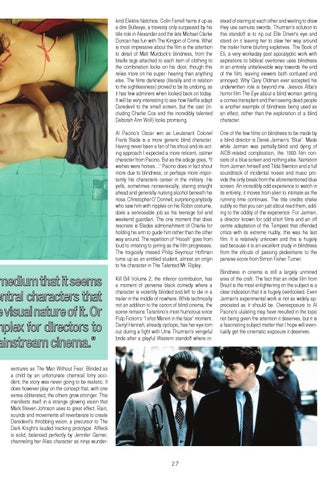
FOXCATCHER DIRECTED BY Bennet Miller WRITTEN BY E. Max Fyre and Dan Futterman STARRING Steve Carell Channing Tatum Mark Ruffalo Bennet Miller’s latest film Foxcatcher is relentless. It is relentlessly bleak in its depiction of 1980s America, relentlessly critical in its deconstruction of the American drive for success, and relentless in its movement towards inevitable tragedy. Foxcatcher tells the true story of John E. Du Pont (an unrecognizable Steve Carrell), heir to the Du Pont family fortune, and his relationship to the Schultz brothers, wrestlers Dave and Mark (Mark Ruffalo and Channing Tatum respectively) as they train for the 1988 Olympic Games in Seoul. Du Pont, as one of the wealthiest men in America, offers financial support to the brothers and installs himself as the head coach of Team Foxcatcher. First and foremost, Foxcatcher is a character study and it’s strength lies in the performances, specifically that of Steve Carrell and Channing Tatum, both actors undergoing transformations to present something that audiences have never seen from them before. Much attention has been given to the physical transformation of Carrell to more closely resemble the real life John Du Pont. His prosthetic nose, the grey and receding hairline, the sagging skin, fake teeth and pallid complexion combine to truly startling effect, rendering the beloved actor completely unrecognisable. So long a comforting comedic presence, Carrell’s turn here as the unhinged, self-aggrandizing millionaire is unsettling to say the least. It is not just in appearance that Carrell has changed, but his voice too, modulating his pitch and cadence and the rhythm of his speech to truly emulate this man who stares at the camera
with blank eyes sunk deep into their sockets. While Du Pont is an accomplished ornithologist, philanthropist and philatelist (a list he repeats to himself almost as a mantra), Carrell’s portrayal ultimately leads you to see this man as pathetic in his desire for acknowledgement and approval from both his ageing mother (Vanessa Redgrave) and the athletes he surrounds himself with. Despite what we know this man to be there are moments where it is impossible not to feel a great swell of pity in the way he limply jogs around the gymnasium or competes in an over fifties wrestling competition.
grimly in place. Tatum brings an intensity to the role that ties once again to the relentless movement of the film towards tragedy.
Foxcatcher is relentless. It is relentlessly bleak in its depiction of 1980s America, relentlessly critical in its deconstruction of the American drive for success, and relentless in its movement towards inevitable tragedy.
A stand out element of the film, apart from strong performances across the board (Mark Ruffalo is similarly brilliant in a subdued fashion, playing the level headed and loving older brother Dave Schultz), is Miller’s sound design. Music is used sparingly throughout, most often in long, slow shots of the Foxcatcher estate entrenched in a permanent mist and fog that clings to the grounds. But what Miller is truly fascinated by is the physical rhythm of movement. Long stretches of the film are dedicated to the sounds of the gymnasium, the grinding of the leg press layered over the top of wrestlers practicing choke holds and arm drags. An early scene in the film between Ruffalo and Tatum takes place entirely within the sonorous confines of an empty wrestling hall, their grunting conversation repetitively punctuated by the whiplash sounds of hands slapped away and shoes squeaking and dragging against the floor. Even a key confrontation between two characters later in the film is shot without actually hearing any of the conversation, the focus is on the actors with the only sound being the rhythmic drone of an exercise bike. In this fashion Miller draws the audience deep into this harshly competitive world while continually focusing attention on the physical performance of the actors. It is a faith in the performances that is well found and yields stunning results.
Yet it is Channing Tatum who delivers what is possibly a career best performance in his portrayal of a slow yet determined (to the point of self destruction) young man constantly living in the shadow of his brother. Similar to Carrell’s Du Pont, Schultz is an accomplished athlete having won gold at the previous Olympics. Despite all this it is impossible not to view the character as slightly pathetic. When we first meet him he is living in near squalor, a large wall covered with trophies and medals taking pride of place in his bare and dingy flat. While Carrell spends hours in the make up chair to transform into Du Pont, Tatum fits into the role of his character with more subtle changes but all contributing to great effect. These are as small as the way he walks, a hulking presence almost constantly hunched, or the way his bottom lip juts out, his jaw and cheeks set
When Mark Schultz meets Du Pont, he is tempted with money, success and independence yet ultimately what ties these two men together is a feeling of unworthiness and a tendency towards destruction. Du Pont exercises this vice by buying up old military tanks and firing pistols within the confines of a gym whereas Schultz takes it out on himself, punishing his body unremittingly in several of the film’s most uncomfortable scenes.
Aided by three perfect performances, Miller’s film is like watching a train wreck in slow motion; a course has been set and it is impossible to deviate from. Akin to some of Shakespeare’s best work, Foxcatcher builds towards a moment of violence that is shocking in its unexpectedness and tragic in its futility. Even if you know the ultimate outcome of the narrative, you will never look away from the screen.
LACHLAN BAYNES
18 18 18
19
HORRIBLE BOSSES 2 He mediates well between Bateman’s audience addressing straightness and Day’s balls to the wall hectic craziness. Jason Sudafed falls into the category of extremely confident yet pigheaded actors like Will Arnett or Danny McBride. These kinds of characters are great in small doses but we can become easily overwhelmed by the annoying pop music references and overly immature jokes (I am reminded of a particular scene early on that emulates the Austin powers: The Spy Who Shagged Me gag of perspective and shadows that leads to a sub Carry-On level of humor). But, Jason Sudanese does a perfectly fine job rounding off the cast with his amusingly misogynistic one-liners and dopey ideas throughout.
DIRECTED BY Sean Anders WRITTEN BY Sean Anders and John Morris STARRING Jason Bateman Jason Sudeikis Charlie Day 2011’s Horrible Bosses was for many people a pleasant surprise. An original comedy showcasing some of the genres current leading men instead of another repetitive will Ferrell vehicle or the eighth Hangover movie. It was a high (ish) concept comedy that treated us to solid performances and a heap of witty exchanges that kept the smatterings of giggles relatively frequent throughout the picture. It was nothing too mind-blowing, but it was an inoffensive addition to the somewhat suffocating genre that is the Hollywood comedy. Fast-forward two years and we receive the follow up, the imaginatively titled Horrible Bosses 2. Swapping out the trifecta of loathsome employers from the original, played by the predatorial Jennifer Aniston, the ever sinister and cold eyed Kevin Spacey and the surprise hit of the movie, a bloated , balding Colin Farrell doing his take on Tom Cruise in Tropic Thunder, (if Les Grossman worked at a chemical company) are Christoph Waltz and Chris Pine. The events of the film are set into motion when this father and son duo begin a business partnership with our lead characters Nick, Kurt and Dale (Played by Jason Bateman, Jason Sudeikis and Charlie Day respectively). Plans quickly go awry however once cutthroat businessman Waltz screws them on the deal and leaves them five hundred thousand dollars in the hole. A couple of humorously furious scenes later and the trio devise a plan to kidnap Pine and demand a ransom to save their business. To avoid spoilers I will leave it there but needless to say that hijinks ensue.
Clock it up to a lack of sleep or the foreboding grey sky that hovered over me like a vulture as I wandered into Cineworld, but I was not particularly looking forward to seeing this one. All I was expecting was the same movie rehashed with some more familiar faces. And….I was right. This movie does very little to venture off the tracks laid down by the original. Having said that though, did I require anything else? I got my lightning fast exchanges between the three leads, I got Charlie Day being hilariously flustered at even the tiniest problem, hell, I even got the obligatory over the top expensive car chase that logically has no place in the movie but was done for the reason of ‘Fuck it’. This movie ticked all the boxes it needed to tick. I walked into the cinema, I chuckled numerous times, I left the cinema with a grin on my face. That’s all that’s required, job done! Congratulations movie, you’ve beaten out the majority of other schlock fests that I put myself through. You win! Lets all go home. Okay, maybe I should prod this a little further. The three leads are exactly what you’d expect. We get Jason Bateman who gives the standard, beleaguered Bateman performance . He’s a safe pair of hands for this kind of role. Then you have the Tobasco to Batemans tasty yet uninteresting Carbonara, Charlie Day, who coincidentally plays Charlie Day and is the highlight of the movie. The fact that he hasn’t reached Melissa McCarthy levels of over saturation shows just how much of a naturally hilarious screen presence this man is. Even some of the weaker material that this film attempts is livened up by his anxiety-ridden delivery that could make a Lars Von Trier movie a summer smash comedy. Rounding out the archetypal stooges is SNL alumni Jason Sudeikis (And yes, I do have to keep looking back at Wikipedia to spell his name right). With him, we get the salt to finish off our unusual pasta metaphor and maybe it’s an over seasoned dish but one can’t deny that he adds some real flavor. Jason sudiejdneidnfjhsd is a worthy addition to this cast.
20
CHARLIE DAY’S ANXIETY LADEN DELIVERY COULD TURN A LARS VON TRIER MOVIE INTO A SUMMER SMASH COMEDY As regards to the rest of the ensemble we get a veritable mixed bag. Jamie Foxx is typically great as the wonderfully named ‘Mother Fucker Jones’ who adds a bizarre vulnerability to his cat loving insecure criminal. Another winning turn is the deliciously energetic performance from blue-eyed dreamboat Chris Pine who shows an unexpected comedic flair in the role of Waltz’s spoilt, arrogant son. Christoph Waltz, however has seemingly pressed the auto pilot button while he no doubt preps himself for his next star Tarantino role. Seriously, even Kevin spacey, who has been known to collect the odd paycheck on occasion (COUGH 21 COUGH), in his two scenes shows ten times the charisma and sneer that Waltz could muster in his main role. As a whole, Horrible bosses 2 suffers from an often immature script and an irritatingly chart based soundtrack. But it is a great vehicle for the talent of its stars and effectively delivers on laughs, which in the end is all that matters. Will this be a standout of the year? No, but no one is asking it to be. See this purely on the basis of whether you enjoyed the first. Simples.
LEO HANNA
21 21
HOCKNEY DIRECTED BY Randall Wright Hockney is a moving portrait of one of the world’s great, living, modern artists. Directed by Randall Wright, this documentary chronicles David Hockney’s life from his upbringing in Bradford in the forties to moving to Los Angeles in the sixties right up to the present day. It is not the first documentary to have been made about the influential Hockney but it benefits greatly from the use of footage of the artist shot at different points in his life as well as access to the artist’s personal archive and interviews with the artist himself. The documentary investigates Hockney’s artistic method and looks at his influences, personal life and all of the elements which have had an effect upon his artwork. The result is a whimsical documentary filled with wonderful moments, which will please not only those familiar with Hockney’s work, but also those who have yet to be introduced to it. Hockney grew up in a terraced house in Bradford, East Yorkshire at the end of the Second World War. One piece of advice that he fondly remembers being given by his father was to not care what the neighbours thought of him. And care he did not. He fearlessly (and stylishly) wore moleskin trousers, an odd haircut, and thick round black glasses around Bradford while pushing a pram with an easel in it. He went on to the Royal Academy in London and after that New York and Los Angeles. A somewhat cheeky and gregarious fellow, he flourished in America; this is apparent from many of his paintings, which seem to have preternatural and vibrant colours which could
only have been inspired by the intense, richly coloured landscape in Los Angeles. Although the documentary is loosely chronological, the sections in it are connected by intertitles featuring quotes by the artist which are somewhat odd and unnecessary and bear little relation to what is happening at any given time. The documentary benefits from a wide range of people being interviewed, including Hockney’s friends, family and those who sat for his most famous portraits, including Celia Birtwell who was one of the subjects for Mr and Mrs Clark and Percy. All speak fondly of Hockney and although he is very obviously a man who delights in many things in life and has a great sense of fun, Hockney is clearly quite a pri-
vate person. His friends speak candidly about Hockney’s life and relationships in the documentary but the artist himself speaks mainly of his art. A notable exception to this is when Hockney speaks out about living through the AIDs epidemic as a gay man in the eighties and losing many of his dear friends to it. This moving glimpse into the trials and tribulations of Hockney’s life elevates the documentary and grants a rare flash of insight into the man behind the artist’s persona. Perhaps at the heart of this documentary is the desire to know what makes Hockney tick. By visiting the places which influenced some of his more famous paintings as well as using footage of Hockney working and explaining his particular fixations (water, borders, etc.) the viewer gains an insight into Hockney’s artistic process. The viewer is transported directly into Hockney’s mind and one begins to understand where these startlingly vivid works of modern art come from. Hockney is never content to let his work remain the same and it’s remarkable how many shifts and changes his work has gone through in his lifetime. He eagerly finds inspiration in so many things around him, his curiosity is never satiated and he constantly strives to go beyond his own limitations. He has dabbled in opera and in recent years and has become enamoured of technology and has incorporated it into his work. Although there seems to be a slight lack of personal information about Hockney in the documentary, a moving and intimate picture of Hockney and his work emerges. He is a remarkable artist who has never let his work stagnate who retains a certain joie de vivre even while in his seventies.
RACHEL WAKEFIELD-DROHAN 22
PADDINGTON DIRECTED BY Paul King WRITTEN BY Michael Bond and Paul King STARRING Hugh Bonneville Ben Whishaw Nicole Kidman
A mere 56 years since his first literary outing, Michael Bond’s Peruvian bear in London finally makes his big-screen debut in Paul King’s endearing and enjoyable caper. In the safe hands of King and Harry Potter producer David Heyman, Paddington 2014 is thankfully true to the innocent spirit of Bond’s creation, despite the 11th hour departure of Colin Firth as the voice of the titular bear and the recent furore surrounding the film’s ‘damning’ PG rating in the UK. Rather than go the way of the recent ghastly Postman Pat reboot, Paddington is certainly a labour of love, and despite a few missteps, will no doubt bring the politely bumbling bear to a new generation of adoring children and nostalgic adults, whilst hopefully triggering a renaissance for orange-based jam products. This origin tale tracks the furry protagonist from his humble beginnings in Darkest Peru, harvesting oranges on his Aunt Lucy (Imelda Staunton) and Uncle Pastuzo’s (Michael Gambon) makeshift Marmalade factory. When an earthquake devastates their plantation, Paddington journeys to London to find a new home, having learned English customs through years of studying BBC radio. Unfortunately, Paddington quickly finds that despite being able to say that it’s raining in hundreds of ways, he has his work cut out for him in the bustling capital. His endearing naivety is placed in hilarious contrast to the suspicious Londoners he encounters - “there’s some kind of bear over there... probably selling something” – but luckily it’s not long before Paddington has found a ‘temporary’ home with the Brown family, who agree to put him up, Caeser like, in their attic. Naturally, hilarity ensues as the bear struggles with the facilities, toothbrushes and showers prov-
ing most challenging, whilst gradually serving to reconnect the fractured Brown family like a Peruvian E.T covered in hair. Terror looms large however as Nicole Kidman’s taxidermist Millicent, in cahoots with the Browns’ interfering neighbour Mr. Curry (Doctor Who’s Peter Capaldi), seeks to add our hero to her growing collection at the National History Museum. From the hilarious prologue, a Python-esque B&W vignette tracking a British explorer’s early encounters with Paddington’s parents in Peru, it’s apparent that we’re in good company. The film’s strong visual sensibility, with creative and unexpected visual flourishes abound, can be attributed to writer director Paul King’s past outings directing episodes of The Mighty Boosh and his debut feature, the madcap Benny & The Bull. King wisely keeps the family audience in mind however, filling the film with amusing sight gags and crowd-pleasing set pieces. While some may have expected something less broadly mainstream from a director whose most comparable experience is his direction of Boosh’s legendary Crack Fox, the film is assured in the sense that Paddington himself is perhaps the very antithesis of edge. King and his game cast commit themselves wholeheartedly to the film’s infectiously optimistic tone. Hugh Bonneville capably makes Mr. Brown’s blowhardiness endearing – ‘7% of morning breakfast related accidents begin with banisters’, while Sally Hawkins is as good as ever as his long-suffering, yet buoyant wife. Kidman has fun as the film’s villain, even if her intentions to stuff the bear could potentially terrify younger audiences. Heyman rounds up a selection of Potter alumni to spice up proceedings, with the forementioned Gambon and Staunton joined by Jim Broadbent and Julie Walters in minor yet memorable turns, but it’s Capaldi who comes close to stealing the show, with Curry’s attempts to woo Millicent providing some of the film’s biggest laughs. And what of the bear himself? Contrary to the hilarious, yet terrifying memes that emerged this Summer, Paddington is beautifully rendered, with Ben Whishaw’s lightly breathy tones proving a seamless fit for the character. London is pre-
23
sented in its traditionally filmic romantic idyll, though King knows better than to bombard the homegrown audience with the national insignia. That said, Paddington’s idealism goes as far to posit that even pigeons aren’t the complete villains we all know them to be.
Paddington 2014 will no doubt bring the politely bumbling bear to a new generation of adoring children and nostalgic adults, whilst hopefully triggering a renaissance for orange-based jam products. While the film’s crowd-pleasing nature works seamlessly for the most part, there is a tendency to rely on its madcap set-pieces to engage younger audiences. Air-bound flights of fancy down London high streets and the films rooftop climax serve to cinematise Paddington’s adventures – often small scale, low-stakes affairs on page – substantially, yet they do sometimes tend to arrive perhaps too frequently, often to the audible sound of boxes being ticked. These hit their nadir at the midpoint, with Bonneville disguising himself as a cleaning lady as the film threatens to make the plunge into Carry On territory. It’s all for the kids naturally, but King’s screenplay is otherwise marked by a distinct wit – watch for the brief police station scene – that gives these sequences the sense of being ruled by committee. That said, its impossible to resist being swept up in the film’s relentless optimism. With its strong visual sensibility and game cast, Paddington marks itself out as one of the best British family films in recent years.
OLIVER NOLAN
“Our sun is dying” So begins Danny Boyle’s 2007 science fiction film Sunshine, with nuclear physicist Capa (Cillian Murphy) elegantly laying out out the films doomsday scenario and the mission undertaken to save the earth from a never ending deep freeze and the subsequent death of the human race. To say Boyle’s seventh film in the director’s chair was divisive is something of a misnomer. Whilst it did indeed split the critics, it barely registered on the typical filmgoer’s radar, making back just over three quarters of its meagre (for a film of its type) forty million dollar budget. Looking back now, it’s hard to believe that a film which walks a brilliantly fine line between hard science fiction and thrilling, populist entertainment failed to connect with audiences when it was released. From an aesthetic point of view it remains one of the most arresting films of the last decade. The golden, bulky spacesuits worn by Capa and Kaneda (Hiroyuki Sanada) with their limited mobility and thin rectangular visor are instantly iconic. The same can be said of the design for the Icarus II itself, with its curved, solar plate covered dome at the bow, deflecting the relentless heat of the sun from the long, elegant body of the ship with its softly blinking lights and smoothly revolving communication towers. Cinematographer Alwin H. Kuchler gets to show off his entire bag of tricks, drifting between breathtaking wides that highlight the ships insignificance against the behemoth that is the sun and the oppressive interiors of the Icarus II and Kappa’s claustrophobic, sweat filled spacesuit. He plays with focus when depicting heat to great effect, giving us barely visible glimpses of Pinbacker (Mark Strong) revealing himself to Kappa in the third act or Kaneda’s grisly death that sees him flashing in and out of focus as he is engulfed by a wall of flame. The real strength of the visuals is brought to the fore by Boyle’s typically brilliant marriage of lush images with John Murphy’s stirring score. During the opening
act of the film his softly distorted guitars lends an ease to the proceedings as we float gently through space. However, the sounds become jagged, harsh and abrasive as tragedy befalls the crew and the mission devolves into chaos. The absolute highlight is Murphy’s soaring orchestral work Adagio in D Minor which gives an almost religious euphoria to Kaneda’s sacrifice. The score is repeated again during another moving sequence as Capa takes his final walk in his spacesuit, creating an emotional arc as he struggles, falls and ultimately rises, making the final journey to set off his bomb. Sunshine is a film built on oppositions. The most obvious of those being darkness and light. For the first half of its run time, we are presented with an Icarus II (the somewhat pessimistic name of the crew’s spacecraft) filled with welcoming corridors of bright, comforting light, with an oxygen garden of vivid green vegetation and a crew who are bathed in the warm, golden glow of the sun which they take in from the comfort of their observation deck. As the narrative unfolds however and the mission becomes compromised, the light gradually gives way to a creeping, malevolent darkness. The Icarus II becomes an oppressive half lit labyrinth. The expanse of space that envelops it becomes a black abyss ready to swallow up the crew into its vast nothingness and the once welcoming sun mutates into a loudly burning and ferociously blinding harbinger of death. These oppositions can also be applied to the crew themselves. Within their group dynamic (particularly the fraught relationship between Capa and Chris Pine’s engineer Mace) the film creates a brilliant tension between the cold rationale of scientific logic and the emotional and unpredictable nature of the human heart. Those who find themselves frustrated by films in which characters make terrible mistakes for no good reason will struggle to find issues here. Every move made by the crew of Icarus II is talked through in purely rational terms. At one point Mace decides that they’ll vote on
a major decision until the ship’s psychiatrist Searle (Cliff Curtis) reminds him that “We are not a democracy. We’re a collection of astronauts and scientists, so we’re gonna make the most informed decision available to us”. This approach might sound like it makes for woeful drama, but it’s the conflict between the crews logical sensibilities and their humanity which crash violently off one another as the mission unfolds that makes the film so compelling. Rather appropriately, the push and pull between life and death is the final tension that Boyle’s film reveals to us. The protagonists are on a mission to bring back life to a dying star and in turn ensure the survival of the human race. Theirs is a truly humanitarian mission but one fraught with death at every turn. The shadow of their predecessors (the passengers of Icarus I) hang over them; their smiling faces appearing in brief, Fight Club style flashes as their charred remains are discovered aboard their ash filled ship. There’s a knowing irony in the way that the continued existence of mankind depends on the detonation of an enormous nuclear bomb. This idea of death and destruction begetting life can also be seen in the sacrificial nature of the crew. Kappa doesn’t make it the furthest because he’s the strongest, the most resourceful or even the smartest of his group. He does so because his colleagues recognise that he’s the only one who can complete the mission. So Kaneda dies to fix the solar plates, saving Kappa, Searle dies to open the airlock, saving Kappa and Mace dies to restore the ship’s power, saving Kappa. It’s not the man nor the individual that matters, but man’s collective survival that counts. The weighty themes, stunning action, pulsing score and memorable characters combine to make sunshine into a modern masterpiece, one that deserves to be spoken of in the same breath as Metropolis, 2001 and Solaris.
Jack O’Kennedy
UNDERRATED/SUNSHINE 24 24
OVERRATED/CALVARY Calvary has an admittedly brilliant premise. Father James (Brendan Gleeson), is faced in his confession box with a man who says he was a victim of sex abuse as a child at the hands of a Catholic priest. He tells Father James that he will murder him the following Sunday as a symbolic act of vengeance for his own suffering. However, rather than be a catalyst for the kind of tense thriller that one might imagine, the opening gambit is left unpursued for the most part, serving more as a cross for Gleeson’s character to bear than a driving force of the action. Instead, the bulk of the film is taken up with Father James wandering around his Sligo parish, conversing with a variety of locals, as the film shifts between broad social critique, satire, and strong doses of grave introspection. This is the film’s central problem: it really can’t seem to make up its mind as to what it wants to be. Is it a character piece about Father James reconciling with his suicidal daughter (played by the conspicuously English-accented Kelly Reilly) and searching for his faith in the face of his oncoming death and a crumbling Church? Is it an acerbic black comedy about the struggles of being a priest in a post-Celtic Tiger society? Or is it a commentary on the ills and excesses of the same society? The film flirts with each of these ideas but never satisfyingly settles on one. The first avenue would seem the wisest to have followed, given Gleeson’s performance is the film’s strongest suit. Father James is the sort of ‘cool priest’ only found in works of pure fiction, striding around authoritatively in his flowing black cassock while trying to coax people down from their various moral ledges, driving a red convertible and even brandishing a vintage revolver in a handful of scenes. Gleeson has the necessary ability to go between sarcastic sangfroid and raw rage to make this hybrid of Jesus Christ and John Wayne credible, as well as the
warmth and sensitivity to humanise him. Calvary is at its best when Gleeson’s character is the one drawing our attention, particularly as the film moves towards its emotional climax.
Unfortunately, Gleeson’s excellent work is offset by the film’s wildly inconsistent tone, and bizarre cast of supporting characters. Calvary seems to regard itself as a grand inquiry into the Ireland of today, a country which lost its way during the excess of the Celtic Tiger and has been reduced to an amoral quagmire in its wake. But the film paints in broad strokes, and the minor characters which inhabit the town seem to be little more than thinly veiled ciphers for one societal trouble or another. Dylan Moran plays the obnoxiously aloof banker with pretensions towards aristocracy, and his scenes may as well be accompanied by the words ‘financial crisis’ being flashed on the screen in giant red block capitals, such is the lack of subtlety with which the subject is approached. Similarly the appearance of Isaach de Bankolé as Simon, the sole nonIrish character, allows the film to flag up the problem of racism, and Aidan Gillen delivers a curiously hammy performance as the sneering, coke-snorting, atheist doctor. Adultery, domestic abuse, and prostitution also rear their ugly heads through various parishioners. In one utterly head-scratching scene Domhnall Gleeson appears as the local convicted cannibal and is subjected to an interrogation from his real-life father on his fantastical crimes. It exemplifies the film’s haphazard approach, one of a number of strange and irrelevant digressions. The black comedy the film aims for sits uneasily beside the ethical and moral grandstanding, often falling flat. While satire is all well and good, jokes are often crudely inserted into or immediately following key emotional cadences. Scenes dealing with sex abuse are peppered with jokes, and other sequences see grief
25 25
followed by tasteless humour, muddling up the film’s tone. Calvary expects us to care when characters introduced as comic relief have great spiritual epiphanies in the film’s third act, the objects of ridicule being hastily elevated in an attempt to flesh them out.
Director John Michael McDonagh caused a minor furore a number of months ago by claiming in an interview during the film’s U.S. press tour that Calvary is not, contrary to all appearances, an Irish film. Despite the County Sligo locations playing a huge role in the film’s visual makeup, a majority Irish cast and crew, the partial funding of the film by our own Irish Film Board, and the film picking up a number of awards at this year’s IFTAs, McDonagh has every right to categorise the film as he sees fit. However, his comments raise the question of how the film would have been received had it been made by a foreign film company, without as many Irish ties. Would such a negative depiction of the region have offended Irish viewers? It’s impossible to know, though I would imagine it may have tempered some of the commercial and critical success the Calvary saw overseas. Calvary often feels like it is ticking off a shopping list whilst throwing topical issues into an already overflowing basket. Despite the didacticism, it never seems like Calvary has anything interesting to say about society beyond merely paying lip service to its dilemmas, with a pervading fatalism its only unifying message. The film is technically well crafted, and a great Brendan Gleeson performance just barely keeps the thing holding together, but the finished product is little more than an overcooked hodgepodge of weighty themes, thin characters, and misplaced humour.
Liam Farrell
CLOSE Y O U R E Y E S Thomas Emmet explores the depiction of blindness in cinema. Close your eyes. Keep them closed. Mushy carpets and the stale salt smell of popcorn greet you. There is the light tearing of ticket stubs and the dull sound of trailers on a loop. The mechanical whirring of an escalator in the distance leading to screens and bathrooms. In the screen the seats are comfortable, worn by those who sat before, a double crescent imprint on each. You can slide into groove effortlessly. The cup holder beside you is sticky, but not uncomfortably so. There is the susurrus of the audience: teenagers gossiping, couples whispering breathless compliments, parents shushing their spawn. A silence descends slowly and then all at once and suddenly there is the bombardment of sound from the speakers. The movie has begun, but with your eyes closed it’s very difficult to enjoy.
cussing the varying levels of boredom he feels. It is not immediately apparent that he is blind, until his friend disappears below the water and he cannot find her.
Blindness in cinema is a rarely touched upon topic. A selection of forty-five films is listed on IMDB, a number just above January 2014’s total film releases. Film is such a visual medium that it seems anathema to have central characters that cannot respond to the visual nature of it. Or perhaps it is too complex for directors to take a risk upon in mainstream cinema.
The film is on the whole a very average coming of age story, resplendent with teenage awkwardness, first kisses and a group of intolerant machismo boys who torment Leonardo. There are two scenes that stand out however. Avoiding a yawn-inducing assignment on Greek culture, Leonardo and his new friend, soon to become crush Gabriel (Fabio Audi, charmingly clumsy and dashing in the same breath) go to the cinema instead. Leonardo asks Gabriel to explain what is happening in each scene, despite being hushed by other cinemagoers. This scene acts as a catalyst as the two teens become closer through a shared hilarity at the pulp horror unfolding on the screen they are watching. The other scene is Leonardo’s soft-core wet dream, where shapes vaguely resembling characters in the film move against one another, kissing and touching. The characters are white tinged and eerily inhuman, yet this adds a first person perspective to the blindness on screen.
It forms the backbone of Daniel Ribeiro’s first feature length film The Way He Looks, adding the weight of emerging sexuality his protagonist’s troubles. Based on the Iris-winning short film “I Don’t Want To Go Back Alone”, the Brazilian film tackles many aspects of blindness. The film opens with Leonardo (a superb Ghilherme Lobo) lying by the pool in the heat of summer dis-
The film also deals with Leonardo’s need for independence both from his parents and his childhood friend. Set upon travelling to America for a year, he struggles with an overprotective mother who refuses to leave him in the house on his own, should something happen, and a father who benevolently wants what is best for his son. The mother tends towards being shrill and
26
“Film is such a visual m anathema to have ce cannot respond to the perhaps it is too com take a risk upon in ma cliched, which undermines the film, but the father is likeable, notably when he teaches his son to shave on his own. The film tackles the usual tropes of the genre but the blindness aspect adds some fresh ideas to the mix. Daredevil, the highly underrated 2003 superhero film, tackles blindness as a superpower. Ben Affleck, milky eyed and doubtfully ginger, negotiates a daytime job as a lawyer (the superior director’s cut has him take on a case which runs alongside the main plot) and nighttime
medium that it seems entral characters that e visual nature of it. Or mplex for directors to ainstream cinema.”
kind Elektra Natchios. Colin Farrell hams it up as a dire Bullseye, a travesty only surpassed by his title role in Alexander and the late Michael Clarke Duncan has fun with The Kingpin of Crime. What is most impressive about the film is the attention to detail of Matt Murdock’s blindness, from the braille tags attached to each item of clothing to the combination locks on his door, though this relies more on his super- hearing than anything else. The films darkness (literally and in relation to the sightlessness) proved to be its undoing, as it has few admiriers when looked back on today. It will be very interesting to see how Netflix adapt Daredevil to the small screen, but the cast (including Charlie Cox and the incredibly talented Deborah Ann Woll) looks promising.
stead of staring at each other and waiting to draw they use samurai swords. Thurman’s solution to this standoff is to rip out Elle Driver’s eye and stand on it leaving her to claw her way around the trailer home blurting expletives. The Book of Eli, a very workaday post apocalyptic work with aspirations to biblical overtones uses blindness in an entirely unbelievable way towards the end of the film, leaving viewers both confused and annoyed. Why Gary Oldman ever accepted his underwritten role is beyond me. Jessica Alba’s horror film The Eye about a blind woman getting a cornea transplant and then seeing dead people is another example of blindness being used as an effect, rather than the exploration of a blind character.
Al Pacino’s Oscar win as Lieutenant Colonel Frank Slade is a more generic blind character. Having never been a fan of his shout-and-its-acting approach I expected a more reticent, calmer character from Pacino. But as the adage goes, “If wishes were horses…” Pacino does in fact shout more due to blindness, or perhaps more importantly his characters career in the military. He yells, sometimes nonsensically, staring straight ahead and generally nursing alcohol beneath his nose. Christopher O’ Donnell, surprising anybody who saw him with nipples on his Robin costume, does a serviceable job as his teenage foil and weekend guardian. The one moment that does resonate is Slades admonishment of Charlie for holding his arm to guide him rather than the other way around. The repetition of “Hooah” goes from loud to irritating to jarring as the film progresses. The tragically missed Philip Seymour Hoffman turns up as an entitled student, almost an origin to his character in The Talented Mr. Ripley.
One of the few films on blindness to be made by a blind director is Derek Jarman’s “Blue”. Made while Jarman was partially-blind and dying of AIDS-related complication, the 1993 film consists of a blue screen and nothing else. Narration from Jarman himself and Tilda Swinton and a full soundtrack of incidental noises and music provide the only break from the aforementioned blue screen. An incredibly odd experience to watch in its entirety, it moves from alien to intimate as the running time continues. The title credits shake subtly so that you can just about read them, adding to the oddity of the experience. For Jarman, a director known for odd short films and an off centre adaptation of the Tempest that offended critics with its extreme nudity, this was his last film. It is relatively unknown and this is hugely sad because it is an excellent study in blindness from the shouts of passing pedestrians to the pensive score from Simon Fisher Turner.
Kill Bill Volume 2, the inferior contribution, has a moment of perverse black comedy where a character is violently blinded and left to die in a trailer in the middle of nowhere. While technically not an addition to the canon of blind cinema, the scene remains Tarantino’s most humorous since Pulp Fiction’s “I shot Marvin in the face” moment. Darryl Hannah, already cyclopic, has her eye torn out during a fight with Uma Thurman’s vengeful bride after a playful Western standoff where in-
ventures as The Man Without Fear. Blinded as a child by an unfortunate chemical lorry accident, the story was never going to be realistic. It does however play on the concept that, with one sense obliterated, the others grow stronger. This manifests itself in a strange glowing vision that Mark Steven Johnson uses to great effect. Rain, sounds and movements all reverberate to create Daredevil’s throbbing vision, a precursor to The Dark Knight’s lauded tracking prototype. Affleck is solid, balanced perfectly by Jennifer Garner, channeling her Alias character as ninja wunder-
27
Blindness in cinema is still a largely unmined area of the craft. The fact that an indie film from Brazil is the most enlightening on the subject is a clear indication that it is hugely overlooked. Even Jarman’s experimental work is not as widely appreciated as it should be. Overexposure to Al Pacino’s ululating may have resulted in the topic not being given the attention it deserves, but it is a fascinating subject matter that I hope will eventually get the cinematic exposure it deserves.
NETFLIX GRAVEYARD
UNDERCLASSMAN
At first glance, Underclassman seems a lot like the new 21 Jump Street reboot: a young bike cop sent undercover, sexual tension with a hot teacher, some dumb dalliances with underage coeds (the two girls insist that together they’re 34, so it’s all good), strange designer drugs being dealt, misunderstood rich kids mixed up in the criminal activity, countless reprimands from the police captain for reckless behavior, and a school authority figure behind all the madness. But that’s where the similarities stop, because 21 Jump Street manages to make the predictable fun and exciting, while Underclassman just . . . sucks. Simple as that. Nick Cannon plays Tracy “Tre” Stokes, who goes undercover at the prestigious Westbury High School after one of its students is found murdered. It’s not too hard for Tre to blend in because 1) he is probably more immature than the rest of the students, and 2) all of his classmates look like they’re about 30. Naturally, Tre has a troubled backstory because he didn’t graduate high school and he wants to live up to his dead dad’s prowess as a detective. Touching and original, right? Yeah, I didn’t think so either. At some points during the movie Nick Cannon does manage to be funny and charming, but you can get thrown off by this quizzical squint-grimace he pulls all the time, like he can’t understand what’s going on around him. It’s made worse by his weird
jokes about being black that are supposed to be humorous but go a bit too far for the tone of the movie – and not in an edgy Dave Chapelle sort of way, but a simply uncomfortable one. For example, after a particularly rough rugby match with his predominantly white teammates, Tre says, “That was such a bad beating I thought I was gonna have to call Al Sharpton in for a march.” Tre has to buddy up with Rob Donovan (Shawn Ashmore, best known as Iceman from the X Men film series), Westbury’s most popular student and the main murder suspect. They bond through street basketball, and because it’s street basketball Tre gets to do ridiculous things like flip the ball out of his shirt and pull down his opponents’ basketball shorts. Another intriguing fellow is Headmaster Felix Powers, played by none other than Lord Grantham of Downton Abbey himself (commonly known as Hugh Bonneville). There’s also a cameo by Cheech Marin, who huffs and puffs as Tre’s fed-up police captain, but of course gives Tre chance after chance to redeem himself. For a relatively short movie (just about 90 minutes), it manages to pack in a LOT of action. There’s a jet ski race, a bike chase down Venice Beach, a car chase or two, a fist fight on the beach (so romantic), a fight on a boat ending in an explosion, and a paintball scene
involving some poetic talk about Benedict Arnold. If it seems like I’m making a lot of laundry lists in this article, well it’s on purpose because I’m pretty sure that’s what the writers did when they were coming up with the screenplay. “Okay, we need this and this and this and this and let’s throw in a hot Spanish teacher” – I’d say that’s a fairly accurate description of the brilliant work happening in the Underclassman writing room. Okay, now I’m going to spoil the movie for you which I hope isn’t too big a deal (because I’m sure after this you really want to watch it) – BUT LORD GRANTHAM IS THE EVIL MASTERMIND PUPPETEER PULLING THE STRINGS. I think that simple fact in and of itself redeemed the movie a bit for me. Instead of walking around Downton Abbey worrying about the family name and his funds, he is KILLING KIDS AND DEALING DRUGS. Who knew that Lord Grantham was such a bad ass?! He literally says, “Less of the drug dealers with scruples routine and more doing what you’re told,” when one of his underlings seems hesitant about offing Tre. HE’S COLD AS ICE. In the end, I have to admit, I was rooting for evil Lord Grantham. He was far more interesting than Tre, with his daddy issues and penchant for doing the most destructive thing possible (Hmm, let’s not sneak into the warehouse where the drug dealers are plotting, let’s bust in with this fancy car and ruin it for no good reason). Tre was just so utterly predictable and stupid, it’s hard to side with him. At least Lord Grantham goes out with a bang quite literally when he’s engulfed in the flames of the aforementioned boat explosion. Underclassman on the whole presents itself without a single shred of intent to break with your expectations, or at least cheekily acknowledge its triteness like in 21 Jump Street. The film fully embraces, without irony or cleverness, the fact that you get exactly what you expect. Even the most naïve viewer could see practically every plot point coming – save for Lord Grantham, who is the film’s saving grace. But you know, underneath all of the clichés and dumb jokes in Underclassman, there were . . . more clichés and dumb jokes. That’s it.
CLARE MARTIN
28 28
NETFLIX HIDDEN GEM
KLOWN
The Scandinavians are the estranged cousins in the family of Europe. We often forget that they exist but it seems like they’re getting on well enough by themselves with their highly revered health care and education systems so they don’t play on our minds that often. There is actually a very strong Danish presence on Netflix at the moment, with the two Mads Mikkelsen vehicles The Hunt and After the Wedding, Headhunters, The Killing, plus loads of stuff from Lars Von Trier (if you have the stomach for it). These productions are fantastic though it seems they have all been born out of the imagination of a people who go for quite a long stretch of year without any sunlight. They provide a fascinating insight into a culture where you’re more likely to receive a rifle than a car for your sixteenth. However, out of all of these peculiar and deeply upsetting films, Klown is worthy of being this issue’s hidden gem for all of its delightfully whimsical and idiosyncratic charm. Perhaps it is unkind to attribute this to the fact that it is Danish. It is certainly a factor but it is difficult to determine how much of the film’s weirdness can be attributed to its setting in the Scandinavian countryside and how much of it derives from the bizarre and terrifying imagination of screenwriters and lead men Frank Hvam and Casper Christensen. The ‘beak tweak’, a form of punishment given to Frank (the main characters are fictionalised versions of Hvam and Christensen) for not having read the prescribed material for his book club, seems like something that could actually exist in some other culture, either as a ‘wet willy’ substitute among vicious ten year olds, or as a bizarre form of Danish corporal punishment that was most likely outlawed in the forties. On the other hand, I have my doubts that the theoretically romantic ‘pearl necklace’ that Frank intends to give his girlfriend, is a cornerstone of Danish marital tradition (you’ll get this reference if you watch it, damn you.) Regardless, Hvam and Christensen certainly form a formidable comedic duo that are only just beginning to receive some international exposure. The pair are essentially the Danish answer to Mitchell and Webb; Hvam started out in stand up comedy but then went on to collaborate with Christensen on a ‘Pythonesque’ sketch show, which then enabled them to land their own sitcom, Klovn, that lasted for six seasons. Klovn is the show upon which Klown is based and follows the misadventures of self-centred, self-serving manchildren, Frank and Casper. The Mitchell and Webb compar-
ison goes beyond their respective paths to prominence, Hvam is obviously the Mitchell of the two; he is probably the more intelligent guy but he is also the more socially awkward. While Christensen is more polished and charming than Jez of Peep Show, he certainly shares his shallowness and the same disregard for anyone’s happiness but his own. Klown is not dissimilar from the hit Channel 4 programme in style either, reviews often compare it to The Hangover and while there is certainly a very American and ‘laddish’ side to the film’s humour, it bears the trademark cringe-humour found in the best British sitcoms such as The Thick Of It, The Office and indeed Peep Show. It features those kinds of scenes that you wish would just stop happening, regardless of how funny they are. One that comes to mind is the scene wherein Frank tentatively places the tip of his finger in the arse of a woman, who had made them pancakes earlier that day, in the most excruciatingly awkward threesome you are ever likely to see. However, this film has a heart as well. The film’s narrative begins when Frank discovers that his girlfriend Mia is pregnant. He finds out the pregnancy from a third party, as Mia had elected to conceal it from him given that she was unsure of his credentials as a father. This seems fair given that Frank completely rejected the notion of being a Dad mere moments before finding out about his soon to be born child. Klown acknowledges an uncomfortable truth; some people are not meant to be par-
29 29
ents. However, sometimes accidents do happen and there are certain measures in place to deal with them. Despite supposedly not wanting to be a father, Frank immediately decides that he wants to keep the baby, but Mia claims that she wants an abortion. Frank then does the logical thing and kidnaps his twelve year old nephew, Bo, in order to bring him on a canoe trip across the Danish countryside and prove his worth as a father. Klown is a blend of different styles, its humour is as dark as it is playful, as cynical as it is silly and as grotesque as it is wonderful. It is a semi-earnest tale of redemption, of a shallow, self-centred man realising what he really wants after finding himself on the cusp of losing it. Yet Klown never becomes didactic, nor does it go for the hugging and learning type of ending indicative of the American comedy movies that it often tries to emulate. Whenever it threatens to descend into a heart-warming feel-good-movie-of-the-year narrative, Frank and Casper remind you that they are both awful, selfish people who do not deserve your support. Yet seeing them embark on their ‘Tour de Pussy’ with their three-man canoe and Lidl own-brand tent is a thoroughly enjoyable and worthwhile cinematic endeavour.
FINBAR LYNCH
In GRADUATE FOCUS we chat to former film students of Trinity College who are now working in the industry. This time we spoke to Howard Jones (class of 2012) who is now a trainee camera assistant. TFR: When did you realise film was a medium you would like to work in? HJ: I 've always been obsessed with it. I wanted to be an actor when I was young...still do, maybe. I did acting courses and drama summer camps and all that stuff for years. TFR: How did you end up studying film? HJ: Well I thought I wanted to do law. I never thought of a non vocational degree as a practical option. Ruth obviously twigged I loved film and I am close friends with her two sons so it was she who suggested I put film down on my CAO somewhere so I have her to thank. Also I took a fairly relaxed attitude to the leaving cert meaning, thank christ, I did not get the points for law. TFR: How was your experience studying film in Trinity? HJ: I loved every minute. Obviously I have the same complaints as most film graduates, in that I envied the IADT student's access to film equipment and industry pros and a more in depth practical study of film but that’s not what Film Studies in Trinity is. I loved the theoretical side and the critical study of film. TFR: Did you make many shorts in college? HJ: Much to my shame and dismay I must admit: not a single one, apart from those that were part of the course. So I shot and cut a short doc and one other short for a digital video prodution module. You have a few hours and it has to be on campus. The short doc I really like. TFR: What’s been your career path since then? What was your first film related job or venture after college? HJ: A friend of mine, his dad is a DOP. So I cold called a lot of people, him included, and I begged him to get me out on set and help out
on the camera team. Unpaid obviously. That was the second season of Moone Boy. That went well and I got offered some paid work but I had to turn it down. Weirdly enough I got offered a rugby contract with a club in Boston so I moved to America for three months. When I got home from the US I think I probably panicked a bit. TFR: So what made you stop playing rugby and return to film? HJ: My visa expired. I wouldn’t have stayed there. I just did it because it seemed too good an opportunity to turn down but it was never going to be a long term thing. I should have tried to get back into camera departments when I got home but I didn’t really know anyone. I think maybe in hindsight I wanted to work in the industry in any way I could, probably a bit too much, so I started cold calling production offices. I got an internship with Underground Films (They’re the production company behind One Million Dubliner’s). I stayed there for about eight months. I slaved away in the office doing all the production nonsense. Eventually they ended up making a feature and I worked and was paid as a production assistant on that. The feature was St. Patrick’s Day. TFR: So talk to me about your duties as a production assistant, what was a typical day on set like for you how long was the shoot and where did you film? HJ: Shoot was three mad weeks and it was shot all over Dublin. I’m not sure what your average production assistant does. I was always on set and I just did whatever I could. All the administrative boring stuff on set. Then I left Underground and did some commercials work with Ken Wardrop and Andrew Freedman in Antidote. That was more production work but it was making me money so I did it until I finally got work in camera. TFR: What was the first production you got camerawork on? HJ: Charlie was the first big one. That’s the Haughey drama for RTE coming out in Janu30
ary. I did that this time last year. TFR: What was your experience working on that mini series like? HJ: So on that I was trainee and to be honest I was just relieved to be out of production and into camera and working as a trainee camera loader. The hierarchy in the camera department is DOP is the boss. He or she has a focus puller or 1st assistant camera and the 1st AC has a loader and the loader has a trainee. I am basically training to be a loader by definition I guess. TFR: So what does the loader do exactly? HJ: The loader is in charge of all things camera related. So that includes the technical side of things in terms of having all the lenses close to hand, filters, camera accessories and attachments. So anything that the DOP or focus puller would ask for is got in an instant. Loaders also give marks to actors for the focus puller so they hit the same spot each take and they put the clapper board on before each take. Then there’s all the other stuff you would imagine like batteries for the camera, keeping all the gear tidy and maintaining the lenses and the filters etc. TFR: Are there any other projects that you’ve worked on? HJ: Just wrapped on a german film for German TV called A Dangerous Fortune yesterday. It’s a German production, set in Victorian England and shot in Ireland. We were all over Dublin, Wicklow and a few weeks in Kildare. I did some shoots with a director friend of mine for IMAGE.ie. Got myself into a few ads to keep the money coming in, haha.I also did some camera work on the most recent season of Vikings. TFR: Have you any advice for film students whilst they’re still in university? HJ: Shoot all the time and if you want to work in camera, start calling people and getting on sets, getting your name out there, make contacts while you’re in college. The younger you start the better.
INTERVIEW BY JACK O’KENNEDY
5
WORD REVIEWS SCI - FI EDITION
OBLIVION / YOU’VE GOT...TOO MANY TOMS STAR WARS EPISODE 1 / JAR JAR BINKS RUINS DREAMS STAR WARS EPISODE 2 / LESS BINKS...DREAMS STILL RUINED ALIEN / A MOST VIOLENT STOMACH BUG PROMETHEUS / WHAT THE FUCK RIDLEY SCOTT!!! PRIMER / HAVE PEN AND PAPER HANDY STAR TREK INTO DARKNESS / WE SWEAR HE’S NOT KHAN IN TIME / JUSTIN TIMBERLAKE’S STILL IN SYNC TRON / A DOCUMENTRAY ABOUT COMPUTER PROGRAMMERS SNOWPIERCER / ALL ABOARD THE ALLEGORY TRAIN FLASH GORDON / THREE WORDS. BRIAN. BLESSED. FLYING.
31