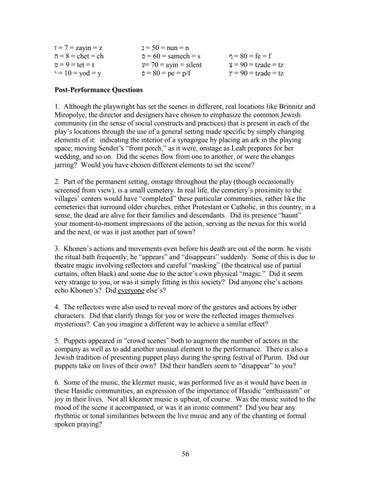
= ז7 = zayin = z = ח8 = chet = ch = ט9 = tet = t = י10 = yod = y
= נ50 = nun = n = ס60 = samech = s =ע70 = ayin = silent = פ80 = pe = p/f
= ף80 = fe = f = צ90 = tzade = tz = ץ90 = tzade = tz
Post-Performance Questions 1. Although the playwright has set the scenes in different, real locations like Brinnitz and Miropolye, the director and designers have chosen to emphasize the common Jewish community (in the sense of social constructs and practices) that is present in each of the play’s locations through the use of a general setting made specific by simply changing elements of it: indicating the interior of a synagogue by placing an ark in the playing space; moving Sender’s “front porch,” as it were, onstage as Leah prepares for her wedding, and so on. Did the scenes flow from one to another, or were the changes jarring? Would you have chosen different elements to set the scene? 2. Part of the permanent setting, onstage throughout the play (though occasionally screened from view), is a small cemetery. In real life, the cemetery’s proximity to the villages’ centers would have “completed” these particular communities, rather like the cemeteries that surround older churches, either Protestant or Catholic, in this country; in a sense, the dead are alive for their families and descendants. Did its presence “haunt” your moment-to-moment impressions of the action, serving as the nexus for this world and the next, or was it just another part of town? 3. Khonen’s actions and movements even before his death are out of the norm: he visits the ritual bath frequently; he “appears” and “disappears” suddenly. Some of this is due to theatre magic involving reflectors and careful “masking” (the theatrical use of partial curtains, often black) and some due to the actor’s own physical “magic.” Did it seem very strange to you, or was it simply fitting in this society? Did anyone else’s actions echo Khonen’s? Did everyone else’s? 4. The reflectors were also used to reveal more of the gestures and actions by other characters. Did that clarify things for you or were the reflected images themselves mysterious? Can you imagine a different way to achieve a similar effect? 5. Puppets appeared in “crowd scenes” both to augment the number of actors in the company as well as to add another unusual element to the performance. There is also a Jewish tradition of presenting puppet plays during the spring festival of Purim. Did our puppets take on lives of their own? Did their handlers seem to “disappear” to you? 6. Some of the music, the klezmer music, was performed live as it would have been in these Hasidic communities, an expression of the importance of Hasidic “enthusiasm” or joy in their lives. Not all klezmer music is upbeat, of course. Was the music suited to the mood of the scene it accompanied, or was it an ironic comment? Did you hear any rhythmic or tonal similarities between the live music and any of the chanting or formal spoken praying?
56