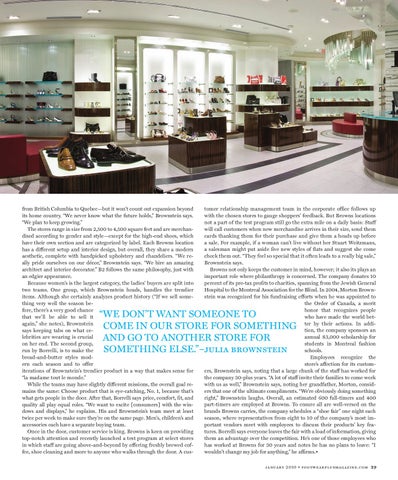
from British Columbia to Quebec—but it won’t count out expansion beyond its home country. “We never know what the future holds,” Brownstein says. “We plan to keep growing.” The stores range in size from 2,500 to 4,500 square feet and are merchandised according to gender and style—except for the high-end shoes, which have their own section and are categorized by label. Each Browns location has a different setup and interior design, but overall, they share a modern aesthetic, complete with handpicked upholstery and chandeliers. “We really pride ourselves on our décor,” Brownstein says. “We hire an amazing architect and interior decorator.” B2 follows the same philosophy, just with an edgier appearance. Because women’s is the largest category, the ladies’ buyers are split into two teams. One group, which Brownstein heads, handles the trendier items. Although she certainly analyzes product history (“If we sell something very well the season before, there’s a very good chance that we’ll be able to sell it again,” she notes), Brownstein says keeping tabs on what celebrities are wearing is crucial on her end. The second group, run by Borrelli, is to make the bread-and-butter styles modern each season and to offer iterations of Brownstein’s trendier product in a way that makes sense for “la madame tout le monde.” While the teams may have slightly different missions, the overall goal remains the same: Choose product that is eye-catching, No. 1, because that’s what gets people in the door. After that, Borrelli says price, comfort, fit, and quality all play equal roles. “We want to excite [consumers] with the windows and displays,” he explains. His and Brownstein’s team meet at least twice per week to make sure they’re on the same page. Men’s, children’s and accessories each have a separate buying team. Once in the door, customer service is king. Browns is keen on providing top-notch attention and recently launched a test program at select stores in which staff are going above-and-beyond by offering freshly brewed coffee, shoe cleaning and more to anyone who walks through the door. A cus-
tomer relationship management team in the corporate office follows up with the chosen stores to gauge shoppers’ feedback. But Browns locations not a part of the test program still go the extra mile on a daily basis: Staff will call customers when new merchandise arrives in their size, send them cards thanking them for their purchase and give them a heads up before a sale. For example, if a woman can’t live without her Stuart Weitzmans, a salesman might put aside five new styles of flats and suggest she come check them out. “They feel so special that it often leads to a really big sale,” Brownstein says. Browns not only keeps the customer in mind, however; it also its plays an important role where philanthropy is concerned. The company donates 10 percent of its pre-tax profits to charities, spanning from the Jewish General Hospital to the Montreal Association for the Blind. In 2004, Morton Brownstein was recognized for his fundraising efforts when he was appointed to the Order of Canada, a merit honor that recognizes people who have made the world better by their actions. In addition, the company sponsors an annual $3,000 scholarship for students in Montreal fashion schools. Employees recognize the store’s affection for its customers, Brownstein says, noting that a large chunk of the staff has worked for the company 30-plus years. “A lot of staff invite their families to come work with us as well,” Brownstein says, noting her grandfather, Morton, considers that one of the ultimate compliments. “We’re obviously doing something right,” Brownstein laughs. Overall, an estimated 600 full-timers and 400 part-timers are employed at Browns. To ensure all are well-versed on the brands Browns carries, the company schedules a “shoe fair” one night each season, where representatives from eight to 10 of the company’s most important vendors meet with employees to discuss their products’ key features. Borrelli says everyone leaves the fair with a load of information, giving them an advantage over the competition. He’s one of those employees who has worked at Browns for 30 years and notes he has no plans to leave: “I wouldn’t change my job for anything,” he affirms.•
“WE DON’T WANT SOMEONE TO COME IN OUR STORE FOR SOMETHING AND GO TO ANOTHER STORE FOR SOMETHING ELSE.” –julia brownstein
january 2010 • footwearplusmagazine.com 29