2
forms of struggle, to the way that media have played a role in refashioning the spaces of habitual exchange? Riots in August 2011 in London have seen the images of capital in its fetishized form taken literally, through the shoplifting that major news channels have called “violent consumerism”. In the face of this, the Olympic Games of last summer – which took place exactly a year after the London riots – have had the function of building a nationalist feelgood sentiment, and by harnessing the spectacle of this corporationdetermined event, attempt to erase the injustices addressed by a year of protests, riots and popular uprisings.
An Excess of Reality – the Power of the Strike by Ron Hanson
The punitive and repressive measures enacted by the Quebec government in response to the 2012 student strikes demonstrate the threat to institutional power that these strikes represent. In disrupting the day-to-day flows of civil society what is revealed is the functioning and structuring of society itself, rippling the veneer of naturalness that is the neoliberal state’s greatest power. Deleuze and Guattari describe the state as an apparatus of capture in which “work” is the capture of “activity.” The
crowds of other kinds, say at a football match or at an underground subway station. In these later occasions, as channelled as they are, energy always threatens to overspill its constraints, but these are small spurts rather than unregulated flows. In the strike, energy threatens to overflow in all directions in overwhelming force. There is a reconfiguring of networks that presents a myriad of challenges to the technocratic order. There is a feeling of empowerment in realising that one is not alone. In the Occupy Wall Street movement and the Arab Spring, suddenly we were presented with empirical evidence of what Antonio Negri and Michael Hardt
The recurring idea of disruption throughout the contributions within this issue explore the various ways in which spaces of capital accumulation can be reinvented, in defiance of the spectacle. This defiance can take the form of the strike and its negative mobilisation reacting to capitalism's intensifying pace; the possibilities of reassesing and reimagining the uses of current civic infrastructures taken for granted, and a re-investment in the media and images circulating in the everyday. 1. Giorgio Agamben, ‘Shekinah’, The Coming Community, University of Minnesota Press, Minneapolis and London, p.86.
dissolution of work back into activity is revealing of its constitutive power and the limits of the state, or of sovereign value of any kind. The state can master the flows but it cannot control them once and for all. Implicit in this act of capture is the effect of that which escapes its grasp. If not effectively curtailed, the trickle can become a tidal wave. Once it reaches a certain level of fluidity, the apparatus can be reconstituted but not exactly as it was before. The effective strike disrupts the symbolic order by creating a new symbol, monstrous it its dimensions and productive in its capacity. It is interesting to compare the effect of a large-scale strike with large gatherings of
have theorised as the “multitude”. The multitude is opposed to the idea of the people – which Negri and Hardt say is a concept which emerged with the state – the dissolution of the ensemble of individuals into the One. The multitude by contrast is made of non-representable singularities that are beyond measure. It is this immeasurability that makes it such a threat to a system of control. “If on the one hand we oppose the multitude to the people,” Negri writes, “on the other hand we must put it in contrast with the masses and the plebs. Masses and plebs have often been terms used to describe an irrational and passive social force, violent and dangerous precisely by virtue of its being easily manipulated. On the contrary, the multitude is an
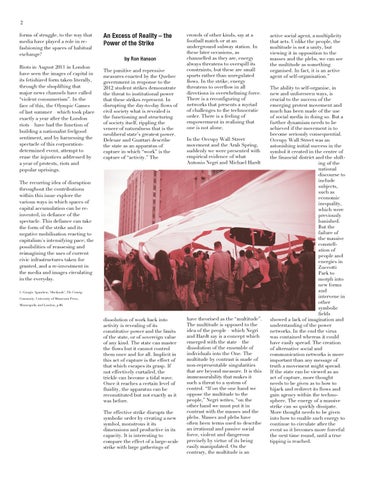
active social agent, a multiplicity that acts. Unlike the people, the multitude is not a unity, but viewing it in opposition to the masses and the plebs, we can see the multitude as something organised. In fact, it is an active agent of self-organisation.” The ability to self-organise, in new and unforeseen ways, is crucial to the success of the emerging protest movement and much has been made of the use of social media in doing so. But a further dynamism needs to be achieved if the movement is to become seriously consequential. Occupy Wall Street was an astonishing initial success in the symbol it created in the centre of the financial district and the shifting of the national discourse to include subjects, such as economic inequality, which were previously banished. But the failure of the massive constellation of people and energies in Zuccotti Park to morph into new forms and intervene in other symbolic fields showed a lack of imagination and understanding of the power networks. In the end the virus was contained whereas it could have easily spread. The creation of alternative social and communication networks is more important than any message of truth a movement might spread. If the state can be viewed as an act of capture, more thought needs to be given as to how to hijack and redirect its flows and gain agency within the technosphere. The energy of a massive strike can so quickly dissipate. More thought needs to be given into how to enable such energy to continue to circulate after the event so it becomes more forceful the next time round, until a true tipping is reached.