
Southwestern Union Adventist Young Professionals 4 Sowing in the Right Soil 8 Supporting Mental Health A Connected Community 11 13 Hope for the Future 6 Building a Community Together in Christ’s Name May | June 2023

SOUTHWESTERN UNION OF SEVENTH-DAY ADVENTISTS SWURECORD.ORG | RECORD@SWUC.ORG
Editorial EDITOR
KRISTINA P. BUSCH KBusch@swuc.org
ASSISTANT EDITOR
TAMMY G. PRIETO TPrieto@swuc.org
CONTRIBUTING EDITORS Arkansas-Louisiana Conference
FRANCES ALCORN | News@arklac.org
Oklahoma Conference
WES VIA | News@okla-adventist.org
Southwest Region Conference LESLIE SOUPET | News@swrgc.org
Texas Conference
KENN DIXON | News@txsda.org
Texico Conference
DEBBY MÁRQUEZ | News@texico.org
Southwestern Adventist University TONY REYES | Communication@swau.edu
AdventHealth
ELIZABETH CAMPS Elizabeth.Camps@adventhealth.com
Design
DESIGNER
TAMMY G. PRIETO
COVER STORY IMAGES SAM COVARRUBIAS
STOCK IMAGES GETTY IMAGES
Operations
ADVERTISING
BRADLEY ECORD BEcord@swuc.org
CIRCULATION
During the Creation week found in Genesis 2:18, God establishes the importance of going through life together. We often talk about growing our congregations, but how can our congregations be more relevant in each other’s daily lives? Is our church family available in times of abundance and need? Do we partner with other families in our schools to educate and care for our children? Do you have a faith circle? Has a trusted friend prayed for you earnestly? Is someone counting on you? Let’s examine our faith communities and see how we can enrich and contribute to their success!
TAMMY G. PRIETO Record@swuc.org
ADDRESS UPDATES
To subscribe, discontinue or change address, email your local conference contact listed above or Record@swuc.org.
SUBMISSIONS
News articles and obituary submissions should be emailed to your local conference contact listed above or Record@swuc.org.
OUR MISSION
Equipping, inspiring and sharing hope and wholeness in the Southwestern Union territory.
OFFICIAL
The Record is published bimonthly for a total of six issues per year and is an official publication of the Southwestern Union Conference of Seventh-day Adventists.
Adventist® and Seventh-day Adventist® are the registered trademarks of the General Conference of Seventh-day Adventists®

P.O. BOX 4000, BURLESON, TX 76097 817.295.0476 | SouthwesternAdventist.org
President Carlos Craig
Executive Secretary Stephen Brooks
Treasurer John Page
Undertreasurer Bo Just
VP Church Ministries Tony Anobile
VP Education Carol Campbell
VP Multicultural Ministries Osvaldo Rigacci
Children’s Ministries Sonia Canó
Church Planting Robin Lopez
Communication Kristina Busch
Community Services Bo Gendke
Evangelism English Stephen Brooks
Evangelism Spanish Osvaldo Rigacci
Family Ministries Letty Craig
Health Ministries Randy Phillips
Human Resources Joel Wallace
Men’s Ministries Tony Anobile
Ministerial Tony Anobile
Ministerial Spouses Letty Craig
Native Ministries Carlos Craig
Personal Ministries Stephen Brooks
Prayer Ministries Helvis Moody
Prison Ministries Tyrone Boyd
PARL Stephen Brooks
Revolving Fund Joel Wallace
Sabbath School Sonia Canó
Secondary Education Mike Furr
Stewardship Tony Anobile
Planned Giving/Trust Services Bo Just
Women’s Ministries Letty Craig
Young Adult/Youth Ministries Helvis Moody
Conferences & Institutions
Arkansas-Louisiana Conference
Arklacsda.org | 318.631.6240
Oklahoma Conference
OkAdventist.org | 405.721.6110

Southwest Region Conference
SouthwestRegionsda.org | 214.943.4491
Texas Conference
TexasAdventist.org | 817.783.2223
Texico Conference
Texico.org | 505. 244.1611
Southwestern Adventist University
SWAU.edu | 817.645.9921
AdventHealth Central Texas
AdventHealth.com/CentralTexas 254.526.7523
AdventHealth Rollins Brook
AdventHealth.com/RollinsBrook 512.556.3682
Texas Health Hospital Mansfield (AdventHealth)
TexasHealthMansfield.org | 682.341.5000
Texas Health Huguley Hospital (AdventHealth)
TexasHealthHuguley.org | 817.293.9110
How relevant and fulfilling is it to have a community of faith? When Jesus established His church, He was not putting in place members of an institution or organization, He was building a community of faith, made up of His disciples. These disciples were motivated to follow Him by faith and were willing to develop a relationship of friendship that transcends worship or some weekly activity.
Christ is the center and essence of that community and to the extent that we follow Him out of love, our communities will remain united in Him. Christ’s Church is more than an institutional organization, it is a family. For this to be a reality, intentionality in the development of our relationships is essential so that we can help, strengthen, encourage and grow.
Ecclesiastes 4:9-12 says, “Two are better than one, because they have a good return for their labor: If either of them falls down, one can help the other up. But pity anyone who falls and has no one to help them up. Also, if two lie down together, they will keep warm. But how can one keep warm alone?
Though one may be overpowered, two can defend themselves. A cord of three strands is not quickly broken.” This verse challenges us to get to know each other as a family, as partners—at least two by two with Jesus. This way we can endure whatever comes our way and then move forward and triumph.
I remember one time when an elder in our church reflected that if he had a car accident early in the morning, he really didn't have anyone he trusted enough in the church to call for help. I wonder, who do we trust in our church community to call at dawn with the assurance that they will come to our aid?
Our church relationships cannot simply be limited to what we do when we meet once or twice a week. Our interaction as a family and community of faith, united in Christ, motivates us to know each other better, to help each other more, to care more for one another, to partner in service and mission. Can the family of God, whom we want to unite with in our community of faith, be as close and dependable as our immediate family?
Solomon’s famous line in the verse
above is, “Two are better than one.” When we live intimately with our Savior and share close relationships with our brothers and sisters, it is easier to get back up if we’ve suffered a fall and to practice tolerance and acceptance with love and kindness. Let us endure and persevere to the end, just like a cord of three strands. Read page 13 for ideas on how to grow relationships with your fellow members in your local church.
By Osvaldo L. Rigacci Vice President for Multicultural Ministries

Adventist Young Professionals (AYP) is more than a community for Mechee Cherine, AYP chapters director and Madeline Small, AYP Dallas chapter coordinator. For them, AYP is an answer to prayer and a catalyst that equips them to thrive as ministry leaders and community builders.

AYP is a global lay-led organization that fosters Christ-centered communities across the Southwestern Union and around the world. Founded in 2019, on the eve of the COVID-19 pandemic, the independent ministry now disciples over 7,000 young people through the transitional period following college and preceding parenthood. Through a global digital community, faith-focused city-based chapters and an annual discipleship convention that trains young adults to collaborate with local churches in building faith communities, AYP is impacting souls for the Kingdom. With an emphasis for missions, the ministry’s leaders seek to unite, engage and inspire young people to get involved in their local church and align in mission.
“I went to a public university, and attended a tiny church where I am one of the few young people,” shares Small. “During the COVID-19 pandemic, I was looking to create spiritual connections and to build friendships with people my age who share in this desire. I found AYP’s virtual groups through social me -
dia, and it truly built my faith and provided me the community I needed in that season. AYP answered my prayers.”
Cherine, who leads Small along with over a dozen other chapter coordinators, shares a similar experience. She found AYP through an online search during a transitional period in her career; this led her to get plugged into a virtual AYP book club. There, she was blessed spiritually and was introduced to new friends with whom she could experience deep conversations about faith and life.
The experiences of Small and Cherine reflect that of thousands of Seventh-day Adventist young professionals who are part of a local church, yet yearn for a support network of fellow young professionals who share in this experience. Unfortunately, many of those who don’t find this within the Church walk away from the faith. AYP provides a support network and inspires young professionals to persevere.
Globally, young adult-led AYP groups are enabling meaningful connections regardless of geographical distance, and local chapters are bringing together young professionals from area churches to collaboratively and innovatively create communities for Christ.

“AYP empowers inreach and outreach to co-exist,” shares Cherine. “I love that spark of excitement when two
Adventists with similar stories or interests find one another during an AYP gathering,” adds Small. “Likewise, it is incredible to see young professionals invite their friends and colleagues of different faith backgrounds, and witness these friendships eventually lead to hearts won for Christ.”
Cherine reflects on how a chapter recently welcomed the Muslim friend of an Adventist young professional and is now introducing her to Christ in an in -
tentional, yet welcoming manner. Preparing for divine appointments such as these is a key aspect of AYP’s focus, which is why discipleship is such an integral focus of the ministry’s programs and resources.
“Each summer, we come together as a global family to gain new tips, tools and techniques in order to represent Jesus each and every day. Throughout the year, mentorship and devotional resources keep the learning journey


alive,” shares Cherine. Through the annual convention and these resources, the organization prepares young professionals to share the Gospel whether at their jobs, amongst their friends or through their local churches. In July, the AYP Convention will return to the Dallas/Fort Worth area focusing on preparing young professionals to thrive at the next level through their God-given calling. a
By Adventist Young Professionals. For more information about the mission and ministry of AYP, visit AYP.me.
Note: Adventist Young Professionals is not part of, affiliated with, or supported by the General Conference of Seventh-day Adventists®. Thus, any content or opinions expressed, implied or included in or with the services offered by Adventist Young Professionals are solely those of Adventist Young Professionals and not those of the Seventh-day Adventist ® Church.

“AYP empowers inreach and outreach to co-exist.”
I will never forget their words, “We want to reach our Nation for Jesus.” I came to tell them about God’s miracles around the world. I came to their church to inspire them with how God was growing the church in foreign lands through the broadcasts of Adventist World Radio (AWR). I shared pictures of hundreds of people being baptized in Zambia. I told of changed lives in the Philippines, of whole churches that changed from Sunday to Saturday worship services because they accepted the Adventist message.
The leaders insisted on a follow-up meeting after church with an urgent request: “We want to reach our Nation for Jesus.” It was not only a humble ask, it was a bold challenge. These Navajo elders were speaking with heavy hearts. They well knew the challenging conditions their communities, their people, were experiencing because they didn’t know the power of God’s love in their hearts. Aside from poverty, disease and family dysfunction, they knew many of their people also lacked hope for the future.
As I saw and heard the sincerity of their request, there was only one response I could give, “Let’s see what God will do for you.” That was the beginning of my incredible three-year journey with wonderful Navajo people of the American Southwest.
In just over a hundred years since the first Navajo tribal member became a Seventh-day Adventist, the Church has attempted to grow in the Navajo Nation with some success: we now have three small churches inside the reservation and a half-dozen on the huge res-

ervation’s perimeters. Three Adventist schools now operate on the elementary and secondary levels.
My new Navajo brothers and sisters sensed that more needed to be done. “If we could have a radio station to reach all of the Navajo Nation, we know our Adventist community would grow tremendously,” they urged. “This is the largest reservation in the country—it’s the size of the state of West Virginia and larger than many other states,” they added. “Our people are radio-oriented; we all listen to radio.”
Quickly my thoughts turned to the possibilities. Radio could be the way to accomplish what the church needs to do to grow in the Navajo Nation; a way to combine efforts and strategically target this great community made up of many small communities. As AWR has proven, radio is the best way to create church communities among many cultures around the world, so why couldn’t it happen here? Do I have enough faith to believe it could be done?
That’s how it started. Since then, God has been opening doors that we needed to walk through.
When AWR leaders heard of this possibility of evangelizing North America’s largest mission field, financial help was offered. When pastors at our Navajo churches considered the impact that radio could have in their land of labor, they suggested we start by buying a half hour per week on the main Navajo station, KTNN, “The Voice of the Nava -
jo Nation.” The pastors asked the Pacific Union Conference for funds, and enough money was provided to purchase airtime and install a production studio in Window Rock, Arizona, the seat of government and capital of the Navajo Nation. Soon two more production studios were installed at La Vida Mission near Farmington, New Mexico, in the Rocky Mountain Conference and at the Gallup All Nations Seventh-day Adventist Church in Gallup, New Mexico, in the Texico Conference.
Church members, mainly in the four conferences that have parts of the reservation in their territory, began sending donations to support the project. At the 2022 Native American Camp Meeting, attendees raised $40,000 for the project. AWR presented three training sessions for tribal members, and the last session graduated 17 radio evangelists who already are gaining practice preparing half-hour weekly programs in English and Navajo. Then the Federal Communication Commission granted construction permits for three radio stations. In short, the miracles have happened so fast it is breathtaking to witness it.
The vision cast years ago by those elders at Window Rock has turned into an avalanche of blessings. But most of all, people from around the Navajo Nation and the surrounding diaspora are already being reached for the Lord. In the first 70 hours on the air at KTNN, 300 people responded to offers of Ad -

ventist literature, Bible studies, family prayer requests and even requests for baptism into the Seventh-day Adventist community of believers.
Early on in this journey of faith, the elders decided to call their future radio network the “Diné Adventist Radio Network.” In their language the word “Diné” means “the People.” Soon, with God’s help, thousands more Navajos will be listening to “The People’s Adventist Radio Network,” on a daily, 24hour basis. God’s Word will reach dozens of communities in Arizona, Utah, New Mexico and beyond. The elders believe many Adventist communities will be the result. They say God’s miracles have only begun! a
By Allen Steele. Steele launched the first AWR broadcasts to Europe, the Middle East and North Africa from Lisbon, Portugal, in 1971, and is the AWR Ambassador in the Texico Conference and consultant for the Navajo Radio. Bud and Norma Heacock (pictured above right) are some of the many volunteers who produce English and Navajo radio content. Reyes Brown (pictured above left) serves as a technician and records and edits the program.

“God’s word will reach dozens of communities in Arizona, Utah, New Mexico and beyond.”

For the past decade or more, many Seventh-day Adventist churches have struggled to succeed with traditional public evangelistic events. The denomination employed these approaches from its beginnings to the mid-20th century, resulting in many churches being planted and established. Over the past few years, I have thought, written and taught about this topic in my seminary classes and seminars for pastors and church members. One of the critical factors that has led to this decline is quite evident—the current culture in these places is nothing like the culture when the Adventist Church began. And yet, many Adventist churches continue conducting evangelism efforts as if it were. Furthermore, just as culture has changed dramatically over the past century and a half, it will continue to change until the end of time. Learning to adjust and adapt continuously is necessary if the church wishes to reach surrounding communities.
As a culture changes, so do people's thoughts and reactions—as noted in the shift from modernism to postmodernism, and more recently, the change from postmodernism to the thoughts and ideas currently shaping the world. While there is a place for tradition, there must also be room to share longloved beliefs in ways that people can relate to and understand. Just as Jesus talked about the sower and the seed to the farmers around Him, we, as followers of Jesus, must pay attention to the stories happening around us. And, in doing so, we must help people living these stories to understand how the Gospel intersects with daily living and can transform their lives, just as it did in Jesus’s day. To be effective in our efforts, we must be relevant.
The Seventh-day Adventist denomination had its origins in America during a time known as the Second Great Awakening.1 During that time, the country
was alive with the gospel and revivals took place in churches every night. Many youth and young adults, filled with a love for Jesus, began studying their Bibles in earnest and making tremendous sacrifices to share what they were learning. 2 Through the leading of the Holy Spirit and visions from God, they discovered in the Bible new and distinctive understandings of some doctrines that shed a brighter light on the character of God. Some of these focused on the sanctuary message, the state of the dead and the Sabbath.
The beliefs and teachings of the Seventh-day Adventist denomination began to develop during subsequent years, and they were written down, organized, published and shared broadly. However, early church pioneers did not record the context in which these fundamental beliefs developed, and as a result, did not capture the culture of on-fire gospel preaching and passionate love for Christ. And, unfortunately, the culture of spirituality and religious fervor in society did not persist.
The culture of the 21st century in America has become more secular.3 Today, we are no longer living in a great awakening of Christianity where most people are on fire for Jesus or are biblically literate. The soil in which the sower is trying to plant has changed. Rather than sowing seeds of doctrine in a soil rich with the Gospel, they are trying to sow them in the hard and rocky soil of secularism. Because of this, teaching Seventh-day Adventist beliefs as they were taught during our denomination’s founding years has proved challeng -
ing. When I was a child, it seemed that lists of behaviors of what to do and what not to do were very common, and teaching how to have a relationship with Jesus was somewhat new. When I was a youth and young adult, Morris Venden and others were just beginning to preach righteousness by faith rather than by works.4
The presentation of and approach to teaching the three angels’ messages is one example of an Adventist teaching that needs to be updated. When I ask Adventist preachers to describe the message of the first angel of Revelation 14, they usually say, “‘Fear God and give Him glory, because the hour of his judgment has come’” (vs. 7, NIV).5 This is partially correct but entirely skips the first part of the message found in Revelation 14:6, which is about proclaiming the everlasting gospel to every tribe, tongue and people. The context of the first angel’s message is primarily about spreading the gospel, which includes respect (fear) for God and joy about His coming judgment because of the liberation from sin and the ending of a sinful world that comes with it. When we include that concept, along with the principles of the rest of the New Testament, we can achieve an even fuller understanding of the message.
As I have contemplated this persistent omission of the first part of the message, the only logical explanation I can come up with is that founders of the Seventh-day Adventist Church may have skimmed over this part because it was already known and understood in their culture.6 But it is not well known
in the secular culture in which a significant part of the church exists today, so we must put it back into the message in order to be effective. We must be culturally relevant with our evangelistic endeavors to reach people and to truly give them the best opportunity to accept Jesus. Additionally, survey research shows that we lose too many of our own Adventist children from our churches. It’s not just the world at large—we struggle to share the Gospel and to convert our own youth.7
How can we develop a gospel culture where we can lovingly disciple our church’s children as well as people from our communities into a personal relationship with Jesus? This is where our church’s schools can play a powerful role. Our schools must be campuses that provide a loving gospel subculture for our children and can be centers of gospel evangelism for our communities as well. Where we once tried to reach our communities directly from our churches, now our churches can also reach our communities by working through our schools.8
There are already some schools using variations of this approach with great success. Drawing on my experience working as a church school-based youth pastor for 20 years, and as a professor teaching about churches and schools collaborating in ministry, my observations and recommendations are summarized below as a four-step process.
1. Help Pastors Get Involved at School. Educators and pastors must both work together to cultivate and build positive relationships between the church and school.

“Today, we are no longer living in a great awakening of Christianity where most people are on fire for Jesus or are biblically literate. The soil in which the sower is trying to plant has changed.”
Educators can create a welcoming atmosphere that encourages pastors to show up at the school regularly and to participate in activities.10 When the pastor reaches out and finds that he or she can develop caring and supportive relationships with the principal, faculty, staff and students by simply showing up, it quickly becomes evident that the church school is an effective place for discipleship. It may be a place to share meals and conversations, participate in work bees, teach baptismal classes, or be a spiritual companion and mentor for faculty, staff and students.
As pastors learn more about the life of the school, they will naturally see the importance of being supportive at school board and committee meetings, more frequently verbalizing support for the school, and sharing good reports about the school with the congregation.

2. Engage in Community Care and Involvement.

Educators and pastors can work together to teach students how to get involved in community outreach. These activities can be humanitarian or more overtly spiritual in nature. They might include local park or highway cleanup, homeless ministry, shut-in visitation with the pastor or an elder or being a partner in giving Bible studies. Another activity is going doorto-door in the community around the school, spreading God's love through sharing simple holiday greetings and baked goods, taking prayer requests or volunteering to help needy neighbors with yard clean up or other chores.12 These are all excellent ways to let your community know you care.
It’s all about breaking out of the fortress mentality and being the hands and feet of Jesus in the world around us. When pastors, teachers and other caring adults engage in outreach activities together with students, it builds
these kinds of activities into the children’s lifestyles and becomes a vital part of their worldview.

3. Have School-based Outreach Evangelism Programs. Educators and pas tors can team up in outreach evangelism based at the school by inviting the community to experience welcoming events and opportunities that Ellen G. White refers to as “acts of disinterested kindness.”13 These are events without a “hook.” That means there is no catch at the end—we just want to help people where they are in life for the sake of helping them. This can include hosting cooking schools and financial peace seminars at the school instead of the church. In most cases, a school campus provides a more welcoming environment for secular people from the community to come and get to know us than for them to come to the church—especially for non-Adventist Christians and non-Christian families who may be sending their children to our schools. Other on-campus activities to which you can invite your school neighbors include gym nights, softball games or craft fairs.
4. Create Worship Experiences that Grow and Nurture Relationships. Educators and pastors can collaborate to create spiritual worship experiences that nurture friendships and grow relationships. These events or experiences, co-hosted by the educators and pastors, can take place at the school. Newfound friends within the community can be invited to participate in these events as part of the discipleship process. Hosting a worship experience on-cam -
pus is an effective way to take the next step in your relationship with those who are now familiar with the school campus and are comfortable being there. As the relationship between the school and community deepens, newcomers will be more interested in learning about what motivates those who attend or lead out in education and worship services.
These worship experiences can happen any night of the week or on weekends. In some instances, a youth or family-oriented church plant may be worth considering. Once the community members become engaged and interested in the spiritual gatherings offered at the school, the next step is to invite them to events hosted at the church where they can be embraced by the church community at large. By engaging in these four steps, the school and local church will help to fulfill the global strategic plan of the Seventh-day Adventist Church, “I will go!”14 a
By Scott Ward. Ward is an assistant professor of discipleship and lifespan education at the Seventh-dayAdventist Theological Seminary at Andrews University.
The four steps shared in this article are detailed at Col laborativeMinistry.org. A longer original version of this article was originally published in the “Journal of Adventist Education.” The article in its entirety and the references/footnotes from this article are available at JournalofAdventistEducation.org/2021.83.3.8.
Strong psychological and emotional health as well as solid relationships are key components in a healthy support system. A healthy support system is made up of friends and family that you can trust, do life with and lean on, especially in times of need and crisis. During times of stress, these are the people that give you strength to keep moving forward.
port networks can promote good mental health, enhance our self-esteem and even reduce physical symptoms. A support network can also encourage us to choose healthy coping behaviors and improve our motivation to get better – this is especially true of peer support, as talking to people who have gone through the same experiences that you are going through is a source
dance and Bible study are some ways to ease mental illness, and being a part of a faith community is essential in being a buffer as it relates to stress.
As compared to people who don’t engage in religious and spiritual practices, those who do so feel closer to God, tend to be more equipped to cope with stress, and report a variety of improvements such as feeling happier,
Studies have shown that there is a direct correlation between one’s social support and different aspects of health and wellness.
Usually, when a poor social network is present, mental illness is also present. Examples of these are depression, anxiety, substance abuse, cardiovascular disease, suicide, etc.1 However, the inverse is true as well. When strong support networks are present there is a decrease in instances of mental illness.
There are numerous benefits to having a social support network. Not only does it increase our ability to cope with stressful situations and alleviate the effects of emotional distress, social sup -

of empathy and provides hope for your own recovery journey. They will also understand what you are going through, while family and friends, despite being loving and supportive, may not. This can lead to you feeling less isolated and alone and they can offer tips and advice for how to deal with your issues based on their own lived experience. 2
Practicing religious and spiritual disciplines can also provide a sense of agency by being proactive when life seems out of control.
Those individuals who have a connection with God tend to turn to their faith while in distress or crisis. Regular engagement in prayer, church atten -
experiencing improved self-esteem, having hope or being certain of their purpose in life. Some also feel they are more resilient for having gone through the trials of life, which have resulted in greater life satisfaction, and spiritual growth.3
Always remember that God is for us and He will never leave us or forsake us.
“I lift up my eyes to the mountains— where does my help come from? My help comes from the Lord, the Maker of heaven and earth.” Psalms 121:1-2.
1American Psychological Association. Manage Stress: Strengthen Your Support Network
2HopeInDepression.org
3MeierClinics.com
 By Lori Futcher, Record Freelance Writer
“Church Ministries is about helping to accomplish the church’s mission, using the gifts and talents within the church,” explains Southwestern Union Vice President for Church Ministries Tony Anobile. “The beauty of what we do is everybody brings their gifts to the table. My forte isn’t going to be yours, and your forte isn’t going to be mine. But together we shine in the areas that we’ve been blessed with. Collectively we make a significant impact.”
Rather than creating new programs at the union level, Anobile is more interested in providing support and promoting programs that the five area conferences are running. He also oversees Adventist Community Services, children’s ministries, men’s ministries, family ministries, Sabbath School ministries, stewardship ministries, women’s ministries, and youth and young adult ministries for the Southwestern Union and works closely with their departmental directors.
Whether Anobile is exploring children’s spiritual styles with children’s ministries, or interacting with stewardship ministries, creating bilingual videos on giving, or helping the youth pass out tents and sleeping bags to homeless immigrants, his focus remains on preparing people for the kingdom.

This is why Anobile and the other Southwestern Union administrators have been bringing Growing the Kingdom events to the conferences within the Southwestern Union. These events train and equip ministry leaders and also provide an opportunity for attendees to ask questions of the union leadership.
“I always say they can ask about the good, the bad and the ugly,” Anobile says. “We’ve had some significant dialogue on a variety of issues.”
At the last Growing the Kingdom
event, held in Oklahoma City, there were more than 200 local church leaders in attendance. “This is a great opportunity to meet the soldiers who are doing the work in the field—both pastors and lay members,” he says.
Anobile emphasizes that lay members are going to become more important over the next couple decades, as many pastors will be retiring and there are not enough new pastors entering the ministry to replace them.

“We need all hands on deck—kids, young adults, adults and seniors,” he says. “If your life has been changed by Jesus, your response should be, ‘I want to tell others about Jesus!’”Following
the pattern of the disciples, whose main focus was mission, Anobile is devoted to preparing people for the kingdom and developing leaders.
The next Growing the Kingdom event will be held September 8-9 in Houston, Texas. Those interested in learning more can call 817.295.0476 or visit SouthwesternAdventist.org/ church-ministries. a

 By Osvaldo Rigacci, Southwestern Union Vice President for Multicultural Ministries
The COVID-19 pandemic really brought to light how important connection and community are for our personal growth and well-being. It was incredible to see our churches learn to adapt to new technology in order to come together and worship. Some churches found creative ways to safely meet in-person with drive-in worship services or outdoor services. Others moved their services online and started small groups that would meet throughout the week. I don't recall hearing of any church who simply shut its doors and closed down completely.
Community is vital to church growth and we most often engage in community outside of our worship services. How can we build these important relationships with our church members so that we have strong faith communities? How can we lay down a foundation for understanding and support amongst our family of believers? Here are some simple and practical ideas for you to consider for yourself and your family. Perhaps try just one or two and see what the results are for you!
Go to dinner. Plan to have dinner on a Friday or lunch on a Sunday with a family or member from church whom you don't know very well. Bonus: aim to do this at least once a month, each time with a new family. Learn more about them by asking them how they came to know Jesus and how they ended up at your local church. Tell them about your personal experience.
Plan a Service Activity. Plan a community service activity with one or two other families from the church. Keeping it small will help keep it intimate. Perhaps you can volunteer somewhere together during the holidays or sign up to help distribute water at a marathon race.

Play Together. Plan a social or recreational activity with a few members or families in your church. Volleyball games, family softball games or basketball tournaments can be a fun way to spend time together.

Share Your Findings. When you have an opportunity, share your experience of intentionally connecting with your church members to the whole church. Challenge your fellow members to do the same and see the ripple effects that the Holy Spirit can produce.

Start a Small Group. Make it a point to get together from time to time to read the Bible and pray together. Schedules can be hard to coordinate, but even if you get together once a month it will give you something to look forward to. Make it a practice to pray for each other when apart, as well as when together.
Challenge Your Family. Make it a point to get to know the visitors in your church. Give a prize to the member of your family who remembers all the names of the visitors after they leave on any given Sabbath. Encourage those you invite to church to do the same with the new people you introduce them to. a

May
1
TEXAS CONFERENCE Standing in the Gap Virtual Prayer Initiative TexasAdventist.org/Prayer
1-5
ARKANSAS-LOUISIANA CONFERENCE
Outdoor School Camp Yorktown Bay TKripps@arklac.org
5-6
ARKANSAS-LOUISIANA CONFERENCE
Spanish Lay Training Camp Yorktown Bay LMelendez@arklac.org
6 TEXAS CONFERENCE Men’s Ministries ReCharge Event Houston Area TexasAdventistMen.org
7 SOUTHWESTERN ADVENTIST UNIVERSITY
Graduation, Keene, Tex. SWAU.edu
June
1-4
OKLAHOMA CONFERENCE/NAD
Zomi Family Camp

Wewoka Woods Adventist Center
OkAdventist.org
3-10
OKLAHOMA CONFERENCE
Hispanic Ministries
Evangelistic Caravan
Wewoka Woods Adventist Center
OkAdventist.org
4
TEXAS CONFERENCE
ForeverOne Marriage Gala
San Antonio Area
13
ARKANSAS-LOUISIANA CONFERENCE
South Louisiana Camp Meeting (English & Spanish) New Orleans, La. LMelendez@arklac.org
19-20
ARKANSAS-LOUISIANA CONFERENCE
English Lay Training Camp Yorktown Bay LMelendez@arklac.org
19-21
SOUTHWESTERN UNION
Women’s Ministries Retreat San Marcos, Tex.
SouthwesternAdventist.org/women
27-28
TEXAS CONFERENCE
Church Treasurer Worship & Training Valley Area
TexasAdventist.org
30-June 3, 2023
ARKANSAS-LOUISIANA CONFERENCE
NWA Camp Meeting (English & Spanish) Gentry, Ark. WGil@arklac.org
ForeverOne.org
5
TEXAS CONFERENCE
Standing in the Gap Virtual Prayer Initiative
TexasAdventist.org/Prayer
11
TEXAS CONFERENCE
Constituency Session
Killeen, Tex.
TexasAdventist.org
17
TEXAS CONFERENCE
Elders’ Encounter
Central Area
TexasAdventist.org
24
TEXAS CONFERENCE
Elders’ Encounter
San Antonio Area
TexasAdventist.org
30-July 2
OKLAHOMA CONFERENCE
Spanish Camp Meeting
Wewoka Woods Adventist Center
OkAdventist.org
BURLESON, TEX. – On Feb. 16-18, 2023 the Southwestern Union Adventist Community Services (ACS) Convention was held at Lone Star Camp in Athens, Tex. We had an amazing time delving into the theme, “Brighten Their Corner.”


Each morning and evening were spent with God through devotionals led by conference presidents, Elton DeMoraes (Texas), Lee-Roy Chacon (Texico), Rick Dye (Arkansas-Louisiana) and Carlton Byrd (Southwest Region). Southwestern Union President Carlos Craig had a special dedication prayer over all the participants and their outreach ministries. Ontario Conference President Mansfield Edwards led the spiritual side of the convention with vespers and the Sabbath service. He also had a moving seminar on the “Older Adult Ministry” he leads. On Sabbath morning, Scott and Julie Griswold, along with their team, shared with us about the blessing of working with refugees. They made us really think about what these refugees may be going through. There was an opportunity to put together 500 care packages for
the homeless on Sabbath afternoon.
We had great presenters all weekend from all over the North American Division and the attendees were blessed. Myrna Sharpe from the Fondren Seventh-day Adventist Church shared, “The ACS convention, ‘Brighten Their Corner' was spirit-filled and vision-filled. The presenters were motivating and the atmosphere was conducive to learning and networking. The venue was serene, and the hospitality was great all through the event. I was blessed. Thanks! I can’t wait for the next one.”
Our guests even included a couple from Boston, Mass. “My friend and I have been blessed to do community outreach here in Boston, yet we were unsure of how to take the Lord’s work to the next level. This convention was a prayer answered. A memorable moment for me was learning how a simple garden could be a powerful tool to spread the Gospel,” said Nedi Rogić from the Boston Temple Seventh-day Adventist Church.
“The Community Service Confer-

ence was indeed worth coming to,” shared Helen Hudson from the Maranatha Seventh-day Adventist Church. “We came home more enthusiastic! We didn’t want to miss any seminars. Thank you, Bo and Deb, for encouraging us to be more in love with Jesus to go out and help our fellowman!”
“Two of our favorite speakers were examples on how to get the youth motivated to help each other and how to properly do fundraising,” said Terry Spradlin of the Alvarado Seventh-day Adventist Church.
“The Southwestern Union ACS Convention was a truly wonderful event,” shared Southwestern Union Vice President for Church Ministries Tony Anobile. “All of the attendees were energized by every meeting, and we are so fortunate to have such committed ACS leaders all throughout the union. I can’t wait for the next one.”
By Deborah Gendke Associate ACS/DR CoordinatorBURLESON, TEX. – The 2023 Southwestern Union Children’s Ministries Retreat took place at Lone Star Camp in Athens, Tex., on March 10-12. More than 300 leaders from across the Southwestern Union participated in the three-day event themed, “Seek & Find”.

Friday afternoon, the participants had the opportunity to visit the Children’s Prayer Room. In the room, the leaders can visit 13 prayer stations and learn how to implement those ideas and stations at their local churches for kids ages three to fourteen.

At the Sabbath school corner, they got new ideas on how to teach the Sabbath school lesson using simple, practical, creative and mostly homemade objects. Studying the lesson should be fun and attractive!
At the general session, Southwestern Union President Carlos Craig welcomed everyone, and Tony Anobile, Southwestern Union vice president for church ministries, translated.
The main seminars presented during the whole weekend were on children’s mental health. We had the privilege to have the Trauma Education and Care team from Andrews University. Five professional presenters that not only shared with us important and valuable information, but took the time to minister in a personal way to some of our leaders.
Sabbath morning was fun but busy, continuing with the mental health training. One unique training was “The Brain
Architecture Game.” We discussed the importance of relationships and focussed on the time and dedication that children’s Sabbath school, Adventurer and Pathfinder leaders provide to the children and their families.
At worship time, the group, Thrive, from the Robertson Spanish Seventh-day Adventist Church in Houston, guided us in praises to the Lord. Our guest speaker was an eighth-grade student from Keene Adventist Elementary School, Nevaeha Wilson. “Ask. Seek. Knock.” was the title of her presentation. She did a great job motivating us to come to the Lord God who is always willing and ready to provide for each and one of us.
We delved into the “Go Fish” program on Sabbath afternoon. This program allows kids to explore their own spiritual gifts and learn how they can minister to others using these God-given gifts. Six different learning stations or “hooks” were set up entitled Teacher/Storyteller, Ministry/Mercy, Music/ Creative Expression, Prayer/Encourager, Artist/Designer and Preacher/Evangelistic.
On Sabbath evening, the Andrews University team gave a presentation on mental health. I’m grateful to God for these leaders and teachers. I pray that the Holy Spirit continues to guide them on the enormous responsibility we have to help kids to be healthy, mentally and spiritually. The team shared resources, important presentations and motivat-
ed us to do our best for the Lord and His little children.
Saturday night, we celebrated each of the dedicated children’s ministries leaders with a special dinner in their honor. We wanted to say thank you, so our team served them at their tables. They were our special guests.
Sunday morning, every one of us was a kid for a day! The Vacation Bible School (VBS) program “Fiercely Faithful” was presented in a very interactive way! We visited the Mazan Oasis for the opening and closing part of the program; singing, praying, watching Adventist Development and Relief Agency videos and more. We played games at the SandPit station, learned about the Bible story at the House of Peace station, made a craft at the Cabana Shop station and, my favorite, we learned about intercessory prayer at the Yeshua’s Gate station. “Fiercely Faithful” is the VBS program for 2023 and is a perfect program to reach out to the children in your community.
God is amazing! We are very blessed to have great resources to work with children. I thank Him for all of the leaders, coordinators and teachers who attended the training and dedicated their time and talent to minister children in the Southwestern Union territory. May the Lord bless us!
By Sonia Cano Children’s Ministries Directore n t r y A R 7 2 7 3 4 4 7 9 7 3 6 2 2 2 1 | O z a r k A c a d e m y o r g
Oklahoma Conference


Arkansas-Louisiana Conference P a r k v i e w A d v e n t s t A c a d e m y 4 2 0 1 M a r t i n L u h e r K n g A v e O k a h o m a C y O K 7 3 1 1 1 4 0 5 4 2 7 6 5 2 5 | P a r k v e w A d v e n t s t A c a d e m y o r g T u l s a A d v e n t i s t A c a d e m y 9 0 0 S N e w H a v e n T u s a O K 7 4 1 1 2 9 1 8 8 3 4 1 1 0 7 | T u l s a A c a d e m y o r g
SouthwesternAdventistEducation.com


One of my favorite things to do as a pastor and believer is to share my walk with others. There is nothing like walking with others and having a good dialogue about Jesus. Not the sheer exchange of ideas and theory, but intentional listening, sharing and journeying with others. I learned those traits from my grandpa and my dad.
Sabbath school is one great opportunity to be intentional. Sadly, too many Sabbath schools have drifted into insignificance because they are solely about information and winning the argument. I fear we have become too much like the “Seventh-day Adventists” of the days of Jesus!

I have always enjoyed watching the Holy Spirit work in the lives of people who are in a Bible study group. My group always met on Sabbath. It always started as a small group but would then naturally grow to a very large group.
I would intentionally start off by going person to person asking each for one thing they wanted to praise the Lord for. What had God done in a
meaningful way for them? After hearing each person’s answer, I would follow up with a second question. What is one thing you want us to pray for this week? Again, we heard from each person. We then would notice different ones that might be missing and I would ask, who will take a name and contact them and pray with them. That was just the beginning of our time.
The second part was to open our Bible. I would take a book like John or Luke and we would start with the first chapter and take it verse by verse. Each person had an opportunity to read a verse, then I would ask questions from the passage. A natural dialogue would develop. Often, I would field questions of how this applied to today and what did that mean in living everyday life. Frankly, we didn’t worry about getting it all done in 13 weeks. If it took six months, so what? The point was engaging men and women in meaningful worship, study and fellowship.
The result was a family of believers— men and women who belonged, be -
came and were God’s by design. Our model was found in Acts 2:42, “They devoted themselves to the apostles’ teaching and to fellowship, to the breaking of bread and to prayer.” And two or three became more than 50. God blessed like it says in Acts 2:47, “And the Lord added to their number daily those who were being saved.” It still works today. Try it and see.
By Richard C. Dye, Sr. President
SLIDELL, LA. – Over 30 young people met together on Jan. 21, 2023 at the Slidell Seventh-day Adventist Church to experience “The Great Escape”. This was the theme for the Teen Prayer Conference this year, which was metaphorical for our escape—from sin and from Satan. The day began with Sabbath school by Lanette Bieber and continued with the main message of the day delivered by the Southwest Region Conference Superintendent of Education Buford Griffith III. Griffith told of his many escapes from problems that the devil devises to snare us into believing that God has abandoned us.
His inspirational talk was a highlight leading us into working through the “escape rooms” in the afternoon. The worship service was followed by lunch, then on to the “escape rooms.”
Three different “escape rooms" were set up for this experience. The young people were divided into groups of 10 and each group got to go through two different rooms. They had to finish the process within an hour, and they all managed to get out safely, some with just a few minutes to spare. The prize at the end was the teen devotional book by Charles Mills, Into the Wild.
When asked what had the greatest
impact on them, the young people responded that the speaker was fantastic, and the “escape rooms” had a powerful effect. The world needs more young prayer warriors joining together in teams like these, dedicated to overcoming the wicked one and escaping from the snares of this world!

The Slidell ladies served up a delightful supper of haystacks for a wonderful day of learning about the many ways that the Lord provides us “a way of escape” as we journey through life.
By Frances Alcorn Communication DirectorHEBER SPRINGS, ARK. – Robert and Tasha Brock were baptized and welcomed into membership at the Heber Springs Seventh-day Adventist Church. It was a high Sabbath for the church.
The Brocks came to our church after watching Doug Batchelor’s seminars on YouTube. They started searching for an Adventist church and found our little church. After months of additional study, they were ready for baptism!
Laurie DeWitt, pastor of the Heber Springs church, baptized them both. DeWitt has guided their growth for several months in personal Bible study.

A potluck followed the wonderful ceremony and church members welcomed them and encouraged them. We are thrilled the Lord sent these precious people to join our flock. Surely the bells of Heaven were ringing joyous sounds that Sabbath!
 By Judith Newton


JEFFERSON, TEX. – Messiah’s Mansion, a full-scale model of the Israelite sanctuary in the wilderness, was put on display in Jefferson, Tex., during the first weeks of November 2022. Oklahoma Academy tours with this replica model and Jefferson Academy Seventh-day Adventist Church was joined with several other area Adventist churches to host the event. The Baton Rouge Seventh-day Adventist Church has a special relationship with Jefferson Christian Academy (JCA), so they made contact and arranged to plan a church road trip! This was a chance to view and to learn about the full-scale model of the sanctuary, as well as the Israelite experience in the wilderness. We got an up-close understanding of the Gospel in symbols.
Our church family was eager to attend. We had 10 families sign up, which included all of our Jones Creek Adventist Academy (JCAA) schoolteachers. Marcos Cruz, the fifth through eighth grade teacher at JCAA, asked if it would be okay for him to invite the kids in his class—well, yes! It was the first weekend of November which is our church potluck, so we left immediately after the fellowship meal with a carpool and caravan of eight vehicles for the four-and-a-half hour ride. We were welcomed at JCA later that evening with the friendliest faces and the most wonderful meal. We occupied 12 rooms on campus which included one large room for our boys and one large room for our girls. On Sunday morning, we were fed a delicious breakfast before an extensive tour of the campus, then we were sent on our way with delicious loaves of homemade bread and fond memories of Christian fellowship.
Since we were a large group, Messiah’s Mansion set up a special morning tour for us. It was important for us as adults, and even more important for our children, to learn about the plan of salvation. The tour is broken into five sections: Overview, Courtyard, Holy

Place, Most Holy Place and the High Priest, and it was a powerful evangelistic tool. Over 2,000 people took the tour during the time it was displayed in Jefferson, Tex. Many other denominations brought tour buses full of guests to tour and learn about the sanctuary.
We thank God for allowing us this opportunity and for the privilege of safe traveling mercies for everyone. “Your ways, God, are holy. What god is as great as our God?” Psalm 77:13.
By Tracy Francis
METAIRIE, LA. – One of the best ways to fulfill the Lord’s instruction to feed, visit, clothe and visit people is to remember our homeless brothers and sisters. Greater New Orleans Christian Academy (GNOCA) has an ongoing ministry that continues to fulfill these needs.
At the end of every semester, GNOCA students, under the direction of the Rodil and Sheila Capobres family, make a decided effort to prepare lunches, make up gift bags with personal items, collect shoes and socks and other items that may be needed or available and
distribute them to the homeless in their area. It’s something that the students look forward to doing for the many homeless people in the New Orleans area. Out of all the schools in the Southwestern Union, GNOCA was picked out of five to be featured in a short video that was shown in our churches for Education Sabbath in March. I hope you got to see our young people in action, happily doing the Lord’s bidding.
By Sylvia DownsHUNTSVILLE, ARK. – The last Food Pantry Giveaway of the year at the Huntsville Seventh-day Adventist Church turned out to be a very special one.

On Dec. 20, 2022, the local Walmart donated a lot of kids’ clothes including hoodies and jeans. There was also a lot of toddler-sized clothing. These items were given away in addition to the regular food pantry items, which are offered twice a month.
A one-hour Bible Study class is conducted before the food giveaway starts and is very faithfully attended. There are other food pantries in the community but the Huntsville church is a favorite due to the warm welcome from

church workers and their emphasis on fresh produce and healthy food items. The pantry is operated by donations from church members.
 By Toni Johnson
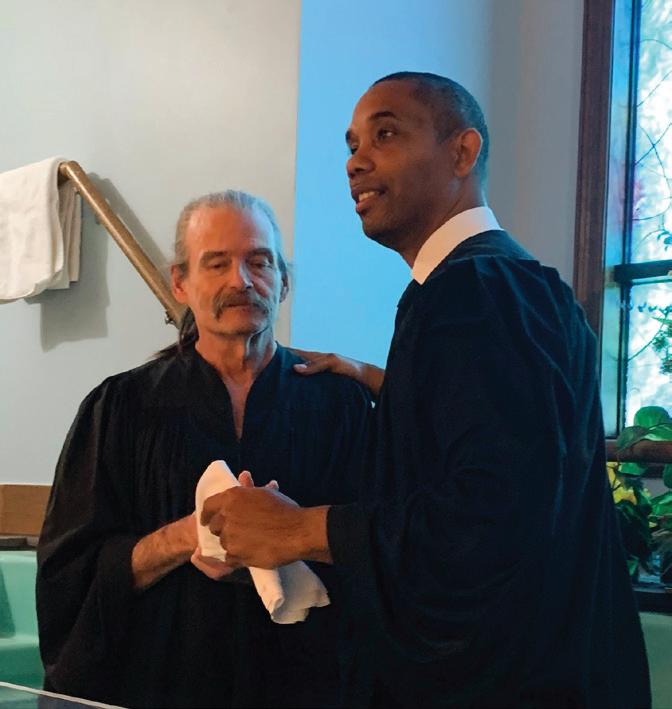
from the church during another difficult time. Smith continued to share the love of Jesus with Harris and, one Sabbath morning, Harris asked for a ride to church. After the service, he stayed for potluck and fellowshipped with many of the church members. Before leaving, Harris asked for Bible studies and Smith happily obliged. Harris soon answered the call of his Savior to be baptized.
LAKE CHARLES, LA. – Evangelism is defined as the spreading of the Gospel by public preaching or personal witness. Equipped with social media, friendship evangelism, Bible studies and pastors, we share the good news of Jesus’s love for His children. Through these methods, many souls are making life-changing decisions at the Lake Charles Seventh-day Adventist Church.
Karen Smith (pictured top right) was born and raised in Lake Charles, La. One day, her son was scrolling through YouTube and listening to different sermons when he landed on a sermon about the law of God. Smith’s son told his mom that she should tune in to the message and she was captivated by what she heard. She had never thought about Sunday being the first day of the week and Saturday being


the seventh day. As she continued to listen and searched for more sermons, she became convinced that she should keep the Sabbath. She searched online for Sabbath-keeping churches and discovered the Seventh-day Adventist Church. When she looked for a local congregation, Smith found the Lake Charles church. After three weeks of attending services, she decided she wanted to be baptized.
Friendship evangelism brought Matthew Martin Harris (pictured top left) to finding a new church home at the Lake Charles church. Harris was a client of Lake Charles member Wade Smith. When Harris fell on hard times, he reached out to Smith who financially blessed him and shared the Gospel with him. Several weeks later, Harris was blessed by a financial donation
Janice Borden (pictured bottom left) recently moved to the Lake Charles area. Borden was no stranger to the Seventh-day Adventist Church as she grew up in a very strict Adventist home and church. Her grandmother had not wanted Borden to get baptized at an early age. Borden attended church into her adult life. Shortly after arriving in the area, she started attending the Lake Charles church and immediately became actively involved. Malcolm Gibson, elder of Lake Charles church, and his wife Darla took a special interest in Borden and would invite her to open the Sabbath with them at their home. It was during these worship meetings that they learned Borden wasn’t baptized and they began doing Bible studies with her. In time, Borden made the decision to get baptized.

Impressed by the sermons of Hillis Jeffries, Lake Charles pastor, James Garret (pictured bottom right) decided to add his name to the church roster. Three years ago, Garret left his church because he wanted to keep all the commandments of God. He gave up eating unclean meats, which is a staple of Louisiana cuisine. He kept hearing the words of Jesus, “If you love Me, keep My commandments.” Since he was already baptized through immersion and was a faithful member of his former church, Garret joined the Lake Charles church through affirmation of faith. Garret was so excited for the day when he would become a member that he invited his entire family to witness him affirming his new vows.
By Rosemarie JeffriesMatthew 18:19-20 offers profound insight for carrying out ministry in church and school settings. Jesus said when two or three people agree on something and pray and ask God for it, He will grant the request. “For where two or three gather in my name, there am I with them.”
That’s a pretty amazing promise for church and school ministries. God promises to give you what you ask for. However, we must examine the promise’s context carefully. This is about doing ministry together in unity of mind and purpose, for Jesus’ sake and in accordance with His will. That is, when a group as small as two or three or large, and agree, have the same mind, feelings and opinion about the arrangements of affairs in the church or school and about things desired for its welfare, and shall ask of God, it shall be
done for them. It is assumed that after much prayer and seeking God’s direction, in harmony with His name or character they ask humbly and in unity, the promise shall be fulfilled.
We see here the need to put any selfish agenda aside and listen to each other’s thoughts. We should prayerfully come together in agreement and bring it to God. The context of these verses shows the importance of working together with others for a common purpose. It implies that more can be done together, that we are better together, that we need each other, and that more harmony is better for ministry. There is synergy that happens that cannot happen when we work alone. There are no Lone Rangers in Christ’s church and ministries. Jesus is especially among us when we seek to serve together and agree on a common goal.
Whatever ministry God may be calling you to do, find others to join you and seek agreement on a common goal or purpose. We are better together.
 By James Shires President

HARRAH, OKLA. – A group of students from Oklahoma Academy visited the Historic Adventist Village in Battle Creek, Michigan for the school’s mission week. After the students arrived, they moved into their lodging house for the week. The next morning after breakfast and worship, they began work.

Throughout the duration of the week, they helped with needed repairs and renovations on the historic buildings and grounds. The work included grouting a tile floor, painting a house and doing general cleanup on the grounds. On the weekend, they gave tours about our Adventist heritage to the many visitors. “It was great to see our heritage as Adventists in real life. Students hear about their Adventist heritage their whole lives, but seeing it in real life helps them realize it’s not just a story. It’s more than that. It’s how our church began. It was good for the kids to see that,” said staff sponsor Emmeline Schofield.
The girls also enjoyed dressing in period clothing, which helped them look authentic as they gave tours throughout the old village. Joy McCormick, a freshman, said that she “really enjoyed dressing up like Ellen G. White.”


Jolene Anderson, a sophomore, said, “I really enjoyed learning how to lay a tile floor. Grouting was something I had never done before. I really liked that part.” Kaity Rodman, a senior, enjoyed working the grounds. Her vocational assignment at the academy is grounds, and she knew exactly what needed to be done.
Don Scherencel, director of the Historic Adventist Heritage Village, told us, “It is really inspiring to see young people that do good, quality work. Most young people today are too engrossed in their phones to learn good work ethics. These kids have restored my faith in young people. Youth truly is the future of our Adventist church.”
God is at work among the youth of
Oklahoma Academy. Our theme this year is “Are You Ready?” We endeavor to train students that are not only ready to be missionaries wherever God may take them but are also ready for Christ’s return. Our mission week is one way of helping train these precious youth.
We’d like to give special thanks to Don Scherencel and the Historic Adventist Village for allowing us to spend that week with them. Thank you for showing our students about the origins of their church.

Pray for Oklahoma Academy as we continue to train young people to serve God. “Then I heard the voice of the Lord saying, ‘Whom shall I send? And who will go for us?’ And I said, ‘Here am I. Send me!’” Isaiah 6:8.
By Annelise JagitschEDMOND, OKLA. – On Jan. 28, 2023, members of the Abundant Life Adventist Church community service program gathered together in a spirit of joy and goodwill. Youth musicians played hymns on the violins as the members of the church came together to package meals and organize free clothing for the homeless in Oklahoma City. Once the meals were together and clothes loaded in cars, they hit the road and set up their tables in an accessible area for the homeless of Oklahoma City. It was a day of hope and selflessness, as the church members united to help those in need.

 By Marlowe Parks
OKLAHOMA CITY – Heads were huddled and voices low as groups of Pathfinders conferred on the correct answer to the question, “According to John 9:3, whom did Jesus say had sinned to cause the man to be born blind?” The Pathfinder Bible Experience is an exciting event that encourages Pathfinders to study and gain a better understanding of the Bible. This year, the event was held on Feb. 4 in three different locations throughout Oklahoma. Twenty teams met in Sulphur, Edmond and Tulsa to test their knowledge of the book of John. The memorization and recall were incredible!
Questions can come from any part of the assigned book and could be about the characters, the plot, the theology or the overall message of the book. It encourages Pathfinders to not just read the Bible but to take the time to study it and understand the meaning of the passages. The event also encourages teamwork and helps build relationships within the Pathfinder clubs.
Participation requires a great deal of studying, memorization and practice. The teams that participate each
year come from clubs all over the state. During the competition, teams answer questions on the book of the Bible they have been studying in a quiz-bowl-style format. This year, 10 of the 20 teams advanced to the conference level Pathfinder Bible Experience which was held at Wewoka Woods Adventist Center on March 4, 2023.
This event is a great opportunity for young people to learn more about the Bible and to practice their knowledge. It also gives them a chance to meet and interact with like-minded individuals from all over the state. We are so excited to get together again and see what these young people are learning about the Bible and who will be heading to Southwestern Adventist University for the Southwestern Union Pathfinder Bible Experience and beyond!
Many thanks to the club leaders and parents who help their club members. They are helping to spread the good news and equip people with the knowledge and spiritual tools needed to lead a life that is pleasing to God.

 By Ashley Alipoon and Caroline Fisher
TULSA, OKLA. – “Magnify the Lord!” The voices of more than 200 students rang clear and loud at the Oklahoma Music Festival on Feb. 5. What an incredible and inspiring night! Under the direction of Erwin Nanasi, and with organizers Adam Littell and Carol Thomas in charge, seven schools from around the state gathered at Adventist Fellowship Church in Tulsa for a wonderful evening of praise and worship. This was the first music festival since 2019, and there wasn’t an empty seat in the house!
The festival began with a welcome from James Shires, Oklahoma Conference president, and a prayer by Adam Littell, Oklahoma Conference director of education. Annette Park managed the logistical side of the production, and Caroline Fisher accompanied the students on the piano. The schools that participated were Parkview Adventist Academy, Tulsa Adventist Academy, Ardmore Adventist Academy, Bristow
Adventist School, Claremore Heritage Adventist School, Pioneer Adventist Christian School and Muskogee Seventh-day Adventist Christian School.
Nanasi said he “was privileged to conduct the mass choir during the music festival! Just to think that the kids are the leaders of tomorrow filled me with joy and awe. The spirit of unity among our conference leadership, teachers, parents and kids was palpable. God is so awesome! Hallelujah!”
Each school performed individual pieces ranging from traditional hymns to the Judaic “Shalom Chaverim” before the students assembled for mass choirs. Malachi Speidel from Ardmore directed the Second Advent Medley, a mashup he crafted himself, while Kurt Paden, a student from Muskogee, accompanied his fellow students on the guitar. It was awe-inspiring to see these students take charge of a project and make it their own. The teachers of the
Oklahoma Conference deserve immense praise for encouraging their students to explore their creativity through music and for recognizing and nurturing their potential.

The highlight of the night was when all seven schools joined together to perform the last few songs of the evening. As the music filled the air and the students’ voices rose in harmony, it was as if the angels in heaven were singing along in unified worship!


This program is possible due to the tireless efforts of our dedicated team of teachers both at their school to practice the pieces and at Adventist Fellowship to supervise their students all day. It took a team to make this program happen, and we have an amazing team!”
By Ashley Alipoon
MUSKOGEE, OKLA. – The Muskogee Seventh-day Adventist Christian Academy recently held a shoe drive fundraiser sponsored by Funds2Orgs. Seventeen bags of new or gently-used shoes were collected, and they will be sent to impoverished areas. This effort not only helps those in need, but also benefits our school. First, we are doing our part to help those in need, and second, we receive funds for collecting the shoes.
We are proud to announce that our shoe drive raised $166 for our school. We are beyond thrilled with the success of our shoe drive because of the sheer amount of shoes we were able to collect. We are grateful to Funds2Orgs for giving us this opportunity. We are proud to be able to help those in need and to raise funds that will benefit our school. We look forward to organizing more fundraisers like this in the future.
By Cindy Adams

The book Seventh-day Adventists Believe: A Biblical Exposition of 27 Fundamental Doctrines says, “The church is the community of believers who confess Jesus Christ as Lord and Savior. It is the body of Christ, a community of faith of which Christ Himself is the Head.” When I consider this definition, then the church is the active, living hands and feet of Jesus, and our communal society’s understanding of Jesus is often viewed through the lens of the church in word and deed.
In Matthew 25, Jesus juxtaposes sheep versus goats and their actions. Sheep are metaphorically characterized as those who meet the needs of people as expressed through feeding the hungry, clothing the naked, visiting the sick, etc. As members of the body of Christ, church members are called to live their lives as sheep in harmony with the life of the Shepherd, Jesus Christ, in order to reach people for Him.
In The Ministry of Healing , Ellen G. White states, “Christ’s method alone will give true success in reaching people. The Savior mingled with men as one who desired their good. He showed His sympathy for them, ministered to their needs, and won their confidence. Then He bade them, ‘Follow Me.’”
We are reminded daily of the imminence of Christ’s Second Coming as the events of Matthew 24 are happening before our very eyes. Given this reality, the Church should passionately and aggressively intensify its efforts to build God’s Kingdom. As Jesus reached people through relevant means in His day, the Church has to do the same in our day. God’s Kingdom must still be built and expanded, yet we have to ask ourselves the questions, “Are we really reaching the needs of people? Is what we’re doing effective? Is what we’re doing relevant? Are we ‘scratching’ where people are ‘itching?’”
Through evangelism, Adventist education, church ministries, community engagement and worship opportunities, we have the grand opportunity to build on the foundation that Jesus established nearly 2,000 years ago. Jesus said, “Upon this rock I will build my church; and the gates of hell shall not prevail against it.” Matthew 16:19 (KJV). Our founder, Jesus, is depending on His church to fulfill the gospel commission He gave to us just prior to His ascension, “Go ye therefore, and teach all nations, baptizing them in the name of the Father, and of the Son, and of the Holy Ghost. Teaching them to observe
all things whatsoever I have commanded you: and, lo, I am with you always, even unto the end of the world.” Matthew 28:19-20 (KJV).
Coca-Cola makes beverages, Dell makes computers, McDonald’s makes hamburgers, Boeing makes airplanes, but the Seventh-day Adventist Church makes disciples of Jesus Christ! It wins men, women, boys and girls for Jesus! Friends, let’s build God’s kingdom! Let’s win individuals for Jesus! And let’s do it together!
By Carlton P. Byrd, D.Min. President
TEXARKANA, TEX. – Bethel Adventist Church School put on a play on Feb. 18, 2023 with Buford Griffith, III leading out with the vesper thought. Immediately following the vesper thought, church members and students of Bethel school presented the play entitled “The Devil on Trial.” There were witnesses from Adam and Eve to Annanias and Sapphira. Even poor Peter had an undercover witness to testify–the cutest little rooster with the sweetest cock-a-doodle-doo report. Samson and Delilah were also part of the play, portrayed by
ARLINGTON, TEX. – What an amazing idea for evangelism! Women, in general, love camaraderie. Every woman enjoys coming together laughing, hugging, sharing, dressing up and sipping tea among friends. No need to mention the thrill of elegance, flowers and fragrance. Women love making friends and sharing the love of Jesus, which is a stupendous way to make new, long-lasting friendships.
The Southwest Region Conference women’s ministries department successfully introduced “Tea Among Friends,” an evangelistic training initiative on Jan. 14, 2023, at the Ebenezer Spanish Seventh-day Adventist Church in Arlington, Tex. The presenters were Leslie Soupet, assistant pastor of the Ebenezer church; Nilda Diep, Texas Conference women’s ministries Spanish coordinator; and Anysia Archibald, Southwest Region Conference women’s ministries coordinator.
On Jan. 21, 2023, the department conducted a second evangelistic training at the Central Regional Spanish Seventh-day Adventist Church in Houston, Tex. The presenters were Nora Rosa-Paez, Southwest Region Conference ministerial spouses association treasurer; Patricia Rangel, North Central Tex-

Christopher Manuel and his wife, Shanequa Manuel. Of course, the devil was found guilty and sentenced to death in hell’s fire never to tempt and torment the universe again.
Lieutenant Mark Shemer and his wife, of Nash, Tex., along with Fire Chief Bruce Dinsmore and his wife, of Wake Village, Tex., were honored with a plaque for their continued service not only to Bethel Adventist Church School but to the community at large.
 By Sandra Clemons Principal/Teacher
as Spanish women’s ministries district leader; Montserrat Varona, Houston Bay Area Spanish women’s ministries district leader; and Anysia Archibald.
The women decorated each location elegantly with flowers, teapots, teacups and an array of tea flavors and delicate treats. All attendees actively participated in the training, which included Ellen G. White’s inspirational thoughts, how to engage “together in mission,” secrets to making decisions, steps to accept Jesus as your personal Savior, helpful biblical texts and so much more.
The training included information on personal etiquette and the history of tea. It also gave everyone the tools to succeed and bring a friend to Jesus. We finalized the training by providing each women’s ministries leader with
the necessary resources to begin training at their respective church. Women’s ministries is committed to evangelism in 2023 through “Tea Among Friends!” We are making friends, reaching hearts and touching lives. We know and understand there will be no crown without stars in Heaven! The women of the Southwest Region Conference say, “Yes, Lord, We Will Go” to the question: “Whom shall I send?” By God’s grace, we are moving with determination. Training in English throughout the conference territory is happening now through July 30. Visit TeaAmongFriends2023.eventbrite.com to learn more.
By Nora Rosa-PaezHOUSTON – On Jan. 14, 2023, Berean Seventh-day Adventist Church of Houston, Tex., celebrated the life and legacy of Claudia Jones Lewis affectionately referred to by many as “Mother Lewis”. Mother Lewis turned 95 on Jan. 19, 2023. The celebration consisted of a service and an afternoon luncheon for Mother Lewis.
During the divine worship experience, Congresswoman Sheila Jackson Lee presented Mother Lewis with a proclamation and a flag that was flown over the capitol in Washington D.C.
Lewis also received proclamations from the mayor’s office, the Office of Commissioner Rodney Ellis of Precinct 1 and the Houston Pastors Ministerial Association.
Videos of birthday salutations were sent in by the Southwestern Union President Carlos Craig and Southwest Region Conference President Carlton Byrd, D.Min. The accomplishments of Mother Lewis were read and noted in the proclamations presented from each city and government official.


Her accomplishments were inspiring. She finished high school at the age of 16 from Jack Yates High School and attended Southern University in Baton Rouge, La. She became a registered nurse, obtained a degree in commercial and residential real estate and received a degree in property appraisal.
She has been a trail blazer, entrepreneur, mother, aunt, spiritual leader and so much more. The many accomplishments that she achieved in her life were incredible. She married the love of her
life and, after visiting the Berean Seventh-day Adventist Church, she left Catholicism and joined the church where she is still an active member. She has held several local church offices, as well as the organizer of the Southwest Region Conference deacons and deaconess. Mother Lewis is a living testimony of what happens when a person surrenders their life to God. According to Mother Lewis, “if you want to live as long as I do, love the Lord like me!”
By Robert Norwood
MISSOURI CITY, TEX. – Dec. 17, 2022, was a special day at the Metropolitan Seventh-day Adventist Church. Three souls have given their lives to Jesus Christ: Rouenn Baysa, Joshua Escasinas and Lissett Cardona.

Rouenn’s mom shared that he had been begging to be baptized for over a year. Although both she and her husband thought Rouenn was too young to make that decision, the mother could only hear these words in her head, “Suffer the little children to come unto me and forbid them not, for of such is the kingdom of Heaven.” “We could not bring ourselves to say no. She was so very excited,” said the mother. Rouenn Baysa was so happy to be baptized by her grandfather Rolando Baysa, pastor
of the Metropolitan church.
Joshua Escasinas, an active Pathfinder, decided to accept Jesus as his guide and to become a role model to his sister and peers. After he rose up from the water, his co-Pathfinders cheered so loudly with joy!
Witnessing Lissett Cardona’s baptism were her husband and daughter. “I want to have a better relationship with God and be a good role model for my daughter,” said Cardona.
We pray for these three souls who have given their lives to Jesus that they may be nurtured as they walk with Him each day.
By Beth DeGraciaNEW ORLEANS – On Aug. 29, 2021, the Ephesus Seventh-day Adventist Church officially closed its doors. Hurricane Ida caused severe damage to the building, making it impossible to worship in. This injured the members’ hearts but not their resolve. The members went into rescue mode, trying to determine where to continue in-person worship services. Prior to the hurricane, Ephesus church held virtual and in-person services every Sabbath. Now with no sanctuary to worship in, the question became “what should we do?”
The Westbank United Seventh-day Adventist Church welcomed the Ephesus members with open arms to worship with them. Opportunities to merge activities of various ministries were available, as well as the pastors sharing the pulpit.
During this time, Harold Goodloe, pastor of Ephesus church, continued his virtual early morning devotion program to encourage and connect with the members. The Ephesus church con -
tinued to connect with the neighbors in the area surrounding their church on Delachaise street. Each quarter, the church had a food distribution event for the people in the neighborhood. The goal was to let the community know they are still our neighbors even though we are not physically there and we will be back!
The members of Ephesus enjoyed worshiping with Westbank church but felt it was time to find a place where they could worship again as a group. The Franklin Avenue Baptist Church was available and it appeared to meet the needs of the church. The members were delighted to be together again. Attendance began to rise at the in-person Sabbath service. Various events took place at this location. The Discover Bible School of Knowledge with the Voice of Prophecy was implemented in March 2022. Members were on fire to spread the Gospel of Jesus by enrolling people in the Bible school. The Breath of Life Revival with Debleaire Snell,
M.Div., was Sept. 14-17, 2022 which continued to encourage the flames of evangelism.
In October 2022, the members felt that it was time to move back to the neighborhood during the reconstruction of the church. Greater Bright Morning Star Missionary Baptist Church, which is a block from the Ephesus site, opened its doors and hearts to Ephesus on Nov. 5, 2022. The church went into evangelism mode and an evangelistic meeting was held Nov. 11-19. Over 40 individuals joined the Ephesus church and the body of Christ!
The future of the physical rebuilding of the Ephesus church is moving forward and the members are excited about the new structure. As the members watch the reconstruction, they continue with the mission which is the church’s vision for 2023, “Kingdom Living, Kingdom Giving and Kingdom Building.”
By Patrice HaywoodNotice is hereby given that the Fifth Quadrennial Session of the Southwest Region Conference of Seventh-day Adventists will convene Sept. 23-24, 2023, at the Keene Seventh-day Adventist Church in Keene, Tex. Registration for the session is scheduled to begin at 7:45 p.m. Saturday night, Sept. 23, 2023. The purpose of the session is to elect officers and departmental personnel for the ensuing quadrennial term, and to transact such business as may properly come before the session. Each church is entitled to one (1) delegate for the organization and one (1) additional delegate for each forty-five (45) members or major fraction thereof and who holds membership in the local church or company, which accredits them.
Carlton P. Byrd, President; Jason C. North, Sr., Secretary; Philip G. Palmer, Treasurer
Notice is hereby given that the Fifth Quadrennial Session of the Southwest Region Conference Association of Seventhday Adventists will convene Sept. 23-24, 2023, at the Keene Seventh-day Adventist Church in Keene, Tex. Registration for the session is scheduled to begin at 7:45 p.m. Saturday night, Sept. 23, 2023. The purpose of the session is to elect officers and departmental personnel for the ensuing quadrennial term, to consider revisions to the constitution and bylaws, and to transact such business as may properly come before the session. Delegates to the Southwest Region Conference of Seventh-day Adventists Fourth Quadrennial Session are also delegates to the Southwest Region Conference Association.
Carlton P. Byrd, President; Jason C. North, Sr., Secretary

When God created the world, it was one. It wasn’t fractured or broken. It was beautiful. Every time there is a conflict, it begins with a disruption. And usually, at the core of that disruption or conflict is sin. The Hebrew word for sin is “chata’ah.” We often think of “chata’ah” as an archery term, to miss the mark, but the word means “to lack.” When someone chooses to sin, what they are doing is diminishing themselves.
When I sin against someone, I make that other person less than God intended and created them to be. I push them down, creating a distance and a divide. And when made to feel “less than,” what many do is fight—wanting to pull themselves up while pushing someone else down. It happens all around us.
In Matthew 18, Jesus paints another way. It’s not about reacting. It’s not about fists. It’s not about avoiding. It’s about having your hands wide open. It’s about believing in what a relationship could be. It’s about responding to conflict. Verse 15 says, “If your brother or sister sins against you [chata’ah] go and point out their fault, just between the two of you. If they listen to you, you have won them over.”
The Scriptures are clear. Go directly to that person and show them what they’ve done.
Let’s be honest. What usually happens? Doesn’t the offended go to one friend (or more) and share. “Can you believe what _____ did?” When they do that, instead of talking with the initial person, they are essentially doing the same thing that was caused to them. They are lessening the perspective that these friends have of that person.
If someone made you feel less than what God intended you to be, will you declare right now: I will not be the kind of person who goes off and whispers, posts and talks about them behind their back, but I will go to the person.
Fighters tend to care about the issue and making sure they win. It’s a competition to them and they demonstrate that they don’t care about the relationship. Avoiders also don’t care about the relationship. They don’t want to put themselves out there. They want to protect themselves.
The Matthew 18 way is believing that conflict isn’t always bad. It has faith that God can do something in the midst of it and reconcile, reunite, restore and renew. It enables you to value the relationship over yourself or the issue truly.
“Mercy and truth have met together; Righteousness and peace have kissed,” Psalm 85:10 (NKJV) shares. The psalmist is not just talking about core values,
it’s almost like each of those four words is people. And if you want true reconciliation, you must bring all four words to the party to bridge the gap, chasm and divide between two people.
We’ve got to learn how to communicate all four—truth, mercy, justice and peace—or we risk having even more conflict.
Let’s pray that we have the right tone. That we engage in a way that causes no distance, divide or gap. That there be oneness and wholeness that would model what God created this world to be in harmony and tune.
 By Elton DeMoraes, D.Min. President

KEENE, TEX. – For the second time, Texas Conference Adventist Community Services (ACS) held a giveaway at its warehouse in Keene, Tex., earlier this year. Church leaders could reserve a time to pick up items provided by various donors, Federal Emergency Management Agency (FEMA), retail stores and other faith-based organizations.
“Our church families are great for helping us to get the donated items to those who need it most,” Bo Gendke, Texas Conference ACS director, shared. He and his wife, Deborah, serve the Texas Conference and the Southwestern Union territory. “Serving in both roles keeps us busy, especially during disasters.”
The ACS giveaway provides an excellent way for church members to “love on their community,” as the Gendkes refer to helping in each area. “Some churches just need a boost to get out of the pew and into the community, and we hope to provide that,” Gendke shared.
Church leaders give the items away in different ways. Some invite people to the church for a free meal and complimentary shopping time to choose items they need. Others go to the streets to find those living without or with little shelter to share blankets, jackets and other necessities. “We also encourage the churches to contact their city officials,” Gendke added. “It is important we work together to help those in need.”
Following the 30-minute reserved pick-up time, individuals were there to give a prayer of blessings with the church leaders and members before they left, as only the Lord knows who will receive the much-needed items and what a blessing it is for the giver and receiver.


“We are a Church that knows prayer works!” Gendke stated. “Prayer is truly the reason our warehouse is bursting at the seams. We asked God to help us reach and care for other ministries besides disaster response and used cloth -

ing. He has answered our prayers very loudly, and we can now help those in [other] ministries.”
This past fall, a “Victory Vault" was created at the warehouse to provide clothing for those entering the workforce. It is in addition to the clothing kits created for those in disasters.
“God has made it very clear to us,” Gendke added, “if we get these resources to the churches to distribute to their communities, He will continue to fill the warehouse.”
Please keep the Texas Conference ACS and its leadership team in your prayers as they work to serve those in need. Find more information and ways to give at Texas-ACS.org. View photos from one of the giveaway events at Flickr.com/TexasAdventist under “ACS Care Package Day.”
By Tamara Michalenko Terry Associate Director for Communication & Public RelationsFAIRVIEW, TEX. – From Jan. 11-21, 2023, members of the Fairview Mosaic Christian Fellowship Seventh-day Adventist Church in Fairview, Tex., joined our brothers and sisters around the globe for the 10 Days of Prayer event initiated by the General Conference of Seventh-day Adventist Church and promoted by the Texas Conference of Seventh-day Adventists.
During this time, God was so gracious and showed His kindness and power in wonderful ways. We knew going in there is power in prayer, but we felt a miracle from God as we gathered in one place, in one accord, praying and fasting.

Our prayer ministries leader, Sue Monroe, had an idea to have a fire pit during the event. Her goal was to make sure that people would pray and do so with others to increase their trust in God. “When I heard the title was Back to the Altar,” Monroe shared, “I had been reading about Moses and Noah. After their experience with God, they each memorialized it with stone altars. I wanted to do that through a fire pit.”
Looking to purchase a fire pit, she soon noticed that they were pretty expensive. So she prayed, telling the Lord, “This is your thing; this is your money; we want to spend the money you’ve given us on the most important things.” After her prayer, she felt

impressed to go to the tractor supply store. When she got there, she asked if they had any fire pits.
After they showed her the expensive models, she asked if they might have anything plain. She was directed to some fire pits on display outside the store. That is when one caught her eye. It had some rust but seemed O.K. otherwise. With a price tag of $99, she pointed out the rust to the manager hoping for a discount. The manager offered her 50 percent off. They gave her an additional $25 off when she went to pay. What an incredible answer to prayer.
Shortly before the event’s launch, Monroe made arrangements for the head deacon, Edsel Mendoza, to set up the fire pit. Learning that he recently had a house fire, she wasn’t sure if he could still complete the request. Yet, there he was on the first day, setting up everything. Monroe was touched by his sacrifice and by the providence of God.
That first night, more people were in attendance than she had expected, so she had to make more copies of the handouts. She felt everyone was so engaged, seeing the need for direction by God.
As I listened to her testimony, I was reminded of a similar scene in the Bible in the book of Acts, “They all joined together constantly in prayer…” Acts
1:14. “When the day of Pentecost came, they were all together in one place.” Acts 2:1. We all remember what happened at that time. God poured out His Spirit and moved powerfully among His people. Just like the narrative in Acts, we saw God do extraordinary things throughout our prayer meetings.
We had a few adults, but we also had youth, teens and children join us. A new member joined us, confiding that this was the first time he had personally prayed with people. We prayed in groups and individually. We worshiped, confessing, praising and praying. God gave us the Holy Spirit, as the presence of the Lord truly came into the room.
“My faith increased,” Monroe added. We experienced the joys of answered prayers, but more than that, we got to know God more deeply through the personal fellowship with Him. In light of all that God has done in this short time of dedicated prayer, I find myself wondering, What if we didn’t stop praying? Prayer is a beautiful and awe-inspiring gift. God still wants to show us His love. He desires that we draw closer to Him into a closer personal relationship. Let’s pray for God to work in mighty ways in our lives.
By Moises LopezALVARADO, TEX. – The Alvarado Seventh-day Adventist Church is ready to build a new facility. It’s been years of design planning and several delays, but God has been answering prayers and opening doors, and now the project is underway! “We are moving in faith, trusting our God that He will help us to succeed,” said Valeri Tchounkovskii, pastor, referring to Nehemiah 2:20.
In 1976, several families from Keene, Tex., started a Sabbath school that eventually formed an official congregation. The slab for a church building was poured in December of 1978, with the fellowship hall added to the new building in 1979. In 1993 there was a desire to have a church school, so the current gym was built for that purpose.

One of the founding members, Jean Bruce, said, “I am so excited to see how this church has grown and am looking
forward to the much-needed new facility.” It will have a seating capacity of 200 that will be built between the existing old church building and the gym.
Don Bowersox, building committee chair, stated, “We look forward to working with Maranatha Volunteers International, who will help us frame the structure May 14-28, 2023. They asked us to assemble a team of skilled volunteers, so we are appealing to anyone who would want to help!
In addition to prayers and financial support, volunteers are needed to help with the food, as three meals a day will be offered to the volunteers. If you want to spread God’s light in Alvarado and help on a Maranatha project, we would love to have you partner with us! Contact Don Bowersox at 817-219-3722 or LoriBowersox@yahoo.com or Chuck Easley at Chuck.Easley@yahoo.com for more information.
By Terrie BaylessNotice is hereby given that the Quadrennial Constituency Session of the Texas Conference of Seventh-day Adventists will convene at the Killeen Civic and Conference Center at 3601 South W.S. Young Drive, Killeen, Tex. 76542 on Sunday, June 11, 2023, at 9 a.m. The purpose of this meeting is to elect executive officers, vice presidents, directors and associate directors for the ensuing quadrennial term, to consider changes in the Constitution and Bylaws and to transact business that comes before the constituents. Each church shall be entitled to one (1) delegate for the organization and one (1) additional delegate for each sixty (60) members or major fraction thereof and who hold membership in the local church which accredits them. Such delegates shall be voted by the business meeting of their respective local church.
Elton DeMoraes, President;David Montoya, Executive Secretary; Randall
Notice is hereby given that the Quadrennial Constituency Session of the Texas Conference Association of Seventh-day Adventists will convene at the Killeen Civic and Conference Center at 3601 South W.S. Young Drive, Killeen, Tex. 76542 on Sunday, June 11, 2023, at 9 a.m. The purpose of this meeting is to elect twenty-one (21) persons, including officers [president, who shall be the president of the Texas Conference of Seventh-day Adventists (an unincorporated body), one or more vice presidents, one or more secretaries, and one or more treasurers], to act as directors for this Corporation, at least eleven (11) of whom shall be laypersons. All shall hold their offices for the ensuing quadrennial term or until their successors are duly elected and appear to enter upon their duties. Delegates may also consider changes to the Bylaws. Delegates, regular and at-large, duly accredited to the Quadrennial Constituency Session of the Texas Conference of Seventh-day Adventists are also delegates to the Texas Conference Association Quadrennial Constituency Session.
Elton DeMoraes, President; Lynette Ecord, SecretarySunday, June 11, 2023 | 9 am
The quadrennial session is available to view for the first time via livestream.

Church-elected delegates, however, must attend in person to vote on agenda items.
Livestream viewing options
Facebook or YouTube @TexasAdventist Watch
TexasAdventist.org

Heraclitus, an ancient Greek pre-Socratic philosopher once said, “there is nothing permanent except change.” There are a lot of people who hate change. For some, change stirs strong emotions like sadness or anxiety, and for others it is just easier to keep things the way they are. Nevertheless, like Heraclitus said, change is inevitable.
Our world has changed drastically in the last 10 years. Even within the Church, things have changed, including how it operates and how we do ministry. We have experienced some of that change in the Texico Conference and I see churches tackling relevant and important issues more than ever before. Churches are getting more involved in their communities, meeting their communities’ needs and extending a helping hand. Our church ministries are thriving.
During the COVID-19 pandemic, I had the opportunity to help one of our conference pastors take food to people who could not leave their homes. Most recently, the El Paso Meraz Spanish Seventh-day Adventist Church was actively assisting immigrants across the United States border by providing food, tents, clothing and other everyday necessities. I was able to join their efforts and it was a blessing to talk and pray for many of them. It was an even bigger blessing to see that the church
was working to meet their spiritual needs, as well.
Church growth and change can take many forms, depending on the ministries and mission of the individual church. Nonetheless, change is important because it is an indicator that a church is not stagnant. According to Cheyenne Bryant, a psychology expert, “change prunes things, circumstances and people that are not serving our better and highest good.” In other words, change can help get rid of things that are not serving us. That same principle goes for our churches. Change prunes and can help a church thrive. I enjoy gardening, and when I prune my trees and plants, they multiply! The process is not always easy or feels good, but in the end, it can be the difference between a church that is prospering or one that is not.

Our goal as a Church is to allow the Holy Spirit to work and bring about change, not only in our lives, but in the lives of others. 2 Corinthians 3:18 says, “and we all, who with unveiled faces contemplate the Lord’s glory, are being transformed into his image with ever-increasing glory, which comes from the Lord, who is the Spirit.” Romans 12:2 states, “do not conform to the pattern of this world, but be transformed by the renewing of your mind. Then you will be able to test and approve what
God’s will is—his good, pleasing, and perfect will.”
Both these Bible texts encourage change and transformation by telling us to contemplate and keep our eyes fixed on Jesus. He will guide us, and show us where the change needs to take place, both in our personal lives, and within our churches. Moving forward, I invite you to look at change as something less hurtful, and instead look at it as something helpful that can enhance our Christian experience. My prayer is that we continue to see change in our churches and that we look to Jesus for His Infinite transforming power and goodness.
By Lee-Roy Chacon President
CORRALES, N.M. – It is with great pleasure that we welcome and introduce Tobin Savage and Joslen Lache as the newest pastors of the Texico Conference. Savage recently began serving the Grants, Pie Town, Crown Point, Gallup All Nations and Reserve Seventh-day Adventist churches. Meanwhile, Lache was welcomed to the Albuquerque North Valley, Albuquerque La Roca and Bloomfield Spanish Seventh-day Adventist churches in January.
“We are thrilled to welcome these dynamic pastors into the Texico pastoral family,” said Texico Conference President Lee-Roy Chacon. “They both bring different skills, talents and lived experiences to their positions. We have no doubt that God will continue to use them in His service.”

Savage (pictured left) has a diverse and seasoned background. He has pastored several churches, taught at Holbrook Indian School for several years and worked as an electrician/instrument technician for the Chevron Pipeline Company. Most recently, he served two churches in the Rocky Mountain Conference and is working on completing his master’s degree. Savage has a passion for building relationships, teaching, outreach and finding
creative ideas for evangelism. His wife Rebekah, is a special education teacher who is also active in Sabbath school and women’s ministries activities. She is an invaluable support and resource to Savage’s ministry.
Lache (pictured center) is a graduate of Southern Adventist University. Upon graduating he moved to the Carolina Conference as a district pastor and associate volunteer lay pastor director for Hispanic ministries. Lache is the first to serve as an associate pastor in a Spanish district in the Texico Conference.
Lache is happily married to Ana Lache. Both were born on the island of Cuba and grew up in New Jersey and Florida respectively. They have been married and serving together in ministry for almost two years and, in 2022, God brought a wonderful addition to their lives through the birth of their daughter, Angelina Lucia. Joslen and Ana work as a team and they share a deep passion to help those who struggle in our society. Through their music and street outreach they want to connect with those in need of God so they may know that Jesus is accepting of all.
The Texico Conference is also excited to welcome back Ricardo Castro (pictured right) who recently complet-
ed his Master of Divinity degree at Andrews University. Castro will be serving a Central New Mexico church district and will be pastoring the Belen, Los Lunas, Socorro and Truth or Consequences churches.


“After a wonderful time at the Seminary, my family and I are glad to be back in the Texico Conference!” said Castro. “We are so privileged to work under such loving and wise leadership and look forward to being a blessing in our new district. We appreciate and welcome all prayers in this great undertaking for God’s glory.”
The Texico Conference is grateful that God led Savage, Lache and Castro to our territory, and we anticipate the great blessings that God will bestow through their ministry.
By Debby Márquez Communication Directorfavoring the more relational style with simple two or three Bible passages and discussion questions. Subsequently, at the El Paso Central church, we have moved our three large sanctuary Sabbath school classes into the Fellowship Hall to carry on this table group approach that is more relation-based and discipleship oriented.”
The El Paso Central church has asked the members to try this method for the first quarter of 2023 and report back to the church board as to how they wish to proceed in the future.
EL PASO, TEX. – The El Paso Central and Northeast Seventh-day Adventist churches kicked off 2023 very united. After many months of planning, the vision of Eliab Quiñones, pastor of El Paso Northeast Seventh-day Adventist Church and the pastor of El Paso Central Seventh-day Adventist Church, Ray House, took place the first two weekends of January. The two churches combined services for the “One Church, One Family” event.
More than 200 people attended the successive weekend events which included a vespers and Sabbath school program, worship service and Bible
study gatherings. There were several breakout seminars that were presented by local speakers and leaders of the Texico Conference. The seminar topics were broad enough to allow attendees to find an engaging topic in which to gain knowledge. The topics included mental health, family, marriage, Christian disciplines, leadership, finances, archeology, dinosaurs and creation.
“People were very interactive in the Sabbath school table groups, using the discipleship styled lessons designed by the South Pacific Division,” said House. “I promoted this as a new way to do Sabbath school in our churches,
The Friday night vespers connected to the weekend were highlighted by two excellent presentations by David Merling, Ph.D., former professor of Archeology at Andrews University and Art Chadwick, Ph.D., Professor of Biology and Geology and director of the Dinosaur Science Museum and Research Center at Southwestern Adventist University in Keene, Tex.
Overall, the “One Church, One Family” event was an exciting church ‘community-building’ event that proved to be successful. The El Paso Central and Northeast churches look forward to coming together again soon.

CORRALES, N.M. – In 2019, plans were created, and several donors stepped up to partner with the Texico Conference to help make a new soccer field for Sandia View Academy (SVA) a reality. The COVID-19 pandemic put the plans on hold, but we are pleased to share that construction of the new field began in December and is quickly progressing.

The new soccer field, which is being built on the north end of SVA’s campus, will have natural turf, sports lighting and will serve as the home for SVA soccer and other physical education activities. The field is also part of a master
plan for a new academy facility when funds can be made available and student enrollment increases to create a greater need for instructional and other educational support areas.
“It will be exciting to have this wonderful new athletic area available for use by the students in anticipation of being involved in a soccer league and for intramural play as well as being available for church groups to use,” said Phil Robertson, Texico Conference executive secretary/treasurer. “There is great enthusiasm for this project as it is another step forward in the develop -
ment of the new SVA facility.” We anticipate that this new field will be ready for use for the 2023-2024 school year.
ALBUQUERQUE – Last December, the Albuquerque Central Seventh-day Adventist Church presented their annual Christmas program. The church was thrilled to welcome approximately 250 attendees, including some who had never been to an Adventist church, to come and enjoy the program. Everyone was invited to a reception in the fellowship hall following the event.
The program’s theme, “The Nativity,” centered around the church’s children and started with a dramatization of Mary and Joseph’s journey to Jerusalem as they traveled to pay their taxes. Amanda Dady, Rachel Avery, Ann Richards and Anneke Conyne worked for several months to make authentic backgrounds which included scenes


of the tax collector booth, the inn, the manger and the house where the Magi brought their gifts to Jesus.
The play featured a mix of Christmas music with the congregation participating in some of the songs. Halfway through the program, an offering was taken up to help a family that had lost their home in a fire a few weeks before. The last part of the program was filled with vocal and instrumental arrangements from members of local churches.


Christmas is an ideal time for outreach, and it is our hope that the name of Jesus Christ was praised with music and rejoicing during this time. We also hope our community was blessed and look forward to doing it again soon.
By Johnny MataBIG SPRING, TEX. – The Big Spring Seventh-day Adventist Church is a small rural church in Big Spring, Tex. In 2006, the church found itself childless. As time passed, Big Spring felt the loss and missed the sound of little feet pitter-pattering in the aisles and the sweet smiles of children. The church members took this absence to heart and felt convicted to pray. After nine years of prayer, Brayden Mogaka, was born in June 2015. Still, the church continued to pray.
In April 2016, another child was born, Launa Ausbie. In May 2017, a Kenyan family joined the church who had a little girl named Ruth Ole Nagol. Before long, there were two births in 2018, just four months apart, Gia Hayley and Brielle Mogaka. The church was beginning to thrive and flourish with the presence of children again.
Shortly after, Rochelle Hayley formed a parent’s group that began to meet twice a month and the parents agreed that they would start an Adventurer’s
club for their children. After a year of planning and preparing the parents to venture into this exciting time in the church’s history, the Young Sowers Adventurer’s Club was formed in August 2022. The church elected Ibrahim Ole Nagol as director of Adventurer club and Andrea Loya as deputy director.
On Nov. 19, 2022, 12 children were inducted into the club by Eliseo Mauricio, Master Guide and Adventurer area coordinator for West Texas. Abner Ra -

Since he was a little boy, Cesar wanted to be baptized. “I was happy that it was finally happening, and I liked studying with my dad,” said Cesar. He was also excited to be baptized alongside his sister Breanna. Both Cesar and Breanna attribute their father as being the greatest influence in their lives. After joining his father’s Bible study, Cesar now feels more confident when speaking with other people.
zon, Big Spring’s pastor, presented the message and had a dedication prayer for them. The induction service was the highlight of the worship service and the children participated in a beautiful program.
The children are committed to dedicating their lives to Jesus and along with their parents, the church is dedicated to helping them grow and learn about Christ as their Lord and Savior.
By Angela CruzODESSA, TEX. – The Odessa English Seventh-day Adventist Church is rejoicing after the baptisms of Jabari Campbell, Cesar Silva, Jr. and Breanna Silva. All three are a part of the Odessa Light Bearer’s Pathfinder Club and are actively taking part in church activities.

“Without him, I wouldn’t be at this point,” said Breanna. “He has helped me be a better person in my life.”
Breanna had been wanting to be baptized and felt like the experience was building up to that moment. Breanna’s encouragement to those considering baptism is, “prepare for it and be willing.”
Jabari Campbell’s friends at church positively impacted him in making his decision. “Seeing all the baptisms happening was inspiring,” said Campbell.
The Bible studies for the baptism process also made him “happier and happier.” The most influential person in Campbell’s life is his grandmother and he admires her hard-working spirit. He is also grateful to the Pathfinders in his church for helping him learn more about God.
The Odessa church is praying for these young people and welcomes prayer for their youth during their walk with Christ.
By Natalie BaezaMANSFIELD, TEX. – Making lasting connections and supporting the journey of new life is a passion for Kristi Fernandez, a labor and delivery nurse at Texas Health Hospital Mansfield (THH Mansfield). After working as a hairdresser for years, she began looking for a career that would continue fulfilling her passion for making friends. She wanted to build relationships and have meaningful interactions in an environment where she could change a person’s life. In the process, they would change her life.

“I am in awe of the miracle of life,” shared Fernandez, “and I get to witness women bring life into the world every day.” She shared some tips new moms can use for their labor experience. “First, it’s important to trust their nurse and feel safe and supported,” she said. “I will hold the mother’s hand, tell them to look me in the eyes, and I intentionally say, ‘you can do this.’ They need to know that I believe they can do it.”
Fernandez has been part of the labor and delivery team at THH Mansfield since it opened in December 2020. Her career has grown alongside the growing hospital, and she loves the positive culture of the team. “I am proud to work for this hospital,” she gushed. Her co-workers have quickly become family and an amazing support system. Beyond the team member environment, there are community events and volunteer opportunities she can participate in, and she thrives off the amazing relationships she is able to build with like-minded nurses.
THH Mansfield is a joint venture between Texas Health Resources and AdventHealth. Operated by AdventHealth, the hospital serves the mission, culture and teachings of whole-person care from the Seventh-day Adventist Church.
Article and Photo by Taylor Weaver THH Mansfield Marketing CoordinatorFORT WORTH, TEX. – Texas Health Huguley Hospital Fort Worth South (THH) has made its mission of Extending the Healing Ministry of Christ the foundation for everything they do. For this reason, patients can count on being met with compassion each time they visit the hospital. Likewise, team members can rely on receiving that same level of compassionate care.
“Team members are real people and superheroes at the same time,” said Anthony Penick, director of mission and ministry for THH. “They are so passionate about providing care to others that it can be easy to forget about receiving care for themselves. I want our team to know and feel they are valued, supported, cared for, heard and seen.”
To support team members’ spiritual and mental well-being, Penick has
launched a two-minute video devotional series that is shared every Monday. Team members are invited to tune in and start their weeks strong as Penick shares on numerous topics pertaining to all seasons of life.
“The goal is to fill up each team member’s spiritual, mental and emotional cup so that they are motivated to use their gifts with excellence as we extend the healing ministry of Christ,” said Penick.

If there is one thing patients and team members have in common, it’s that they can trust Texas Health Huguley to help them feel whole – body, mind and spirit.
By Jasmine Zamora-Garcia THH Creative Copywriter Senior Visual DesignerKEENE, TEX. – Southwestern Adventist University’s Junior Nursing Students’ Dedication was held on Feb. 4 2023, at the Keene Seventh-day Adventist Church. Family and friends came to show their support as the class members marched down the aisle and took a seat on stage. Classmates gave an opening prayer, special music and introduced their speaker, Chief Nursing Officer for Kettering Health Miamisburg Stephen O’Neal.
Southwestern Adventist University’s Chair of the Department of Nursing
Professor Kerrie Kimbrow explained why the ceremony takes place at this point in the students’ academic journey. “By the junior year, students have a very good understanding of the profession and healing ministry they are dedicating themselves to,” she said. “They have already completed foundational nursing courses and spent significant time in the hospital taking care of patients.”
Southwestern Adventist University’s Department of Nursing is grateful for

their generous partnerships with Kettering Health and AdventHealth, “prestigious healthcare institutions across the nation,” pointed out Kimbrow. “For Kettering to send their speaker for this occasion and provide stethoscopes for all the students shows a level of support that is just amazing,” she said.
O’Neal opened his remarks talking about tools and segued into talking about a nurse’s most important tool— not a stethoscope, but love. “Your truest and greatest gift is your heart,” he shared with students. “As you encounter and take care of other humans, the most important thing you can do is to love them, to accept them for where they are, to treat them as your most prized possession and to give them yourself.”
After the address, Gideon’s International presented Bibles to the nursing students, a resource to provide encouragement for themselves and their patients. After accepting their pocket-size New Testament, they walked across the stage and accepted O’Neal’s gift
on behalf of Kettering Health, a new stethoscope. Then it was the students’ turn to give a gift, a rose, to their biggest supporters in the audience.
After the class recited the Nightingale Pledge, Southwestern Adventist University (SWAU) Religion Professor Joaquim Azevedo, father of class member Rebekah Azevedo, took the stage. He challenged the class to make their career their ministry and then prayed a prayer of dedication over them.
“The nursing dedication ceremony symbolizes a turning point in the educational journey for our students,” said SWAU President Ana Patterson. “As they embark on the final year of their education, our hope is that they feel the support of their community and a renewed commitment to the nursing profession.”
By Michelle Bergmann Freelance WriterKEENE, TEX. – Matthew 18:15-20 is often seen through the lens of conflict management within the Church. While this passage outlines how the Church should approach disputes, I believe this passage is really counsel for building the faith community. It reminds us—the Church—that to be God’s faith community members, we must listen to each other, speak clearly and lovingly and remember that we are God’s reconciliation agency to draw the lost to their Savior. Sometimes when this passage is read, verse 20 is omitted, but verse 20 is the anchor point of the passage. Matthew wrote that when two or three gather in Jesus’s name, He is with them. This is not just a memory verse, it is a promise. The point of this passage is that Jesus is with His followers.
Some of the more visible opportunities for building a faith community on the campus of Southwestern Adventist University (SWAU) are in its classes and worship services. There are also small groups, Knight’s Worship prayer meetings, weeks of prayer and service events. While these are essential to building the faith community, often it
happens when two or three believers meet together to hold each other accountable.
Recently, after one of her classes ended and students filed out of the classroom, one young lady lingered behind. She chose her words carefully and said, “I related to what you were talking about in class today.”. As the conversation unfolded, it became clear that the Holy Spirit was convicting her of the need to reevaluate who Jesus is in her life.
On the campus of SWAU, the building of the faith community is often found in late-night conversations in the dorm, when a student has the opportunity to talk one-on-one with a dean, or maybe after a game when a student athlete and coach pause to talk. Growth also happens at work, when a SWAU staff member listens to the concerns of a student worker.
Faith grows in the conversations before and after class, during office hours when students meet with professors and chaplains and in university vehicles, as our students travel with music groups and sports teams and go on

Honors Program tours, biology trips and mission trips.
Building a faith community is helping our students to develop a clear, biblical picture of a loving God who has gone to great lengths to have a relationship with humanity. As students see who Jesus is, our prayer is that they will choose to live under the complete authority of Jesus. This means to trust Him in big and little decisions while living lives that reflect the loving character of God. While Christianity is not defined by suffering, we want our students to understand that following Christ may include being willing to suffer for Him. To study the lives of the original 12 disciples is to see lives so committed to God that no matter the hardship, living for Christ meant more than a life of comfort.
Building a faith community is really growing disciples. Matthew 18 promises that where growing disciples are, Jesus is, and He is at Southwestern Adventist University!
By Russ Laughlin Vice President for Spiritual DevelopmentUnion College, Lincoln, Neb. is searching for applicants for a History Professor to teach various courses in global non-western history, cultural history, political science and/ or ancient classical history in the Politics, History and International Relations Program. This is a full-time, exempt position to start June 1, 2023. Please see the full job description and instructions for application at UCollege.edu/employment and direct any inquiries to Bruce Forbes at Bruce.Forbes@ucollege.edu
Union College, Lincoln, Neb. is searching for candidates for two positions in the campus library: Library Director and Reference and Instruction Librarian. Please see full job descriptions and instructions for application at UCollege.edu/ employment or contact Ed Allen at Ed.Allen@ucollege.edu for more information.
COUNTRY PROPERTY FOR SALE. Moyers, Okla., top of the hill SDA country living community. Nice view. Lots of trees. Cleared lot with a septic. Internet/cell tower close by. Two access roads to the property. Two lots; 2 acres $15k, 2.6 acres $20k. Text 817.919.7034
Move with an award-winning agency. Apex Moving & Storage partners with the General Conference to
provide quality moves at a discounted rate. Call us for all your relocation needs! Adventist beliefs uncompromised. Contact Marcy Danté at 800.766.1902 for a free estimate. Visit us at ApexMoving.com/adventist
NEW/USED Adventist Books: TEACH Services helps authors publish their book, including editing, design, marketing and worldwide distribution. Call 800.367.1844 for a free evaluation. Visit LNFBOOKS.com for used books and your local ABC or TEACHServices.com for new book releases.
Come enjoy a 7-day Health and Healing Retreat with Wellness Secrets! You may be dealing with some serious health challenges or you sense a need for change but as of yet haven’t developed anything serious. For more information email Contact@wellness-secrets.com or call 479.752.8555.
Early Bird Registration. Katy Adventist Christian School (KACS) (Pre-K to 8th Grade), located in Katy, Tex. on the west side of Houston, has ongoing Early Bird Registration for the school year of 2023-2024. Register early and take advantage of the Early Bird Tuition and Registration pricing. Visit: KatyAdventistSchool.com. Contact KACS at: 832.913.3838 or KACS2021@gmail.com
MAY 2023 - FREE SHARING CARDS. LifeTalk Radio has beautiful free sharing cards for all occasions with encouraging messages like “God Loves You” and “You Matter to God” and Scripture. Share hope and love with others.
Order free cards at: LifeTalk.net/ sharing-cards
EARTH BURGER: Adventist owned plant-based fast food restaurant Earth Burger is now franchising. Sabbath closure is approved. All territories are currently available. For inquiries, visit EarthBurger.com/franchise.
Creek Seventh-day Adventist Church. Military service: U.S. Air Force veteran. Survivors: wife, Cecilia Landry Castania; daughter, and faithful caregiver, Beryl Castania of Cleburne, Tex.; step-son, Christopher Dupeire (Holly) of Belle Rose; brother, Kenneth Robert Castania (Carolyn) of North Carolina; daughter-in-law, Shelly Castania of Cleburne, Tex.
Chissell, Bernice, born Sept. 8, 1941, Picayune, Miss.; died Dec. 10, 2022, Picayune, Miss. Church membership: Ephesus Seventh-day Adventist Church. Survivors: son, Japheth Chisell, III; two granddaughters; two greatgrandsons; and one greatgranddaughter.

Alton Wall and Nina Chapman-Wall married Dec. 20, 1952, celebrated 70 years of marriage this past December. Both raised in Texas, Alton in Marietta and Nina in Union Chapel, only a stone’s throw away from Marietta, were friends growing up as their parents were close friends. Through a life-time together, Alton and Nina have three children, seven grandchildren, eight great-grandchildren and two great-great grandchildren. They have been members of the Marietta-New Hope Seventh-day Adventist Church in Marietta, Tex., since 1958! Happy 70th anniversary from your New Hope church family!
Castania, Alvin Lee, died Feb. 11, 2022, Plaquemine, La. Church membership: Jones
Francois, Sr., Curtis O’Neil, born Nov. 7, 1960, New Orleans, La.; died Nov. 21, 2022, New Orleans, La. Church membership: Ephesus
Back Pages: Submit announcements, milestones, obituaries and address changes to Record@SWUC.org or visit SWURecord.org.
Advertising: Cost information and deadlines: Bradley Ecord at BEcord@swuc.org.
News and Articles: Send local church or school news, along with high-resolution photos, to your local conference communication department listed on page 2. If you are interested in writing for the Record, email Record@swuc.org.
Seventh-day Adventist Church. Survivors: mother, Edna Woods Francois; aunt, Juanita Woods; two sons, Curtis Francois, Jr. and
Devin Francois; two sisters, Cassandra Francois DeCoux and Colleen Francois Norwood; brother, Cedric Francois (Delores).
Garrison, Beatrice Bruno, born 1947, Algers, La; died Nov. 12, 2022, Algers, La. Church membership: Ephesus Seventh-day Adventist
Church. Survivors: sons, Leroy (Nina) and Lance Garrison; two grandchildren and five great-grandchildren.
Joseph Edward “Jae-Yung” Park was born on Feb. 19, 1997, in South Korea, the son of Jung-Wook “Apple” and Annette Park. Jae-Yung went to sleep in Jesus on Feb. 6, 2023, at the age of 25, in Redlands, Calif., where he resided.
Jae-Yung grew up in Bristow, Okla., and attended Bristow Adventist School from Kindergarten to 8th grade. He then attended Ozark Adventist Academy in Gentry, Ark., and went on to graduate with a bachelor’s degree in kinesiology from Southwestern Adventist University in Keene, Tex. In 2022, he graduated with a degree as a Physical Therapy Assistant (PTA) from Loma Linda University and passed his boards in January of 2023.
Jae-Yung had a passion for bodybuilding and helping people, and he believed that becoming a PTA was his calling to help others live their best and healthiest lives. He was excited to start his new career.

Jae-Yung is survived by his parents, Jung-Wook Park
and Annette Park of Edmond, Okla.; his older brother and sister-in-law, Jae-Min Park and Ashley Li from Rochester, N.Y.; and his younger brother, Scott Park of Edmond, Okla. He also leaves behind aunts and uncles, Terry and Lisa Cantu of The Woodlands, Tex.; In Jong and Eun Hee Choi of Tulsa, Okla.; Myung Hee Park of South Korea; David and Marrolyce Wilson of Mills, Wyo.; David Donahoo of Mills, Wyo.; cousins, Jennifer, Richard, Sophia and Charlotte
Eastham of Katy, Tex.; Tony, Alice and Alexander of Houston, Tex.; Jake, Ida, Kevin and Andrew Choi of Kansas City, Mo.; Michael, Sue, William and Isabella Chong of Dallas, Tex.; Cameron, Katie, Brooke and Macey Parmely of Casper, Wyo.; Stacy and Tae-Lyn Faigle of Paradise Valley, Wyo.; and David Kolb of Casper, Wyo.
Donations may be made to the “Jae-Yung Scholarship Fund,” which helps children attend Bristow Adventist School who cannot afford it. Donations can be made to Bristow Adventist School, P.O. Box 838, Bristow, OK 74010, marked Jae-Yung Scholarship Fund, or at: AdventistGiving.org/donate/ANW8CB.
Thelma Ethel Roberts Moon passed from this earth on Jan. 7, 2023, at the age of 94. She resided in Broken Arrow, Okla., but was born in Wichita Falls, Tex., on Aug. 28, 1928 to Joseph F. Roberts and Gladys (Wisdom) Roberts.

Thelma was a very capable and intelligent woman who graduated from high school at the age of 16, and then attended Union College in Lincoln, Neb., where she met her future husband, Edward Lloyd Moon. They had four children and moved a lot because of Lloyd’s job with Citgo. Thelma had many jobs over the years and enjoyed her work at the University of Chicago and Oklahoma State University
where she worked as a health and nutrition aide teaching nutrition to at-risk populations.
Thelma lived a life of service to the Lord and was devoted to helping others. She and her husband were very active in youth groups within the Seventh-day Adventist church.
A beautiful person, Thelma will be missed by family and many friends in the Broken Arrow Seventh-day Adventist Church.
Thelma is survived by her four children and their families: Carol Moon; Edward Lloyd Moon (Debby); Joye Honeycutt (Jim); Mike Moon (Angela), as well as her grandchildren: Theresa and Jason, Laura and Joe, Cassie and Shawn, Chelsea and Garrett, Crystal and Jordan, Sarah and Tony and great- and great-great-grandchildren.
Herman Britt Doze, Jr., died Nov. 30, 2022, in Bossier City, La. Britt was born on July 31, 1945, in Haynesville, La., the oldest of four children born to Herman Britt Doze, Sr. and Mary Deloris Speech of Houston, Tex. Britt was raised by his grandparents, Lemmie and Loreen Speech, in Haynesville, La., and was given much love and many opportunities in life. He excelled in school, sports and his first love –music.
Britt had a beautiful singing voice and a life-long love for singing, playing musical instruments and performing. Upon graduation from high school in 1963, Britt chose to attend Southern University and A&M College in Baton Rouge, La. During the Vietnam era, Britt was selected for the Air Force Band. In 1964, Britt met Carolyn Smith, who became his college sweetheart and three years later, his wife. To this union of 28 years, a daughter, Tracy, was born. They traveled the world and had many exciting adventures together. In 1979, Britt, Carolyn and Tracy were baptized together into the Seventh-day Adventist Church in Alexandria, Va.
After serving four years in the Air Force, Britt completed his undergraduate education and graduate education at Louisiana State University. He then joined the U.S. Army and was inducted as a commissioned officer at the rank of First lieutenant in 1975. He practiced Clinical Social Work in the Army, for over 20 years, achieving the rank of Lieutenant Colonel.

At churches around the world where the family were members Britt served as a Sabbath School teacher, Pathfinder leader, sang special music and loved bringing others to the foot of the cross, even baptizing a soldier, to whom he had witnessed to while stationed in Sinai, Egypt.
Britt married Col. Elizabeth Anderson, M.D. in 1995 adding Eliana, Justin, Brittany, Jonathan, DeAnna and John-Michael to the family.
Britt is survived by seven children; Tracy (Ron) Francis of Baton Rouge; Eliana, Justin, Brittany, Jonathan, DeAna and John-Michael; five grandchildren, Azzy, Jordan, Ayden, Kacy and Rohn-Michael; ex-wives, Carolyn and Elizabeth; and two sisters; Tarana DozeSmith and Pamela Doze-McCoy. Britt also leaves behind many loving nieces, nephews, cousins and friends.
Loney R. Duncan, 89, passed away in his home in Fairview, Tex., on June 5, 2022. He was born on July 16, 1932 to Viola and Lon Duncan and grew up in Coffeyville, Kan. Loney attended Oak Park Academy and Union College, completing his degree in electrical engineering at Kansas State University. He met his wife, Jeannine, the day of her baptism while stationed in France shortly after the Korean War. After they married, Loney began his career in engineering with Collins Radio in Cedar Rapids, Iowa, and spent the next 40 years becoming Vice President of Advanced Technology involved in rewarding projects with aerospace and military communications for Rockwell International, now Raytheon.

Loney’s career brought Jeannine and their three daughters to the Dallas metroplex where he was active in various local Seventh-day Adventist churches as a faithful Sabbath School teacher, elder, school board chairman, church board and finance committee member. In addition, his passion for communications and spreading of the gospel led him to serve as a board member at the General Conference for Adventist World Radio while assisting in the designing, planning and building of its massive antennae on the island of Guam.
In his spare time, Loney found much pleasure in his involvement with the endangered population of the Eastern Blue Bird, fledging over 300 of them. In addition, his work with the Heard Museum, as the Volunteer of the Year, led the museum to receive a grant from Cornell University.
Loney is survived by his wife, Jeannine; daughters, Cosette Goodnight, Liz Simons (Sam), and Christine Painter (Gary); his grandchildren, Elyse Goodnight, Ericca Cook (Mckennan), Arin Beyer (Macy), Brandon Painter (Lindsey), Rachelle Painter and great-grandson, Jonas Cook. He is also survived by sisters, Martha Pope of California, and Carolyn Teal of Arkansas.
James R. Chapline, age 77, of Elkhart, Tex., passed away peacefully at his home surrounded by his devoted family on Oct. 19, 2022. He was born in Houston, Tex,, on April 6, 1945, to Charles Lee Chapline and Fannie Elizabeth Daily Chapline.
Chapline was a loving family man with a heart as big as Texas. He truly cared for other people and would be the first to lend a helping hand to someone in need. He put his heart and soul into everything he pursued in life and expected nothing in return.
Chapline previously lived in Keene, Tex., where he served as mayor from 2014-2018. He owned his own business in the air conditioning industry from 1973-1991, and once served as the president for the Greater Houston Air Conditioning Council and TACCA. From 1993-2021 he owned and operated Complete Energy Systems, a controls company.

Chapline was a faithful member of the Elkhart Seventh-
day Adventist Church. He was greatly loved by his family and friends and the lessons he taught in life will be passed down to future generations.
Lee Chapline is preceded in death by his parents, Charles and Fannie Chapline; sisters, Ralph Juaunita Chapline, Pat Holland, Ruby Conner, Martha Hagood; brothers, Bill Chapline, Charles Chapline, Paul Chapline; and his brother-in-law, Randal Powell.
He is survived by his loving wife of 51 years Linda Powell Chapline; son, DeWayne (Jenny) Chapline of Jacksonville, Tex.; brother, David (Nelva) Chapline of Burleson, Tex.; sister-in-law, Liz Powell, and Debbie (Frank) Howard; brothers-in-law, Lawrence (Carol) Powell; Jerry Lynn (Jerry Ann) Powell.
Chapline also leaves behind his grandchildren, Jennifer, Lauren, June, Faith, Zachary and Maxwell; greatgrandchildren, Morgan, Maicee, Raylei, Emalee, Elena and Gemma, and numerous nieces and nephews.
Robert G. Cooper passed away peacefully on Dec. 21, 2022, at his home in Keene, Tex. He was born on Feb. 24, 1930, in St. Louis, Mo. He graduated as president of his class at Sunnydale Academy in 1948. He went on to Union College where he prepared to teach elementary school, and graduated in 1952. He met and married Vivian B. Rabun in Elgin, Tex., after a year of teaching there. Together they raised their daughter, Terri, and their son, Stanley.
Robert taught for 10 years in Elgin, Austin, San Antonio, Waco and Keene. The family left Keene in 1961 for Loma Linda where he worked in the library for five years while he pursued his M.S. in Library Science. They returned to Keene in 1966 where he became library director of the Findley Memorial Library, which went through several expansions due to the school’s growth. He helped plan and move into the new Chan Chun Centennial Library before retiring in 1996. He was the Library Director for Southwestern Adventist University for 30 years. He also set up the Keene Adventist Elementary School library.
In the 90’s he began cataloging books for Adventist elementary schools. He cataloged books for some 20
schools in Texas and California. He also volunteered one day a week each at KAES, CTA and SWAU, and two days a week at Keene City Hall.
Robert also served as councilman for Ward III from 19831985, 1992-2008, 2015-2022, and as mayor pro-tempore for one of those years. He was dedicated to serving the city and was also an archivist for the city. He always tried to help those who needed it, but did not want to be recognized for his efforts.
He was preceded in death by his wife, Vivian B. Cooper, who passed away in May of 2020. He is survived by his daughter, Terri Culver (Jim), their daughter, Angela Culver (Jedidiah Esparza), and by his son, Stanley Cooper, Ph.D. He is also survived by a sister-in-law and brother-in-law, Betty and Earl Hold, as well as three nieces and a nephew.


PO Box 4000, Burleson, TX 76097

Crush your 2023 goals!
When you join the AdventHealth team, you’ll have access to debt-free educational assistance and student loan support. Grow in the classroom and in your career through our new partnership with Guild, a best-in-class education administrator. With access to more than 400 programs at high-quality institutions, you can move forward in your chosen career path. From day one of employment, you can apply to enroll in one of the many programs available or take steps toward tackling student loans.
Pursue your passions with peace of mind.
