DRYLAND FOR KIDS
Waiting on weights by michael j . stott
photo provided by bob bowman
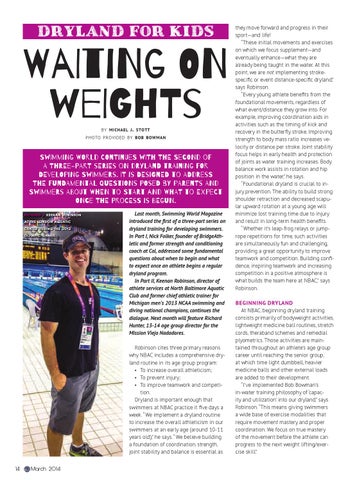
Swimming World continues with the second of a three-part series on dryland training for developing swimmers. It is designed to address the fundamental questions posed by parents and swimmers about when to start and what to expect once the process is begun. pictured > keenan robinson at the london aquatic center during the 2012 olympic games.
Last month, Swimming World Magazine introduced the first of a three-part series on dryland training for developing swimmers. In Part I, Nick Folker, founder of BridgeAthletic and former strength and conditioning coach at Cal, addressed some fundamental questions about when to begin and what to expect once an athlete begins a regular dryland program. In Part II, Keenan Robinson, director of athlete services at North Baltimore Aquatic Club and former chief athletic trainer for Michigan men’s 2013 NCAA swimming and diving national champions, continues the dialogue. Next month will feature Richard Hunter, 13-14 age group director for the Mission Viejo Nadadores. Robinson cites three primary reasons why NBAC includes a comprehensive dryland routine in its age group program: • To increase overall athleticism; • To prevent injury; • To improve teamwork and competition. Dryland is important enough that swimmers at NBAC practice it five days a week. “We implement a dryland routine to increase the overall athleticism in our swimmers at an early age (around 10-11 years old),” he says. “We believe building a foundation of coordination, strength, joint stability and balance is essential as
14
they move forward and progress in their sport—and life! “These initial movements and exercises on which we focus supplement—and eventually enhance—what they are already being taught in the water. At this point, we are not implementing strokespecific or event distance-specific dryland,” says Robinson. “Every young athlete benefits from the foundational movements, regardless of what event/distance they grow into. For example, improving coordination aids in activities such as the timing of kick and recovery in the butterfly stroke. Improving strength to body mass ratio increases velocity or distance per stroke. Joint stability focus helps in early health and protection of joints as water training increases. Body balance work assists in rotation and hip position in the water,” he says. “Foundational dryland is crucial to injury prevention. The ability to build strong shoulder retraction and decreased scapular upward rotation at a young age will minimize lost training time due to injury and result in long-term health benefits. “Whether it’s leap-frog relays or jumprope repetitions for time, such activities are simultaneously fun and challenging, providing a great opportunity to improve teamwork and competition. Building confidence, inspiring teamwork and increasing competition in a positive atmosphere is what builds the team here at NBAC,” says Robinson. BEGINNING DRYLAND At NBAC, beginning dryland training consists primarily of bodyweight activities, lightweight medicine ball routines, stretch cords, theraband schemes and remedial plyometrics. Those activities are maintained throughout an athlete’s age group career until reaching the senior group, at which time light dumbbell, heavier medicine balls and other external loads are added to their development. “I’ve implemented Bob Bowman’s in-water training philosophy of ‘capacity and utilization’ into our dryland,” says Robinson. “This means giving swimmers a wide base of exercise modalities that require movement mastery and proper coordination. We focus on true mastery of the movement before the athlete can progress to the next weight lifting/exercise skill.”
March 2014
March2014.indd 14
2/21/14 1:05 PM