The packaging industry is a hotbed of innovation and all eyes are on the future. Development has never been as rapid as now, with new technologies and new attitudes. The industry is moving in many riveting directions. This is both chal-
lenging and inspiring. Here we present some of the outstanding trends. All are represented at Scanpack in one way or another. Welcome to the future and to Europe’s hottest packaging exhibition!
These are the hottest four trends at the exhibition 1
The materials of the future ü Renewable ü Economical ü Functional
Nanotechnology, refinement of biomass, bioplastics with new properties, graphenebased super paper – the packaging materials of the future are being developed at an incredible rate. And the process is fast. IN PLASTICS the direction is away from fossil-based raw materials to focus on renewable materials. Bioplastic can be made from most materials, but the commercial materials used today are starch and cellulose. Intensive research is taking place, with the plastics and pulp industries moving towards each other. Tetra Pak is the first in the industry to have produced the first entirely plant-based packaging for liquid food. Screw caps and protective plastic film are made of bioplastic from Brazilian sugar cane. ECOLEAN AND SCANFILL are leading the way for plastic with a very high proportion of chalk, which results in economical, light packaging. Chalk is not the
2
only suitable material - Trioplast uses crushed oyster shells instead for its plastic bags. Innventia has a large number of future-oriented projects. Paper material that can be patterned with soft and rigid properties offers brand new design opportunities. In partnership with Södra, a PLA/ cellulose fibre material has been developed that is suitable for robust packaging. Self-shaping or selfopening packaging made of interactive paper and packaging material is another exciting example. BILLERUDKORSNÄS’ new long fibre-based material is light, tough and very strong, with a unique deepdrawing capacity and integrated barrier properties. It is a material that encourages innovation. Nanotechnology creates new opportunities for smart packaging with unique functionality. Graphene also has an exciting role to play in the development of intelligent packaging with powerful barrier properties and offers the opportunity to create surfaces that are extremely waterrepellent.
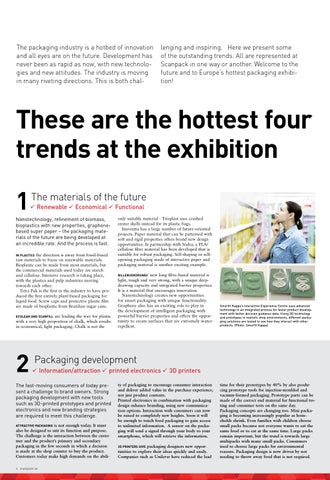
Smurfit Kappa’s interactive Experience Centre uses advanced technology in an integrated process for faster product development with better decision guidance data. Using 3D technology and prototypes in realistic shop environments, different packaging solutions are tested to see how they interact with other products. (Photo: Smurfit Kappa)
Packaging development ü Information/attraction ü printed electronics ü 3D printers
The fast-moving consumers of today present a challenge to brand owners. Strong packaging development with new tools such as 3D-printed prototypes and printed electronics and new branding strategies are required to meet this challenge. ATTRACTIVE PACKAGING is not enough today. It must also be designed to suit its function and purpose. The challenge is the interaction between the customer and the product’s primary and secondary packaging in the few seconds in which a decision is made at the shop counter to buy the product. Customers today make high demands on the abili4 scanpack.se
ty of packaging to encourage consumer interaction and deliver added value in the purchase experience, not just product contents. Printed electronics in combination with packaging design enhance branding, using new communication options. Interaction with consumers can now be raised to completely new heights. Soon it will be enough to touch food packaging to gain access to unlimited information. A sensor on the packaging will send a signal through your body to your smartphone, which will retrieve the information. 3D PRINTERS GIVE packaging designers new opportunities to explore their ideas quickly and easily. Companies such as Unilever have reduced the lead
time for their prototypes by 40% by also producing prototype tools for injection-moulded and vacuum-formed packaging. Prototype parts can be made of the correct end material for functional testing and consumer tests on the same day. Packaging concepts are changing too. Mini packaging is becoming increasingly popular as households shrink. Even families with children choose small packs because not everyone wants to eat the same food or to eat at the same time. Large packs remain important, but the trend is towards large multipacks with many small packs. Consumers used to choose large packs for environmental reasons. Packaging design is now driven by not needing to throw away food that is not required.