DECEMBER 2018
Cover Photo: Lesia Kostiw
HELLO, 2019! A LETTER FROM THE STUDENT EDITOR Welcome to the last issue of Student 2018! If you’re a student, you are probably enjoying a much needed break right now. I’ll admit, November and December were tough for me as well, but with some perseverance we are now on the doorstep of 2019. I want to give the biggest shout out ever to our President, Stephanie, who made it through her first term of Law school, faced many challenges in her new apartment, continued to do all things SUSK, and probably like five other things I don’t even know about. She’s an amazing leader, and we are so lucky to have her! We have a variety of content this issue, with focus on events that have past over the last two months. Some articles to note, are SUSK’s presence at the Ukrainian World Congress, as well as our efforts to commemorate the 85th anniversary of Holodomor across the country. Other articles of interest include contributions from a variety of students on learning either English or Ukrainian, and former SUSK President Christine Czoli’s “Reflection on Maidan”. There are lots of interesting articles and you will definitely want to make it to the end. It remains my goal to highlight our young artists in our Ukrainian community. This can be in a variety of mediums, with this issue’s cover being a photograph by Lesia Kostiw. A couple quick notes for Ukrainian art opportunities for students. Firstly, The Shevchenko Foundation has released their poem for their annual bookmark competition. I had the hounour of having my artwork featured on it last year, and highly recommend other students enter their work into this competition. Additionally, there is the new Reach Arts Mentorship Program. All kinds of artists and designers can apply for this grant. This is the first year it has been available. We have received some great feedback from our first issue of Student. Moving to the online platform of Issuu has really helped us track our readership, and work towards more engagement with our publication. Additionally, we continue to work to post original online content to Facebook in our “off” months. These posts often feature light-hearted content or content that we believe students would be interested in. As we continue to track what our readers are actually, well reading, we can better tailor our content to those interests. We can’t wait to fulfill our 2019 goals for Student, as well as celebrating Student’s 50th Anniversary! See you in 2019! Dayna Konopelny Даня Конопельна Student Editor
2 UKRAINIAN CANADIAN STUDENTS’ UNION
VOLUME 61, ISSUE 02
CONTRIBUTORS Stephanie Nedoshytko
Raya Dzulynsky
Nadia Panas
Dayna Konopelny
Nykola Dovgyy
Kiegan Lloyd
Ashley Halko-Addley
Natalie Blysniuk
Artem Iermak
Roman Grod
Christine Czoli
Lesia Kostiw
INDEX 04
President’s Message
05
On the “Gram
06
From the Archives of Student: SUSK Over the Years
08
Ukrainian World Congress
09
Advice from an Alumna
10
SUSK Commemorates 85th Anniversary of Holodomor
12
Learning the Language
17
It’s Christmas Time in the City
21
Reflections on Maidan
22
The Importance of the Preservation of Ukrainian Dance Archives in Saskatchewan
3 UKRAINIAN CANADIAN STUDENTS’ UNION
VOLUME 61, ISSUE 02
Вітаю! Welcome to the Student Publication, SUSK’s quarterly student-run magazine designed to showcase the work of Ukrainian-Canadian students from across the country. To all our student readers, I realize you are well into final exams and final term papers of the semester. As a firstyear law student, let me remind you, you will get through this! Despite everything seeming like it may not be going your way, keep in mind that there is life after university/college. To anyone who is an alumnus, remember the difficulties you went through as a busy student while still remaining an active member of the community. Send us your luck. To anyone who is a member of the community, be kind to the students in your lives. Taking on a multitude of responsibilities takes a toll on a person. I hope that everyone takes a moment for self-care during these stressful times. I hope that this issue will give you a moment to take your mind off of the constant stress of academia. It’s been a busy first semester for SUSK and our member organizations. Firstly, I’d like to bring attention to SUSK’s increased presence on Instagram. If you like procrastinate by watching “insta-stories” or playing the Ukrainian version of “this-that,” then join us by following @SUSKNational. Thanks to our wonderful Student team, Dayna Konopelny and Nykole King, you are also welcome to follow SUSK blog posts on Facebook. From fun “Ukrainian-style” Halloween costumes to learning how to write for Student, SUSK will be keeping you entertained. Stay up to date on social media! We also hope you enjoy our new Student format on Issuu thanks to Nykole. As a part of SUSK’s advocacy strategy, we launched a partnership with Postcards for Prisoners in October. Ukrainian Student Organizations (USOs) across Canada have been holding postcard writing events on campus to support Ukrainians unjustly imprisoned in Russia. While most USOs have received great feedback, some students have been facing backlash from non-aligning groups. SUSK will lend our support to ensure that we remain active and involved in this important movement. I’d like to especially thank VP West Devon Goldie for launching this event in Victoria, BC, with the Ukrainian Students’ Society. We look forward to more students taking part. Additionally, USOs have been active in raising awareness of the Holodomor throughout October. Many USOs held vigils, placed sheaves of wheat with short information pamphlets around campus, attended commemorations, and held several-day displays across campus. SUSK is proud of our members for continuing to raise awareness! With the Ukrainian-Canadian student movement growing, SUSK is pleased to announce that in November there was a revival of the Algonquin College Ukrainian Students Club. With new leadership, the USO is very excited to work together with the additional USOs in the Ottawa area. SUSK looks forward to supporting future events and activities. Lastly, perhaps the most exciting piece, SUSK is excited to announce that the 2019 Annual SUSK Congress will be taking place in Winnipeg! Given SUSK’s 65th anniversary this academic year, we are extremely pleased to hold Congress in the city where the Ukrainian-Canadian student movement began and where it was revived. More details will follow soon. Given this is the last issue before різдво and маланка, I’d like to wish you a Merry Christmas and happy holidays. All the best in the new year! Веселих свят і бажаю вам щасливого нового року! Stephanie Nedoshytko Стефанія Недошитко SUSK President
4 UKRAINIAN CANADIAN STUDENTS’ UNION
VOLUME 61, ISSUE 02
ON THE ‘GRAM Featuring the Instagram posts from our clubs across the country.
FOLLOW SUSK NATIONAL
5 UKRAINIAN CANADIAN STUDENTS’ UNION
VOLUME 61, ISSUE 02
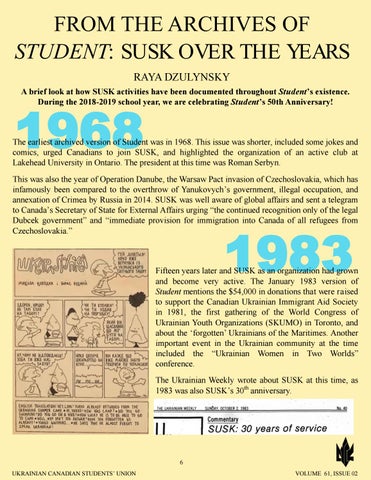
FROM THE ARCHIVES OF STUDENT: SUSK OVER THE YEARS RAYA DZULYNSKY A brief look at how SUSK activities have been documented throughout Student’s existence. During the 2018-2019 school year, we are celebrating Student’s 50th Anniversary!
1968
The earliest archived version of Student was in 1968. This issue was shorter, included some jokes and comics, urged Canadians to join SUSK, and highlighted the organization of an active club at Lakehead University in Ontario. The president at this time was Roman Serbyn. This was also the year of Operation Danube, the Warsaw Pact invasion of Czechoslovakia, which has infamously been compared to the overthrow of Yanukovych’s government, illegal occupation, and annexation of Crimea by Russia in 2014. SUSK was well aware of global affairs and sent a telegram to Canada’s Secretary of State for External Affairs urging “the continued recognition only of the legal Dubcek government” and “immediate provision for immigration into Canada of all refugees from Czechoslovakia.”
1983
Fifteen years later and SUSK as an organization had grown and become very active. The January 1983 version of Student mentions the $54,000 in donations that were raised to support the Canadian Ukrainian Immigrant Aid Society in 1981, the first gathering of the World Congress of Ukrainian Youth Organizations (SKUMO) in Toronto, and about the ‘forgotten’ Ukrainians of the Maritimes. Another important event in the Ukrainian community at the time included the “Ukrainian Women in Two Worlds” conference. The Ukrainian Weekly wrote about SUSK at this time, as 1983 was also SUSK’s 30th anniversary.
6 UKRAINIAN CANADIAN STUDENTS’ UNION
VOLUME 61, ISSUE 02
1998
The last SUSK Congress was in Banff. In 1998, 20 years ago, SUSK Congress was in Calgary and in Banff. Articles in STUDENT informed readers of the Canada Ukraine Internship Program where young Canadians could go work in Ukraine and SUSK’s opinion on various Canadian policies. Other articles discuss SUSK Congress and other activities of SUSKites.
2013
SUSK was very active in 2013, with five STUDENT issues coming out over the year: March, April, a special Congress issue, October, and December. The Ukrainian drama film, “Fire Crosser” was analyzed and discussed, as well as “From Hens to the Holodomor”, Andrea Chalupa’s National Speaking Tour commemorating the 80th anniversary of the Holodomor. A successful SUSK Congress was held in Edmonton, AB. Sparked by the decision of the Yanukovych government not to sign the Ukraine-European Union Association Agreement, Майдан or Euromaidan began on November 21, 2013. UkrainianCanadian students expressed their concern and support in the December issue of STUDENT.
7 UKRAINIAN CANADIAN STUDENTS’ UNION
VOLUME 61, ISSUE 02
UKRAINIAN WORLD CONGRESS ROMAN GROD From November 25 – 27 the Ukrainian World Congress hosted its XI congress. This congress had a great lineup of speakers and performers. On the opening night we heard a great opening greeting The President of Ukraine Petro Poroshenko, as well as other honorary guests from the Ukrainian Parliament. Mr. Poroshenko took this opportunity to thank the World Congress for its tremendous support and work over the past years, and highlighted that he looks forward to many more prosperous years to come. Following the greetings the Ukraine World Congress presented a number of individuals with the St. Volodymyr Medals, thanking them and recognising them on their many contributions to Ukraine and the Ukrainian community. Among the recipients was the past Prime Minister of Canada Steven Harper who during terms took a strong position against Russian aggression in Ukraine. The first full day of congress was a full and busy day of events, highlighting financial reports, video reports from member organization, and an interesting panel highlighting the Ukrainian World Congresses development strategy for its effective growth over the upcoming years. In the evening the congress broke into its regional round tables where individuals from various regions were able to discuss important issues in in their regions, and how we were to approach them in the upcoming months and years. 8 UKRAINIAN CANADIAN STUDENTS’ UNION
Tuesday November 27th started off with a morning full of various panels, ranging from the role of the diaspora in the economic development of Ukraine, to Mutual understanding and cooperation between Ukrainian diaspora and ethnic and religious communities around the world, to Formation of a conscious Ukrainian through the prism of education, youth organizations, cultural and art associations, etc, in which I was privileged to be a panellist. This panel was comprised of Andrea Kardaz, a member of CYM Kiev who was born and raised in Canada, Katya Tomko, one of the founding members of Plast in the Netherlands originally from America, Dmitrii Lecartev, President of CKYMO, and myself as a member and Vice President Finance for SUSK. We took this opportunity to discuss struggles in our respective countries, support that we have received, and the importance of our respective organizations for ensuring a prosperous Ukrainian future. This was an opportunity for me to understand why what we are doing as SUSK in Canada is of such importance to the larger community. It also allowed me to give some input as to why countries should look to not only expand their existing youth organisations but to also build organisations such as SUSK in order to ensure their students stay involved during their time in Continued on page 23. VOLUME 61, ISSUE 02
ADVICE FROM AN ALUMNA ASHLEY HALKO-ADDLEY In 2017, I graduated from the University of Saskatchewan, and with that I left my university life behind. One of the hardest parts was transitioning out of my role with my Ukrainian Student Organization, the USUSA, after it being such a huge part of my life for four years. All of a sudden, I found myself no longer a member of a group that was a part of my daily life and a part of my identity. I was now part of a larger network of alumni, some who chose to stay connected and some who left and never looked back. I knew then, and I still know now, that I want to be the kind of alumna who chooses to stay connected to the group, but at the time I wasn’t sure what that would look like. What is the role of alumni? My transition from member to alumna was difficult. That first year, it was hard to watch the group transition and change and become independent. I felt left out, because it was primarily my friends who were still running the group and I was no longer a part of it. I watched them plan and execute events, and I wanted nothing more than to be there with them. I decided that my role was to provide as much input and advice as I could, but at the same time I didn’t want to be overbearing. I’m afraid I may have failed at the last part, having pushed too hard for them to do something ‘the way we’ve always done it’ or provided input when it wasn’t asked for. I may have been a little too much of a ‘back seat driver’ alumna in the beginning. I’m happy to report that after the initial year it has become much easier. The membership has mostly turned over and while I still have a couple friends in the group, I no longer feel like I’m missing out or like I need to be in constant contact to make sure they’re okay. However, I find myself returning to my initial question, ‘What is the role of alumni?’
As Alumni Director of SUSK and as an alumna of a USO, I would like to attempt to answer what I see the role of alumni to be and how you can choose to be connected to your alma mater USO without being ‘back seat driver’ alumni. As alumni, you can: Act as a member of a network who holds an institutional memory for the group. Remember that really cool event that your USO hosted five years ago when you were still a student? Well maybe your USO has decided to bring it back. Now would be the perfect time to provide them with some old photos, an old poster you may have, or something useful you remember from before that’s still relevant to them today. Give advice but wait to be asked. The nature of USOs being full of students means lots of turn over. Be available to give an opinion or advice on what they’re doing because they don’t know everything that has happened in the past. But, in order to avoid being a ‘back seat driver,’ wait to be asked and give advice as suggestions rather than demanding that this is the what they need to do. Volunteer at their events. Remember how difficult it was to find volunteers for your event? Reaching out to the group and letting them know you’re willing and able to volunteer for their events can relieve a lot of stress for the group. Make sure you’re up front about when and what you’re able to volunteer with so they know exactly what they can rely on you for. Support their social media. Sharing their events and liking their posts can go a long way in helping to make sure they get the exposure they need. Continued on page 23.
9 UKRAINIAN CANADIAN STUDENTS’ UNION
VOLUME 61, ISSUE 02
SUSK COMMEMORATES 85th ANNIVERSARY OF HOLODOMOR NYKOLA DOVGYY The week of Nov. 18 marked the 85th anniversary of the Holodomor, a genocide from 1932-33 that took the lives of millions of ethnic Ukrainians in what was then the Soviet Union. At that time, Joseph Stalin implemented a grain collection program that crippled farmers in Ukraine as it demanded too much of Ukrainian farmers and left villages with no food. The starvation of Ukrainians impeded their ability to revolt against the Soviet regime for independence. On this 85th anniversary, we find ourselves commemorating the Holodomor at a time where Russian aggression is yet again is taking a stranglehold of Ukraine. The killing of Ukrainians in 1932-33 left a large area of the Soviet Union unpopulated, but the Soviet Union moved ethnic Russians to that region so that grain production could continue. Today, Russian officials claim that because Eastern Ukraine is populated by ethnic Russians that this is justification for their illegal annexation of the Crimean Peninsula and further aggression into Eastern Ukraine. Russia can make such a claim nearly entirely in thanks to the Holodomor. It is important for organizations such as SUSK to continue to commemorate our history and ensure that the atrocities of the Holodomor are not forgotten. Commemorations took place across the country during National Holodomor Awareness Week with Ukrainian Student Organizations hosting events both on-campus and for their community at large. Events ranged from vigils, movie screenings and displays all in hopes of spreading awareness and remembering the millions of victims of the Holodomor. SUSK partnered with the Ukrainian Canadian Congress (UCC) National Holodomor Awareness Committee and formed a project in which students from across the country submitted articles about the Holodomor to local media outlets. The mentorship program with UCC had members from across the country, mainly Irene Mycak and Marco Levytsky, editing and providing feedback on the articles before they went to print. The program was a great success with articles being written from Victoria to Ottawa! SUSK is ensuring that the victims of Holodomor are not forgotten and that Canadians across the country are more aware of the genocide that killed millions of Ukrainians in 1932-33. Вічная Пам'ять. 10 UKRAINIAN CANADIAN STUDENTS’ UNION
VOLUME 61, ISSUE 02
COMMEMORATIONS ON CAMPUSES
11 UKRAINIAN CANADIAN STUDENTS’ UNION
VOLUME 61, ISSUE 02
A AB B C... C...
LEARNING TH
LONDON IS THE CAPITAL OF GREAT BRITAIN NADIA PANAS
My name is Nadia, and I am a second-year student at the University of Regina taking Social Work. I am from Lviv, Ukraine, so naturally, I will be sharing my experience of learning English. Just like for many kids back home, my struggle with English began in school. For me, it was in grade one. My parents told me that I used to recite newly learned English words in my sleep. This must have been a sure sign of my “talent” with languages. However, as the school years went by, the only sure thing I could say confidently in English was, “Hello, my name is Nadia. I live in Lviv. London is the capital of Great Britain.” I cannot complain about my teachers because they did their best, but without seeing any practical use of learning another language, I did not feel the need to put in an effort. This all changed around seven years ago when I decided to come to Canada for a year. At that point, I had concluded that a class setting would not work for me, and, in preparation for my departure, I decided to read a book by one of my favourite authors in its original language, English. This was a good way for me to
actually remain interested in the process of learning. Another thing I did was watching movies in English with English subtitles. In that way, I could learn the proper pronunciation and spelling of the new words in a more relaxed and enjoyable way. However, I think that the most helpful was having actual conversations with people whose first language is English. I was lucky to meet many people who patiently waited for me to form sentences, explained new words and corrected my mistakes in a candid manner. I think, the biggest challenge for me was to overcome my fear of speaking in public and revealing my accent or being misunderstood. The greatest revelation was that “W” and “V” are actually different sounds and “wery vell” is not the same as “very well”. Jokes aside, learning English has been a fun challenging and rewarding process. I am happy with the progress I have made so far. However, there is still lots I can work on, especially when it comes to academic English.
12 UKRAINIAN CANADIAN STUDENTS’ UNION
VOLUME 61, ISSUE 02
HE LANGUAGE
А АБ Б В... В...
RELEARNING NATALIE BLYSNIUK My name is Natalie Blysniuk, and I’m in my third year of Medical Science at the University of Western Ontario. I’m a second generation Canadian, but I grew up speaking Ukrainian exclusively until around the age of five. I was raised by my parents and extended family with the language of their parents – all immigrants. Even though I was born in Canada, I did not know any English and I spoke with an accent. I vividly remember my first day of Kindergarten. I went to Josyf Cardinal Slipyj, a Ukrainian Catholic school with a half day of Ukrainianbased education for Junior Kindergarten and Senior Kindergarten. I told my mom as she dropped me off that I decided I would not speak to the half-day English teacher simply because she could not speak Ukrainian. (Spoiler alert: I didn’t follow through with that decision and I ended up learning English quickly at the age of six.)
Throughout elementary school, my parents did their best to encourage our household to speak Ukrainian. Unfortunately, as young children, my brother and I didn’t recognize the importance of language to our culture, and we pushed back. Now, we rarely speak Ukrainian at home. Something that was such a huge part of my childhood, my childhood development, my education, and my family, had essentially disappeared in my teens. At 20 years old, I struggle to string together a coherent sentence in my native language. I’ve always imagined my future with children who’ve continued to keep in touch with their background and who were able to grow up speaking the language that means so much to me, but I worry that this won’t be the reality.
My family took the time and care in order to instill a love of our culture in my from birth through the Ukrainian language. Despite growing up in Canada, my language was a central part of my childhood, and language being incredibly important to development, it would have made an impact on my brain development. After 15 years of learning English, my Ukrainian has almost disappeared.
My struggle is with relearning the language that means so much to me, to my grandparents who were not able to speak their native tongue, to my parents who had seen their parents’ pain, to those in Ukraine who are still unable to embrace their culture in the face of Russian pressures. The Ukrainian language is incredibly important to be and will not stop trying to relearn the language that was once so integral to my life.
13 UKRAINIAN CANADIAN STUDENTS’ UNION
VOLUME 61, ISSUE 02
А АБ Б В... В... A much smaller and cuter version of myself used to spend her preschool days in two places: at the Sadochok, run by the nuns, or going on excursions with my Baba and Dido. Surprisingly, Baba and Dido did not teach me as much Ukrainian as one would think. They gave me the basic words, but I was never capable of forming sentences. However, many of my friends at Sadochok never spoke English, so to this day I’m not sure how we communicated. I can only guess that I had a better understanding when I was younger.
BEGINNER 1 DAYNA KONOPELNY
Vladimir Institute with a beginner level 1 course. Most of it was a refresher, but I finally learned how to put words together to actually make a sentence! I would look forward to Ukrainian class on Thursday evenings and I continued to take classes again this year. I am in a class with great people, all of different backgrounds and reasons for wanting to learn Ukrainian. We joke around a
I grew up having Ukrainian classes in school from Kindergarten to grade eight. I was able to sing every Christmas carol, church hymn and cute little poem in Ukrainian, but continued to lack the ability to form cohesive sentences. My parents never put me in Ukrainian school on the weekend, so once I was in high school, I was no longer learning any Ukrainian. Flash forward to my university years when I compiled a list of all the things I wanted to do but had convinced myself that “I didn’t have enough time to do it.” Learning to speak a second language fluently was on the top of my list. Since I already had a basic knowledge of Ukrainian and French I knew these would be the first two languages to start with. Although this goal was on my list, I still found it difficult to find time and the resources to pursue when I was living in Winnipeg. When I moved to Toronto last year, I decided to take advantage of the evening Ukrainian classes taught at St.
lot, and it is a great environment where we don’t worry about making mistakes because we’re all learning. My Ukrainian ability is still at the level of a young child, but I’m learning. I’m learning and I love the process of learning. There are no marks or tests. I make lots of mistakes, get corrected and then get better. Also, being a full-time university student sometimes makes having the energy to make it to class difficult, but I am always glad that I made it to class. I will be in Ukraine this summer and look forward to using my new language skills. The next goal is how to be funny in another language!
14 UKRAINIAN CANADIAN STUDENTS’ UNION
VOLUME 61, ISSUE 02
DECIPHERING THE “NOISE” ARTEM IERMAK My name is Artem and I came to Canada from Ukraine. As many Ukrainians, I learned English in kindergarten, school and university (business English). Depending on the school, students in Ukraine have to choose one or more foreign languages to study. In my case, I chose English, and I never regret the decision I made. After the university, I continued to learn English in
After I came to study in Canada, I got an additional challenge, which happens with many international students, adaptation regarding language. After I dived into the English language environment, I had a constant headache for about first 3-4 months. Especially terrible were lessons at the college. I had to push and strain myself to understand what teachers are saying. My brain just never experienced so much of foreign language before and was overwhelmed. I am very thankful to Canadians for they have been very patient when foreigners speak English. Many people supported and motivated me when I was using English. It helped to get rid me of the fear of making mistakes, which often stops one from using an international language. That taught me do the same for people who speak or learn Ukrainian. It’s funny, but my first days in Canada people speaking sounded like a kind of “noise.” I could not distinguish what people were saying in the bus or bus stop. Also, when a person was speaking to me without eye contact, I often didn’t understand that it has been said to me. But after 3-4 months something switches in the brain, and understanding of the language becomes natural.
specialized language schools. My motivation for that was not only self-improvement, but also the fact that English is often a mandatory skill if you want to get a job in Ukraine, especially in finance. I remember when I started to learn English the two following things were the most difficult for me: - pronunciation of some sounds and letters like for example “q”, “th” as there is not such sounds in Ukrainian language; - changing the mind so it could create sentences using English way, which is different.
One of the greatest revelations for me was the fact that living in an English speaking country does not mean that you can actually learn or improve your English. You still have to learn new words and construction, practice to speak and understand English. Therefore, I never stopped to learn English and I am going to improve it by attending English classes. It is very important for me to know the language well of the country where I live. In my understanding, learning another language improves a person’s mind flexibility and opens a door to the information in that language. It could be books, magazines, games and many other things. Additionally, if you know more languages you can make more social and business connection and get friends and business benefits.
A AB B C... C... 15
UKRAINIAN CANADIAN STUDENTS’ UNION
VOLUME 61, ISSUE 02
16 UKRAINIAN CANADIAN STUDENTS’ UNION
VOLUME 61, ISSUE 02
IT’S CHRISTMAS TIME IN THE CITY PHOTOS: LESIA KOSTIW
TEXT: DAYNA KONOPELNY
Each December people flock to the Distillery District in Toronto to enjoy the magic of the Christmas Market. Cute booths reminiscent of a European Christmas market line the cobblestone streets of the Distillery District, while crowds of people weave their way through to find the perfect gift or to try the mulled wine. Lesia and I hit the Christmas Market Sunday morning after church in early December. We were in search of the perfect shot for the cover of Student. Lesia, having lived in Toronto her whole life, had never been to the Christmas Market. I had gone last year in the night to see it all lit up, but had to fight off lots of people and the bitter cold (coming from a Manitoban – it really was cold). The greatest thing of the Christmas Market is the looming countdown to Christmas. I always wonder if it implies “5 days until Christmas” (in a happy, cheery elf -like voice), or “FIVE DAYS UNTIL CHRISTMAS!!!” (in a frantic, panicked voice). What started as an adventure to find the perfect shot for the cover, ended with the decision to showcase more of Lesia’s photographs. This two page spread captures the essence of the atmosphere at the Christmas Market. It is definitely something I would recommend to do if you were in Toronto in December.
17 UKRAINIAN CANADIAN STUDENTS’ UNION
VOLUME 61, ISSUE 02
18 UKRAINIAN CANADIAN STUDENTS’ UNION
VOLUME 61, ISSUE 02
19 UKRAINIAN CANADIAN STUDENTS’ UNION
VOLUME 61, ISSUE 02
WE WANT TO HEAR FROM YOU! If you would like to be heard or have something to share, send it in! Submit your material to student@susk.ca
20 UKRAINIAN CANADIAN STUDENTS’ UNION
VOLUME 61, ISSUE 02
REFLECTIONS ON MAIDAN CHRISTINE CZOLI Five years ago, students came to the Maidan to defend their future - a future with Europe that respected democracy and the rule of law. The events that transpired there, in the central square in Kyiv, inspired many around the world, including Ukrainian Canadian students. I spent three days on Maidan in December 2013, just two weeks after Ukrainian students were beaten by the Berkut forces. At that time, there was a lull in the violence, and the atmosphere was incredible, with every person contributing what they could for the Maidan. I had never witnessed such expression of freedom, such compassion for others, and such determination for a shared vision of the future. It was a rare expression of human solidarity. The best description of this experience I’ve come across comes from Marci Shore, historian and author of the book “The Ukrainian Night”: “The Maidan was the site of the A ufhebung [repeal] of subjectivity: the highest moment of the achievement of selfhood was simultaneously the overcoming of the individual self, its transcendence into solidarity … This state of transcendence was fragile, it could last for but a moment - but it was a moment that most people never experienced in their lifetime. It was an encounter with one’s deepest selfhood through an encounter with others, the results of which could not have been foreseen.” Bearing witness to this solidarity inspired me to relay support to the people gathered at Maidan on behalf of Ukrainian Canadian students, on stage in Kyiv in the middle of a cold December night. And I was not alone in this: once back home, many students from across Canada reached out to SUSK, inspired to support Ukrainians in their cause. Ukrainian Canadian students became involved in demonstrations, charitable fundraisers, and arts projects, and raised awareness about the Maidan on their campuses. The energy and creativity expressed by SUSKites in this time was momentous, embodying a popular slogan of the Maidan: “Я крaпля в океaні, який змінить Укрaїну” / “I’m a drop in the ocean that will change Ukraine”. These activities strengthened SUSK by fostering growth of its member USOs and deepening its ties with other organizations in the Ukrainian Canadian community - all of which have helped SUSK to the present day. While it was a privilege to lead SUSK through the time of the Maidan, it is an even greater privilege to see that SUSK continues to inspire students to grow and become community leaders. And that is incredibly important, as the fight for dignity that began with Maidan continues today. I hope that the Maidan continues to serve as an inspiration to Ukrainian Canadian students - that real change begins with each one of us. Christine Czoli was SUSK President from 2013-2015. 21 UKRAINIAN CANADIAN STUDENTS’ UNION
VOLUME 61, ISSUE 02
THE IMPORTANCE OF THE PRESERVATION OF UKRAINIAN DANCE ARCHIVES IN SASKATCHEWAN KIEGAN LLOYD In this short discussion paper on Ukrainian dance in Saskatchewan, the reader will become familiar with a project idea that I feel is important to the preservation of our Ukrainian identity. As a Ukrainian dancer in retirement, and a beginning historian, I feel strongly that Saskatchewan Ukrainian dance practitioners have at best a mediocre understanding of the history of Ukrainian dance in Saskatchewan. My project will not only bring a more focused and accurate representation of Ukrainian dance on the Saskatchewan prairies to Ukrainian dancers in the dancehall/classroom. Ultimately, Ukrainian dancers will acquire a better appreciation of this vivacious performing art form and for the forbearers who created this cultural dance legacy, still present to this day. I will summarize briefly the history of the first wave of Ukrainian settlers in Canada and how they used dance as not only a form of performing art, but as a tool of cultural perseveration and exchange. In his doctoral dissertation on Ukrainian Folklore titled The Kolomyika: Change And Diversity In Canadian Ukrainian Polk Dance (1991), Andriy Nahachewsky begins
by telling the reader that dance is often classified by nominal criteria, that is that all dances with a given name are frequently assumed to be similar. However, they may represent a wide variety of phenomena with differing histories, functions, 1 contexts, and forms. This is especially apparent in Ukrainian dancing in Canada today. There were three main periods of migration of Ukrainian settlers to Canada, but I will only discuss the first as being perhaps the most important. Between 1896 and the outbreak of the Mechanised War in 1914, approximately 170,000 Ukrainians migrated to Canada from their homelands.2 One factor that led to this migration was due to the Polish and Russian landlords who governed them. The landlords had an abundance of food and land, but the Ukrainian peasants were not as fortunate. “The peasant class had worked the soil all of their lives, and often had little to show but a permanently bent back, gnarled hands, broken health, and a load of debt in return for years of unremitting toil.”3 Ol’ha Woycenko described further incentives to leave Ukraine:
It may be said that poverty, hunger for land, lack of political freedom, no opportunities for education and self-advancement, social restrictions, and personal problems had contributed to the mass exodus overseas.4 There were also personal motivating factors behind Ukrainians’ desire to seek a new land which offered greater opportunities for them and their families—Canada was a place of hope. Shaw explains that while many Ukrainians accepted the opportunity to begin afresh, none could foresee the hardships of the actual journey nor those problems which would beset them when they reached their final destination.5 Upon arrival in Canada, ship-weary Ukrainian travellers were transported by the trainload into a prairie wilderness. Few were prepared for the vastness of the land, the severity of prairie winters, the range of equipment required to break and clear virgin ground, or for the tremendous drain on personal energy.6 Many survived and stayed, taking root and attracting others of their kind who subsequently settled on homesteads nearby. Thus, small Continued on page 23.
1
Andriy Nahachewsky, The Kolomyika: Change and Diversity in Canadian Ukrainian Folk Dance (PhD diss., University of Alberta, 1991), 6. 2 Sylvia J. Shaw, A ttitudes of Canadians of Ukrainian Descent Toward Ukrainian Dance (PhD diss., University of Alberta, 1988), 35. 3 Shaw, A ttitudes, 35. 4 Ol’ha Woycenko, The Ukrainians in Canada (Canada Ethnica IV., Winnipeg MA: Trident Press, 1968), 194-195. Also, see Shaw, A ttitudes, 35. 5 Shaw, A ttitudes, 35. 6 Shaw, A ttitudes, 36.
22 UKRAINIAN CANADIAN STUDENTS’ UNION
VOLUME 61, ISSUE 02
Advice from an Alumna
The Importance of the Preservation of Ukrainian Dance Archives in Saskatchewan
continued from pg. 9 Provide them opportunities.
with
continued from pg. 22
funding
It’s great if you’re able to make a donation to the club yourself, but often when we’re just starting out that’s not always possible. Letting them know about funding opportunities with Ukrainian (and non-Ukrainian) organizations you’re involved with can really help them in making sure they have the funds they need to thrive. Learn to let go and support every event they have, even when it’s not done the way you would have done it. Your time with your USO was great. You created and hosted new events and had a blast doing it. Now it’s someone else’s turn to find that joy in having an idea and seeing it through to implementation. Your job now is to sit back, relax, and see what awesome ideas they come up with.
Ukrainian World Congress continued from pg. 8 University. Amongst us we found one common dilemma that is going to have to be addressed over the upcoming years and that is there is a gap in involvement in the Ukrainian community from roughly the ages of 24 – 35 when individuals are just starting out their careers.
pockets of people with similar “. . . bonds of dialect, costume, tradition, and even close family relationship . . . were formed.”7 One of the first regions in Saskatchewan to be populated by Ukrainian settlers is the Swan Lake area. Nahachewsky writes that as early as 1904, a large group of Ukrainians from the town of Borshchiv in Halychyna settled on homesteads in this region (Bukovynlan settlers arrived some time later). This area was densely populated by the 1920s, with practically every available homestead being claimed.8 When Ukrainian peasants immigrated to Western Canada, they brought with them not only their material possessions but also their aesthetic and cultural values including dance.9 I feel it is important that we as a Ukrainian community preserve our Ukrainian identity through the preservation of community archives - in this context, dance archives. Locating and having these community archives will help ensure and protect our Ukrainian legacy, and help us remember those past people who lived in a different time period—where we can have a better sense in who they were, and furthermore, who we are as a UkrainianCanadian community in the 21st century. Having access to community archives is vital in understanding more of who we are as a culture, community and as individuals. In closing, I hope I have been successful in persuading you to recognize the importance of community development through preserving community archives. I wholeheartedly believe that this will be a worthwhile enterprise. If you have any questions, comments or ideas please feel free to contact me. I look forward in collaborating with my Ukrainian community around Saskatchewan and Canada. 7
Shaw, A ttitudes, 36. Andriy Nahachewsky, First Existence Folk Dance Forms A mong Ukrainians in Smoky Lake, A lberta and Swan Lake, Saskatchewan (Masters thesis., University of Alberta, 1985), 38. 9 Nahachewsky, First Existence, 38. 8
Bibliography Nahachewsky, Andriy. The Kolomyika: Change and Diversity in Canadian Ukrainian Folk Dance. PhD diss., University of Alberta, 1991. ___________, Andriy. First Existence Folk Dance Forms A mong Ukrainians In Smoky Lake, Alberta And Swan Lake, Saskatchewan. Masters thesis, University of Alberta, 1985. Shaw, Sylvia J. A ttitudes of Canadians of Ukrainian Descent Toward Ukrainian Dance. PhD diss., University of Alberta, 1988.
Finally, following the adoption of amendments to the By-laws, resolutions and budgets, the delegates of the Ukrainian World Congress elected Paul Grod, as President and Stefan Romaniw from Australia, as First Vice-President of the Ukrainian World Congress. UKRAINIAN CANADIAN STUDENTS’ UNION
About the Cover Artist Lesia Kostiw is a Toronto-based photographer. She completed her Bachelor of Media Studies at University of Guelph Humber. Lesia is active in CYM, and uses her photography talents each summer at CYM Tabir in Montreal. 23 VOLUME 61, ISSUE 02