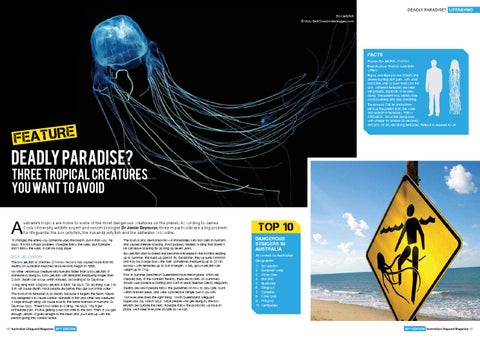
deadly paradise? lifesaving Box jellyfish
© Gary Bell/OceanwideImages.com
BoxJellyfish 24M1211-13 BGextend
Facts Name: Box jellyfish, chironex
Distribution: Tropical Australian waters Signs and Symptoms: Instant and severe burning skin pain, with what looks like whip or burn marks on the skin. Adherent tentacles are often still present, especially if severely stung. The patient may rapidly lose consciousness and stop breathing. Treatment: Call an ambulance, remove the patient from the water and restrain if necessary. Follow DRSABCD. Flood the stung area with vinegar for at least 30 seconds, and pick off any remaining tentacles. Referral is required for all.
e r u t a e f
Deadly Paradise?
Three Tropical Creatures You Want to Avoid
A
ustralia’s tropics are home to some of the most dangerous creatures on the planet. According to James Cook University wildlife expert and venom biologist Dr Jamie Seymour, three in particular are a big problem for lifeguards: the box jellyfish, the irukandji jellyfish and the saltwater crocodile.
‘It changes the entire way someone uses the beach, put it that way,’ he says. ‘It’s not a major problem, if people follow the rules. But if people don’t follow the rules, it can be a big issue.’
Box Jellyfish
The box jellyfish or chironex (Chironex fleckeri) has caused more than 60 deaths on Australian beaches since records began in 1883. No other venomous creature kills humans faster than a box jellyfish. If someone is stung by a box jellyfish with tentacles measuring longer than 2–3 m, death can occur within minutes, according to Dr Seymour. ‘A big sting from a big box jellyfish is fatal,’ he says. ‘So anything over 2 to 3 m will cause death. Most people die before they get out of the water.’ The toxin in its tentacles is so deadly because it targets the heart; nature has designed it to cause cardiac standstill in fish and other sea creatures. A large enough sting will cause exactly the same scenario in humans, Dr Seymour says. ‘There’s two sides to a sting,’ he says. ‘You’ll get immediate pain. It’s like getting a red hot knife to the skin. Then, if you get enough venom, it goes straight to the heart and you’ll end up with the person going into cardiac arrest.’ 40 Australian Lifeguard Magazine 10 th edition
The toxin is also dermonecrotic—it immediately kills skin cells in humans and causes intense scarring. If not properly treated, a sting that doesn’t kill can leave scarring for as long as seven years. Box jellyfish start to breed and become noticeable in the months leading up to summer, the build-up period. By December, they’re quite common and may be a large size—the ‘bell’ sometimes measuring up to 20 cm across—with tentacles up to 3 m in length. A fully grown jellyfish can weight up to 2 kg. Prior to summer, beaches in Queensland have nets in place, which are checked daily. In the Northern Territory, there are no nets, so swimmers should wear protective clothing and swim in areas deemed safe by lifeguards. Deaths are rare if people follow the guidelines on how to stay safe: swim within marked areas, and wear a protective stinger suit if you can. ‘Not everyone does the right thing,’ North Queensland Lifeguard Supervisor Jay March says. ‘Most people who get stung by the box jellyfish are outside the nets. If people follow the protocols we have in place, we’ll keep everyone as safe as we can.’
Top 10 dangerous stingers in Australia As ranked by Australian Geographic 1 2 3 4 5 6 7 8 9 10
Box jellyfish European wasp Honey bee Bull ants Bluebottle Stingrays Stonefish Cone snail Platypus Centipedes
10 th edition Australian Lifeguard Magazine 41