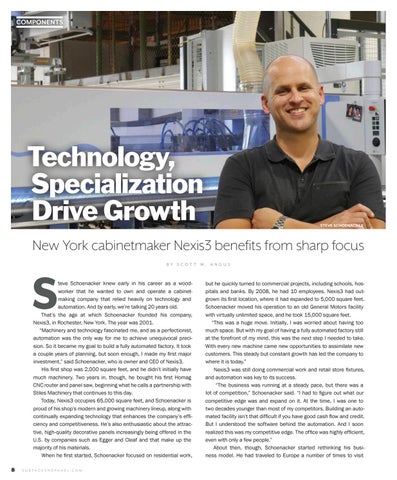
Technology, Specialization Drive Growth
STEVE SCHOENACKER
New York cabinetmaker Nexis3 benefits from sharp focus BY SCOTT W. ANGUS
S
teve Schoenacker knew early in his career as a woodworker that he wanted to own and operate a cabinetmaking company that relied heavily on technology and automation. And by early, we’re talking 20 years old. That’s the age at which Schoenacker founded his company, Nexis3, in Rochester, New York. The year was 2001. “Machinery and technology fascinated me, and as a perfectionist, automation was the only way for me to achieve unequivocal precision. So it became my goal to build a fully automated factory. It took a couple years of planning, but soon enough, I made my first major investment,” said Schoenacker, who is owner and CEO of Nexis3. His first shop was 2,000 square feet, and he didn’t initially have much machinery. Two years in, though, he bought his first Homag CNC router and panel saw, beginning what he calls a partnership with Stiles Machinery that continues to this day. Today, Nexis3 occupies 65,000 square feet, and Schoenacker is proud of his shop’s modern and growing machinery lineup, along with continually expanding technology that enhances the company’s efficiency and competitiveness. He’s also enthusiastic about the attractive, high-quality decorative panels increasingly being offered in the U.S. by companies such as Egger and Cleaf and that make up the majority of his materials. When he first started, Schoenacker focused on residential work,
8
SURFACEANDPANEL.COM
but he quickly turned to commercial projects, including schools, hospitals and banks. By 2008, he had 10 employees. Nexis3 had outgrown its first location, where it had expanded to 5,000 square feet. Schoenacker moved his operation to an old General Motors facility with virtually unlimited space, and he took 15,000 square feet. “This was a huge move. Initially, I was worried about having too much space. But with my goal of having a fully automated factory still at the forefront of my mind, this was the next step I needed to take. With every new machine came new opportunities to assimilate new customers. This steady but constant growth has led the company to where it is today.” Nexis3 was still doing commercial work and retail store fixtures, and automation was key to its success. “The business was running at a steady pace, but there was a lot of competition,” Schoenacker said. “I had to figure out what our competitive edge was and expand on it. At the time, I was one to two decades younger than most of my competitors. Building an automated facility isn’t that difficult if you have good cash flow and credit. But I understood the software behind the automation. And I soon realized this was my competitive edge. The office was highly efficient, even with only a few people.” About then, though, Schoenacker started rethinking his business model. He had traveled to Europe a number of times to visit